Taiwan Dollar Rally: 3 Stock & FX Strategies

How to Trade When Foreign Institutional Buying Drives Taiwan Dollar Appreciation? Three Investment Strategies for a Stock and Currency Rally
Recently, market sentiment has shifted dramatically as hot money flows into Taiwan, with foreign institutional investors returning aggressively to the Taiwan stock market. This has created a classic scenario of foreign institutional net buying and Taiwan dollar appreciation, resulting in a “strong stock and currency rally”. As the market continues to climb and bullish sentiment dominates headlines, many investors feel both excited and anxious: Is it still a good time to enter the market? Should you chase already-surging momentum stocks or position yourself in lagging sectors that have yet to move? During this liquidity-driven rally, is day trading, short-term speculation, or long-term investing the better approach?
If you are asking these same questions, this article is for you. Drawing on the perspective of an experienced investor, we will break down three core strategies and risk management techniques for navigating a stock and currency rally, helping you avoid emotional decisions and make smarter investment choices throughout this liquidity-driven market.
Strategy 1: Determine the Market Cycle and Adjust Your Capital Allocation Accordingly
Liquidity-driven rallies often move quickly and aggressively, but that does not mean every stock will rise indefinitely. The first and most important step is understanding “where the market currently stands” within its cycle. This will directly influence how much capital you should commit and how much risk you should take.
Characteristics of the Early, Main, and Late Stages of a Bull Market
Generally speaking, a complete bull market can be divided into three broad phases:

Three Stages of a Bull Market: From Skepticism to Market Euphoria
- Early Stage: This phase typically occurs after a prolonged downturn or a significant market correction. Investor sentiment remains pessimistic, trading volume is low, and margin balances are subdued. Foreign institutions quietly begin accumulating positions while stock prices gradually rise. Most retail investors remain on the sidelines. This stage generally offers the lowest risk and is the most suitable time to begin building positions gradually.
- Main Uptrend Stage: Positive news becomes widespread, market confidence fully recovers, trading volume expands significantly, and margin balances increase rapidly. Sector-wide rallies emerge, and retail investors begin actively chasing prices. This stage usually delivers the strongest gains but also introduces greater volatility. Investors should follow the trend while remaining alert to signs of overheating.
- Late Stage: Market sentiment reaches its most euphoric stage, with trading volume often surging to exceptionally high levels. Warning signs such as bearish divergences, including “rising prices accompanied by declining volume” may also begin to emerge. At this point, bullish news dominates the headlines, but price volatility becomes extreme, with sharp rallies and sell-offs occurring in rapid succession. Margin balances climb to historical highs as retail investors enter the market en masse, while foreign institutions and major market participants may already be quietly distributing their positions. Although further upside remains possible during this phase, the risk level is exceptionally high and a trend reversal can occur at any time. From a trading perspective, investors should consider gradually reducing their exposure and taking profits, rather than committing substantial new capital to the market.
Key Indicators: Trading Volume, Margin Balances, and Technical Indicators (RSI and KD)
Determining the market cycle should not be based on intuition alone. Objective indicators provide valuable confirmation:
- Trading Volume: Healthy rallies are typically accompanied by rising prices and increasing volume. If prices continue rising while volume declines, or if a large-volume bearish candlestick appears, it may signal overheating or a potential reversal.
- Margin Balances: Margin financing reflects retail investors’ willingness to borrow money to buy stocks. When margin balances rise rapidly or reach historical highs, it often indicates elevated retail optimism and increasingly unstable market positioning. This can be a warning sign of excessive speculation.
- Technical Indicators: Oscillators such as the RSI and KD indicators can help identify “overbought conditions”. As a general guideline, when the daily RSI exceeds 80 or the KD indicator’s K value surpasses 90, the market may be overheated and vulnerable to a short-term correction.
How to Adjust Portfolio Exposure Based on Market Positioning
Once you understand the market cycle, capital management becomes much more systematic. A simple approach is to use an inverted “pyramid allocation strategy”:

Inverted Pyramid Capital Allocation: The Hotter the Market, the More Cautious You Should Become
- Early Stage: Invest aggressively. Consider allocating 50% to 70% of available capital to the market.
- Main Uptrend Stage: Follow the trend. Maintain or moderately increase exposure to approximately 70% to 80%, but avoid excessive leverage.
- Late Stage: Gradually reduce exposure. Lower portfolio allocation to below 50%, or even less, while maintaining higher cash reserves to prepare for potential reversals.
Remember, surviving the rally is more important than maximizing short-term gains. Strong capital management is your best protection during any liquidity-driven market.
Further Reading (Highly Recommended)
RSI Indicator Guide 2026: From Beginner to Expert, Master RSI Divergence in One Article
Strategy 2: Focus on Stock Selection, Not Market Prediction, by Identifying Sectors Favored by Foreign Institutions
During stock and currency rallies, foreign institutional investors often play the dominant role in driving market direction. Their capital flows frequently determine which sectors become market leaders. As a result, “stock selection over market timing” becomes the key mindset. Rather than trying to predict how far the index can rise, focus on identifying the companies and sectors receiving strong institutional support.
How to Track Daily Foreign Institutional Buying and Selling Activity
The first step in monitoring institutional activity is learning how to access public data. The most authoritative source is the Taiwan Stock Exchange. Investors can review the daily “Foreign and Mainland Chinese Investor Net Buying and Selling Summary Report” directly through the exchange. Many brokerage platforms and financial websites also provide user-friendly visualizations that make tracking institutional activity much easier.
Identifying Potential Opportunities Through Consecutive Net Buying Activity
When analyzing foreign institutional trading data, several factors deserve special attention:
- Consistency: “Consecutive” buying activity is generally more meaningful than a single day of purchases. Stocks that have been accumulated for three, five, or even ten consecutive trading sessions often indicate stronger institutional conviction and may reflect underlying fundamental support.
- Purchase Volume and Value: In addition to the number of consecutive buying days, the “size” of the net buying position is equally important. For large-cap blue-chip stocks, it may be more accurate to focus on the net buying “value”. For small- and mid-cap stocks, investors can observe the proportion of net buying “volume” relative to total trading volume. If foreign investors’ net purchase volume accounts for more than 20% of the day’s trading volume, it indicates a highly significant market impact.
- Sector Concentration: Pay attention to whether foreign institutions are directing capital toward “specific sectors” such as AI servers, semiconductor equipment manufacturers, or financial stocks. When capital flows concentrate within a particular industry group, it often signals the emergence of a primary market theme capable of sustaining a longer-term trend.
Avoid Stocks Being Used as “Cash Machines” by Foreign Institutions
Where there is buying, there is also selling. While tracking stocks favored by foreign institutional investors, it is equally important to avoid stocks that are being used as “cash machines” by those same institutions. If a company’s fundamentals have not deteriorated significantly, yet it is experiencing persistent and heavy foreign institutional selling, investors should be cautious. This may indicate that institutional capital is being rotated from former market leaders into new themes. Buying into such stocks prematurely can easily result in catching a falling knife.
Don’t Just Follow the Trades! Understanding the Hidden Meaning Behind Foreign Institutional Buying Reports
Many retail investors blindly follow trades whenever they see foreign investors recording net purchases, but this can be extremely risky. You must understand that “foreign investors” are not a single homogeneous group. The strategies and motivations behind their trading activities can vary significantly. Learning to interpret the “hidden message” behind the data is essential if you want to improve your chances of successfully following institutional trades.
Distinguishing Between “Real” and “Pseudo” Foreign Institutional Investors Through Brokerage Branch Analysis
The term “fake foreign investors” commonly used in the market does not refer to illegal capital. Rather, it describes funds that are “based overseas but controlled from Taiwan”. These funds may originate from major shareholders, market operators, or high-net-worth investors in Taiwan who establish overseas companies or accounts and then reinvest in Taiwan under the identity of foreign investors. The advantages of this arrangement can include tax benefits, while also creating the appearance of foreign net buying activity that may attract retail investors to follow the trade.
So how can you tell the difference? While there is no method that is 100% accurate, certain clues can often be identified by examining the “brokerage branch” through which the trades are executed:

Identifying Different Types of “Foreign Investors”: Long-Term Positioning Versus Short-Term Speculation
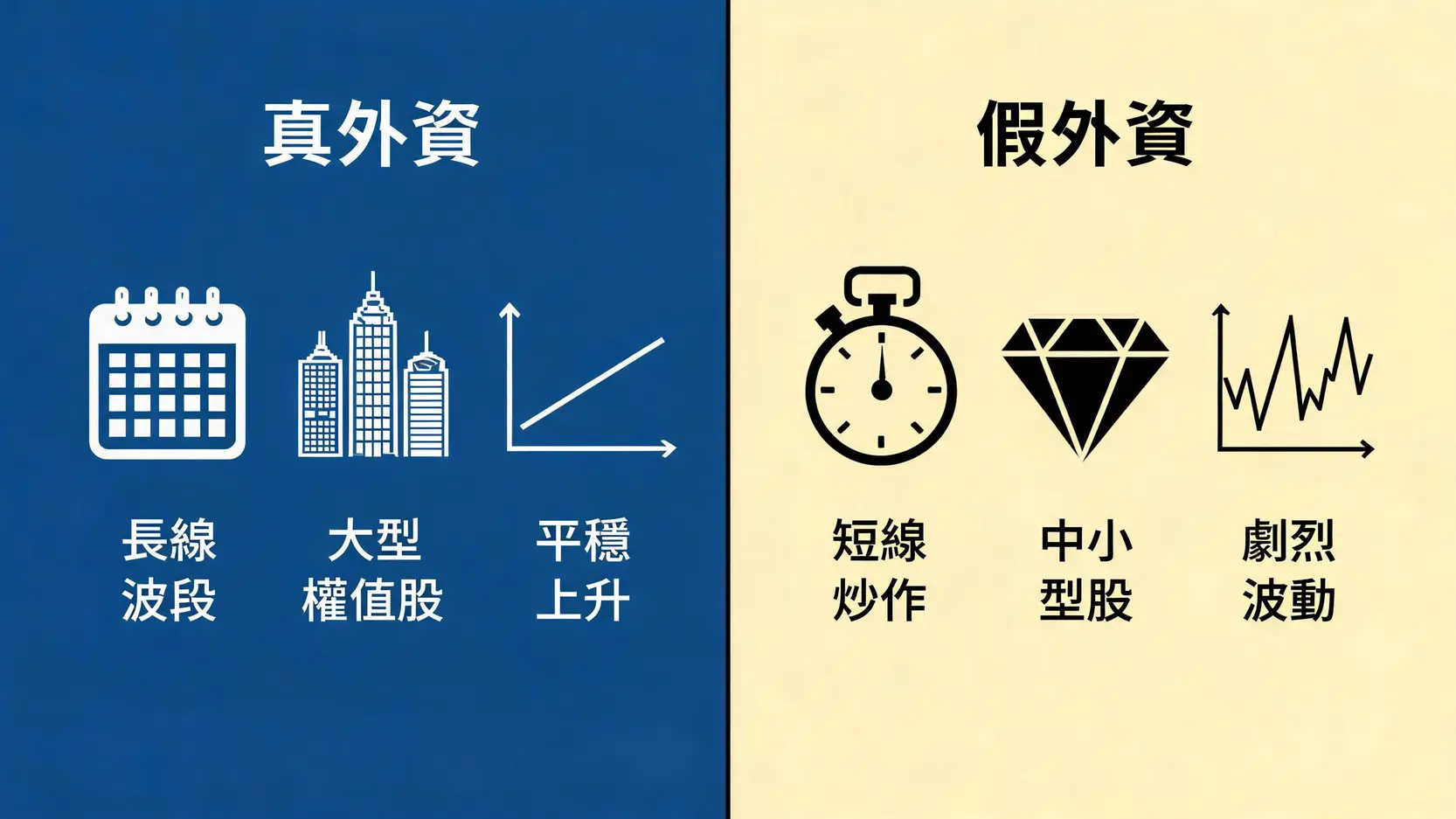
- Real Foreign Institutions (Long-Term Investors): These investors typically execute trades through major international brokerage firms such as Merrill Lynch, Morgan Stanley, Goldman Sachs, and Credit Suisse. Their trading patterns are generally longer-term, consistent, and supported by detailed research reports. They tend to favor large-cap market leaders and industry champions.
- Pseudo Foreign Investors (Short-Term Traders): Although they may also use foreign brokerage channels, their behavior is usually much more speculative and short-term in nature. They often focus on smaller-cap stocks with concentrated ownership structures. If a particular foreign brokerage branch aggressively buys a stock one day and aggressively sells it the next, investors should exercise caution.
Why Do Stocks Sometimes Fall Even When Foreign Institutions Are Buying?
This is one of the most frustrating experiences for retail investors: “Foreign institutions bought tens of thousands of shares, so why is the stock falling instead of rising?” Several explanations are possible:
- Left-Hand-to-Right-Hand Transactions: Market operators or insiders may use multiple accounts or foreign entities to conduct wash trades, creating the illusion of strong institutional buying and high trading volume while quietly distributing shares to retail investors chasing momentum.
- Other Institutional Selling: Foreign institutions may be buying, but mutual funds, proprietary trading desks, or other large investors may be selling even more aggressively. In such cases, overall selling pressure can still dominate.
- Hedging Strategies: Foreign investors may purchase “cash equities” while simultaneously establishing “short positions” in the futures or options market as part of a hedging strategy. In such cases, the purpose of buying the underlying shares is not necessarily a bullish view on the stock’s price outlook, but rather to satisfy the requirements of a broader trading or risk management strategy.
Combining Institutional Activity With Company Fundamentals to Avoid Blindly Following the Crowd
The most robust approach is to combine “capital flow analysis (foreign investor activity)” with “fundamental stock analysis“. When you identify a stock that has been receiving consistent net buying from foreign investors, you should conduct further research into the following:
- Is the company’s revenue and profitability growing?
- Does the industry have favorable long-term prospects?
- Are valuation metrics such as the P/E ratio and P/B ratio still reasonable?
Only when a stock possesses both a “capital flow advantage” and strong “fundamental support” can your investment benefit from a dual layer of conviction, allowing you to hold the position with greater confidence and pursue sustainable long-term returns.
Strategy 3: Risk Management Through Profit Targets and Stop Losses
During liquidity-driven rallies, market optimism often becomes excessive, causing investors to forget about risk. However, every party eventually comes to an end. When the music stops, you want to ensure you are not the last person left on the dance floor. Establishing a clear exit strategy is essential for preserving profits and limiting losses.
Warning Signs of an Overheated Market: Excessive Positive Divergence and High-Volume Bearish Candles
Beyond the previously discussed RSI and KD indicators entering extreme overbought territory, two additional technical warning signs deserve attention:
- Excessive Positive Divergence: When a stock price surges sharply within a short period, it can move significantly above its medium- to long-term moving averages, (such as the monthly or quarterly moving average). This condition is known as an “excessive positive deviation”. Stock prices tend to gravitate back toward their moving averages over time, so an excessive positive deviation often indicates that the short-term advance has become overstretched. As a result, profit-taking pressure may emerge at any time, potentially leading to a pullback or price correction.
- High-Volume Bearish Candlestick: After a stock has already risen substantially, if it suddenly records its highest trading volume in recent periods and closes with a large bearish candlestick, this is often a sign that major market participants or foreign investors are heavily distributing their holdings, commonly referred to as “distribution”. This is a highly dangerous reversal signal and may warrant reducing exposure or exiting the position altogether.
Trailing Stop Strategies: Let Your Profits Run
For positions that are already profitable, knowing how to exit effectively is an art in itself. A “trailing stop strategy” is one approach worth considering. The concept is simple: your stop level “moves along with the stock price”, allowing you to lock in gains while still giving the position room to benefit from further upside potential.
For example, you might establish a rule to exit “if the stock declines by 10% from its highest point during the current trend”. If the stock rises to NT$100, your trailing stop would be set at NT$90. If the stock subsequently climbs to NT$120, the stop level automatically moves up to NT$108 (120 × 0.9). The advantage of this approach is that it prevents premature selling while ensuring that most accumulated profits are preserved if the trend eventually reverses.
Fixed Percentage Stop Losses: Maintaining Investment Discipline
No investor can expect every trade to be profitable. The purpose of a stop loss is to control losses and prevent minor setbacks from turning into major financial damage. One of the simplest approaches is the “fixed percentage stop-loss method”.
Before entering a position, determine the maximum loss you are willing to tolerate, such as 8% or 10%. Once the stock reaches that level, the stop loss must be “executed without hesitation” and without hoping for a rebound. Maintaining strict discipline is one of the defining characteristics shared by successful investors.
Frequently Asked Questions (FAQ)
Q: Foreign institutional investors are buying aggressively, and both stocks and the Taiwan dollar are rising. Is it too late to enter the market now?
A: There is no definitive answer. The key factors are the current “market stage” and “stock selection”. If the market has already entered the late stage of a bull run and investor sentiment has become excessively euphoric, the risks are indeed higher, and your capital allocation should be reduced accordingly. However, even when the broader market is trading near highs, there may still be lagging sectors or stocks that are only beginning to move. The goal is not to predict the market’s peak but to focus on fundamentals and institutional positioning, identify opportunities with favorable risk-reward profiles, and establish clear stop-loss levels.
Q: If foreign institutional investors switch from net buying to net selling, should I exit immediately?
A: There is no need to panic. The first step is determining whether the selling represents a “strategic adjustment” or a “trend reversal”. If the selling occurs over a single day or a short period and the volume is relatively small, it may simply reflect profit-taking or capital rotation, in which case further observation may be appropriate. However, if foreign institutions engage in “persistent and large-scale selling”, especially if the stock breaks below important technical support levels (such as the monthly moving average), investors should consider reducing positions or exiting entirely while waiting for greater trend clarity.
Q: Besides following foreign institutional buying activity, what other stock selection methods are available?
A: Following institutional capital flows is one way to trade with the trend, but it is far from the only approach. Investors can also focus on “industry trends”, identifying sectors with strong growth potential over the coming quarters or years, such as artificial intelligence, electric vehicles, and renewable energy. From there, they can select leading companies within those industries. Another approach is to focus on “fundamentals”, seeking companies with consistently growing revenue and earnings per share (EPS). Combining multiple stock selection methods can help create a more diversified and well-rounded investment portfolio.
Conclusion
In summary, when navigating a liquidity-driven market fueled by foreign capital and accompanied by simultaneous strength in both equities and the currency, investors should focus on three core principles: “assessing market conditions, selecting quality stocks, and managing risk rigorously”. Rather than trying to predict the market’s exact peak amid an influx of capital, it is often more productive to concentrate on identifying fundamentally strong companies that continue to attract institutional interest. By understanding how capital is allocated across different market phases, learning to interpret the signals behind foreign investor positioning, and establishing a clear exit strategy before entering a trade, investors can make more informed decisions. While following the prevailing trend, it is essential to remain disciplined and objective. Only then can investors not only participate in the benefits of a liquidity-driven rally but also emerge as true long-term winners.
Related Articles
-
[Second Half of 2026] Complete Japanese Yen Outlook Forecast: The Ultimate Currency Exchange Strategy for Investors and Travelers Following record-breaking market interventions, the future outlook for the Japanese yen is filled with both uncertainty and opportunity. Will the yen regain its strength, or will it fall to new lows? This...2026 年 6 月 5 日
-
How Significant Is the Impact of the Geopolitical Risk Premium on Taiwan Stocks? Understanding the Risks, Opportunities, and Investment Strategies In an increasingly globalized world, Taiwan's stock market is influenced not only by economic fundamentals but is also constantly exposed to complex geopolitical risks. From tensions in cross-strait relations to...2026 年 6 月 5 日
-
The Fourth Largest Net Buy in History! Foreign Investors Snap Up NT$62.7 Billion of Taiwan Stocks, Revealing Three Key Signals Behind Stocks and the Currency Rising in Tandem Taiwan's stock market staged a stunning rally, surging more than 900 points in a single day with trading volume reaching extraordinary levels....2026 年 6 月 5 日