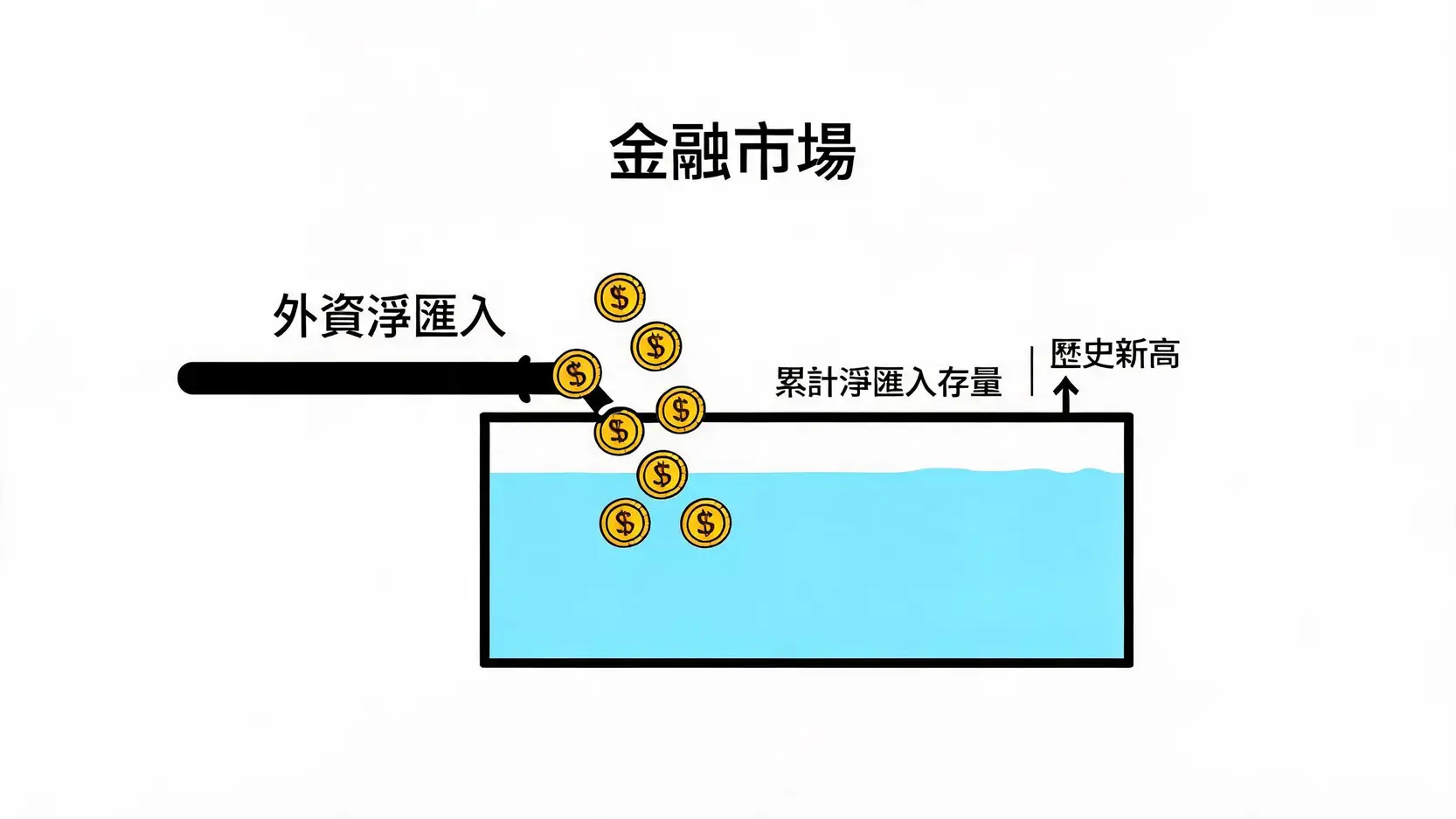
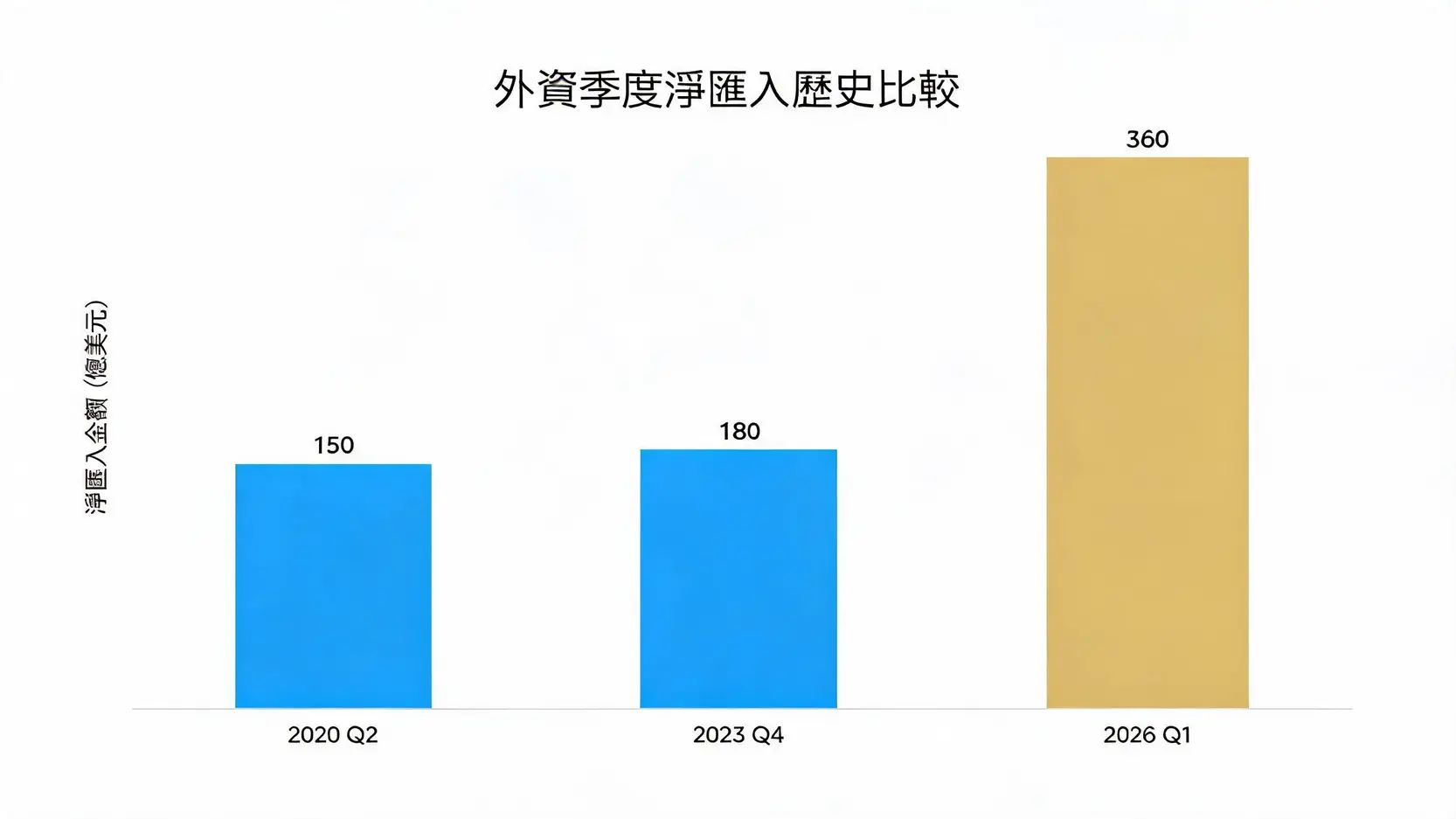
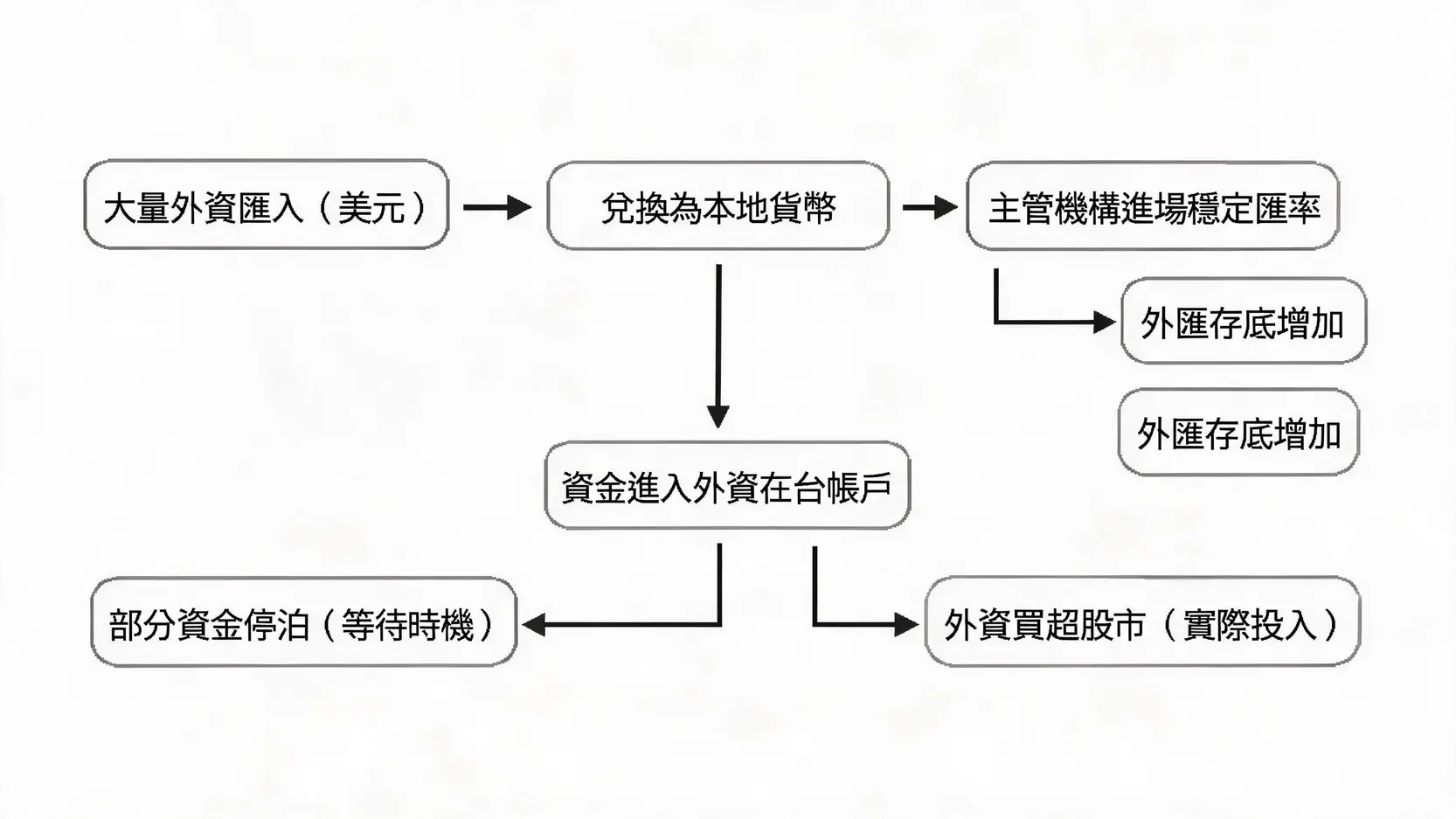
Illustration: The interaction between foreign capital inflows, net stock purchases, and foreign exchange reserves.
Why Is Global Capital Flowing Into Taiwan? Three Major Attraction Factors
Why has Taiwan become a preferred destination for international capital among so many global markets? The answer lies in three structural advantages that create a powerful magnet effect. From its irreplaceable position in the global technology ecosystem to its solid economic fundamentals, Taiwan has become one of the world’s most attractive destinations for capital.
AI Leadership: Taiwan’s Irreplaceable Role in the Global Technology Supply Chain
If 2023 marked the emergence of AI, then 2026 represents the period of AI-driven expansion. Demand for high-performance chips has grown exponentially across applications ranging from cloud data centers to edge computing devices, and Taiwan sits at the center of this technological revolution.
- Semiconductor Leadership: Foundries led by Taiwan Semiconductor Manufacturing Company (TSMC) possess the world’s most advanced manufacturing technologies and serve as essential partners for leading AI chip companies (such as NVIDIA and AMD).
- Comprehensive Ecosystem: Beyond semiconductor manufacturing, Taiwan offers a complete technology supply chain that includes IC design companies (such as MediaTek), packaging and testing leaders (such as ASE), and server manufacturers (including Foxconn and Quanta). This integrated ecosystem makes the statement “the heart of AI is in Taiwan” increasingly difficult to dispute.
Global capital naturally seeks growth opportunities, and AI remains one of the most compelling long-term growth themes of the coming decade. Investing in AI-related companies effectively means investing in the future of technology, making Taiwan a core allocation target for international investment funds.
Further Reading (Highly Recommended)
Building a Foreign Capital Flow Copy Trading Model: A Stock Market Indicator for Accurately Tracking Institutional Positioning
Best US ETFs for 2026: A Complete Guide to Market Index and Gold ETFs With Risk Analysis
Relatively Stable Economic Fundamentals and Attractive Dividend Yields
Beyond the technology sector, Taiwan’s solid economic fundamentals have also provided foreign investors with confidence. Compared with many major economies still struggling with high inflation and sluggish growth, Taiwan has demonstrated remarkable resilience.
- Strong Export Performance: Benefiting from robust demand for AI-related products, Taiwan’s exports have remained strong, driving corporate revenue and profits to record highs.
- High Cash Dividend Yields: Taiwanese companies have long maintained a tradition of generous dividend distributions, and the Taiwan stock market consistently ranks among the highest in the world for average cash dividend yields. In an uncertain global environment, stable dividend income is highly attractive to long-term capital seeking safety and consistent returns (such as pension funds and sovereign wealth funds).
This unique combination of offensive potential (AI-driven growth) and defensive strength (high dividend yields) makes Taiwan stocks an exceptionally attractive asset allocation choice in the eyes of foreign investors.
Safe-Haven Capital Flows Amid Global Geopolitical Risks
In recent years, growing geopolitical uncertainty around the world has made the “safety” of capital an increasingly important consideration in investment decision-making. Although cross-strait relations continue to attract attention, Taiwan’s market has, in certain respects, demonstrated characteristics of a safe-haven destination.
- Capital Relocation From Other Markets: Some funds previously allocated to other Asian markets have shifted toward Taiwan due to rising economic or political uncertainties elsewhere. Taiwan’s transparent regulatory framework, sound legal environment, and clear industrial growth outlook have made it an attractive alternative.
- Strategic Importance: Taiwan’s critical position within the global semiconductor supply chain makes it an indispensable component of the global economy. This “Silicon Shield” effect provides a degree of stability and confidence for investors.
Geopolitics remains a double-edged sword. However, recent capital flow trends suggest that international investors are placing greater emphasis on Taiwan’s industrial advantages and economic stability.
Foreign Capital Net Inflows vs. Foreign Institutional Net Buying: Why Are They Sometimes Out of Sync?
Many investors become excited when they see a sharp increase in foreign capital net inflows, assuming that the stock market is about to surge. However, there are times when the index barely moves, or foreign investors are even reported as recording “net selling” activity. These discrepancies between different sets of data often confuse newer market participants. Understanding the reasons behind this apparent mismatch is an essential step toward mastering the dynamics of liquidity-driven market trends.
Capital Inflows Do Not Necessarily Mean Immediate Stock Purchases
Think of a foreign portfolio manager as a cautious hunter. Before entering the hunting ground (Taiwan’s market), they first transport sufficient ammunition (capital) into the area. However, they do not necessarily use all of it immediately. After capital enters Taiwan, it may remain in several different forms:
- Capital Parking: Funds may temporarily remain in Taiwan dollar demand deposits or time deposits at local banks, earning interest while investors wait for more attractive entry opportunities. This allows them to react quickly if market conditions change.
- Bond and Money Market Allocations: Some capital may initially be allocated to highly liquid and lower-risk instruments such as government bonds or money market products.
- Foreign Exchange Hedging: Large institutional investors face significant currency risk. They may use part of their capital to enter Taiwan dollar-related forward contracts or other derivatives to hedge exchange rate exposure or pursue arbitrage opportunities.
As a result, “net inflows” represent the size of “potential future buying power”, while “net buying and selling” activity reflects actual market actions. The gap between these two figures often reveals foreign investors’ short-term caution or uncertainty.
The “Pseudo Foreign Investor” Myth: Distinguishing Short-Term and Long-Term Capital
The market frequently discusses the concept of “pseudo foreign investors”, referring to domestic capital that is routed through overseas entities before being reinvested into Taiwan. This structure may provide tax advantages or facilitate certain trading strategies. Such capital often exhibits several characteristics:
- Short-Term Trading Behavior: Frequent buying and selling of popular thematic stocks, unlike traditional foreign institutions that prefer long-term holdings in large-cap market leaders.
- Suspicious Jurisdictions: Capital often originates from offshore financial centers such as the Cayman Islands or the British Virgin Islands.
Although identifying genuine and pseudo foreign investors can be difficult for retail investors, brokerage branch activity may provide clues. If a particular “foreign investor” consistently executes trades through a small group of local brokerage firms and focuses primarily on smaller-cap stocks, it may represent domestic capital operating under a foreign identity. Genuine long-term international investors typically transact through major global financial institutions (such as Merrill Lynch and Morgan Stanley).
Using Data Divergence as a Leading Indicator
Savvy investors can often uncover valuable clues about the market’s direction by analyzing situations where “net inflows” and “net buying or selling activity” move out of sync:
- Net Inflows Exceed Net Buying: If large inflows continue while stock purchases remain relatively modest, foreign investors may be optimistic about the long-term outlook but cautious about near-term market conditions. During such periods, the market may move sideways near highs, and investors should avoid chasing prices while waiting for pullbacks.
- Inflows Slow While Net Buying Continues: If inflows begin to decline but foreign investors continue buying stocks, they may be deploying previously parked capital. This can signal a late-stage rally, making it important to monitor whether liquidity momentum is weakening.
- Outflows and Net Selling Occur Simultaneously: This is the clearest warning signal. When foreign investors aggressively sell stocks while also converting Taiwan dollars back into foreign currencies and withdrawing funds, it typically indicates a strong desire to exit the market and often precedes a more substantial correction.
How Should Investors Respond to a Foreign Capital-Driven Market Rally?
When foreign capital creates powerful market momentum, retail investors are like small boats navigating large waves. Following the trend is generally the most effective approach. Rather than attempting to predict the market’s exact peak, investors should focus on developing strategies that allow them to navigate the environment successfully.
Follow Foreign Institutions: Focus on Large-Cap Leaders and Technology Stocks
Foreign investors manage enormous pools of capital and generally favor highly liquid, large-cap companies with dominant industry positions. Instead of searching endlessly for speculative winners, investors may benefit from following the same path.
- Large-Cap Market Leaders: Companies such as TSMC (2330), Foxconn (2317), and MediaTek (2454) are not only industry leaders within Taiwan but also critical participants in global supply chains. These companies frequently serve as core holdings for foreign institutions.
- Technology and AI-Related Stocks: Focus on industries benefiting from major long-term trends, including AI servers, thermal management solutions, semiconductor intellectual property, and advanced packaging technologies. These sectors represent key areas where foreign investors seek excess returns.
- High-Dividend ETFs: Investors who prefer not to analyze individual stocks can consider high-dividend or market-cap-weighted Taiwan ETFs that hold many of the same companies favored by foreign institutions, allowing professional managers to handle stock selection.
Risk Management: Be Prepared for the End of the Liquidity Party
Liquidity can lift markets, but it can also accelerate declines. Foreign capital can enter quickly and leave just as rapidly. If global financial conditions change dramatically (such as an unexpectedly hawkish shift by the US Federal Reserve) or if Taiwan’s competitive advantages weaken, capital outflows could trigger sharp market declines.
- Avoid Excessive Leverage: Limit the use of margin financing or stock futures. Maintain sufficient cash reserves to withstand periods of market volatility.
- Diversify Investments: Even if you are optimistic about AI-related opportunities, diversify across multiple themes and companies rather than concentrating all capital in a single stock.
- Establish Stop-Loss Levels: No matter how favorable market conditions may appear, investors should establish clear stop-loss (take-profit) levels for their positions and adhere to them with discipline, preventing small losses from turning into major setbacks.
Further Reading (Highly Recommended)
Complete Guide to Taiwan Dollar Appreciation: Five Key Drivers, Three Major Impacts, and Smart Strategies for 2026
The Ultimate Guide to Compute Power Investing: How to Position for Compute Power Securitization and Find the Next NVIDIA
Key Indicators to Watch: Tracking Foreign Institutional Futures Open Interest and Taiwan Dollar Exchange Rate Trends
In addition to monitoring net buying and selling activity in the cash market, foreign institutional positioning in the futures market and movements in the Taiwan dollar exchange rate are two more sensitive leading indicators that can help investors identify trend changes early.
- Foreign Institutional Open Interest in Taiwan Index Futures: This is a key indicator for observing foreign investors’ bullish or bearish outlook on the future direction of the broader market. Generally, foreign investors’ open positions in Taiwan Index Futures are maintained as “net long positions”. If the size of these net long positions continues to decline significantly, or even shifts from net long to net short, it is a very strong warning signal.
- Taiwan Dollar Exchange Rate: The exchange rate is the most direct reflection of capital flows. If the Taiwan dollar shifts from an appreciation trend into a clear depreciation trend against the US dollar, it often signals that foreign investors are moving capital out of Taiwan. Exchange rate reversals frequently occur before major stock market corrections.
Frequently Asked Questions About Foreign Capital Net Inflows
Q: If foreign capital net inflows continue increasing, will Taiwan stocks keep rising indefinitely?
A: Not necessarily. Foreign capital net inflows represent strong potential buying power and serve as the “fuel” supporting higher stock prices. They can be viewed as a highly positive long-term indicator. However, they do not guarantee that the stock market will rise “every day”. In the short term, stock prices remain influenced by domestic and international news, technical factors, earnings results, and market sentiment. As discussed earlier, capital entering Taiwan may not immediately flow into equities. Therefore, net inflows serve as a compass indicating the broader market direction, but they should not be the sole basis for short-term trading decisions.
Q: Where does the money go after foreign investors transfer it into Taiwan?
A: There are three primary destinations. The first and largest is the Taiwan stock market, particularly large-cap stocks and technology leaders. The second is Taiwan dollar deposit accounts at local banks, where capital may temporarily remain while investors wait for attractive entry opportunities. This is one reason why net inflows often exceed net buying activity. Third, a portion of capital may be allocated to Taiwan’s bond market, particularly government bonds, to generate stable returns and provide defensive positioning.
Q: What should I do if foreign investors begin withdrawing capital from Taiwan?
A: The first rule is to remain calm and avoid panic selling. Investors must determine whether the outflows represent a “short-term adjustment” or a genuine “trend reversal”. If net outflows occur for only a few days and the broader economic and industry outlook remains unchanged, they may simply reflect routine profit-taking. However, if large and persistent outflows emerge alongside sharp Taiwan dollar depreciation and a substantial reduction in foreign institutional net long futures positions, it may indicate a major trend reversal. In such situations, investors should consider reducing portfolio exposure, especially in stocks that have already experienced significant gains, while increasing allocations to defensive assets or cash.
Q: How can I access the latest foreign capital inflow data?
A: The most authoritative source is the website of the Securities and Futures Bureau under Taiwan’s Financial Supervisory Commission. The bureau generally publishes the previous month’s “Statistics on Foreign and Mainland Chinese Investor Trading Activity and Capital Flows in the Securities Market” at the beginning of each month (typically around the fifth day). Many financial news websites and brokerage applications also summarize and distribute these figures in a more accessible format for investors.
Conclusion
In summary, foreign capital net inflows reached a record high for the same period in 2026, driven primarily by Taiwan’s irreplaceable leadership position within the global AI supply chain, supported by strong economic fundamentals and attractive dividend yields. This powerful capital momentum provides meaningful downside support for Taiwan stocks and continues to enhance the market’s long-term value proposition.
However, as a prudent investor, you must clearly understand that “net inflow” does not equal “immediate net buying”. Capital parking strategies, hedging requirements, and the distinction between genuine and pseudo foreign investors are all important factors that should be considered when interpreting the data. Rather than blindly chasing rising prices, investors should treat foreign capital flows as an important macroeconomic indicator and combine them with other leading signals, including foreign institutional futures open interest and Taiwan dollar exchange rate movements.
Ultimately, success during this foreign capital-driven market cycle depends on returning to the fundamentals: identifying high-quality companies with long-term growth potential while maintaining disciplined risk management. By doing so, investors can capitalize on favorable market conditions while remaining resilient during periods of uncertainty, fully benefiting from the opportunities created by this powerful wave of capital.