US Stock ETF Picks 2026: Broad Market & Gold Guide

Updated: 2026/03/02  |  CashbackIsland

美股ETF推薦2026:追蹤大市、黃金ETF全攻略與風險分析

Want to invest in the US stock market but find selecting individual stocks too complicated? US stock ETFs provide a simple and effective way to achieve diversified investment. This comprehensive “US stock ETF recommendations” guide will explore in depth how to choose the “broad-market tracking ETFs” that best suit you, as well as “US gold ETFs” used as hedging tools during economic uncertainty. Before you begin investing, it will also provide a thorough analysis of common “ETF investment risks”, helping you avoid pitfalls and make more informed decisions. 


Why Should You First Consider Broad-Market US Stock ETFs?

For many investors, especially beginners, directly attempting to pick individual stocks is like searching for a specific fish in a vast ocean, time-consuming and filled with uncertainty. Broad-market tracking ETFs, by contrast, are like a net that captures the entire school of fish, allowing you to easily obtain the market’s average returns. This is also the core principle of index investing repeatedly recommended by Warren Buffett for ordinary investors. 


One-Click Exposure to the US Economy: How Diversification Reduces Risk

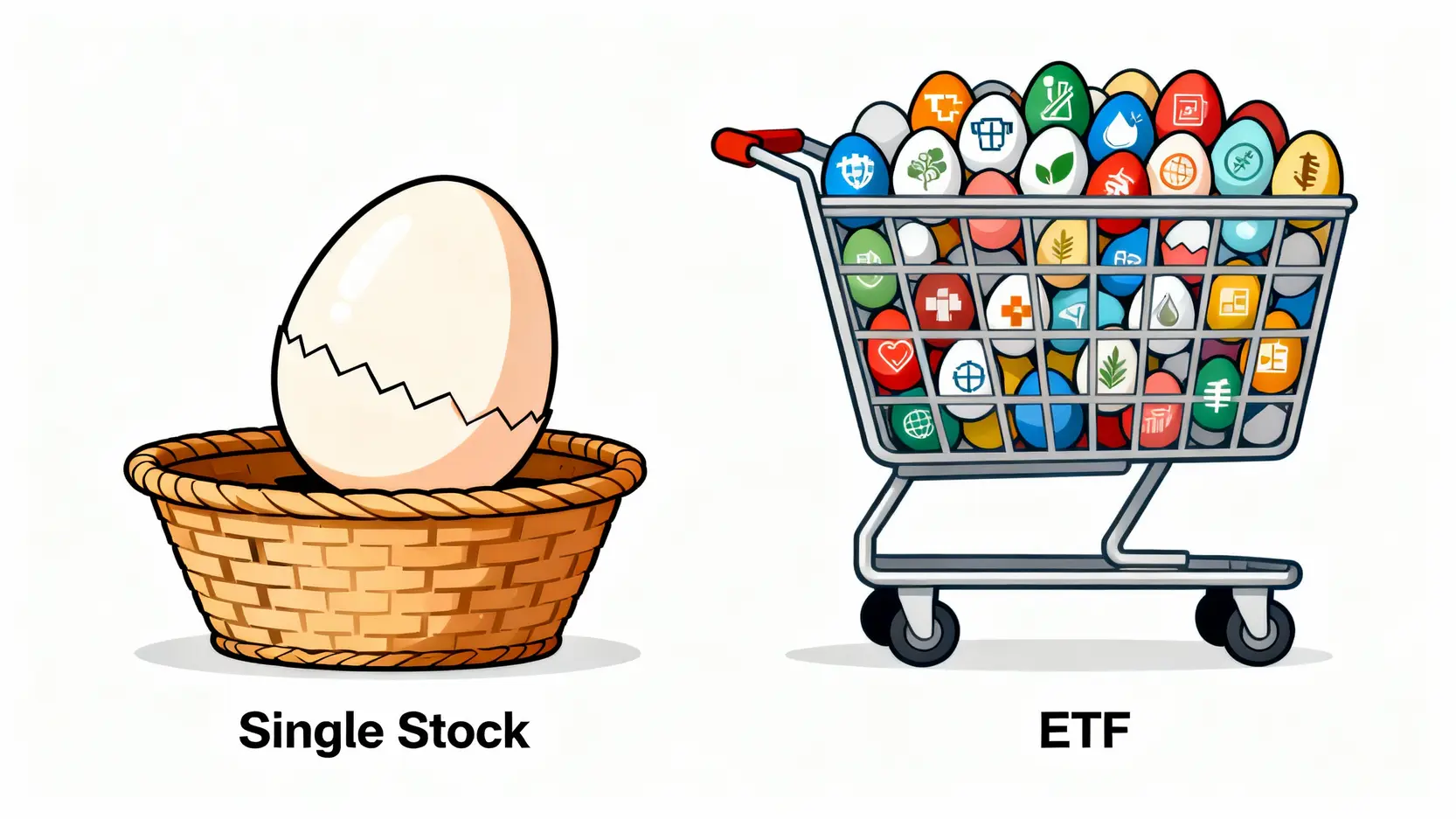
The greatest risk of investing in a single company’s stock lies in “unsystematic risk”, meaning company-specific issues such as poor management, product failure, or industry scandals. If that company’s share price plunges, your investment may suffer significant losses. In contrast, broad-market tracking ETFs, such as those tracking the S&P 500 Index, are equivalent to buying shares of 500 of the most representative large US companies in a single transaction. Your investment is automatically diversified across sectors such as technology, finance, healthcare, and consumer industries, effectively reducing the risk of a “single-stock blowup”. Even if one or two companies perform poorly, the overall impact on your portfolio is relatively limited, fulfilling the golden rule of “do not put all your eggs in one basket”.

一張對比圖,左邊是一個籃子裡放著一顆大雞蛋,代表個股投資風險集中;右邊是一整個購物車裡裝滿許多小雞蛋,代表ETF分散投資降低風險。

Illustration: Investing in a single stock is like putting all your eggs in one basket, while an ETF spreads risk across hundreds of companies.


Popular Broad-Market ETF Recommendations: Core Comparison of VOO, VTI, and QQQ

There are many broad-market tracking ETFs available, but the following three are the most popular among investors, each with its own characteristics:

Ticker Full Name Tracked Index Annual Management Fee Key Features
VOO Vanguard S&P 500 ETF S&P 500 Index 0.03% ✅ Tracks 500 of the largest US companies, best representing the overall US economy, with extremely low fees, suitable for stable core holdings.
VTI Vanguard Total Stock Market ETF CRSP US Total Market Index 0.03% ✅ Covers nearly 4,000 US stocks, including large-, mid-, and small-cap companies, offering broader diversification than VOO and targeting growth across the entire US market.
QQQ Invesco QQQ Trust NASDAQ-100 Index 0.20% ✅ Focuses on the non-financial stocks of the Nasdaq 100 Index, primarily major technology companies, with higher volatility and potentially higher returns, suitable for investors confident in technology stocks.

Simply put, if you want to steadily follow US economic growth, VOO is the top choice; if you want maximum diversification across the entire US stock market, VTI is more comprehensive; if you are bullish on the explosive potential of technology stocks and can tolerate higher risk, QQQ is the best choice.

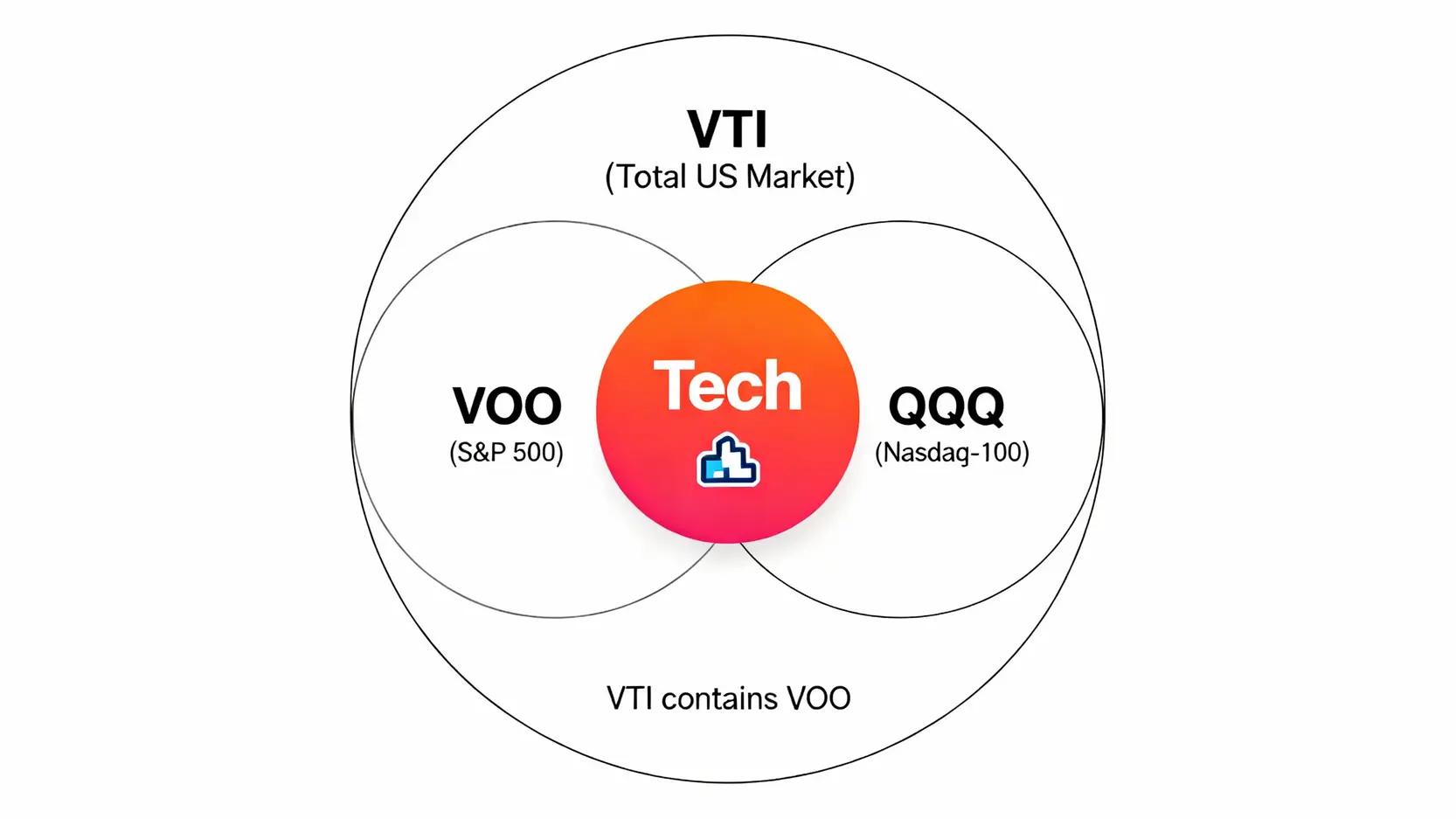
一張概念圖,用三個圓圈展示VTI、VOO和QQQ三隻ETF的關係。最大的圓圈VTI(全市場)包含了較小的圓圈VOO(標普500),而代表科技股的QQQ圓圈則與兩者都有重疊。

The Scope Relationship Between VTI, VOO, and QQQ: VTI Has the Broadest Coverage, VOO Is Its Core Component, While QQQ Focuses on Technology Stocks.


Further Reading (Highly Recommended)

What Are ETF Risks? A Comprehensive Analysis of ETF Risk Levels and Investment Management Strategies

2026 Hong Kong US Stock Investing Guide: Fees and Account Opening at a Glance, Even Beginners Can Buy With Ease! 

A Safe-Haven Choice in Turbulent Times: Are US Gold ETFs Worth Investing In?

When markets are filled with uncertainty, such as heightened geopolitical tensions, recession fears, or periods of high inflation, investors’ risk-off sentiment tends to rise. In such times, gold often becomes a “safe haven” for capital. However, holding physical gold comes with storage and security hassles, while US gold ETFs offer a low-cost and convenient alternative.


The Role and Function of Gold ETFs in a Portfolio

The primary function of gold ETFs is not to pursue high growth, but to provide “hedging” and “capital preservation”. Gold price movements are typically negatively correlated or weakly correlated with equities, meaning that when stock markets fall, gold prices may rise or remain stable. Adding a certain allocation of gold ETFs to a portfolio can reduce overall losses during market turbulence and act as “insurance”. In addition, in an inflationary environment driven by monetary easing, gold, as a scarce precious metal, has intrinsic value that helps counter currency depreciation, making it an ideal long-term store of value.


Popular US Gold ETF Recommendations: An In-Depth Analysis of GLD vs IAU

The two most mainstream gold ETFs on the market are GLD and IAU. Both directly hold physical gold bars, and their share prices are highly linked to the price of gold.

Ticker Full Name Annual Management Fee Assets Under Management (AUM) Key Features
GLD SPDR Gold Shares 0.40% Huge ✅ The first gold ETF in the market, with the largest scale and trading volume, offering excellent liquidity, suitable for frequent trading or large investors.
IAU iShares Gold Trust 0.25% Massive ✅ Lower management fees than GLD, making it more cost-effective for long-term holders. Each share represents a lower gold value, providing a more accessible entry threshold.

In summary, if you are a day trader or an institutional investor who prioritizes top-tier liquidity, GLD is the best choice. However, for most retail investors who focus on long-term holding and cost, IAU, with its lower annual fee, is clearly the more attractive option.


Must Read Before Investing: A Comprehensive Analysis of ETF Investment Risks

Although ETFs offer the advantages of diversification and convenience, they are by no means a “zero-risk” investment tool. Before committing capital, you must clearly understand the potential ETF investment risks in order to be fully prepared.


Market Risk: Unavoidable Systematic Risk

This is the most basic and most important risk. An ETF’s value depends on the basket of assets it holds. If you buy VOO, which tracks the broad market, when the overall US stock market declines due to factors such as an economic recession or a financial crisis, VOO’s NAV will inevitably decline as well. This type of market-wide risk is called systematic risk and cannot be eliminated through diversification. Investing in ETFs means being prepared to move with the market.


Tracking Error Risk: Why Can an ETF Underperform Its Index?

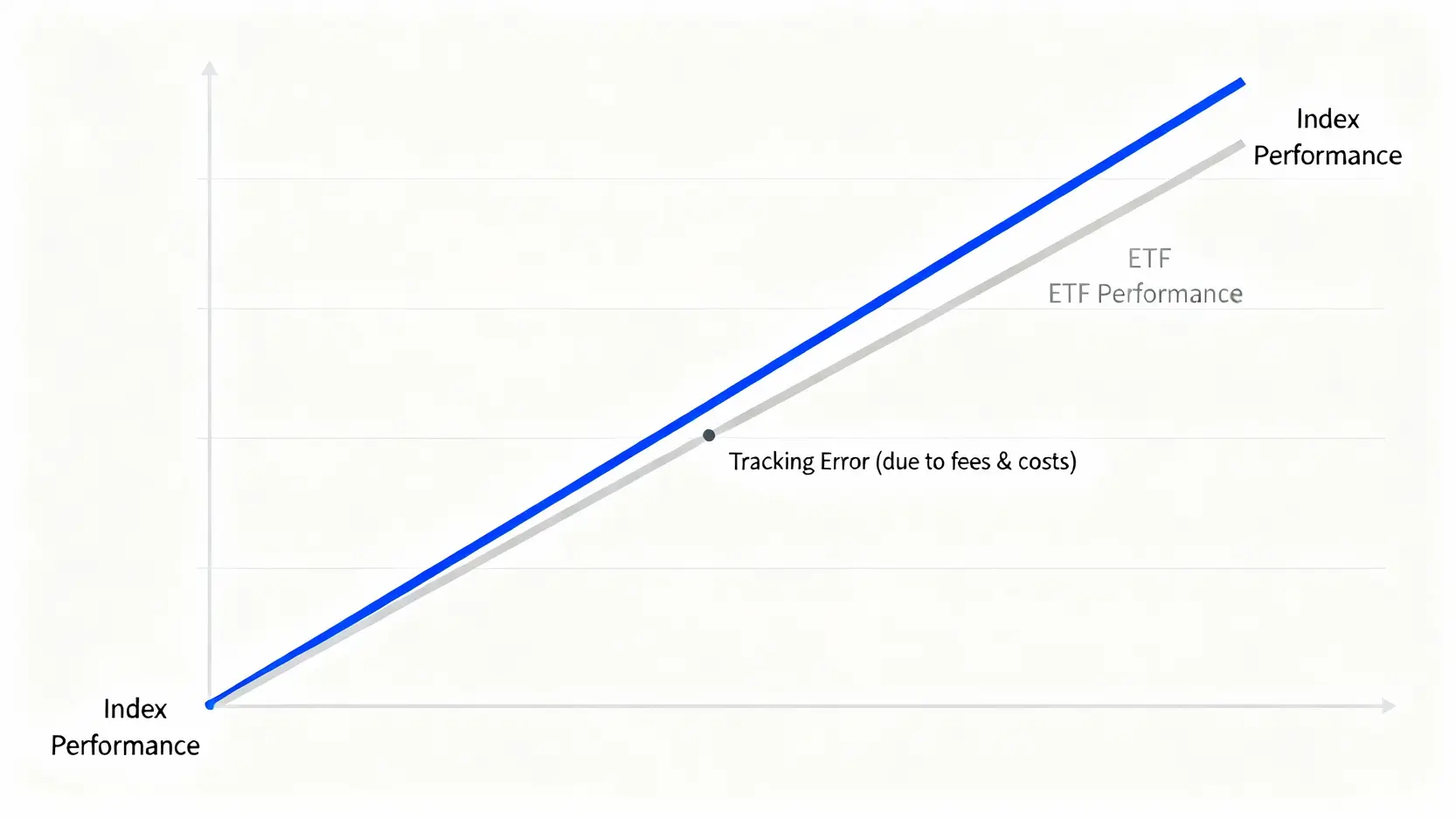
In theory, an ETF’s performance should fully replicate the index it tracks. But in reality, there is always a small gap, known as “tracking error”. The main causes of tracking error include:

  • Management Fees: ETF providers charge management fees, which are deducted directly from fund assets, inevitably causing the ETF’s returns to be slightly lower than the index itself.
  • Transaction Costs: When index constituents change, the ETF fund manager must buy and sell stocks to rebalance, and the resulting transaction costs erode returns.
  • Cash Drag: The fund may hold a small amount of cash to meet subscriptions and redemptions. This portion of cash that is not invested in the market cannot generate returns, and it can drag overall performance, especially during a bull market.

Choosing ETFs with low fees and large scale can usually minimize tracking error.

一張解釋追蹤誤差的折線圖。圖中有兩條線,代表指數表現的藍線和代表ETF表現的灰線。灰線緊隨藍線但始終略低於它,兩者之間的差距被標示為「追蹤誤差」。

Tracking Error Illustration: Due to costs such as management fees, an ETF’s actual performance will slightly lag the index it tracks.


Liquidity and Premium-Discount Risk: The Hidden Costs in Trading Prices

ETFs trade on exchanges like stocks, with their market price determined by supply and demand, while their intrinsic value is determined by the total value of the assets held (NAV, Net Asset Value). In most cases, the market price stays very close to NAV. However, when markets are extremely volatile or an ETF itself is thinly traded, a “discount” (market price below NAV) or a “premium” (market price above NAV) may occur.

  • Liquidity Risk: For niche ETFs with low trading volume, the bid-ask spread may be wider, meaning you buy at a higher price and sell at a lower price, increasing trading costs.
  • Premium-Discount Risk: If you buy at a large premium, you are effectively paying too high a price; if you sell at a large discount, you will incur additional losses.

To avoid this risk, you should prioritize actively traded mainstream ETFs such as VOO and GLD, and avoid trading during highly volatile periods such as the market open or close.


Frequently Asked Questions (FAQ)

Q: How Should Beginners Buy Their First US Stock ETF?

A: First, you need to open a securities account that supports trading US stocks. You may choose an international broker (such as Interactive Brokers or Fidelity) or a local bank or broker that offers sub-brokerage services. After completing account opening and funding, enter the ETF ticker you wish to purchase (such as VOO) on the trading platform, set your buy price and quantity, and submit the order to complete the transaction.

Q: What Are the Main Costs and Fees of Investing in US Stock ETFs?

A: There are three main costs: 1. Trading Commission: The fee charged by the broker for each buy or sell transaction. Many international brokers now offer zero-commission trading. 2. ETF Management Fee (Expense Ratio): The annual fee deducted by the ETF provider from the fund’s assets. This is an internal expense and is not directly charged to you. 3. Dividend Tax: The US imposes a 30% withholding tax on cash dividends paid to non-residents. This tax is automatically deducted when you receive dividends.

Q: What Is the Difference Between High-Dividend ETFs and Broad-Market Tracking ETFs?

A: Broad-market tracking ETFs (such as VOO) aim to replicate the performance of the entire market, with holdings that include both growth and value companies. Their dividend yield is usually around the market average. High-dividend ETFs (such as SCHD), on the other hand, specifically select companies that consistently pay higher dividends, with the goal of providing investors with steady cash flow income. High-dividend ETFs may have lower price growth potential compared to broad-market ETFs, but they offer more stable cash flow, making them suitable for retirees or income-focused investors.

Q: What Is the Difference Between Gold ETFs and Physical Gold?

A: Gold ETFs are fund shares traded on stock exchanges. They offer high liquidity and low trading costs without the need to worry about storage, but they require payment of management fees. Physical gold (such as gold bars or coins) is an asset you can physically hold. It does not involve management fees, but it typically has higher bid-ask spreads when buying and selling, and you must consider storage and insurance costs. ETFs are more suitable for purely investment purposes, while physical gold carries the tangible aspect of asset ownership.


Conclusion

In summary, broad-market tracking ETFs allow you to steadily participate in the growth of US stocks, while US gold ETFs can provide hedging during market volatility. Among the many US stock ETF recommendations, choosing products that align with your personal risk tolerance and investment objectives is crucial. However, always remember that any investment involves risk. Before taking action, you must thoroughly understand various ETF investment risks, such as market volatility, tracking error, and liquidity issues, so that your asset allocation can advance to the next level and steadily move toward financial freedom.

If you liked this article, please share it!

Related Articles

  • How to Buy Bitcoin in 2026: A Beginner’s Guide
    How to Get Started with Bitcoin? The Complete 2026 Bitcoin Buying Guide for Beginners After watching Bitcoin repeatedly reach new highs in recent years and successfully pass spot ETF reviews in the US and Hong Kong in 2024, officially entering mainstream financial markets, many investors have turned their attention to...
    2026 年 7 月 20 日
  • Gold V-Shaped Rebound: Bottom Signal or Bull Trap?
    Is Gold’s V-Shaped Rebound a Bottom-Fishing Signal? A Complete Guide to Trading Strategies Amid “$100 Price Swings” What Is a Gold V-Shaped Rebound? More Than Just a Technical Pattern The gold market has recently experienced sharp rises and falls, with prices frequently displaying dramatic “gold V-shaped rebounds”. Single-day “$100 price...
    2026 年 7 月 20 日
  • 2026 PPI Guide: PPI vs CPI and Stock Market Impact
    What Is PPI Data? 2026 Latest Analysis: Understand the Differences from CPI and How It Affects Stock Market Trends With market information constantly changing, do you always hold your breath while waiting for CPI data to be released? But did you know that a more forward-looking inflation indicator, PPI data...
    2026 年 7 月 20 日
返回顶部