Options Buying Strategies for Extreme Market Risks

Options Buyer Strategies During Extreme Market Conditions: Black Swan Hedging and Cross-Market Arbitrage During Volatility Surges
The most terrifying aspect of financial markets is not a gradual decline, but overnight flash crashes and cross-market capital withdrawals accompanied by volatility surges. In the highly unpredictable global macroeconomic environment of 2026, geopolitical risks and delayed economic effects have intertwined, leaving markets constantly under tension. When faced with such unpredictable events, traditional asset allocation and diversification strategies are often powerless. This article integrates volatility surface analysis, overnight session risk control, and Friday options characteristics to build a robust options buyer strategy framework for extreme market conditions tailored for advanced investors. Through this framework, which combines profit opportunities for options buyers during extreme conditions with a comprehensive cross-market defense structure, you will learn how to not only survive black swan hedging scenarios, but also precisely capture dual arbitrage opportunities when volatility and market declines occur simultaneously, maximizing the benefits of cross-market arbitrage.
The Three Major Characteristics of Black Swan Market Conditions and a Comprehensive Cross-Market Defense Framework
Throughout financial history, we have witnessed countless market collapses, whether caused by unexpected central bank policy reversals or regional crises. These black swan events always arrive without warning. When true panic spreads, markets exhibit extreme chain reactions. To establish an effective cross-market defense framework, it is essential to first deeply understand the underlying logic and characteristics of these market conditions.
Double Collapse in Equities and Currencies Triggered by Forex Carry Trade Unwinding
In stable market environments, large multinational institutions often utilize low-interest-rate currencies, such as the Japanese yen or Swiss franc, to conduct carry trades, deploying massive amounts of capital into higher-yield risk assets. However, when a black swan event occurs, market risk aversion rises instantly, forcing these institutions into large-scale deleveraging and position unwinding. This not only triggers panic selling in high-yield stocks and bonds, but also causes safe-haven currencies to appreciate rapidly, creating the well-known phenomenon of a “double collapse in equities and currencies”.

Chain Reaction of Double Collapse in Equities and Currencies Triggered by Forex Carry Trade Unwinding
At such moments, simply holding assets in a single market exposes investors to severe liquidity stress. If investors can anticipate this reversal in capital flows in advance, they can hedge using foreign exchange options or highly sensitive volatility products. For investors with strong defensive requirements, gaining a deep understanding of crisis response strategies is crucial. It is highly recommended to study The Ultimate Black Swan Hedging Guide: Why Traditional Diversification Fails? to understand how to incorporate advanced defensive investment tools into asset allocation strategies to withstand sudden liquidity depletion.
Panic Sell-Offs Amplified by Low Liquidity During Overnight Sessions
Modern financial markets now operate as a 24-hour global network. Many major macroeconomic data releases or unexpected geopolitical events often occur late at night in Asian time zones, coinciding with active trading hours in Europe and the US. During overnight sessions, because the number of participating market makers and liquidity providers is relatively lower, once large-scale indiscriminate sell orders emerge, insufficient market depth rapidly magnifies the decline. This “liquidity vacuum” creates the perfect environment for instantaneous volatility spikes.
To survive in such extreme and fragile environments, traditional stop-loss orders often fail completely due to severe slippage. Therefore, establishing options buyer positions in advance and utilizing their asymmetric characteristics, where the maximum risk is limited to the premium paid while potential profits remain theoretically unlimited, becomes the golden rule of overnight risk control.
Building an Options Buyer Hedging Matrix and Dual Arbitrage Strategy for Extreme Market Conditions
Once we understand the destructive power of black swan events, the next step is to transform from passive defense to proactive positioning. Precisely capturing dual arbitrage opportunities when volatility and market declines occur simultaneously is the key factor separating long-term performance among advanced investors. Here, we will break down how to build a multidimensional, low-cost hedging matrix through options buyer strategies.
Using Long-Dated Deep Out-of-the-Money Puts to Establish a Low-Cost Defense
Many investors hold a common misconception about options buyer strategies, believing that long-term buyer positions continuously lose value due to time decay (Theta). Indeed, blindly purchasing near-term at-the-money contracts in calm market environments results in extremely low long-term success rates. However, our core objective is black swan hedging during extreme market conditions, so the strategy focuses on “low-cost positioning” and “high-multiple explosive potential”.
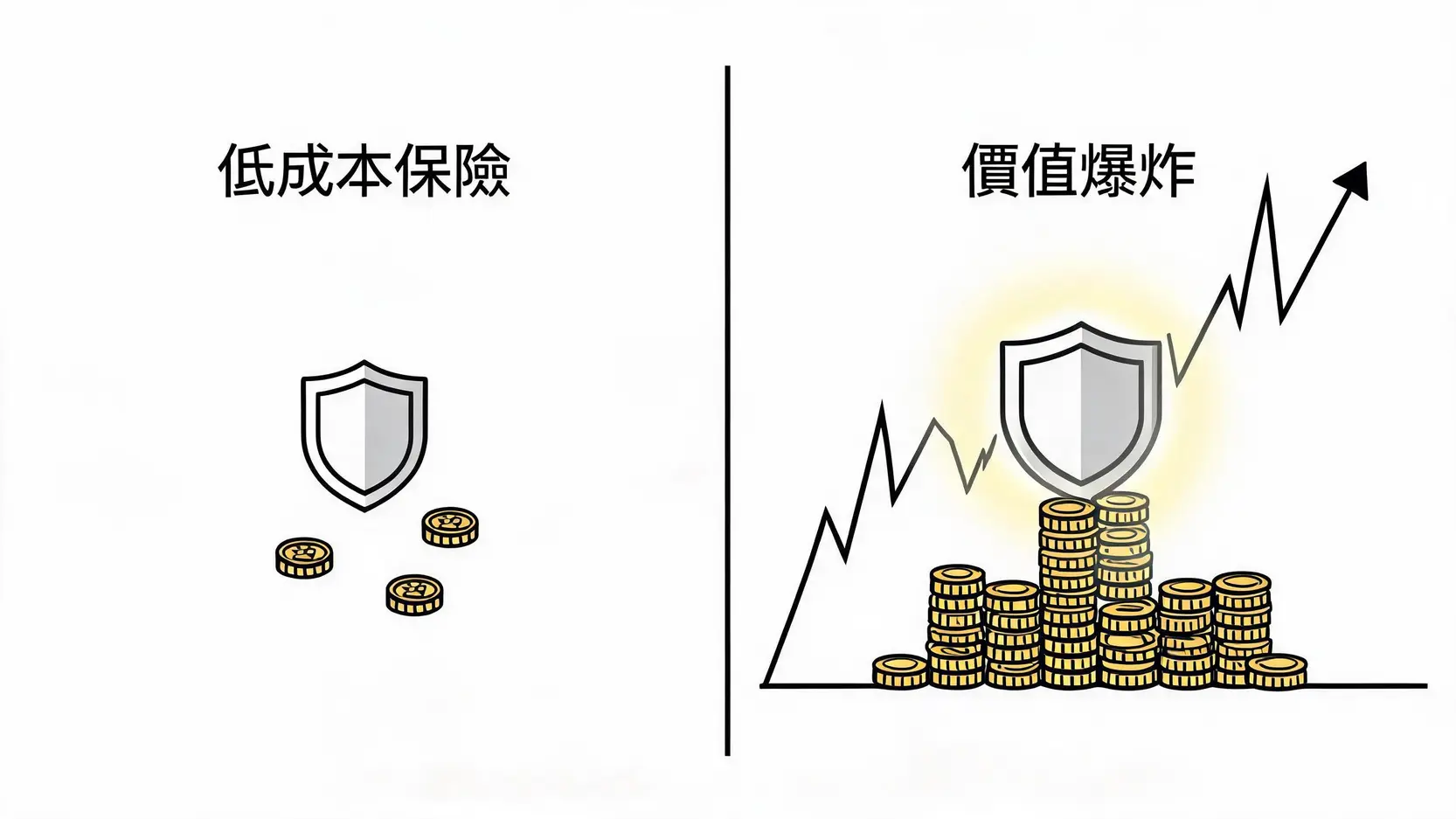
A practical approach is to regularly allocate a very small percentage of total capital, such as 1%, toward purchasing long-dated deep out-of-the-money put options expiring three to six months later. Under normal and optimistic market conditions, the premiums of these contracts are extremely cheap, functioning like catastrophe insurance for the portfolio. Once the market experiences extreme conditions, a sharp index decline combined with a violent expansion in implied volatility (IV) can cause these deep out-of-the-money contracts to increase geometrically in value, generating extraordinary profits and perfectly demonstrating the essence of options buyer strategies during extreme market conditions.

Deep Out-of-the-Money Puts: From Low-Cost Defense to Explosive Value Expansion
If you wish to further understand the basic mechanics of options contracts and additional practical combinations, it is recommended to carefully study How to Trade Options? Master Options Trading From 0 to 1 and the Four Major Strategies (2026 Beginner’s Guide), building a solid theoretical foundation for future advanced trading techniques.
Reverse Convergence Trading During Extreme Volatility Surface Skew
When panic sentiment reaches historical extremes, the options market reflects investor anxiety through an extremely steep “volatility surface” skew. In other words, market demand for downside protection through puts becomes far greater than demand for upside participation through calls, causing deep out-of-the-money puts to exhibit much higher implied volatility than equally distant out-of-the-money calls. This extreme pricing imbalance creates exceptional entry opportunities for cross-market arbitrage.
When the VIX fear index surges to extreme levels, such as above 40 or even 50, rational advanced traders recognize that such severe volatility panic cannot persist indefinitely. At this stage, in addition to pure options trading strategies, traders can also combine VIX-related futures instruments for hedging purposes. By referencing authoritative industry analyses such as How to Use Futures Contracts for Risk Management? VIX Futures Analysis, traders can learn how to utilize the mathematical tendency of volatility to revert toward the mean and execute reverse convergence trades. When market sentiment stabilizes slightly and implied volatility collapses sharply through an IV crush, precisely positioned short volatility trades can generate extremely substantial profits even if the underlying asset prices have not yet shown meaningful rebounds.
Exclusive Integrated Trading Strategy: Dynamic Arbitrage Using Friday Options and the VIX
After mastering the foundational logic of defense and counterattack, we now move to more advanced and refined practical techniques involving the optimal profit timing for options buyers during extreme market conditions. In particular, ahead of weekends when major global economic data releases or escalating geopolitical events intensify uncertainty, market hedging sentiment and fear often reach peak levels. During these periods, the dynamic interaction between Friday-expiring short-dated options and the VIX index becomes a powerful weapon capable of significantly enhancing trading performance.
Using Friday Contracts for Short-Term Vega Attacks Ahead of Major Data Releases
Major economic events such as monthly nonfarm payroll reports, CPI inflation data, or unexpected Federal Reserve interest rate decisions often trigger violent cross-market volatility. Before these events occur, market expectations continuously push up implied volatility in short-dated options contracts. By utilizing ultra-short-dated Friday options nearing expiration, investors can flexibly construct long straddle or long strangle volatility strategies.
Because these weekly contracts possess extremely high Gamma values, they are highly sensitive to even small price movements in the underlying asset. As long as the released data deviates significantly from market expectations and triggers a one-sided extreme market move, the price of one side of the options structure can surge sharply, easily offsetting the minimal cost of the opposite side expiring worthless. This represents a classic profit strategy utilizing ultra-short-term volatility explosions to conduct Vega attacks.

Using Straddle and Strangle Strategies to Capture One-Sided Explosive Moves Following Major Data Releases
After Extreme Market Conditions End, Quickly Transition From Buyer to Seller to Collect Elevated Premiums
Another defining characteristic of black swan events is that they “arrive quickly and disappear quickly”. Once panic sentiment has been fully released, central banks often intervene rapidly by injecting liquidity or implementing emergency monetary easing policies to stabilize market confidence. This critical turning point is a wealth redistribution signal that options traders must identify with precision.
After the most dangerous phase of extreme market conditions has passed, although prices may stop collapsing sharply, implied volatility often remains elevated. At this stage, traders should decisively shift their mindset from “buyer hedging” to “seller premium collection”. During the early stages of market stabilization, selling longer-dated or wider out-of-the-money options allows traders to collect heavily inflated premiums driven by lingering market fear. This flexible transition between offensive and defensive positioning, along with the ability to shift psychological frameworks accordingly, represents the highest level of cross-market arbitrage and long-term consistent profitability.
Further Reading (Highly Recommended)
Frequently Asked Questions About Options Buyer Strategies During Extreme Market Conditions
Can buying deep out-of-the-money options really generate profits during extreme market conditions?
Absolutely. During genuine extreme market conditions, the underlying asset price can experience irrational vertical collapses while implied volatility surges sharply at the same time. These two powerful forces create an extraordinary multiplier effect on deep out-of-the-money put options, causing contract prices to increase by dozens or even hundreds of times within an extremely short period. This is more than sufficient to offset the small insurance costs paid during normal periods while generating substantial positive cash flow for the investment portfolio.
Will options buyers suffer losses from volatility collapsing after volatility spikes sharply?
This is an extremely profound and professional question. Indeed, once market panic sentiment fades, volatility often experiences a rapid and aggressive collapse, which can be devastating for investors still holding long option positions. Therefore, the key to profiting from options buyer strategies during extreme market conditions lies in “taking profits when conditions are favorable and scaling out gradually”. When a black swan event occurs and volatility reaches its peak, traders must gradually lock in profits from highly profitable positions instead of greedily holding them for too long. In fact, once signals become sufficiently clear, traders should even consider reversing into short volatility seller positions.
What level of capital is required for this comprehensive strategy?
As a buyer-oriented defensive strategy, the capital threshold is actually highly accessible and flexible. We generally recommend that advanced investors allocate only 1% to 3% of total capital toward regularly purchasing long-dated deep out-of-the-money options as extreme market insurance. This is an amount that, even if it expires worthless during stable market conditions, will not damage the safety of the principal capital. However, when a black swan event strikes, the powerful protective effect it provides can save the entire core investment portfolio from severe damage.
What hidden risks exist when executing cross-market arbitrage strategies?
The greatest risks in practical cross-market arbitrage execution are “liquidity risk” and “margin call risk”. During extreme market conditions, bid-ask spreads for certain derivatives can widen dramatically as market makers pull back liquidity, and there may even be temporary periods where trades cannot be executed smoothly. In addition, if your arbitrage structure involves futures or short options positions, you must ensure that your account always maintains extremely sufficient available margin. Otherwise, before the market reverses at a critical turning point, poor capital management could result in the system forcibly liquidating your positions.
Conclusion
Although extreme market conditions are rare, they are the absolute key factor determining long-term account survival rates and compounded returns. By fully integrating overnight hedging concepts, stock-currency correlation warning signals, and options buyer strategies during extreme market conditions, you will no longer fear the harsh tests of black swan hedging. Instead, you will be able to patiently wait and capture substantial profits from periods of extreme market panic. Never wait until the storm arrives before searching for an umbrella. Reassess your investment portfolio now and make the most comprehensive preparations for future volatility surges and cross-market arbitrage opportunities.
Related Articles
-
Practical Applications of Volatility Surfaces: From Options Modeling to Advanced Skew Trading Strategies In options markets, implied volatility is never a flat line. Instead, it forms complex "smile" or "skew" surfaces. For advanced traders, mastering the practical applications of volatility surfaces is equivalent to possessing a lens that reveals market...2026 年 6 月 3 日
-
Building a Foreign Capital Flow Copy Trading Model: A Stock Market Indicator for Accurately Tracking Institutional Positioning In Asia-Pacific stock markets, foreign capital inflows and outflows often determine the direction of the index. However, simply looking at daily net buy and sell data is no longer enough. Only by building...2026 年 6 月 3 日
-
Understanding Sovereign Risk: A Complete Guide to Emerging Market External Debt Stress Rating Systems External Debt Stress Basics: Why Do Countries Need to Borrow From Abroad? Want to tap into the opportunities of emerging markets, but worried about stepping on a debt landmine? For investors seeking higher yields, the attractive...2026 年 5 月 26 日