CNH-CNY Arbitrage Guide 2026: Spread & Hedging

2026 Offshore Renminbi Range-Bound Arbitrage Trading Guide: Mastering the CNH-CNY Spread and a Profit Guide to Hedging Through Two-Way Volatility
Against the combined influence of global macroeconomic developments and international trade policies, the foreign exchange market in 2026 has become increasingly complex. The Renminbi exchange rate often exhibits a pattern of initial depreciation followed by stabilization. This two-way volatility not only tests the patience of market participants but also creates abundant profit opportunities. For experienced foreign exchange traders, the pricing gap between the onshore Renminbi (CNY) and offshore Renminbi (CNH) provides the ideal environment for executing offshore Renminbi range-bound arbitrage strategies. Mastering this advanced offshore Renminbi range-bound arbitrage approach not only allows traders to seek stable returns amid repeated exchange rate fluctuations, but also enables them to apply disciplined spread hedging techniques to effectively manage the uncertainty created by two-way Renminbi volatility.
This article takes the perspective of an experienced investor to break down the practical methods used by institutional market participants, helping you understand the liquidity dynamics behind CNH and CNY while providing a step-by-step guide to achieving consistent profitability in the 2026 foreign exchange market.
In-Depth Analysis of the Mechanisms Behind Onshore and Offshore Renminbi Spreads
Why does the same currency have two different prices in the foreign exchange market? To understand the core of offshore Renminbi range-bound arbitrage, one must first understand the fundamental sources of the spread between onshore Renminbi (CNY) and offshore Renminbi (CNH). This is not merely a quotation difference, but the result of interaction between two fundamentally different market structures.
Liquidity and Regulatory Differences Between CNH and CNY
The onshore market (CNY) operates primarily within mainland China and is subject to strict capital controls and daily central parity guidance by the People’s Bank of China (PBOC). Market participants are mainly domestic import-export enterprises and major commercial banks, creating a strong connection to the real economy. As a result, onshore Renminbi movements tend to be relatively stable, heavily influenced by policy direction, and often serve as an anchor for exchange rate stability.
In contrast, the offshore market (CNH, primarily centered in Hong Kong but also covering Singapore, London, and other financial centers) operates in a highly market-driven environment. Capital can move freely without restrictions, and exchange rates are determined entirely by international supply and demand dynamics. When international capital reacts to China’s economic outlook, global monetary easing policies, or geopolitical developments, CNH often experiences sharp price fluctuations before CNY does. This unique “one country, two currencies” structure means that during unexpected events, the offshore market reacts faster and more aggressively than the onshore market, creating significant pricing divergences. This serves as the strongest foundation for spread hedging and arbitrage opportunities.
Comparison of Onshore and Offshore Market Characteristics
The Three Major Macroeconomic Catalysts Behind Spread Expansion
In the market environment of 2026, experienced traders closely monitor the following three macroeconomic catalysts because they are the primary drivers of rapid spread expansion and two-way Renminbi volatility:
- US-China Interest Rate Differentials and Monetary Policy Divergence: When the monetary policy paths of the Federal Reserve (Fed) and the People’s Bank of China diverge significantly (such as one pursuing monetary easing while the other maintains high interest rates), yield-seeking capital flows are rapidly reflected in the offshore market. This may place pressure on CNH or drive rapid appreciation, widening the spread relative to CNY.
- Global Geopolitical Developments and Tariff Barriers: The resurgence of trade wars or changes in tariff policies often directly impact risk sentiment in international foreign exchange markets. During such periods, offshore Renminbi serves as a hedging vehicle for international capital and tends to experience significant range-bound volatility.
- Chinese Economic Data and Liquidity Management: When key macroeconomic indicators (such as PMI data or import-export growth figures are released) or when the central bank tightens offshore Renminbi liquidity by issuing offshore central bank bills in Hong Kong, market supply and demand can become temporarily imbalanced, often creating ideal arbitrage entry opportunities.
Further Reading (Highly Recommended)
Complete Guide to CNY vs CNH: Understanding the Onshore and Offshore Renminbi Spread
Building a High-Probability Offshore Renminbi Range-Bound Arbitrage Model
After fully understanding the underlying causes of the spread, the next step is disciplined practical execution. In an environment where two-way Renminbi volatility has become the norm, accurately identifying optimal entry and exit opportunities is essential. Building a stable and mathematically sound range-bound arbitrage model is the key to success.
Defining Volatility Support and Resistance Ranges
The first step in range-bound arbitrage is defining an effective exchange rate trading range through technical analysis and long-term historical backtesting. In the 2026 foreign exchange market, investors can closely monitor the relationship between the US Dollar Index (DXY) and the daily Renminbi central parity rate while using Bollinger Bands or standard deviation models to identify extreme upper and lower price boundaries.
In practice, when the spread between CNH and CNY expands abnormally to between 300 and 500 basis points (pips), it enters the range monitored by institutional traders. Experienced traders then evaluate whether market sentiment has become excessively overbought or oversold. If the analysis suggests that the move reflects short-term liquidity pressure or emotional reactions rather than a fundamental long-term trend reversal, it may represent a high-probability arbitrage opportunity.
Applying Grid Trading Strategies to Buy Low and Sell High
After identifying solid support and resistance zones, entering a position with a full allocation (all-in) often comes with drawdown risks that may be difficult to withstand. At this point, incorporating a “grid trading strategy” is an extremely practical and highly defensive approach for executing forex arbitrage.
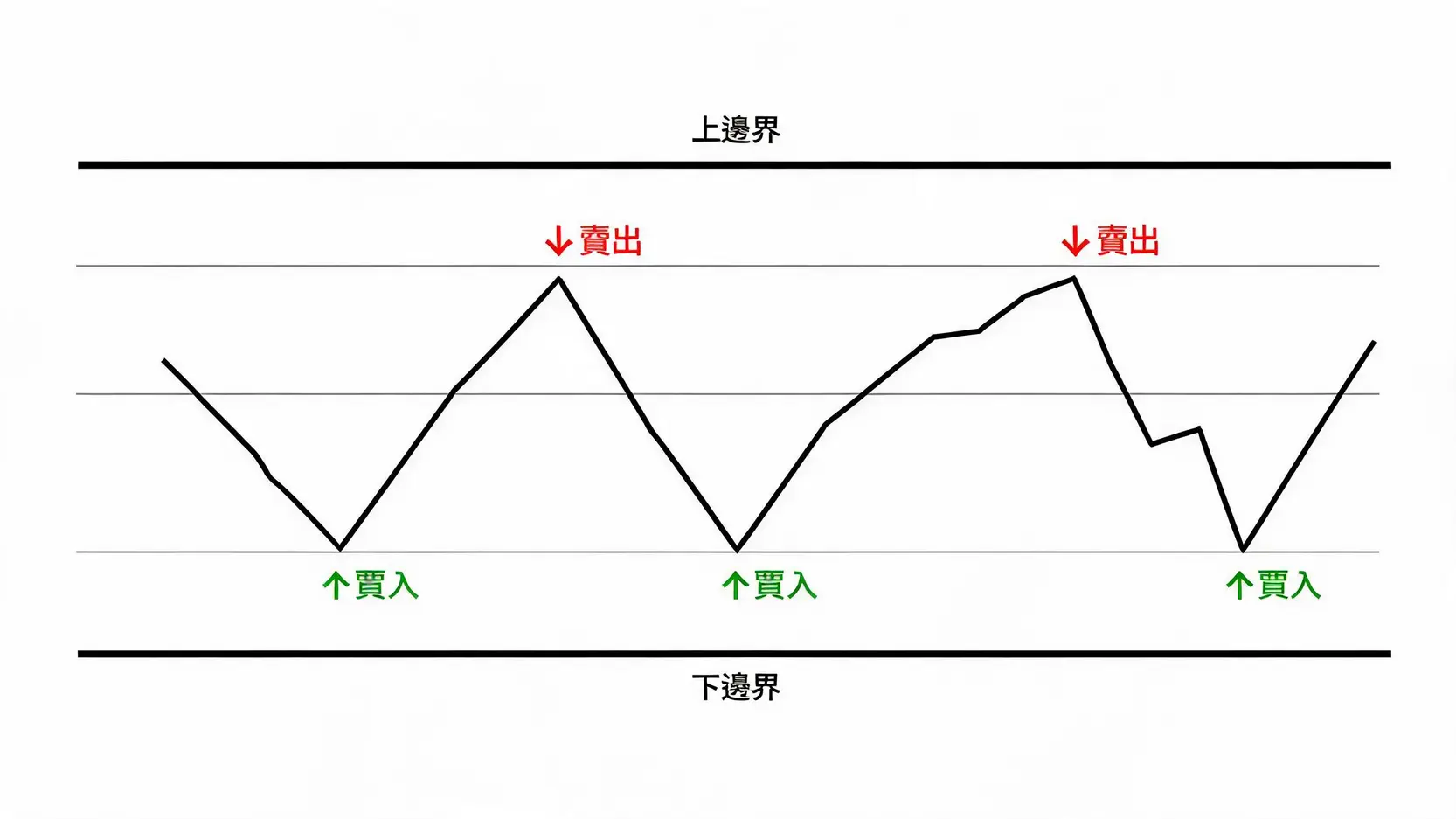
The core concept of grid trading is disciplined capital allocation through staggered entries. Assume that the offshore Renminbi exchange rate fluctuates actively between 7.1500 and 7.2500. As the spread gradually widens, traders may establish small arbitrage positions mechanically at predetermined intervals (such as every additional 50 points of spread expansion). As the spread converges as expected, positions are closed sequentially for profit. This approach aligns perfectly with the two-way volatility characteristics of offshore Renminbi. Because prices rarely move indefinitely in one direction within a range-bound market and are typically accompanied by technical corrections, grid trading allows investors to continuously harvest spread profits without needing to predict exact market tops or bottoms.

Illustration of a Grid Trading Strategy in a Range-Bound Market Environment
Defensive Strategies: Building Effective Extreme-Event Spread Hedging Mechanisms
Financial markets are always filled with uncertainty and black swan events. During rare extreme events, what was expected to be a healthy range-bound environment can suddenly transform into an uncontrolled directional breakout. Therefore, constructing a comprehensive spread hedging mechanism serves as the final line of defense for preserving capital.
Managing Crises When the Spread Exceeds 1,000 Points
Historical market experience shows that during periods of extreme panic or major policy shifts, the spread between CNH and CNY can rise irrationally and has at times exceeded 1,000 basis points. In such situations, traders holding large opposing arbitrage positions without protection may face severe margin calls and substantial unrealized losses.
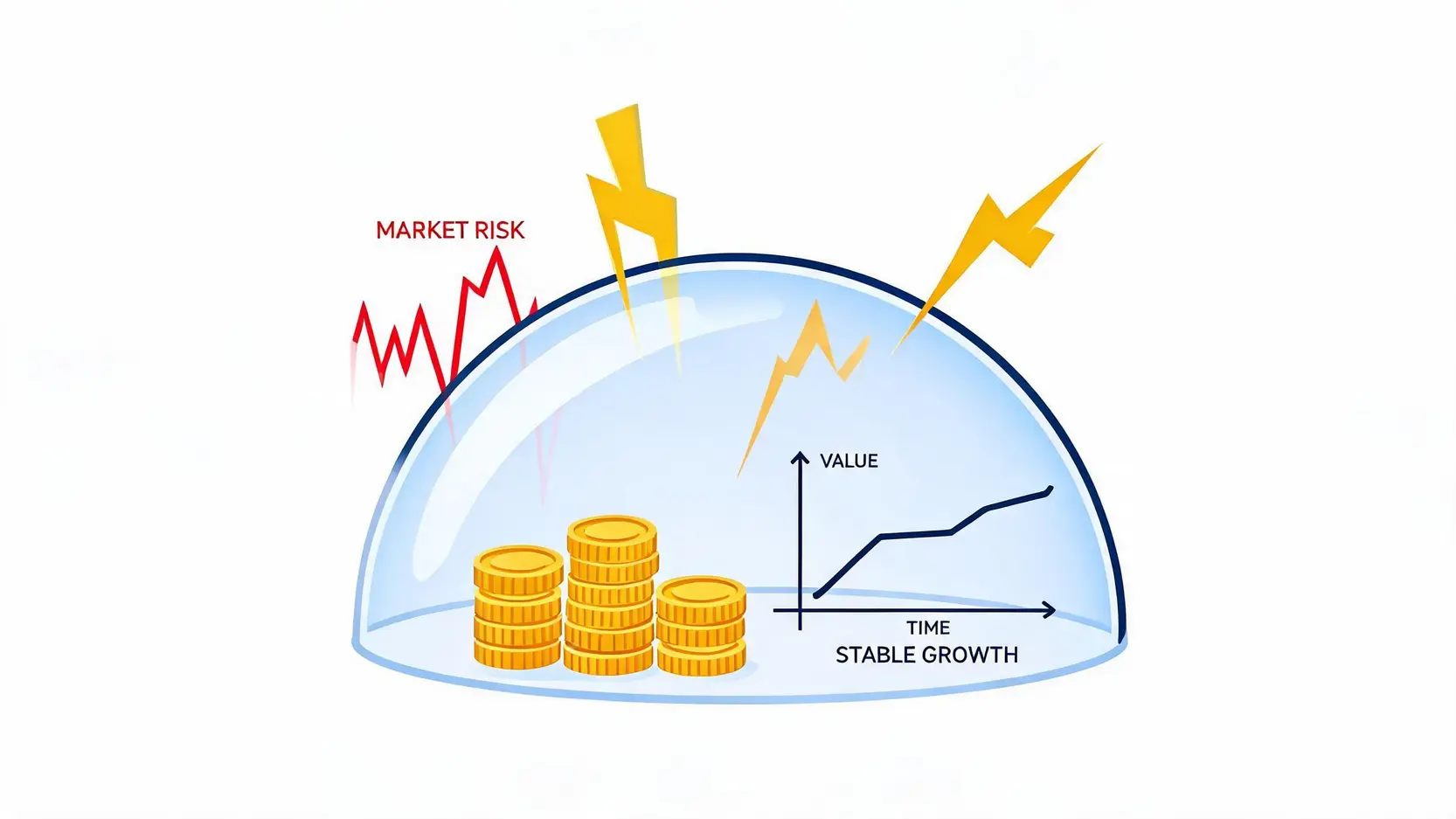
In practice, strict capital management and stop-loss mechanisms are absolutely essential. When the spread decisively breaks above the maximum threshold defined by the arbitrage model, traders must aggressively reduce risk or activate protection through derivatives such as options. For example, purchasing deep out-of-the-money currency options as portfolio insurance can provide substantial protection. If an extreme one-way market move occurs, the explosive gains from the options position can significantly offset losses from spot arbitrage positions. This is one of the key reasons professional institutions can successfully execute offshore Renminbi range-bound arbitrage over the long term.

Risk Hedging Protection Mechanisms During Extreme Market Volatility
Using Non-Deliverable Forward Contracts (NDFs) to Lock in Arbitrage Profits
Beyond options, Non-Deliverable Forwards (NDFs) represent one of the most powerful tools available to institutions for managing two-way volatility. Because onshore Renminbi remains subject to strict capital controls, foreign corporations and offshore institutional investors cannot easily conduct large-scale spot market hedging within mainland China. In such situations, NDFs, which trade entirely in offshore markets and settle in US dollars through cash differences, become an irreplaceable investment instrument.
By trading NDF contracts, investors can lock in future exchange rates at a specific point in time. When highly attractive spreads emerge between onshore and offshore Renminbi markets, investors can simultaneously establish offsetting NDF positions in the forward market to eliminate future exchange rate exposure. This not only significantly improves capital efficiency but also transforms what would otherwise be directional speculation into genuine low-risk or near risk-free arbitrage.
Recent authoritative market coverage, including reports from Economic Daily News indicating that both offshore and onshore Renminbi exchange rates have strengthened simultaneously with accelerating appreciation, further demonstrates that under certain macroeconomic conditions, Renminbi exchange rates can display strong resilience and linkage effects. This reinforces the importance of foreign exchange traders monitoring both markets simultaneously.
Further Reading (Highly Recommended)
Frequently Asked Questions: Offshore Renminbi Two-Way Volatility Arbitrage FAQ
Q: Can ordinary retail investors personally execute risk-free arbitrage between offshore and onshore Renminbi markets?
A: In theory, the logic is the same, but in practice, execution is extremely difficult. Onshore Renminbi (CNY) is subject to strict cross-border capital controls, making it difficult for overseas retail investors to freely open domestic bank accounts and conduct large-scale real-time fund transfers. Most retail investors and independent traders typically focus on two-way volatility trading within the offshore Renminbi (CNH) market through regulated foreign exchange margin trading platforms, or indirectly participate in spread hedging strategies through exchange rate ETFs and related derivatives.
Q: What is the biggest potential risk of a range-bound arbitrage strategy?
A: The most critical risk of this strategy is a “genuine breakout from the trading range”. When structural changes occur in the global macroeconomic and political environment (such as the outbreak of a major geopolitical conflict or the implementation of unexpectedly aggressive monetary easing policies by major central banks) exchange rates may completely break out of their previous equilibrium range and develop into a powerful one-way trend. If arbitrage traders fail to establish strict stop-loss levels or lack effective options hedging mechanisms, they may face substantial unrealized losses or even the risk of liquidation.
Q: How can investors accurately track the real-time impact of the US Dollar Index on Renminbi spreads?
A: The US Dollar Index (DXY) has always served as a key benchmark and directional indicator for the global foreign exchange market. Investors can monitor DXY movements in real time through professional financial terminals (such as Bloomberg and Reuters) or through major financial information websites. As a general rule, when the US Dollar Index rises strongly due to safe-haven demand or expectations of higher interest rates, the more market-driven offshore Renminbi typically depreciates first, rapidly widening the spread relative to the regulated onshore market. The opposite is also true. Overlaying DXY price charts with CNH/CNY spread charts for detailed comparative analysis is a standard operating procedure used by experienced traders to identify high-probability entry opportunities.
Q: Is grid trading still suitable in the volatile foreign exchange environment of 2026?
A: Absolutely. In fact, it may be more effective than ever. The reason is that the 2026 market environment is filled with complex policy variables and conflicting bullish and bearish expectations, making it difficult for exchange rates to sustain long-term one-way trends. Instead, short-term sharp fluctuations and repeated market reversals have become increasingly common. These characteristics of a clearly two-way volatility market create the ideal environment for grid trading strategies to capitalize on their “buy low, sell high” advantages. As long as investors remain disciplined and properly manage overall capital allocation and grid density, they can steadily accumulate meaningful returns amid market volatility.
Conclusion: Finding Stable Spread Returns Amid Two-Way Renminbi Volatility
In summary, successfully executing offshore Renminbi range-bound arbitrage over the long term requires not only a high degree of sensitivity to global macroeconomic developments and central bank policy boundaries, but also trading discipline as precise and consistent as a machine. The recurring expansion and convergence of spreads between onshore and offshore Renminbi vividly reflect the ongoing struggle between market greed and fear, as well as the powerful forces of cross-border liquidity flows.
As professional foreign exchange investors pursuing absolute returns, we should not fear market volatility. Instead, we should view every episode of two-way volatility as a valuable source of profit opportunities. By defining precise and statistically meaningful trading ranges, applying grid trading strategies in a flexible yet disciplined manner, and decisively activating powerful defensive mechanisms such as spread hedging and forward foreign exchange contracts when extreme market conditions threaten, you can confidently unlock your own profit formula within the unpredictable two-way volatility environment of 2026 and achieve steady asset growth under controlled risk conditions.
Related Articles
-
Complete Guide to Virtual Asset Trading Platform (VASP) License Applications: A 2026 Hong Kong Web3 Compliance Practical Guide At the pivotal moment of 2026, as global financial digitization accelerates at an unprecedented pace, Hong Kong has firmly established itself as a leading Web3 compliance hub in Asia and around the...2026 年 6 月 3 日
-
Friday Taiwan Index Options Buyer Strategies: Precisely Capturing Explosive Market Moves From Non-Farm Payroll Data Many investors often complain that options buyers have low win rates, frequently predicting the direction correctly but ultimately losing to time decay. However, under the new dual-settlement system, short-term volatility and event-driven trading have created...2026 年 6 月 3 日
-
Practical Stock-Currency Linked Hedging Portfolio Strategies: The Perfect Asset Allocation Approach to Defend Against a "Triple Selloff" in Stocks, Bonds, and Currencies When global financial markets face dramatic macroeconomic turning points, traditional single-market hedging tools are no longer capable of handling systemic collapses. Looking back at capital markets since 2026,...2026 年 6 月 3 日