Bitcoin Options Guide: Calls, Puts & BTC Strategies

Updated: 2026/05/08  |  CashbackIsland

btc-options-trading-guide

Bitcoin Options Beginner Guide: BTC Options Tutorial, Understand the Differences Between Call and Put Options and 4 Major Trading Strategies in One Article

Want to profit from Bitcoin (BTC) price volatility but feel that futures trading carries too much risk? Then Bitcoin options may be the more flexible and risk-controlled alternative you are looking for. However, many beginners feel overwhelmed when they first encounter terms like Call, Put, strike price, and premium. This BTC options tutorial will explain everything in the simplest way possible, guiding you from zero to fully understanding the differences between Call and Put options, while also providing detailed order placement steps and practical beginner strategies to help you confidently take your first step into Bitcoin options trading and learn how to navigate market volatility more intelligently. 


What Are Bitcoin Options (BTC Options)? How Are They Different From Futures Contracts?

Bitcoin options are financial derivatives contracts that give the buyer the “right”, but not the “obligation”, to buy or sell a specified amount of Bitcoin at a predetermined price (strike price) on a future date (expiration date). Simply put, you can think of them as a type of “crypto insurance” or a “reservation ticket” for future prices. You pay a relatively small amount of money (premium) to secure a future trading opportunity.


Three Core Elements: Premium, Strike Price, and Expiration Date

To understand BTC options, you must first master these three core elements:

  • Premium: This is the fee paid by the buyer to the seller in exchange for obtaining the option “right.” Whether the option is exercised or not, this fee is non-refundable. It is similar to an insurance premium.
  • Strike Price: This is the agreed price at which you can buy or sell Bitcoin in the future. This price is fixed and does not fluctuate with market prices.
  • Expiration Date: This is the validity period of the options contract. Once this date passes, the contract expires and your rights disappear.


Options vs. Futures: Buying Rights Instead of Obligations, With More Controlled Risk

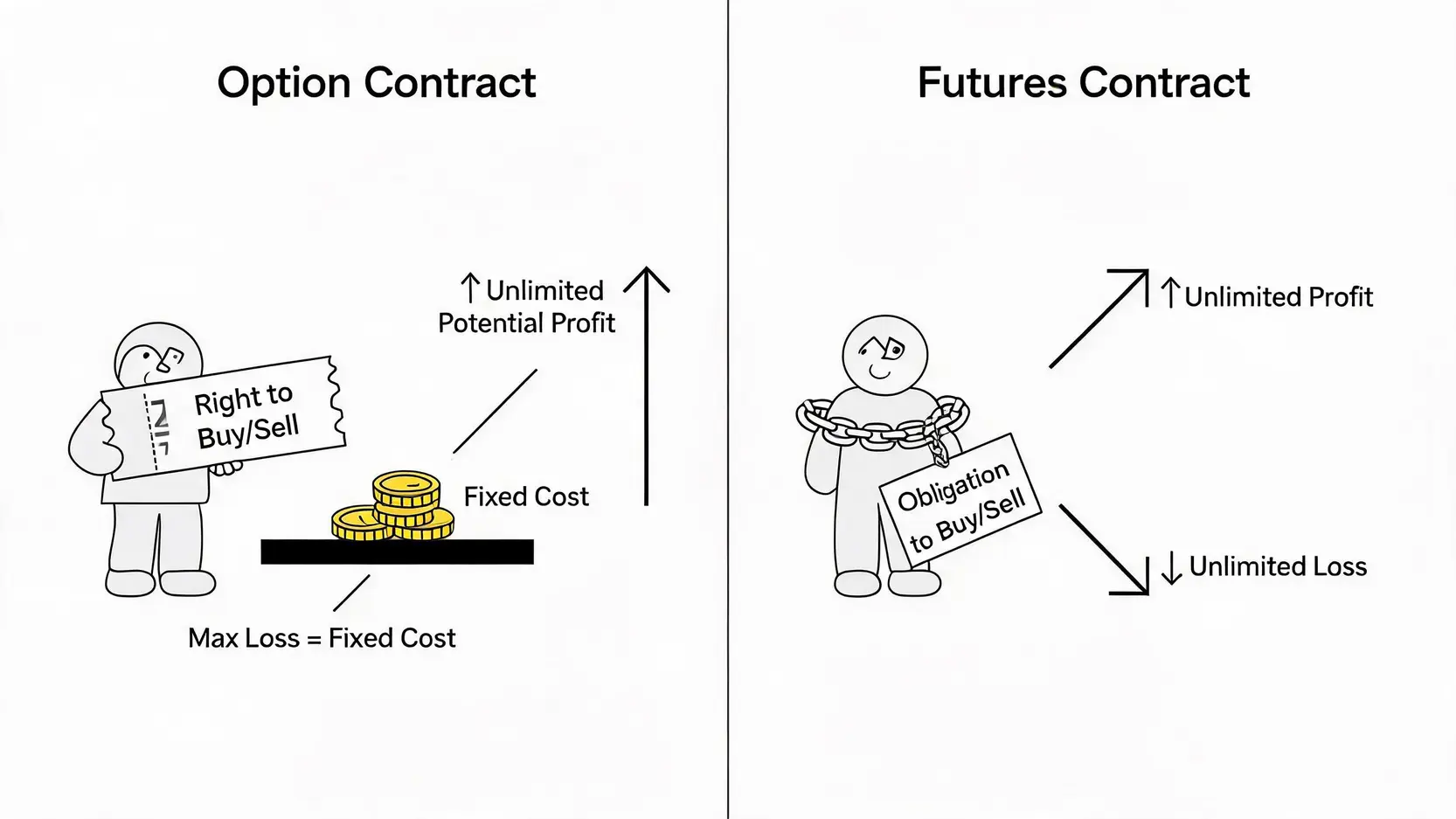
Many beginners confuse options with futures, but they are fundamentally different. Bitcoin futures contracts represent an “obligation”. Regardless of market movement, both buyers and sellers “must” complete the transaction at the agreed price upon expiration. This means losses can theoretically be unlimited if the market moves against your expectations.

In contrast, Bitcoin option buyers only have a “right”. If the market moves in your favor, you may choose to exercise the option for profit. If the market moves against you, your maximum loss is limited to the premium paid upfront. This characteristic of “limited downside with unlimited upside” is one of the greatest attractions of options trading for investors.

比特幣期權與期貨合約的核心區別對比圖,顯示期權是權利而期貨是義務。

The biggest difference between Options and Futures lies in “rights” versus “obligations”. For option buyers, losses are limited to the premium paid.


Further Reading (Highly Recommended)

【Bitcoin short-selling tutorial】Complete guide to 5 ways to short Bitcoin

Arbitrage trading strategy guide: 5 major arbitrage opportunities and core formulas explained


What Are the Differences Between Call and Put Options? Understand the Core Differences at a Glance

After understanding the basic concepts of options, the next and most important step is understanding the difference between Call options and Put options. This is the core of all BTC options education and the key factor determining your trading direction.

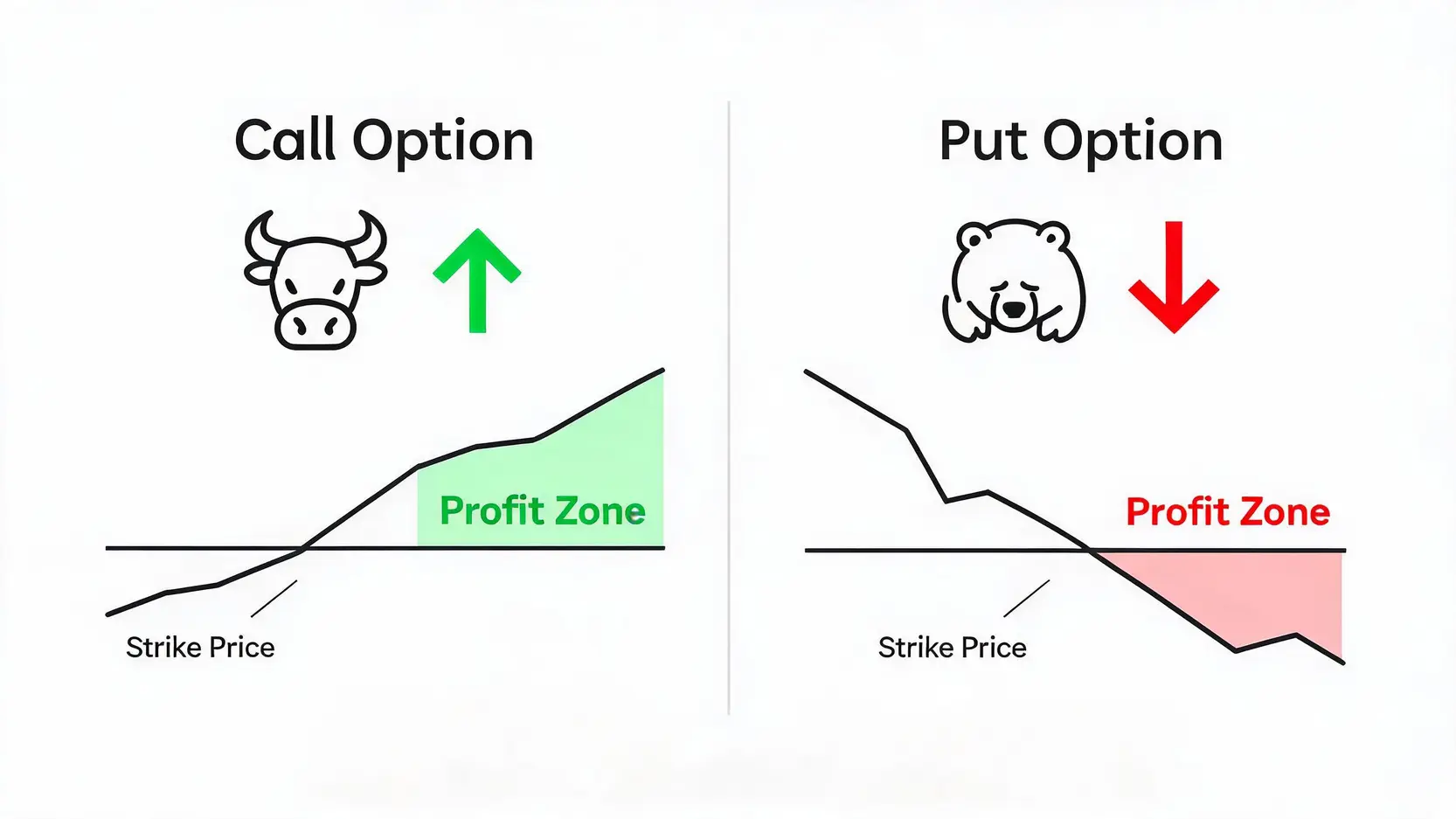
看漲期權(Call)與看跌期權(Put)的核心概念示意圖。

Understand at a glance: Buy Call Options when expecting prices to rise, buy Put Options when expecting prices to fall.


Call Option: When You Expect BTC Prices to Rise

A Call Option gives the holder the right to “buy” Bitcoin at a specified strike price in the future. When you strongly believe Bitcoin prices will rise significantly, you can buy a Call Option. If the future market price of BTC rises above your strike price, you can buy BTC at the lower strike price and sell it at the higher market price to profit from the difference.

Example: You believe BTC, currently priced at $60,000, will rise in the future. You pay a $1,000 premium to purchase a one-month Call Option with a strike price of $65,000. One month later, if BTC rises to $70,000, you can exercise the option, buy BTC at $65,000, and sell it in the market for $70,000, generating a $5,000 profit. After deducting the premium cost, your net profit is $4,000. If BTC does not rise above $65,000, you can simply choose not to exercise the option, limiting your maximum loss to the $1,000 premium.


Put Option: When You Expect BTC Prices to Fall

A Put Option works in the opposite way. It gives the holder the right to “sell” Bitcoin at a specified strike price in the future. If you believe Bitcoin prices are about to decline, or if you want to hedge the BTC you already hold, you can buy a Put Option. If BTC prices fall below your strike price, you can still sell BTC at the higher strike price, locking in profits or minimizing losses.

Example: You currently hold BTC and are worried the price may fall from $60,000. You pay an $800 premium to buy a one-month Put Option with a strike price of $58,000. One month later, if BTC crashes to $50,000, you can exercise the option and sell your BTC at $58,000, successfully avoiding a potential $8,000 loss. This is an excellent example of hedging.


Buyer (Long) vs. Seller (Short): Four Basic Position Types and Profit/Loss Analysis

In the options market, you can act not only as a “buyer” (Long/Buy), but also as a “seller” (Short/Sell), meaning you sell options to others and earn premiums. This creates four basic trading structures, each with completely different risk and reward profiles:

Position Type Market Expectation Maximum Profit Maximum Loss

Suitable Scenario

Long Call Expecting a strong price increase Unlimited Premium paid Using small capital to capture a major upside move, expecting a strong bullish trend
Short Call Expecting sideways movement or a price decline Premium received Unlimited Believing the price has limited upside and aiming to profit from time value decay
Long Put Expecting a sharp price decline Strike price – premium Premium paid Expecting a bearish trend or hedging spot holdings
Short Put Expecting sideways movement or a price increase Premium received Strike price – premium Believing the downside is limited and willing to accumulate at lower prices

For beginners, it is recommended to start with the relatively lower-risk “buyer” side strategies (Long Call or Long Put), because your maximum loss is locked in from the beginning, without additional liquidation risk.


BTC Options Tutorial: 5 Steps for Beginners to Complete Their First Trade

Now that you understand the theory, let’s move into practical execution. Below are the detailed steps for beginners to complete their first Bitcoin options trade and successfully start their Bitcoin options journey

Step 1: Choose a Secure Bitcoin Options Exchange

Options trading requires strong liquidity and exchange stability. The current mainstream platforms offering Bitcoin options trading include:

  • Deribit: The world’s largest cryptocurrency options exchange with the best liquidity, preferred by professional traders.
  • OKX: A fully featured platform offering unified accounts, allowing users to move capital conveniently across products.
  • Binance: The world’s largest spot exchange, offering relatively simple options products suitable for beginners.

Choosing a reputable platform with a user-friendly interface is the first step toward successful trading.


Step 2: How to Read an Option Chain Interface?

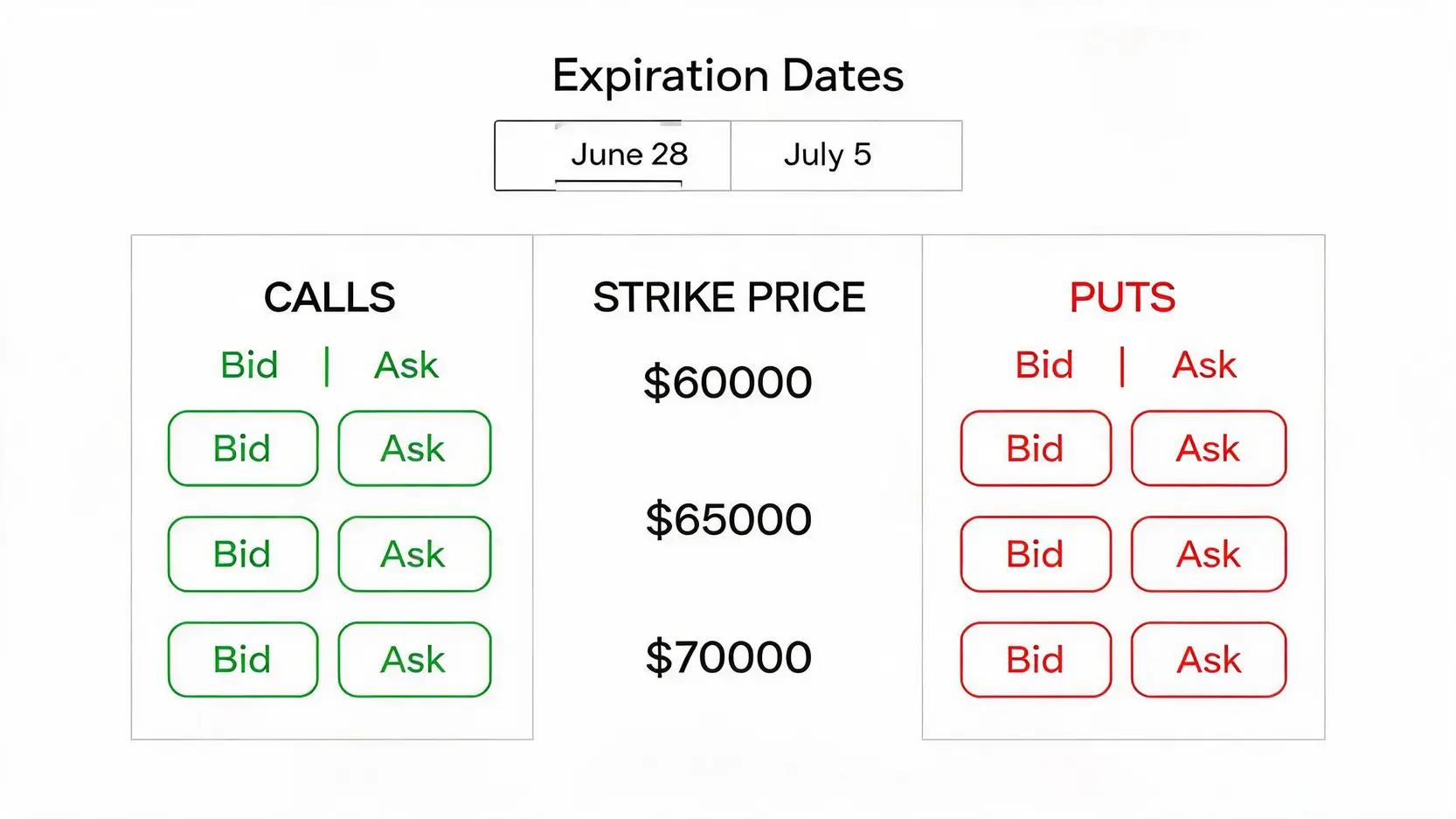
After entering the options section of an exchange, you will see a quotation table called the “Option Chain”. Although it may appear complicated at first, its structure is actually very clear.

比特幣期權鏈報價介面示意圖,展示履約價、看漲期權和看跌期權的佈局。

Simplified option chain interface: strike prices are shown in the center, Calls on the left, and Puts on the right.

  • Middle column: Usually displays the “Strike Price”, arranged vertically.
  • Left section: Displays data for “Call Options”, including bid price, ask price, trading volume, and more.
  • Right section: Displays data for “Put Options”.
  • Top tabs: Allow switching between different expiration dates.

Learning how to quickly identify the contract you want from the option chain is a fundamental skill.


Step 3: Select Expiration Date and Strike Price

This is the core of your strategy. Your choices should be based on your market outlook:

  • Expiration Date: How long do you think it will take for the market move to occur? Short-term options (such as weekly options) have cheaper premiums but faster time decay, while long-term options (such as quarterly options) are more expensive but provide the market with more time to move.
  • Strike Price: Where do you think the price will rise or fall to? “At-the-money” options (close to market price) are more sensitive to price movements, while “out-of-the-money” options (far from market price) are cheaper and offer greater leverage potential, but also carry a higher risk of expiring worthless.


Step 4: Enter Premium and Quantity, Then Execute the Order

After selecting a contract, click on it to open the trading window. You will need to enter:

  1. Price: The premium price you are willing to pay.
  2. Quantity: The number of option contracts you want to buy.

After confirming all details are correct, click “Buy” or “Sell” to submit the order.


Step 5: Set Take-Profit and Stop-Loss Levels to Manage Position Risk

Although buying options carries limited risk, proper risk management remains important. After the order is executed, you should consider:

  • Take Profit: If the premium doubles as prices rise, should you partially close the position to lock in profits?
  • Stop Loss: If the market moves completely against your expectations, should you close the position early while the premium still retains some value instead of waiting for it to expire worthless?

Always monitor your positions and adjust according to market conditions.


Four Bitcoin Options Strategies for Beginners

For beginners, there is no need to pursue complicated combinations. Starting with the following four basic Bitcoin options strategies is a more stable approach. 

Long Call: High Potential Return With Small Capital

This is the most straightforward bullish strategy. If you believe Bitcoin will experience a strong upward move in the short term, you can buy an out-of-the-money Call Option. Since out-of-the-money options are relatively cheap, if your directional prediction is correct and BTC surges sharply, the premium return can reach several hundred or even thousands of percent, achieving significant leverage with small capital.


Long Put: Insurance for Spot Holdings

If you are a long-term Bitcoin holder (HODLer) but are concerned about a short-term correction or black swan event, buying a Put Option is an ideal insurance strategy. By spending a relatively small premium, you can protect your large spot holdings against downside risk. Even if prices crash, losses in your spot holdings can be offset by profits from the Put Option.


Covered Call: Generate Additional Premium Income While Holding Spot Assets

This is one of the most popular income-generating strategies. If you already hold Bitcoin spot assets but expect prices to remain range-bound rather than surge significantly in the short term, you can sell a Call Option with a strike price above the current market price. In doing so, you immediately receive premium income. As long as BTC prices do not rise above the strike price at expiration, you keep the premium as extra cash flow generated from your holdings.


Protective Put: A Defensive Strategy During Bear Markets

This strategy follows the same logic as “insurance for spot holdings”, involving simultaneously holding Bitcoin spot assets and buying a Put Option. Its main objective is to lock in the minimum value of your assets during bear markets or periods of high uncertainty. It establishes a clear “floor price” for your portfolio, allowing you to navigate market volatility with greater peace of mind.


Bitcoin Options Beginner FAQ

Q: Are Bitcoin options high risk?

A: The level of risk depends on your role. As a “buyer” (Long Call/Put), your maximum risk is limited to the premium you paid, with no liquidation risk. However, as a “seller” (Short Call/Put), your potential losses can be unlimited (especially when selling Call options). This requires extremely strict risk management and is not recommended for beginners.

Q: What is the minimum amount of capital required for options trading?

A: The entry barrier for options trading can be very low. The value of an options contract depends on its premium. For some deeply out-of-the-money long-dated contracts, the premium may cost only a few US dollars or even less. This allows beginners to learn and experience options trading with a very small amount of capital.

Q: After buying an option, do I have to wait until expiration to close the position?

A: Not at all. Just like stocks, options can be sold and closed at any time before expiration during trading hours. When the premium price rises and reaches your profit target, you can sell early to lock in profits. Conversely, if your market outlook turns out to be wrong, you can also exit early to reduce losses.

Q: How is the option premium determined?

A: The premium is mainly composed of two parts: “intrinsic value” and “time value”. Intrinsic value depends on the difference between the strike price and the current market price, while time value is influenced by factors such as the remaining time until expiration and market volatility. The longer the time until expiration and the greater the market volatility, the more expensive the premium (time value) usually becomes.


Conclusion

In summary, Bitcoin options provide a highly flexible derivatives tool with relatively controllable risk. Whether you want to amplify returns during strong market trends or protect existing holdings from downside risk, options can serve a valuable purpose. By understanding the core differences between Calls and Puts, along with the basic order process and beginner strategies, even new traders can begin using options for more refined trading approaches. This BTC options tutorial provides a clear introduction to help you get started. Now choose a reliable exchange, begin with a small amount of capital, and start your first Bitcoin options trade!

If you liked this article, please share it!

Related Articles

  • Volatility Surface Guide: Skew Trading Strategies
    Practical Applications of Volatility Surfaces: From Options Modeling to Advanced Skew Trading Strategies In options markets, implied volatility is never a flat line. Instead, it forms complex "smile" or "skew" surfaces. For advanced traders, mastering the practical applications of volatility surfaces is equivalent to possessing a lens that reveals market...
    2026 年 6 月 3 日
  • Foreign Capital Flow Model: Track Institutional Money
    Building a Foreign Capital Flow Copy Trading Model: A Stock Market Indicator for Accurately Tracking Institutional Positioning In Asia-Pacific stock markets, foreign capital inflows and outflows often determine the direction of the index. However, simply looking at daily net buy and sell data is no longer enough. Only by building...
    2026 年 6 月 3 日
  • Options Buying Strategies for Extreme Market Risks
    Options Buyer Strategies During Extreme Market Conditions: Black Swan Hedging and Cross-Market Arbitrage During Volatility Surges The most terrifying aspect of financial markets is not a gradual decline, but overnight flash crashes and cross-market capital withdrawals accompanied by volatility surges. In the highly unpredictable global macroeconomic environment of 2026, geopolitical...
    2026 年 6 月 3 日
返回顶部