[Bitcoin Short Selling Tutorial] A Complete Guide to 5 Ways to Short Bitcoin | Recommended Best Cryptocurrency Short Selling Platforms
As you watch the price of Bitcoin continue to decline, do you feel anxious, believing that in a bear market you can only suffer losses? In fact, market downturns also contain profit opportunities. This article will provide a detailed breakdown of the complete process of short selling Bitcoin, teaching you how to short Bitcoin and offering an in-depth comparison of major cryptocurrency short selling platforms, enabling you to find strategies to turn the tide in a declining market and convert market volatility into potential gains. Whether you are seeking to hedge spot risk or searching for a profit formula in a bear market, this guide will be your essential handbook.
What Is Bitcoin Short Selling? Why Learn to Short Bitcoin in a Bear Market?
Bitcoin short selling, also known as going short, is an investment strategy based on the expectation that an asset’s price will decline. Unlike the traditional “buy low, sell high”, the core of short selling is “sell high, buy low”, generating profit from price declines. In the highly volatile cryptocurrency market, especially during bear market phases, learning how to short Bitcoin is not only a defensive measure but also a proactive profit seeking technique.
The Basic Principle of Short Selling: Borrow First, Sell, Then Buy Back at a Lower Price
The mechanics of short selling may sound complex, but in essence they can be simplified into the following four steps:
Borrow the asset: First, you borrow the Bitcoin you intend to short from an exchange or broker.
Sell the asset: Next, you sell the borrowed Bitcoin at the current market high price in exchange for cash.
Wait for the price to decline: When the timing is right and the Bitcoin price falls as expected.
Buy back and return: You purchase the same amount of Bitcoin from the market at a lower price and return it to the lender.
Illustration of the Four Steps of Short Selling: Borrow First, Sell, Profit From the Downward Price Difference.
The price difference in between, after deducting trading fees and borrowing interest, constitutes your profit. For example, suppose you borrow 1 BTC and sell it when the price is $50,000, receiving $50,000. When the price falls to $40,000, you spend $40,000 to buy back 1 BTC and return it. In doing so, you successfully earn a profit of $10,000 from the price difference.
The 3 Main Timing Opportunities for Shorting Bitcoin: Hedging, Bear Market Profit, and Arbitrage Strategies
Learning to short Bitcoin allows investors to respond flexibly under different market conditions. The main application scenarios include:
Bear market profit: This is the most direct motivation. When the macroeconomic environment deteriorates, market sentiment turns pessimistic, or major negative news emerges, and Bitcoin is expected to continue declining, short selling enables you to earn returns directly from the downward movement.
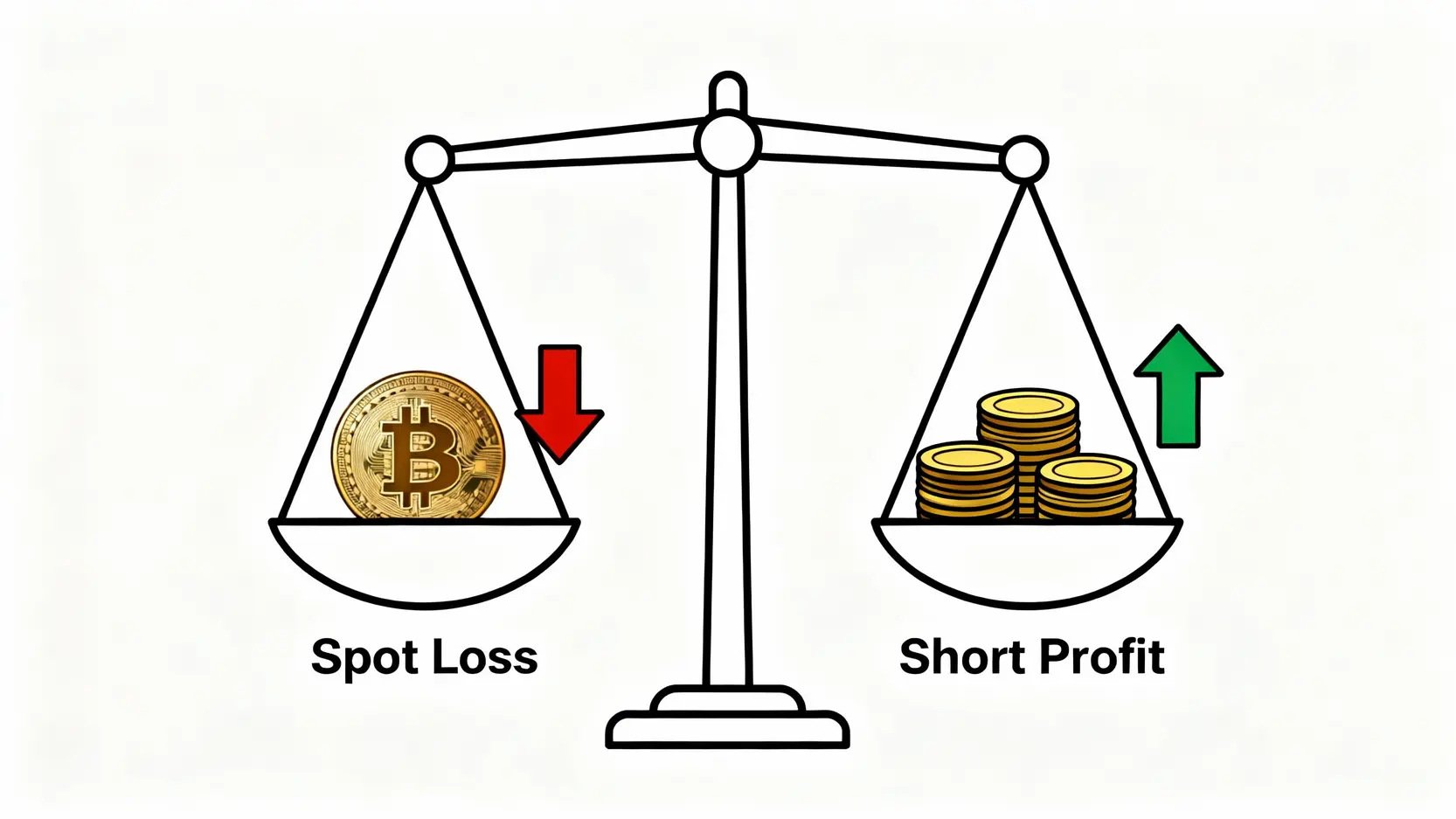
Hedging: If you hold a large amount of Bitcoin spot for the long term but are concerned that a short term correction may erode your asset value, you can open an equivalent short contract. In this way, even if your spot holdings incur losses due to price declines, the profits from the short contract can offset part or all of the losses, functioning as insurance for your assets.
Hedging Strategy: Use the Profit From Short Contracts to Offset Losses in Spot Assets During Price Declines.
Arbitrage strategy: Sophisticated traders exploit price differences between different markets or platforms. For example, when the Bitcoin futures price on Exchange A is significantly higher than the spot price on Exchange B, you can short the futures on Exchange A while buying a spot on Exchange B to lock in a risk free price difference.
[Must Read for Beginners] Comparison of 5 Mainstream Methods of Shorting Bitcoin
There is more than one way to execute Bitcoin short selling. The market offers various financial instruments, each with its own advantages, disadvantages, and suitable investor profiles. The following section will provide a detailed introduction to five of the most mainstream short selling methods.
Method One: Trade Cryptocurrency Futures
Futures contracts are currently the most popular and highest volume method for shorting Bitcoin. Investors do not trade actual Bitcoin but instead buy and sell a contract to “settle Bitcoin at a specified price at a future date”. To short, you simply sell (that is open a short position) in a Bitcoin perpetual contract or delivery contract.
Advantages: High liquidity, availability of high leverage (up to 125 times) and relatively low trading fees.
Disadvantages: High leverage brings high risk, which may lead to forced liquidation, and funding rates must be paid.
Suitable for: Active traders with in depth market knowledge who can tolerate higher risk.
Method Two: Use a Contract for Difference Platform
A Contract for Difference (CFD) is another widely used derivative instrument in foreign exchange, stocks, and cryptocurrencies. It allows traders to speculate on the price difference between opening and closing positions without actually owning the asset. The operation is similar to futures trading, and selecting sell establishes a short position. To learn more about the details and risks of CFD trading, it is recommended to read CFD Trading Strategies: The Complete 2026 Guide to Avoiding 7 Major Fatal Risks!.
Advantages: Regulated by traditional financial authorities (such as ASIC and FCA), trading interfaces are generally more beginner friendly, and multiple asset classes are available.
Disadvantages: Spreads and overnight fees may be relatively high, and not all platforms offer 24/7 trading.
Suitable for: Investors who wish to trade multiple asset classes on a single platform and prefer platforms regulated by traditional financial institutions.
Method Three: Invest in an Inverse Bitcoin ETF
For investors accustomed to traditional financial markets, an Inverse Bitcoin ETF provides a convenient channel for short selling. Such ETFs aim to deliver the inverse of Bitcoin’s daily return. For example, when Bitcoin declines by 5 percent in a day, a one times inverse ETF should rise by approximately 5 percent. Investors can achieve a short selling effect simply by purchasing this type of ETF through a traditional securities account.
Advantages: Simple operation, no need to open a dedicated cryptocurrency account, relatively lower risk (with no forced liquidation).
Disadvantages: Management fees and decay exist, making it unsuitable for long term holding, limited product selection, and primarily listed in the US and Canadian markets.
Suitable for: Traditional investors who only hold securities accounts or conservative users seeking lower risk short selling tools.
Method Four: Conduct Margin Trading on an Exchange
Margin trading (also known as leveraged trading) is conducted directly in the spot market. Traders borrow Bitcoin from the exchange and immediately sell it in the spot market. After the price declines, they buy back the same amount of Bitcoin in the spot market and return it to the exchange, earning the price difference.
Advantages: Operates directly in the spot market, with a relatively straightforward mechanism.
Disadvantages: Leverage is usually lower (generally 3 to 10 times), borrowing interest must be paid, and liquidity may be lower than in the futures market.
Suitable for: Traders familiar with spot trading who require moderate to low leverage.
Method Five: Purchase Bitcoin Put Options
Options are more complex derivatives. Purchasing a put option grants the holder the “right”, but not the “obligation” to sell Bitcoin at a specified price (the strike price) before a specific future date. If the market price of Bitcoin falls below the strike price, the value of the option increases, and investors can profit by selling the option. This is a short selling method with limited risk (where the maximum loss is the premium paid) and potentially unlimited returns.
Advantages: Maximum loss is controllable and limited to the premium you pay.
Disadvantages: The concept is complex, involving time value decay, Theta, and implied volatility, IV, making it highly challenging for beginners.
Suitable for: Professional traders with extensive knowledge of financial derivatives.
Comparison and Recommendations of the Best Cryptocurrency Short Selling Platforms in 2026
Choosing a reliable, powerful, and cost effective cryptocurrency short selling platform is crucial. Different short selling methods correspond to different types of platforms. The following provides a categorized comparison for your reference.
[Preferred Choice for Futures Trading] Comparison of Platform Features and Fees of Binance and OKX
For traders who wish to short Bitcoin through futures contracts, Binance and OKX are undoubtedly the two major players in the market.
Binance: As the cryptocurrency exchange with the largest trading volume globally, Binance offers unparalleled liquidity and market depth, meaning your orders can be executed quickly with minimal bid ask spreads. Its futures products are comprehensive, and the trading interface is powerful and suitable for all types of traders.
OKX: OKX is renowned for its innovative products and robust Web3 ecosystem. Its unified account system makes fund management more convenient, and the app trading experience is smooth. For users seeking an integrated trading experience (that combines trading, DeFi, and NFT services in one platform), OKX is an attractive choice.
[CFD Trading Platforms] Analysis of the Advantages and Risks of Mitrade and IG Market
If you prefer trading on strictly regulated platforms, CFD platforms are an ideal option.
Mitrade: Regulated by institutions such as the Australian ASIC, Mitrade is known for its simple and user-friendly trading platform and competitive trading costs. It offers a zero commission trading model (with costs included in the spread), making it very suitable for beginners.
IG Market: As a long established UK listed company, IG is regulated by multiple top tier global financial authorities (such as the FCA) and enjoys a strong reputation. It offers a wide range of trading products, including cryptocurrencies, foreign exchange, and indices, making it suitable for investors seeking professional grade trading tools and diversified assets.
[Inverse ETF Tool] How to Short Bitcoin Through Traditional Brokers
To purchase an inverse Bitcoin ETF, you need a securities account that allows trading in US or Canadian stocks. For example, BITI (ProShares Short Bitcoin Strategy ETF), listed in the US, is a typical example. You simply enter the ticker symbol in your broker’s app and buy it as you would an ordinary stock. Although this method is straightforward, you should note that its daily rebalancing mechanism may cause returns to deviate over long term holding, making it more suitable for short term operations.
Table Comparison: Features of Various Platforms, Suitable Users and Account Opening Guide
Short Selling Method
Recommended Platform
Key Features
Suitable for
Futures Contracts
Binance, OKX
High Leverage, High Liquidity, Low Fees
Professional and Active Traders
Contract for Difference (CFD)
Mitrade, IG Market
Strictly Regulated by Financial Authorities, User Friendly Interface
Beginners and Investors Who Prefer Traditional Regulation
Inverse ETF
Traditional Brokers (Such as Interactive Brokers)
Simple Operation, Controllable Risk (With No Forced Liquidation)
Traditional Financial Investors and Risk Averse Individuals
Margin Trading
Major Exchanges That Support Leveraged Trading
Direct Spot Trading, Straightforward Mechanism
Traders Familiar With the Spot Market
Risks and Precautions of Bitcoin Short Selling
Although Bitcoin short selling is a powerful profit tool in a bear market, the risks involved are far higher than those of traditional buy and hold strategies. Before committing capital, you must clearly understand the following points.
Unlimited Loss Risk: Why Is Short Selling More Dangerous Than Going Long?
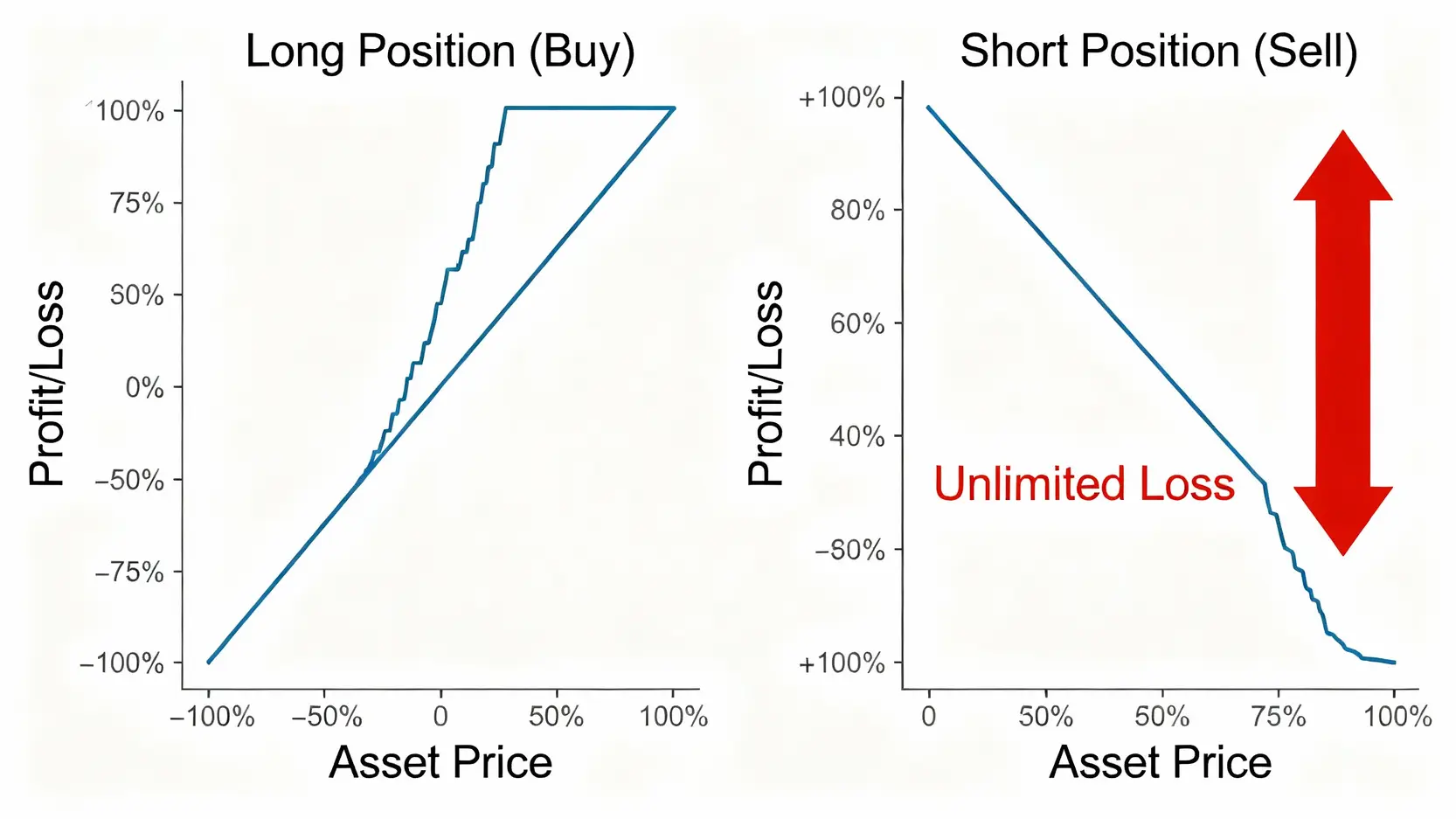
This is the core risk of short selling. When you buy (go long) Bitcoin, your maximum loss is 100 percent, meaning if the price falls to zero, you lose your entire principal. However, when you short sell, the theoretical upside of an asset’s price is unlimited. If the price of Bitcoin rises instead of falls, your losses will continue to expand and may far exceed your initial margin. The authoritative financial website Investopedia has repeatedly emphasized that short selling requires extremely strict risk control.
Asymmetrical Risk: Going Long (Left) Has a Maximum Loss Limited to Principal, While Short Selling (Right) Has Theoretically Unlimited Loss.
Funding Rates and Holding Costs: The Hidden Expenses of Long Term Short Positions
When using perpetual contracts to short, you are required to periodically pay or receive a “funding rate”. This rate is designed to balance the contract price with the spot price. When the market is generally bullish, short position holders usually need to pay funding fees to long position holders. If you maintain a short position for an extended period, this continuous cost will erode your potential profits and become a significant hidden expense.
Forced Liquidation Risk Management and Stop Loss Strategy
When you use leverage to short and the market price moves in an unfavorable direction (rises), your margin will decrease. Once losses reach a certain level and your margin is insufficient to maintain the position, the exchange system will automatically force liquidate the position (commonly known as “liquidation”), and you will lose all margin.
To avoid such catastrophic consequences, setting a stop loss is an absolutely necessary discipline. When opening a position, you should set a maximum loss price that you can tolerate. Once the market reaches that price, the order will automatically close the position, locking the loss within a controllable range.
FAQ: Frequently Asked Questions About Bitcoin Short Selling
Q: Is shorting Bitcoin legal in Hong Kong?
A: Yes, it is legal to trade Bitcoin derivatives (such as futures and CFDs) through compliant platforms in Hong Kong. The Securities and Futures Commission of Hong Kong (SFC) has issued regulatory guidelines for virtual asset trading platforms. However, investors should choose platforms that hold proper licenses or have strong reputations internationally, and always stay informed about the latest regulatory developments.
Q: How much capital is required to short Bitcoin?
A: The required capital varies depending on the instrument and platform you choose. On futures or CFD platforms that offer high leverage, you may begin trading with only dozens of dollars. For inverse ETFs or margin trading, higher initial capital is usually required. Always invest only funds that you can afford to lose.
Q: Besides Bitcoin, which other cryptocurrencies can be shorted?
A: Almost all major cryptocurrencies can be shorted on large exchanges. In addition to Bitcoin (BTC), high market capitalization cryptocurrencies such as Ethereum (ETH), Solana (SOL), and Ripple (XRP) generally have good liquidity and are suitable for short selling.
Q: What is the fundamental difference between short selling and going long (buying)?
A: The fundamental difference lies in the risk and return structure. Going long (buying), bets on price appreciation, with a maximum loss of 100 percent (total loss of principal) and theoretically unlimited profit. Short selling bets on price decline, with a maximum gain of 100 percent (if the price falls to zero) but theoretically unlimited loss. This asymmetrical risk structure is precisely why short selling requires more rigorous risk management.
Conclusion
In summary, Bitcoin short selling is a high risk yet potentially high return investment strategy. It provides investors with the ability not only to survive but also to profit in a bear market. From high leverage futures contracts and regulated CFDs to simple inverse ETFs, the market offers diversified tools to meet the needs of investors with different risk preferences. Before deploying your Bitcoin short selling strategy, be sure to thoroughly understand how each method operates and the risks involved, especially the threats of unlimited loss and forced liquidation. Choose a reputable cryptocurrency short selling platform that suits your trading style, and always prioritize risk management. This is the sustainable path to successful trading.
How to Get Started with Bitcoin? The Complete 2026 Bitcoin Buying Guide for Beginners After watching Bitcoin repeatedly reach new highs in recent years and successfully pass spot ETF reviews in the US and Hong Kong in 2024, officially entering mainstream financial markets, many investors have turned their attention to...
Is Gold’s V-Shaped Rebound a Bottom-Fishing Signal? A Complete Guide to Trading Strategies Amid “$100 Price Swings” What Is a Gold V-Shaped Rebound? More Than Just a Technical Pattern The gold market has recently experienced sharp rises and falls, with prices frequently displaying dramatic “gold V-shaped rebounds”. Single-day “$100 price...
What Is PPI Data? 2026 Latest Analysis: Understand the Differences from CPI and How It Affects Stock Market Trends With market information constantly changing, do you always hold your breath while waiting for CPI data to be released? But did you know that a more forward-looking inflation indicator, PPI data...