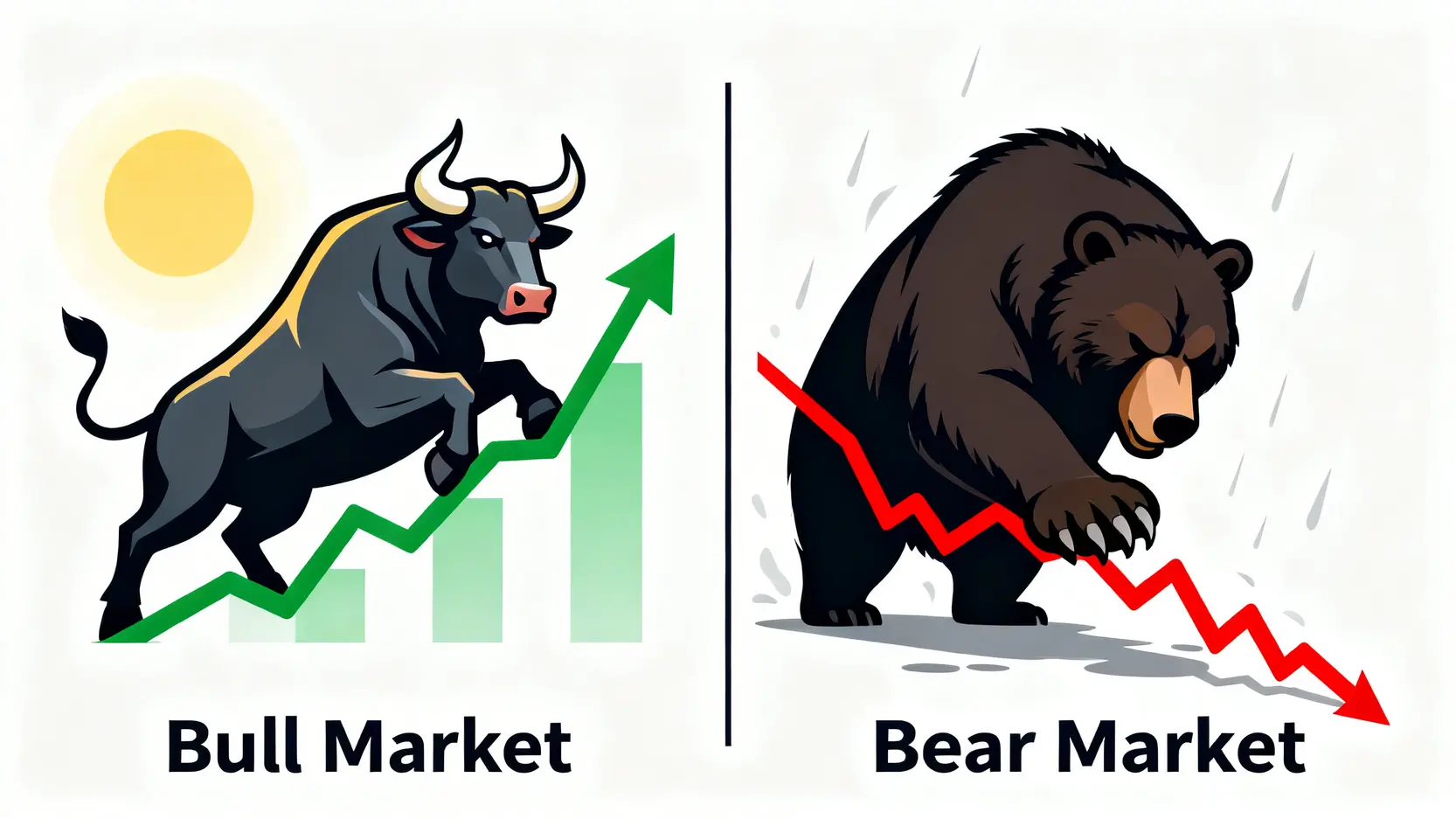
The Four Stages of a Bear Market: Market sentiment moves from optimistic denial to panic and despair, and finally toward the first signs of hope at the bottom.
Stage One: Pullback From the Peak While Optimism Remains
This stage usually occurs after the market reaches the peak of a bull market. Prices begin to decline from their highs, but most investors remain influenced by the previous optimistic environment and view the decline as a “healthy correction” or a “buying opportunity”. Trading volume remains active, but the leading stocks that previously rose the most may already begin to decline first. During this stage, denial and hope dominate market sentiment.
Stage Two: Panic Selling as Market Confidence Collapses
As stock prices continue breaking new lows and negative economic data emerges, market sentiment quickly deteriorates. Optimism is replaced by panic, and investors begin selling their holdings regardless of price, a phenomenon often referred to as “capitulation”. This stage usually experiences the most severe declines, with trading volume expanding sharply. The market becomes filled with pessimistic predictions, and the VIX volatility index often surges during this period.
Stage Three: Despair at the Bottom With Extremely Low Trading Volume
After panic selling subsides, most investors who wanted to sell have already exited the market. The downward trend slows, but there is little momentum for recovery. Even positive news receives minimal market reaction. At this stage, investors generally feel exhausted and indifferent, losing almost all interest in the market. Trading volume falls to extremely low levels, market volatility declines, and prices enter a prolonged period of sideways consolidation. This is commonly referred to as the “bottom building” process.
Stage Four: Bottom Formation and Gradual Recovery as a New Bull Market Emerges
Amid despair, opportunities quietly appear. Some forward looking value investors and institutional investors begin accumulating undervalued quality assets at low prices. Stock prices start to recover gradually, but most retail investors remain cautious and believe the rebound may simply be a “Dead Cat Bounce”. As prices gradually break through key resistance levels and economic data begins to improve, market confidence slowly returns, laying the foundation for the next bull market.
Investment Wisdom During a Bear Market: Three Stable Response Strategies
When facing a bear market, panic is the greatest enemy. Adopting rational and stable investment strategies can not only protect your assets but also create opportunities to plant the seeds of future wealth during market lows.
Strategy One: Cash Is King, Preserve Your Strength
In a bear market, cash is not only a defensive asset but also the “ammunition” for capturing future opportunities. Holding an appropriate proportion of cash allows you to avoid missing opportunities at market bottoms due to depleted funds. It also reduces the overall volatility of your investment portfolio, allowing you to sleep peacefully at night.
Strategy Two: Gradually Buy High Quality Assets
Trying to predict the exact market bottom is futile. A more pragmatic strategy is to adopt “regular fixed-amount investing” or “buying in batches” (Dollar-Cost Averaging, DCA). Select high-quality companies with healthy balance sheets, strong long-term competitive advantages, and that have been undervalued during the bear market, and gradually build positions as the stock price declines. This can effectively average down costs and wait for the market to recover in order to obtain substantial returns.
Strategy Three: Avoid High Risk Speculative Assets
Bear markets squeeze out market bubbles. High risk speculative stocks that were heavily promoted during bull markets but lack real profit support (such as meme stocks or certain unprofitable technology companies) often experience the most severe declines during bear markets and may even face the risk of losing all value. At this stage, capital should be concentrated in leading companies with mature business models and stable cash flow.
Further Reading (Highly Recommended)
Cryptocurrency Crash? Do Not Panic! Master the Five Major Causes of Market Crashes and Bear Market Survival Strategies at Once
The Ultimate Guide to Arbitrage: Five Risk Free Arbitrage and Hedging Strategies (Forex / Cryptocurrency)
Bear Market Frequently Asked Questions (FAQ)
Q: How long does a bear market usually last?
A: According to historical data, the duration of a bear market varies. Since World War II, bear markets in the US S&P 500 Index have lasted about 12 to 18 months on average. However, each bear market has different causes and macroeconomic conditions, so the duration can vary significantly. The key is not to predict when it will end, but to ensure that your investment portfolio can weather the downturn.
Q: What is the difference between a bear market and a market correction?
A: The main difference lies in the depth of the decline. Generally speaking, when the market falls between 10% and 20% from its peak, it is referred to as a “correction” or “consolidation” (Correction), which is a common and healthy pullback during a bull market. Once the decline exceeds 20%, it enters the technical definition of a “bear market”, indicating that the long-term trend of the market may have reversed.
Q: In a bear market, do all stocks decline?
A: Although the vast majority of stocks decline during a bear market, not all do. Some sectors with defensive characteristics, such as utilities, consumer staples, and healthcare, tend to perform better than the broader market during a bear market because their demand remains relatively stable and is less affected by economic cycles. However, this does not mean they will not decline at all.
Q: Is a bear market a good time to enter the market?
A: For long term investors, a bear market can indeed provide an excellent opportunity to buy quality assets at discounted prices, often summarized by the phrase “be greedy when others are fearful”. However, the key is to invest in stages and be psychologically prepared for the possibility that your capital may remain tied up for a period of time. For short term traders, the volatility in a bear market is extremely high and the risks are significant, so attempting to catch the bottom is generally not advisable.
Q: How can you determine whether a bear market has ended?
A: Technically, when a market index rebounds and rises more than 20% from its lowest point, it is generally considered the beginning of a new bull market. In addition, some supporting signals can also be observed, such as the market no longer reacting violently to negative news, leading economic indicators (such as the Manufacturing PMI) bottoming out and rebounding, and market sentiment gradually improving from extreme pessimism.
Conclusion
In summary, understanding the meaning of a bear market, the causes that trigger it, and the different stages of its development is a fundamental lesson for every mature investor. A bear market undoubtedly brings the challenge of shrinking assets and psychological pressure, but it also provides a valuable opportunity to reassess the health of your investment portfolio and to identify investments with genuine long term value at a lower cost. When facing a market downturn, maintaining a calm mindset, adhering to sound investment principles, and keeping sufficient cash reserves are the keys to weathering the storm and being fully prepared for the next phase of economic recovery.