What Is a Bull Market? Definition & 3 Strategies

Updated: 2026/03/10  |  CashbackIsland

bull-market-guide

What Is a Bull Market? Understanding the Definition, Characteristics, and Three Major Investment Strategies

You often hear in financial news that a “bull market is coming”, but do you really understand what a bull market means? Many beginner investors miss profit opportunities simply because they do not clearly understand what a bull market is and its market characteristics. When market sentiment is strong and stock prices continue to rise, it signals the arrival of a period full of opportunities. This article provides a complete explanation of the definition and origin of a bull market, and explores its typical characteristics and different stages in depth, helping you learn how to identify market trends and seize investment opportunities. 


What Is a Bull Market? A Deeper Understanding of Its Definition and Origin

To capture profit opportunities in a bull market, you must first have a clear understanding of it. A bull market is not simply another term for rising stock prices. Behind it lies a more rigorous definition and an interesting historical background, both of which form the foundation for developing successful investment strategies.


The Formal Definition of a Bull Market: More Than Just Rising Prices

In financial markets, the common definition of a bull market refers to a period when market prices (such as stocks, cryptocurrencies, or real estate) rise broadly and continuously. Technically, many analysts consider “a rise of more than 20 percent from a recent market low” as a signal that the market has entered a bull market. However, a true bull market is not merely about numerical growth. It is usually accompanied by strong economic fundamentals and optimistic investor sentiment. This creates a positive cycle: economic improvement drives corporate earnings growth, which pushes stock prices higher. Rising stock prices then reinforce consumer and investor confidence, further stimulating the economy.


Comparison Table of the Core Differences Between Bull Markets and Bear Markets

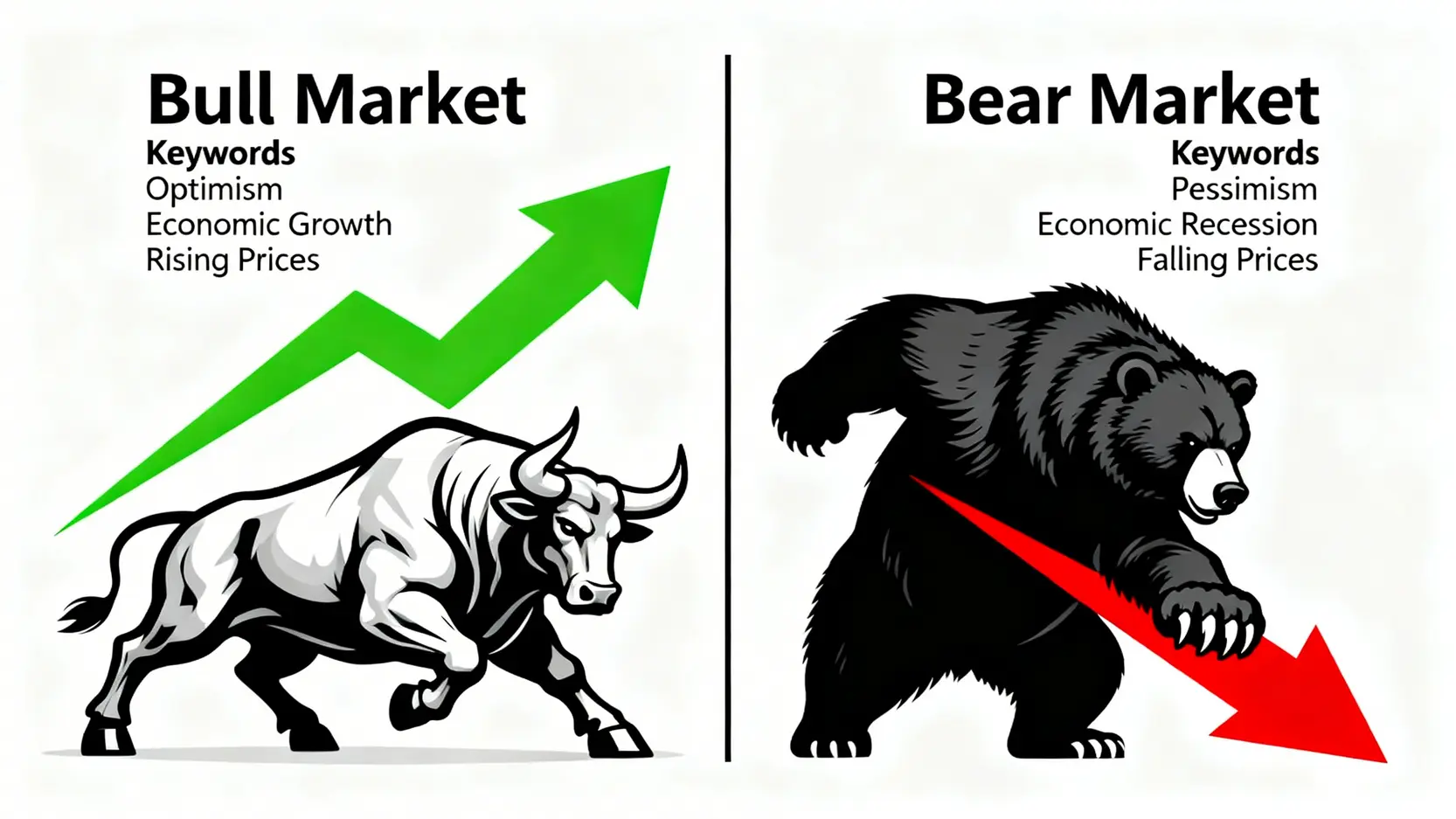
Bull markets and bear markets represent two extreme states of the market, and understanding their differences is essential. A bear market is the opposite of a bull market. It usually refers to a situation where the market declines more than 20 percent from its peak, accompanied by pessimistic sentiment and expectations of economic recession. Through the table below, you can clearly see the core differences between the two at a glance:

Comparison Aspect Bull Market Bear Market
Market Trend Continuous rise, repeatedly reaching new highs Continuous decline, repeatedly testing new lows
Investor Sentiment Optimistic, greedy, and confident Pessimistic, fearful, lacking confidence
Economic Conditions Strong growth, low unemployment rate Slowing or recession, high unemployment rate
Trading Volume Prices rising with increasing volume, active trading Increasing volume during declines, decreasing volume during rebounds
Investment Strategy Follow the trend, buy and hold Conservative and defensive, holding cash or safe haven assets

牛市與熊市核心差異的對比圖,左邊是代表上漲市場的公牛,右邊是代表下跌市場的熊。

Bull Market vs Bear Market: A Clear Contrast Between Market Trends and Investor Sentiment.

In a bear market, investment strategies need to be more cautious, and contrarian approaches may even be considered. To learn more, you can refer to Cryptocurrency Crash? Do Not Panic! Master the Five Major Causes of Market Crashes and Bear Market Survival Strategies at Once

Why Is It Called a “Bull Market”? An Interesting Origin Story

The most widely accepted explanation for the term “bull market” comes from the attacking style of a bull. When a bull attacks, it thrusts its horns upward from below. This motion vividly illustrates the upward trend of rising stock prices. In contrast, the term “bear market” is believed to originate from a bear striking downward with its paws, symbolizing falling market prices. This vivid metaphor allows investors to easily remember the core characteristics of these two market conditions.


Master the Five Key Characteristics of a Bull Market to Easily Identify Market Direction

Determining whether a bull market has arrived cannot rely solely on rising stock prices. A healthy bull market is usually accompanied by several clear macroeconomic and market characteristics. Learning to observe these signals can help you judge market direction more accurately and avoid falling into the trap of a “false rebound”.


Characteristic One: Strong Economic Data Across the Board (GDP Growth, Declining Unemployment)

A strong macroeconomic environment is the most solid foundation of a bull market. When you see the following data continuously improving, it often signals the early or middle stages of a bull market:

  • Gross Domestic Product (GDP) growth: Indicates that the overall economic output of the country is increasing, giving companies more opportunities to generate profits.
  • Declining unemployment rate: More people being employed means stronger consumer spending power, which drives sales across various industries.
  • Moderate inflation: A reasonable level of inflation can help companies raise prices and increase profits. However, excessive inflation may erode purchasing power and serve as a warning signal for the market.


Characteristic Two: Rising Investor Confidence and Optimistic Market Sentiment

Markets are driven by people, which makes sentiment indicators very important. In a bull market, the overall atmosphere tends to be highly optimistic:

  • Positive media coverage: Financial news is filled with favorable reports, and headlines frequently highlight stock markets reaching new highs.
  • Active participation from retail investors: “Stock gurus” seem to appear everywhere, more beginners open brokerage accounts, and discussions about stocks become part of everyday conversation.
  • Fear and Greed Index: Tools such as CNN’s Fear & Greed Index often remain in the “Greed” or even “Extreme Greed” zone for extended periods, reflecting the collective mood of the market.


Characteristic Three: Significantly Increased Trading Volume

“Rising prices accompanied by increasing volume” is a golden rule in technical analysis for confirming trends. In a bull market, when stock prices rise, trading volume typically expands at the same time. This indicates that a large amount of capital is entering the market and that investor participation is strong. The upward trend is supported by solid buying demand rather than manipulation by a small group of participants. Conversely, if the stock price rises but trading volume declines (price up, volume down), it may be a warning signal, indicating that the upward momentum is insufficient.


Characteristic Four: Continuous Growth in Corporate Earnings

Sustained stock price growth ultimately requires support from corporate fundamentals. During a bull market, the earnings reports of most listed companies frequently deliver positive surprises, with profits and revenue consistently exceeding market expectations. This growth in earnings not only demonstrates economic strength but also provides the most substantial driving force behind rising stock prices. Analysts may continue raising their future earnings forecasts, further pushing up target price levels.


Characteristic Five: Frequent Initial Public Offering (IPO) Activity

When market sentiment is strong, many companies choose this period to conduct their Initial Public Offering (IPO), as a bull market can provide higher valuations and easier access to capital. Therefore, when the IPO market becomes exceptionally active and newly listed stocks often surge after listing, it usually indicates that the bull market is entering its middle to later stages. However, this may also signal that the market is overheating, and investors should begin paying closer attention to risk.


Further Reading (Highly Recommended)

What Is the S&P 500? Beginner’s Investment Guide: Understanding Its Components, ETFs, and How to Invest

Cryptocurrency Crash? Do Not Panic! Master the Five Major Causes of Market Crashes and Bear Market Survival Strategies at Once


The Three Stages of a Bull Market: How Should You Deploy Your Investment Strategy?

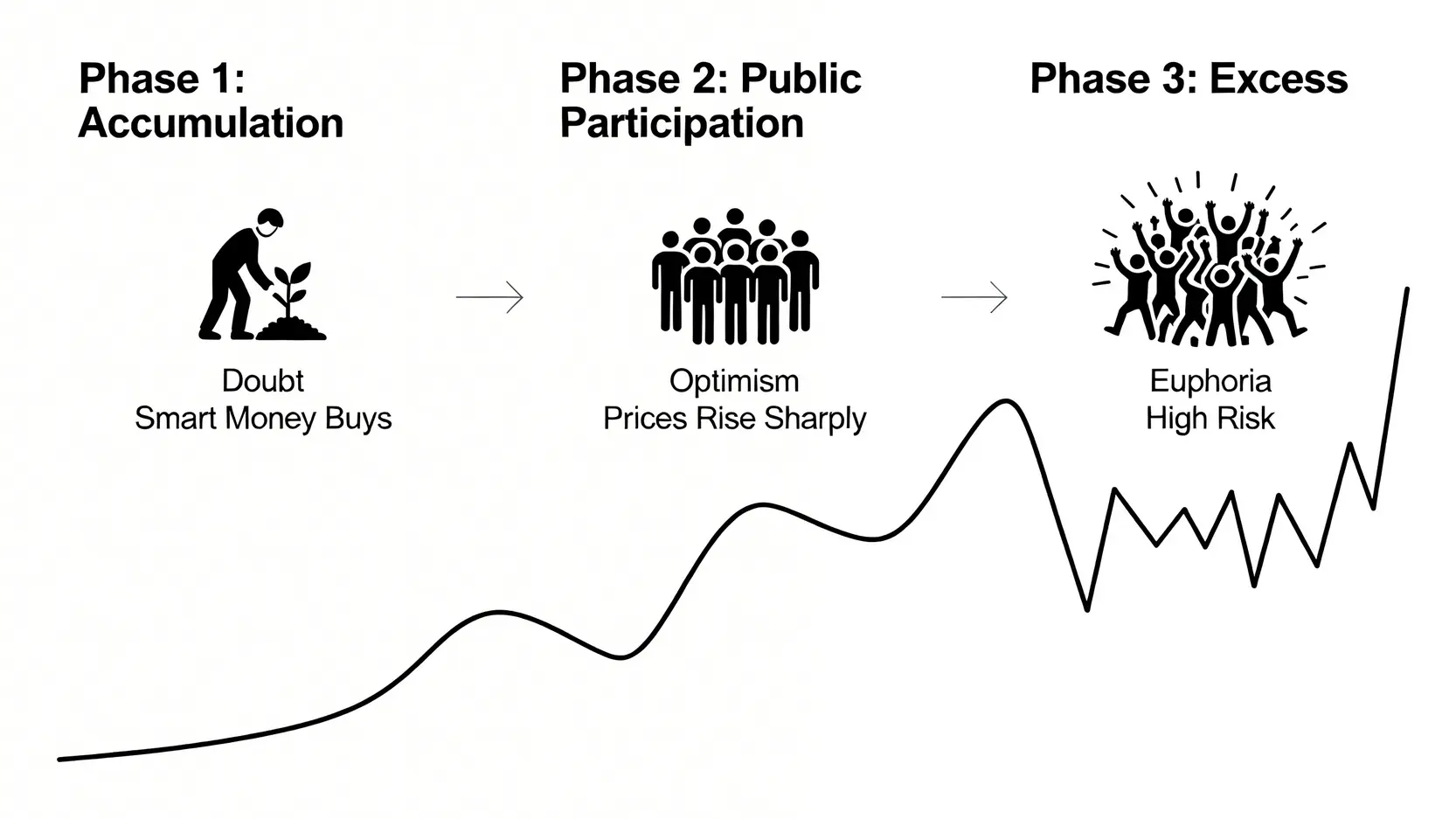
According to the classic Dow Theory, a bull market does not rise in a straight line indefinitely. Instead, it can be divided into three stages with distinct psychological and market characteristics. Understanding which stage you are currently in is crucial for adjusting investment strategies and controlling risk.

牛市三階段示意圖,展示了從累積期、主升期到狂熱期的市場演變過程。

The Three Stages of a Bull Market: Born in doubt, growing in optimism, and ending in frenzy.


Stage One (Accumulation Phase): Rising Amid Doubt as Smart Money Quietly Enters

This is the beginning of a bull market and usually starts quietly near the end of a bear market when overall sentiment is at its most pessimistic. At this time, economic data may still appear weak and the public remains doubtful about the market outlook. However, some forward looking “Smart Money”, such as institutional investors and value investors, may already recognize that the worst period has passed and begin accumulating undervalued quality assets at lower prices. The characteristics of this phase include: Gradually rising stock prices, relatively modest trading volume, and fragile market confidence

Stage Two (Mark Up Phase): Confidence Established as Public Capital Flows In

This is the longest stage of the bull market and often the most profitable one. As economic data improves significantly and corporate earnings accelerate, market confidence is fully restored. Retail investors and trend followers begin to enter the market in large numbers after recognizing a clear upward trend. The characteristics of this stage include faster price increases, significantly expanded trading volume, and broad based gains across nearly all sectors. This is the golden period for enjoying asset appreciation. 

Stage Three (Frenzy Phase): Everyone Is Talking About Stocks as Risk Quietly Accumulates

This is the final stage of a bull market and also the most dangerous one. Market sentiment reaches its peak and speculative behavior becomes widespread. Almost everyone is talking about stocks, and even people who have never invested before begin entering the market. The media widely reports stories about “stock market geniuses”, while speculative stocks and concept stocks are heavily promoted and valuations become irrationally high. At this point, “Smart Money” has already begun gradually selling its holdings and transferring positions to retail investors entering the market at the end. This stage is characterized by: accelerating stock price increases, significantly expanding trading volume, and nearly all sectors rising, with the market appearing highly prosperous. This is the golden period for enjoying asset appreciation.

How Should You Invest When a Bull Market Arrives? Three Practical Suggestions for Beginners

After understanding the definition and stages of a bull market, the most important question becomes how to act. When facing a rising market, beginner investors often feel both excited and fearful. The following three stable investment strategies can help you capture opportunities while controlling risk. 

Strategy One: Follow the Trend by Choosing Leading Stocks or Index Funds (ETF)

In a bull market, “the trend is your friend”. Rather than trying to identify the next soaring stock, it is often better to focus on investments that represent the broader market or industry trend. For beginners, the simplest approaches include:

  • Investing in index funds (ETF): For example, ETFs that track the US S&P 500 index allow you to purchase the strongest 500 companies in the market at once, enabling you to enjoy the average market return while effectively diversifying risk. To learn more about ETFs, you can read What Is the S&P 500? Beginner’s Investment Guide.
  • Selecting leading industry stocks: In a bull market, industry leaders usually perform the best. These companies possess strong brands, large market share, and solid profitability, making their stock price growth more stable.


Strategy Two: Use Dollar Cost Averaging to Spread Costs and Benefit From Growth

Attempting to “buy low and sell high” by perfectly capturing every market turning point is nearly impossible for most investors. A more practical approach is Dollar Cost Averaging. Regardless of whether the market rises or falls, you invest a fixed amount at regular intervals. During a bull market, this approach helps you:

  • Avoid chasing highs and selling lows: A disciplined investment approach helps eliminate emotional decision making.
  • Stay consistently invested in the market: Ensuring you do not miss the entire major upward trend due to fear of short term pullbacks.
  • Build long term positions: Gradually accumulate assets and benefit from the power of compounding.


Strategy Three: Stay Rational and Set Profit Taking Levels to Avoid Chasing High Prices

One of the most common mistakes in a bull market is going all in during the most euphoric third stage and eventually becoming trapped at the market peak. Therefore, staying rational and establishing a clear exit plan is essential. You can:

  • Set profit taking targets: Decide in advance that when your investment gains reach a certain percentage (such as 50 percent or 100 percent), you will sell gradually.
  • Use trailing stop loss orders: As the stock price rises, gradually increase your stop loss level to lock in profits.
  • Watch for warning signals: When the market begins showing the frenzy characteristics of the third stage (such as widespread speculation and irrational surges) in low quality stocks, it is important to become more cautious and reduce positions appropriately.


Frequently Asked Questions About Bull Markets (FAQ)

Q: How long does a bull market usually last?

A: The duration of a bull market is uncertain and may range from several months to multiple years. Historically, the average bull market in the US has lasted about 3.8 years, although this is only an average value. The length of a bull market depends on many factors, including the economic cycle, monetary policy, and major technological innovation.

Q: How can you determine whether a bull market is about to end?

A: Identifying the peak of a bull market is extremely difficult, but several warning signals are worth monitoring. For example, central banks around the world are beginning to tighten monetary policy (through interest rate increases), market valuations rising far above historical averages, extremely optimistic investor sentiment (representing the frenzy stage of a bull market) and leading stocks beginning to lose momentum. When these signals appear frequently at the same time, it may be time to become cautious and gradually reduce positions.

Q: Do all stocks rise during a bull market?

A: Not necessarily. Although the overall market trend moves upward during a bull market, often described as “a rising tide lifting all boats”, the performance of different industries and companies can vary greatly. Typically, cyclical industries (such as technology, finance, and consumer discretionary sectors) perform better during bull markets than defensive sectors (such as utilities and consumer staples). In addition, companies with weak fundamentals or poor management may still decline even during a bull market.

Q: What is the difference between a bull market and a bubble?

A: A bull market represents healthy price growth supported by economic fundamentals and corporate earnings growth, while a bubble refers to a situation where asset prices deviate significantly from their intrinsic value, primarily driven by speculation and irrational expectations. The later stages of a bull market often show signs of bubble formation. The ultimate outcome of a bubble is a collapse that leads to a sharp decline in asset prices, whereas a healthy bull market may end with a moderate correction or a period of consolidation.


Conclusion

In summary, understanding the meaning of a bull market and mastering its characteristics are essential skills for every investor. From learning the basic definition of a bull market, to identifying key signals such as improving economic conditions and rising investor confidence, and understanding the psychological changes across the three stages of a bull market, all of these can help you make wiser decisions during market uptrends. By following the trend, applying Dollar Cost Averaging, and maintaining rational investment discipline, you can truly capture the wealth building opportunities created by a bull market instead of losing direction during periods of market euphoria.

If you liked this article, please share it!

Related Articles

  • Volatility Surface Guide: Skew Trading Strategies
    Practical Applications of Volatility Surfaces: From Options Modeling to Advanced Skew Trading Strategies In options markets, implied volatility is never a flat line. Instead, it forms complex "smile" or "skew" surfaces. For advanced traders, mastering the practical applications of volatility surfaces is equivalent to possessing a lens that reveals market...
    2026 年 6 月 3 日
  • Foreign Capital Flow Model: Track Institutional Money
    Building a Foreign Capital Flow Copy Trading Model: A Stock Market Indicator for Accurately Tracking Institutional Positioning In Asia-Pacific stock markets, foreign capital inflows and outflows often determine the direction of the index. However, simply looking at daily net buy and sell data is no longer enough. Only by building...
    2026 年 6 月 3 日
  • Options Buying Strategies for Extreme Market Risks
    Options Buyer Strategies During Extreme Market Conditions: Black Swan Hedging and Cross-Market Arbitrage During Volatility Surges The most terrifying aspect of financial markets is not a gradual decline, but overnight flash crashes and cross-market capital withdrawals accompanied by volatility surges. In the highly unpredictable global macroeconomic environment of 2026, geopolitical...
    2026 年 6 月 3 日
返回顶部