eToro vs IG Markets: Spread & Fee Comparison

eToro vs IG Markets Ultimate Showdown: A Comprehensive Comparison of Spreads and Fees
When choosing a trading platform, trading costs are a key factor that directly erode investment returns. Many investors hesitate between eToro and IG Market, with the core question being which offers lower spreads under the “eToro IG Market spread” comparison. It is often unclear which platform has a more competitive spread structure and overall eToro trading costs. This article provides an in-depth breakdown of the various fees charged by eToro and IG Market, offering a comprehensive IG vs eToro platform comparison covering core spreads, overnight fees, and deposit and withdrawal charges. It aims to help you make the most informed decision, effectively lower your investment threshold, and ensure every dollar is put to optimal use.
Core Trading Cost Comparison: Whose Spread Charges Are Lower?
The spread, which is the difference between the bid price and the ask price, is the most fundamental and most frequently incurred cost in all Contracts for Difference (CFD) trading. Even a small difference in spreads can accumulate into substantial expenses under frequent trading. Let us examine how IG Market and eToro differ in their spread pricing strategies.
IG Market Spread Pricing Model: An Analysis of Spreads on Major Forex, Indices, and Stock CFDs
As one of the largest CFD brokers in the world, IG Market is well known for its highly competitive spreads. Its spread pricing model mainly features the following characteristics:
- Floating spreads: IG’s spreads change in real time according to market volatility and liquidity. During stable market conditions and high trading volume periods (such as the overlap of the European and US sessions), spreads are usually very low.
- Forex spread advantage: On major currency pairs, such as EUR/USD, IG’s spreads can be as low as 0.6 pips, making it highly attractive to short term and intraday forex traders.
- Indices and commodities: For mainstream indices such as Germany’s DAX40 and the US S&P500, spreads are also competitive, typically fluctuating around 1.0 point.
- Stock CFDs: What is stock CFD trading? In simple terms, it is a type of derivative financial instrument. IG’s spreads in this segment are relatively transparent, but it is important to note that commission charges may also apply (which will be discussed in detail later).
eToro Spread Pricing Model: An Analysis of Spreads on Major Forex, Indices, and Stock CFDs
eToro attracts a large number of users with its “social trading” and “commission free stock trading” features, and its spread model differs significantly from that of IG:
- Fixed but wider spreads: eToro’s spreads are relatively fixed and are less affected by sharp market volatility, providing traders with cost certainty. However, generally speaking, its spreads are wider than IG’s.
- Forex spreads: Taking EUR/USD as an example, eToro’s spreads usually start from 1.0 pips, offering no significant advantage compared to IG.
- Cryptocurrency advantage: It is worth noting that eToro offers a wider selection of cryptocurrencies for trading, and its spreads are considered mid range within the industry.
- Stocks and ETFs: One of eToro’s major selling points is its 0% commission trading on “real stocks” and ETFs (not CFDs), meaning you are buying and selling the actual underlying assets. There is no platform added spread, only the natural market bid ask difference. This is one of the biggest distinctions between eToro and IG, which primarily provides CFDs.
Tabulated Comparison: Overview of Spreads on Popular Products for eToro vs IG Market
To give you a clearer view of the differences, the table below summarizes the typical spread ranges for several popular trading products. Please note that these figures are reference values at the time of writing, and actual spreads may vary depending on market conditions.
| Trading Product | IG Market Typical Spread) | eToro (Typical Spread) |
Remarks |
| (EUR/USD) | From 0.6 pips | From 1.0 pips |
IG has a clear advantage in forex spreads. |
| US S&P 500 (CFD) | From 0.4 points | From 0.75 pips | IG is also more competitive in index CFDs. |
| Spot Gold (XAU/USD) | From 0.3 points | From 0.45 pips | The difference is not significant, but IG is slightly better. |
| Tesla Stock (TSLA CFD) | Market spread + commission | Approximately 0.20% | eToro incorporates costs into the spread, while IG charges spread + commission. |
| Bitcoin (BTC) | From 36 points | 0.75% | eToro is more prominent in cryptocurrency trading. |
Further Reading (Highly Recommended)
Comparison of Other Trading Fees: Watch Out for Hidden Charges That Affect eToro Trading Costs

Savvy investors understand that spreads are only the tip of the iceberg. To fully evaluate IG Market spread charges and eToro’s total costs, it is essential to examine overnight fees, commissions, and deposit and withdrawal charges as well.
Overnight Fees: Calculation Methods and Differences Between the Two Platforms
When you hold a Contract for Difference (CFD) position overnight, the platform will charge or pay overnight fees, also known as financing costs or swap rates. This fee arises from borrowing funds to maintain a leveraged position.
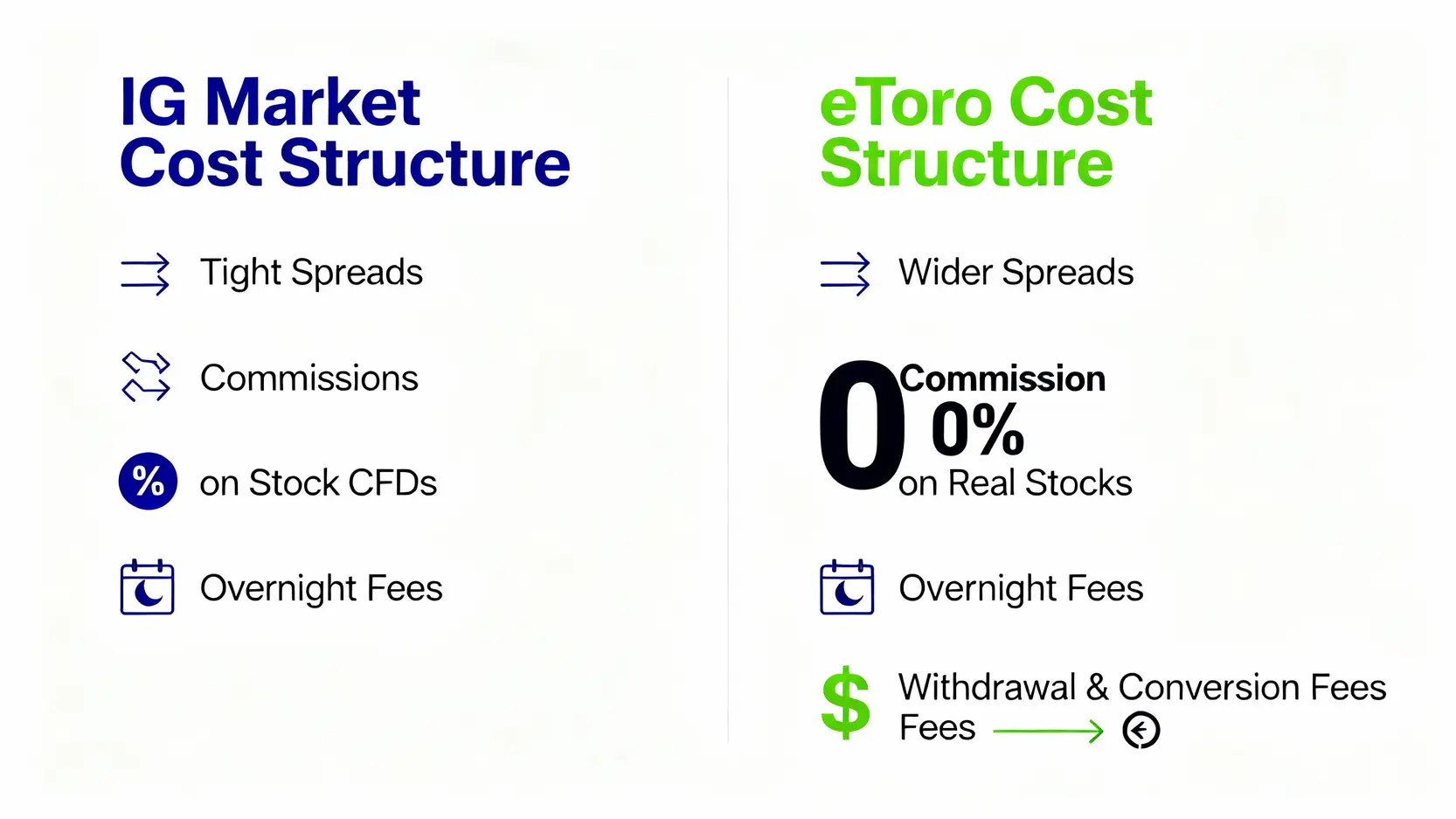
- IG Market: The calculation method is relatively transparent. Long positions (buying), usually incur the relevant interbank rate of the currency pair plus IG’s administrative fee (approximately 2.5 percent). Short positions (selling), may receive interest minus the administrative fee. You can clearly find the specific daily rates on the product information page within its platform.
- eToro: eToro’s overnight fee calculation is similar, but its administrative charges are generally included and the rates are comparatively less transparent. For traders who hold positions long term, this cost may gradually erode profits without being noticed. In particular, for cryptocurrency CFDs, eToro’s overnight fees are relatively higher.
Commission Charges: How Do Cost Structures Differ for Stocks and ETFs?
Commission is another important cost consideration, especially in stock trading.
- IG Market: It primarily charges commissions on stock CFD trades. For example, the commission for US stock CFDs is approximately USD 0.02 per share (with a minimum charge of USD 15). This may be more cost effective for large volume traders, but for smaller traders, the minimum fee threshold can be a significant burden.
- eToro: This is eToro’s key advantage. It offers 0 percent commission trading on real stocks and ETFs across multiple global markets. This means you are actually holding shares of the company rather than trading CFDs. For investors seeking long term value investing and building a diversified stock portfolio, eToro’s appeal is unmatched.
Deposits, Withdrawals, and Currency Conversion Fees: Which Platform Is More Convenient and Cost Effective for Withdrawals?
The convenience and fees associated with deposits and withdrawals are often overlooked hidden costs for beginners.
- IG Market: It offers multiple deposit methods, such as credit cards and bank transfers, with most being free of charge. Withdrawals are also relatively convenient, with low or no fees. It supports multiple base currencies (such as US dollars, euros, British pounds, and Australian dollars). If your deposit currency matches your account base currency, you can avoid currency conversion fees.
- eToro: All trading accounts are denominated in US dollars. This means that if you deposit funds in a non-US dollar currency (such as Hong Kong dollars or Malaysian ringgit), eToro will charge a currency conversion fee (usually calculated in pips). In addition, eToro charges a fixed USD 5 withdrawal fee per transaction. Although the fee is not high, frequent small withdrawals can become cost ineffective.
Comprehensive Platform Evaluation: More Than Just Costs in the IG vs eToro Comparison
When choosing a trading platform, cost should not be the only consideration. Platform stability, product diversity, and security are equally fundamental in determining your trading experience and the safety of your funds.
Product Diversity: Who Offers More Choices, IG or eToro?
In terms of the breadth of tradable markets, the two platforms have clearly different positioning.
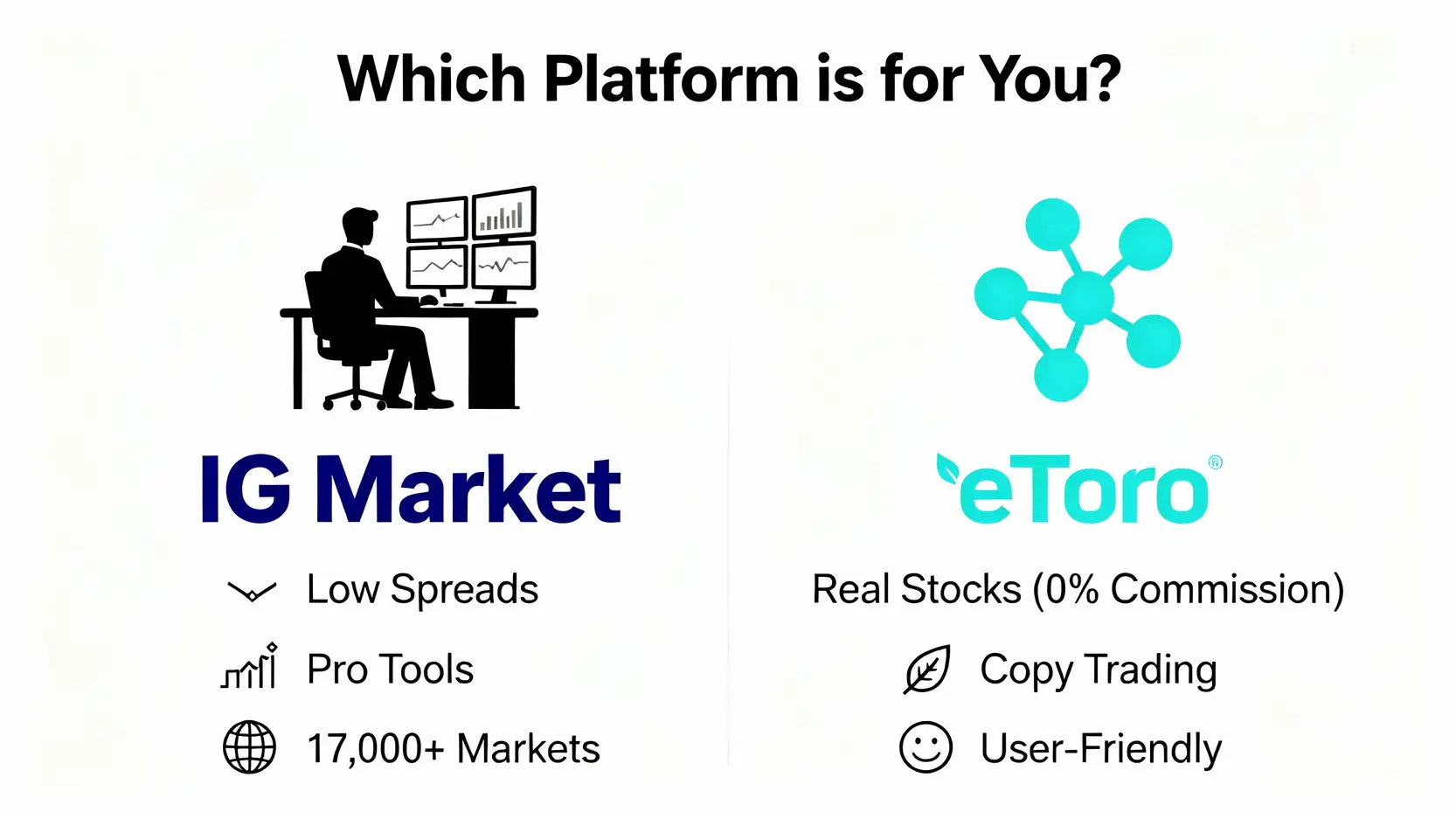
- IG Market: It can be described as a market leader. It offers more than 17,000 trading instruments across global financial markets, covering forex, indices, stock CFDs, commodities, cryptocurrencies, options, bonds, and more. Whether you want to trade rare currency pairs or niche stock CFDs in specific industries, you can almost always find them on IG.
- eToro: Although the number of available markets (approximately 3,000 or more) is far fewer than IG, its product structure is more tailored to retail investors. In addition to CFDs, it provides real stocks, ETFs, and exclusive CopyPortfolios (which are thematic investment portfolios). Its core advantage lies in “social trading” and the “CopyTrading” feature, which allows beginners to replicate the portfolios of top traders.
Platform Stability and User Experience: The Importance of Smooth Execution
In fast moving markets where every second counts, platform stability and execution speed are crucial.
- IG Market: It offers professional grade trading platforms, including its proprietary web based platform, mobile applications, and support for ProRealTime and MT4. Its platform is known for powerful charting tools, fast order execution, and high stability, earning the trust of professional and institutional traders.
- eToro: The platform is highly user friendly, with an intuitive interface that resembles social media, significantly lowering the barrier to entry for beginners. However, during extreme market conditions, some users have reported delays or lag. While its social features are innovative, it may not be the first choice for professionals seeking maximum trading performance.
Regulation and Security: Which Platform Better Protects Your Funds?
Capital security is the foundation of all investing. Fortunately, both eToro and IG Market are brokers regulated at the highest global standards.
- IG Market: It is strictly regulated by multiple top tier global regulatory authorities, including the Financial Conduct Authority (FCA), in the United Kingdom and the Australian Securities and Investments Commission (ASIC). As a publicly listed company, its financial condition is transparent, and client funds are held in segregated accounts, offering a high level of security.
- eToro: It is also regulated by the FCA, ASIC, and CySEC (the Cyprus Securities and Exchange Commission) among others. It provides segregated fund protection for clients, ensuring that client funds remain protected in the event of platform issues.
Overall, both platforms meet the highest industry standards in terms of regulation and security, giving investors confidence. When selecting a recommended forex trading platform, regulation must be the primary consideration.
Conclusion

In summary, eToro and IG Market each have their own strengths in trading costs and platform positioning, and there is no absolute winner or loser. The right choice depends entirely on your personal investing style and needs.
If you are one of the following types of investors, IG Market may be the better choice for you:
- Frequent short term or intraday traders of forex and indices who have very high requirements for low spreads.
- Experienced traders who need a wide range of trading tools and professional chart analysis.
- Explorers who want access to a broad range of markets, including more niche instruments.
If you match the following profile, eToro may suit you better:
- Value investors who want to invest long term by buying and holding real stocks and ETFs.
- Beginner investors who are interested in social trading and want to reference or copy expert strategies.
- Users who prefer a simple and intuitive interface and do not want to deal with complex charts.
Before making a final decision, be sure to evaluate both platforms’ spreads and total trading costs based on your trading frequency, the instruments you trade most, and your capital size. You can even open a demo account on each platform to experience their workflows and actual trading costs firsthand before deciding.
FAQ: Common Questions About eToro and IG Trading Costs
Q: Which is more suitable for beginners, eToro or IG Market?
A: Generally speaking, eToro is more beginner friendly due to its minimalist interface and innovative “CopyTrading” feature. Beginners can directly replicate the strategies of successful traders and learn while investing. On the other hand, IG Market offers more powerful and professional platform features, which may involve a learning curve, but it also provides extensive educational resources.
Q: For forex trading, does IG or eToro offer lower spreads?
A: For forex trading, especially major currency pairs, IG Market’s spreads are typically much lower than those of eToro. If you are an active forex trader, choosing IG can significantly reduce your trading costs.
Q: Besides spreads and overnight fees, what other potential costs should be considered?
A: Potential fees to watch for include inactivity fees (as both platforms may charge if there is no trading activity for an extended period), withdrawal fees (with eToro charging a fixed USD 5 per withdrawal) and currency conversion fees (which apply on eToro when depositing in non US dollar currencies). Be sure to review each platform’s fee disclosure page carefully before opening an account.
Q: Does eToro’s CopyTrading feature require additional fees?
A: No. eToro’s CopyTrading feature itself is free of charge. You do not need to pay extra commissions or management fees for copying other traders. Your trading costs remain the same as regular trades, including spreads and overnight fees. This is one of the reasons for its popularity.
Q: What professional trading tools does IG Market offer?
A: IG Market provides a range of powerful tools for professional traders, including the free ProRealTime advanced charting software, which offers more than 100 technical indicators and automated trading capabilities. In addition, IG offers DMA (Direct Market Access) services, allowing traders to interact directly with the exchange order book for improved liquidity and transparency.
Related Articles
-
【Hong Kong Crypto Credit Card Comparison】Crypto.com Card vs Binance Card Ultimate Showdown (Including Application Guide and Fee Analysis) Looking to use your crypto directly for daily spending but unsure which card to choose? With the wide array of crypto credit cards on the market, especially the highly popular Crypto.com Card...2026 年 4 月 14 日
-
[2026 Hong Kong Monthly Dividend Fund Recommendations] Top 10 High-Yield Funds Compared, with a Comprehensive Breakdown of Income Strategies and Pitfalls In the current prolonged low interest rate environment, relying solely on bank savings is almost unable to keep up with inflation, and assets are gradually shrinking in real terms....2026 年 3 月 26 日
-
A Guide to Hong Kong Financial Websites for Forex: A Comparison of 5 Major Real-Time Quote Platforms (ET Net/AAStocks) In the fast-changing forex market, obtaining fast and accurate information is the key to successful investing. Are you tired of financial websites with outdated information and delayed quotes? Do you want...2026 年 3 月 26 日