What Is Cloud Mining? Top Platforms & Risk Guide

What Is Cloud Mining? Comparison of 5 Major Platforms and a Complete Guide to Cloud Hashrate Contract Risks
Want to earn passive income through cryptocurrency mining but find buying mining machines, handling technical setups, and paying electricity fees too complicated? Cloud mining seems like a low-barrier option. However, the wide variety of cloud mining platforms and the complexity of contract terms can be overwhelming, and many worry about falling into cloud hashrate contract risks. What exactly is cloud mining? This article explains it in detail from the ground up, provides an in-depth comparison of 5 major cloud mining platforms, and teaches you how to identify potential risks, select the investment option that suits you best, and safely take your first step.
What Is Cloud Mining? Understand the Operating Principle in 3 Minutes
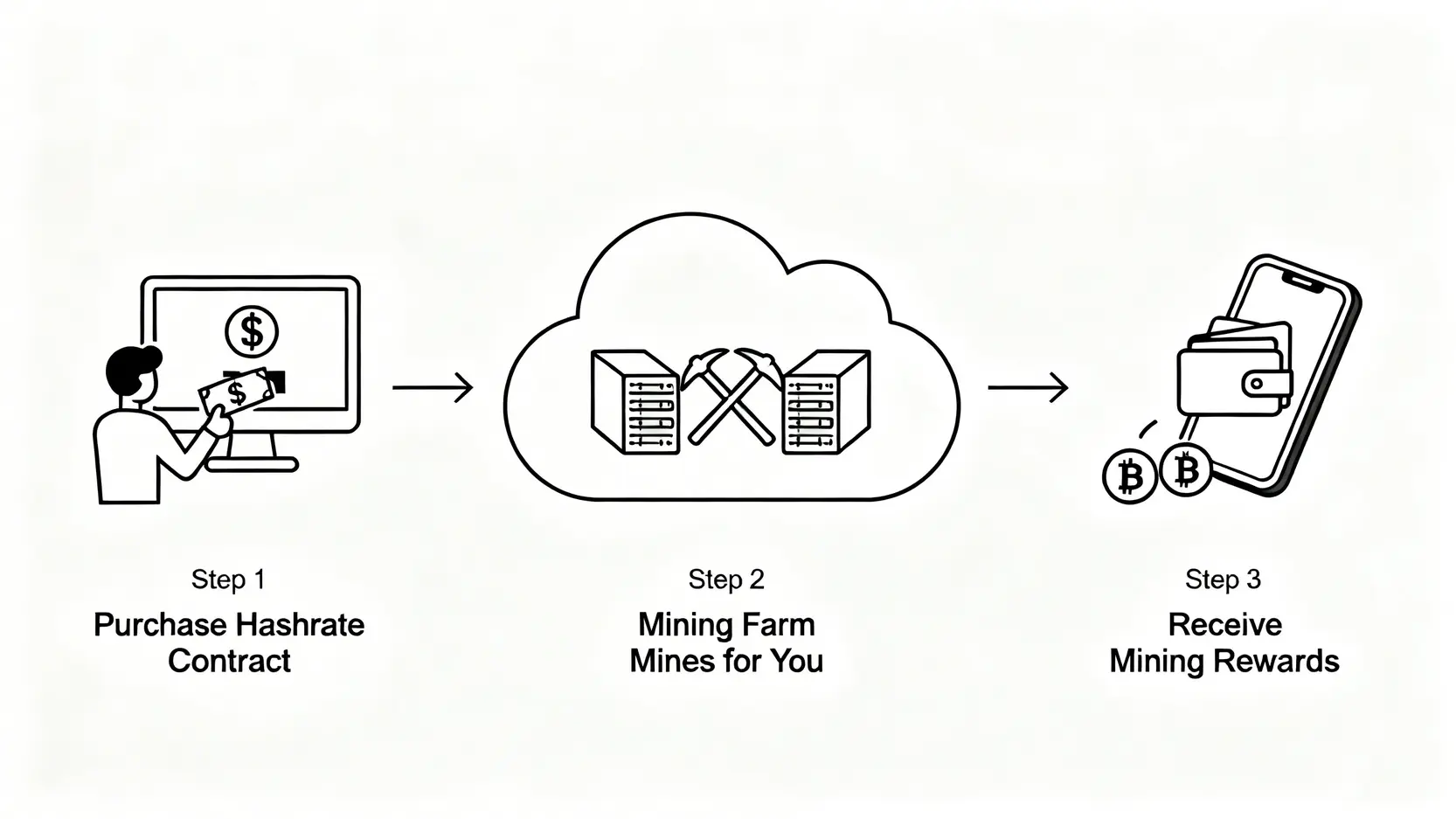
In simple terms, cloud mining allows you to participate in cryptocurrency mining without owning physical mining machines. Instead, you “rent” computing power (known as “hashrate”) from a company that operates large professional mining farms. By signing a cloud hashrate contract and paying a rental fee, the company mines cryptocurrency on your behalf and periodically distributes the mined coins to your digital wallet after deducting operational costs (such as electricity and maintenance). This model enables ordinary investors to enter the world of cryptocurrency mining and earn potential returns.

Traditional Mining vs Cloud Mining: Why Cloud Mining Is More Suitable for Beginners?
For novice investors, traditional mining has a high entry barrier. Cloud mining addresses these challenges and has become a more popular choice. The main difference is that cloud mining eliminates the complex setup and high costs associated with traditional mining for beginners:

| Comparison Items | Traditional Mining | Cloud Mining |
| Hardware Cost | Very High. Requires purchasing expensive specialized mining machines (ASIC) or high-performance graphics cards (GPU). | Low. No hardware purchase is needed; you only rent hashrate according to your budget. |
| Technical Barrier | High. Requires self-assembly, setup, cooling, and handling software installation and maintenance. | Very Low. The platform handles all technical issues; users only need to register and purchase a contract. |
| Operating Cost | High and Variable. Includes 24/7 electricity costs, cooling expenses, and potential maintenance fees. | Fixed and Transparent. Fees are usually included in the contract price or daily management charges. |
| Space Requirements | Requires a well-ventilated, spacious location and tolerance for noise and heat. | None. The mining machines are located in remote professional farms, with no impact on your daily life. |
| Flexibility | Low. Once purchased, switching to mine other types of coins is relatively difficult. | High. You can easily switch between different hashrate contracts to mine various cryptocurrencies. |
Cloud Hashrate Contract Core Concepts Explained
Cloud hashrate contracts are at the heart of cloud mining. When purchasing a contract, you need to understand several key concepts:
- Hashrate: Refers to the computational power of the mining equipment, usually measured in TH/s (Terahashes per second) or GH/s (Gigahashes per second). The higher the hashrate, the stronger the mining capacity you are “renting,” and theoretically, the more coins you can mine.
- Contract Duration: Refers to the length of time you rent the hashrate, ranging from a few months to several years. After the contract expires, you will no longer receive mining rewards.
- Hashrate Fee: The one-time or installment payment you make to purchase a specified hashrate.
- Electricity/Maintenance Fee: The daily fee charged by the platform to maintain the operation of the mining machines, usually automatically deducted from your mining earnings each day. The level of this fee directly affects your final return.
Understanding these basic concepts is the foundation for comparing cloud mining platforms and evaluating potential returns.
Comprehensive Comparison of the 5 Major Cloud Mining Platforms in 2026
Choosing a reliable cloud mining platform is key to success. Below we analyze five well-known platforms in the market to help you make a more informed choice. Please note that platform services and fees may change at any time, so always check official websites for the latest information before investing.
Bitdeer
- Advantages: Spun off from mining giant Bitmain, with strong backing and high transparency. Users can directly track the mining machines corresponding to their hashrate and freely buy or sell hashrate on the market.
- Disadvantages: Relatively high prices, and popular contracts are often sold out quickly, requiring timely purchase.
- Fee Structure: Mainly hashrate fee + electricity fee. Electricity costs fluctuate based on the actual conditions of the mining farm and are deducted daily from earnings.
Binance Cloud Mining
- Advantages: Provided by Binance, one of the world’s largest cryptocurrency exchanges, with good reputation and secure funds. The interface is integrated into the Binance App, very convenient for existing Binance users.
- Disadvantages: Relatively few product options, shorter contract durations, and contracts often sell out quickly.
- Fee Structure: Includes hashrate fee and electricity fee, clearly listed at the time of purchase.
KuCoin Cloud Mining
- Advantages: Service under the major exchange KuCoin, offering mining contracts for multiple cryptocurrencies with more diverse options.
- Disadvantages: Some contracts require high upfront costs, which may not be suitable for small investors.
- Fee Structure: Prepaid hashrate fee + daily deduction for electricity/management fees.
ECOS
- Advantages: Operates in the Armenia Free Economic Zone, enjoying tax incentives and stable power supply. Offers an all-in-one service including cloud mining, wallets, and an exchange.
- Disadvantages: Lower recognition compared with leading platforms, requiring more time to establish market trust.
- Fee Structure: Offers flexible contract duration options with clear fee structure, but unit prices should be carefully compared with other platforms.
Genesis Mining
- Advantages: One of the oldest cloud mining companies in the market, operating for many years and accumulating a solid user reputation.
- Disadvantages: Contracts are often sold out in recent years, and there are some controversies regarding operational transparency; user reviews are mixed.
- Fee Structure: Varies by contract type; some are all-inclusive, while others require daily maintenance fees.
[Comparison Table] Overview of Hashrate Fees, Contract Durations, and Expected Returns Across Platforms
| Platform | Main Cryptocurrency | Contract Duration | Fee Structure |
Suitable For |
| Bitdeer | BTC, ETH, etc. | Usually Longer (More Than 180 Days) | Hashrate Fee + Floating Electricity Fee | Investors Seeking Transparency and With Sufficient Capital |
| Binance | BTC | Relatively Short (30-180 Days) | Hashrate Fee + Electricity Fee (Estimated) | Existing Binance Users, Those Who Prefer Short-Term Contracts |
| KuCoin | BTC, KAS, etc. | Primarily Short to Medium Term | Hashrate Fee + Daily Management Fee | Investors Who Want to Try Mining Emerging Cryptocurrencies |
| ECOS | BTC | Flexible (50-5000 Days) | Total Contract Price (Including All Fees) | Beginners Who Want One-Stop Asset Management |
| Genesis Mining | Multiple Cryptocurrencies | Usually 1-2 Years | One-Time Fee or Daily Charges | Requires Careful Evaluation, Suitable for Experienced Investors |
Note: Expected returns are influenced by multiple factors such as coin price, overall network hashrate difficulty, and platform fees. The table above is for reference only and does not constitute investment advice.
Further Reading (Highly Recommended)
The Devil Is in the Details: Breaking Down 4 Major Potential Risks of Cloud Hashrate Contracts
Although cloud mining is convenient, it is far from guaranteed profit. Before investing funds, you must clearly understand the cloud hashrate contract risks behind it, which may even be higher than those of traditional investment tools.
Market Risk: How Do Coin Price Fluctuations Affect Your Mining Returns?
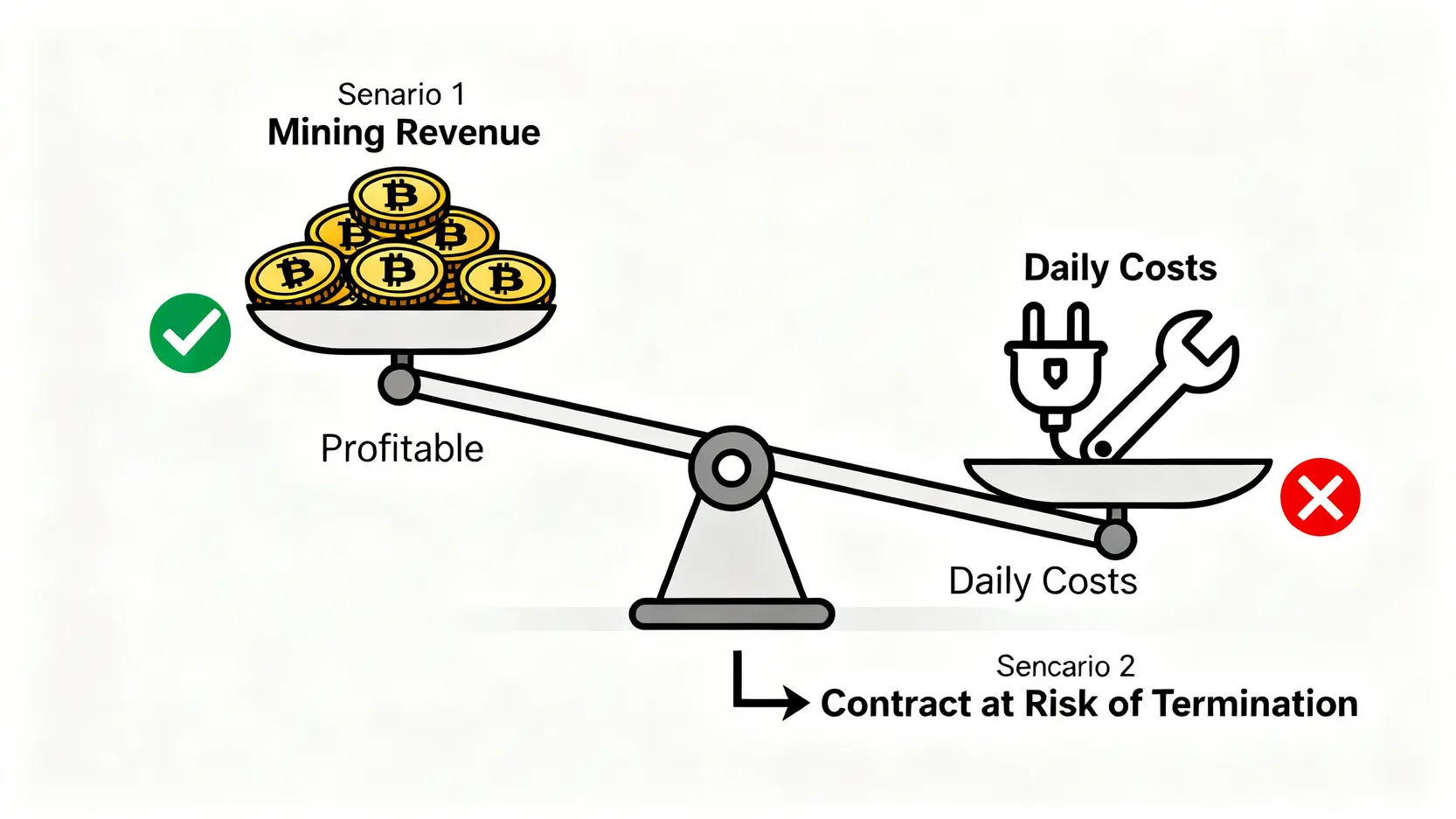
This is the largest and most direct risk. Your mining returns are settled in cryptocurrency, but your costs (contract fees, electricity fees) are usually priced in fiat currency (such as Hong Kong dollars or US dollars). When coin prices fall significantly, the fiat value of the coins you mine daily may not even be enough to cover the daily electricity costs. In extreme situations, your daily earnings may even become negative.

Platform Risk: How to Identify Scam Platforms and Ponzi Schemes?
The cryptocurrency industry contains many fraudulent projects, and cloud mining is one of the hardest-hit areas. Some scam platforms do not possess any real mining machines at all; they simply use funds from later investors to pay “returns” to earlier investors, forming a classic Ponzi scheme. Once the capital chain breaks, the platform shuts down and disappears. Methods to identify such platforms include:
- Beware of Excessively High Return Promises: If a platform guarantees fixed and extremely high daily returns, it is almost certainly a scam.
- Lack of Transparency: Legitimate platforms try to disclose information such as mining farm location (at least the country), company registration information, and team background.
- Extremely One-Sided Online Reviews: If the internet only contains large numbers of identical positive promotional articles without any real user discussions, caution is required.
Remaining vigilant at all times is extremely important. You can refer to more information about investment scam alerts to strengthen your ability to identify risks.
Contract Risk: Hidden Fees, Lack of Transparency, and Contract Termination Clauses
Before signing a contract, all terms must be carefully reviewed. Many disputes arise from contract details:
- Hidden Fees: In addition to hashrate fees and electricity fees, are there withdrawal fees, management fees, or other miscellaneous charges?
- Return Fluctuations: How are returns calculated? Is there any minimum guarantee? (Usually not.)
- Termination Clause: Many contracts include an “automatic termination clause”, meaning if mining revenue fails to cover electricity and maintenance fees for several consecutive days, the platform has the right to terminate your contract unilaterally without providing any refund.
Operational Risk: What Happens if the Mining Farm Stops or Equipment Fails?
Even the most reliable platforms may face unpredictable operational issues, such as:
- Power Outage: Electricity supply at the mining farm location may be unstable.
- Equipment Failure: Mining machines operate 24/7 and experience heavy wear, so breakdowns can occur at any time.
- Network Issues: Network interruptions at the mining farm may prevent hashrate from connecting to the mining pool.
- Force Majeure: Natural disasters, policy changes, and other factors may cause mining farms to shut down.
You need to understand how these situations are handled in the contract and whether the platform provides compensation for downtime.
Beginner’s Guide: 5 Steps to Choose a Reliable Cloud Mining Platform
After understanding the risks, if you still decide to try cloud mining, the following five steps can help you make safer choices. For any investment, doing proper research is always the first step, especially in emerging markets such as cryptocurrency. You may refer to investment safety guidelines provided by authoritative institutions to build proper risk awareness.
Step 1: Evaluate Platform Reputation and Transparency
Take time to research the platform’s background. How long has the company been established? Who are the founding team members? Is company registration information publicly available? Are there many real photos or videos of the mining farms? A reputable platform does not hide such information.
Step 2: Carefully Compare Hashrate Costs and Management Fees
Do not only look at the surface price of hashrate. Combine the “hashrate fee” with the “total electricity or management fees” across the entire contract period to calculate the total cost, then compare cost-effectiveness across platforms. Some platforms offer cheaper hashrate fees but higher electricity costs, while others are the opposite.
Step 3: Calculate Expected Return on Investment (ROI)
You can use online mining profitability calculators by entering the hashrate you plan to purchase, the platform’s fee structure, the current coin price, and mining difficulty to estimate your payback period and expected returns. Remember that these are only estimates, and actual results constantly change. Never treat estimated results as guaranteed returns.
Step 4: Review User Feedback and Community Discussions
Visit independent community platforms such as Reddit, Telegram, and Trustpilot to see real user feedback about the platform. Pay attention to discussions about withdrawal speed, customer support responsiveness, and earnings stability. Be cautious of excessive praise or overwhelmingly negative reviews, and make judgments based on multiple perspectives.
Step 5: Start With Small Investments and Diversify Risk
No matter how confident you are in a platform, start with the smallest contract amount for your first investment. Experience the full process of purchasing, receiving mining rewards, and withdrawing funds. After confirming everything works smoothly, you can consider increasing your investment. At the same time, avoid placing all funds in a single platform or contract. Diversification is a fundamental principle for reducing risk and is considered a golden rule in any investment beginner guide.
Further Reading (Highly Recommended)
Frequently Asked Questions (FAQ)
Q: Is cloud mining legal?
A: The legality of cloud mining depends on the laws of the country or region where you are located. In most places, cloud mining itself is not illegal, but cryptocurrency-related activities may be subject to financial regulations. You must ensure that the platform you choose operates in compliance with local regulations and that your own investment activities are lawful.
Q: What happens to my cloud hashrate contract if cryptocurrency prices drop significantly?
A: If coin prices fall sharply, the fiat value of your daily mining output will decrease. If it falls to a point where your earnings are insufficient to cover the daily electricity and maintenance fees, many platform contracts will trigger an automatic termination clause. Your contract will become invalid, and no refund will be provided. This is one of the main risks of cloud mining.
Q: What is the typical return rate of cloud mining?
A: There is no fixed return rate. Returns are a dynamic variable influenced by multiple factors, including cryptocurrency prices, overall network mining difficulty, the hashrate cost you purchase, and platform fees. Any platform that promises fixed and high returns is highly suspicious. You must perform your own calculations before investing and be prepared for the worst-case scenario.
Q: What is the difference between cloud mining and directly buying cryptocurrency?
A: Directly buying cryptocurrency is a more straightforward investment, where your profit or loss depends entirely on price fluctuations. Cloud mining is similar to investing in the “capacity to produce cryptocurrency”, allowing you to continuously receive newly mined coins. In a bull market, directly buying cryptocurrency may generate faster returns; however, during a bear market or price consolidation period, mining may provide a way to continuously generate cash flow (in the form of cryptocurrency) which some consider a more stable long-term strategy.
Conclusion
In summary, cloud mining provides the public with a convenient way to participate in cryptocurrency mining, eliminating the high hardware costs and technical barriers. However, thorough research must be done before investing. Understanding “what cloud mining is” is only the first step. More importantly, investors must learn how to compare cloud mining platforms and fully understand the complex cloud hashrate contract risks behind them. There is no free lunch in this market. Every potential high return comes with corresponding high risk. It is hoped that this complete guide will help you make informed decisions and safely seek opportunities in the cryptocurrency world.
Related Articles
-
Complete Guide to Virtual Asset Trading Platform (VASP) License Applications: A 2026 Hong Kong Web3 Compliance Practical Guide At the pivotal moment of 2026, as global financial digitization accelerates at an unprecedented pace, Hong Kong has firmly established itself as a leading Web3 compliance hub in Asia and around the...2026 年 6 月 3 日
-
2026 Offshore Renminbi Range-Bound Arbitrage Trading Guide: Mastering the CNH-CNY Spread and a Profit Guide to Hedging Through Two-Way Volatility Against the combined influence of global macroeconomic developments and international trade policies, the foreign exchange market in 2026 has become increasingly complex. The Renminbi exchange rate often exhibits a pattern...2026 年 6 月 3 日
-
Friday Taiwan Index Options Buyer Strategies: Precisely Capturing Explosive Market Moves From Non-Farm Payroll Data Many investors often complain that options buyers have low win rates, frequently predicting the direction correctly but ultimately losing to time decay. However, under the new dual-settlement system, short-term volatility and event-driven trading have created...2026 年 6 月 3 日