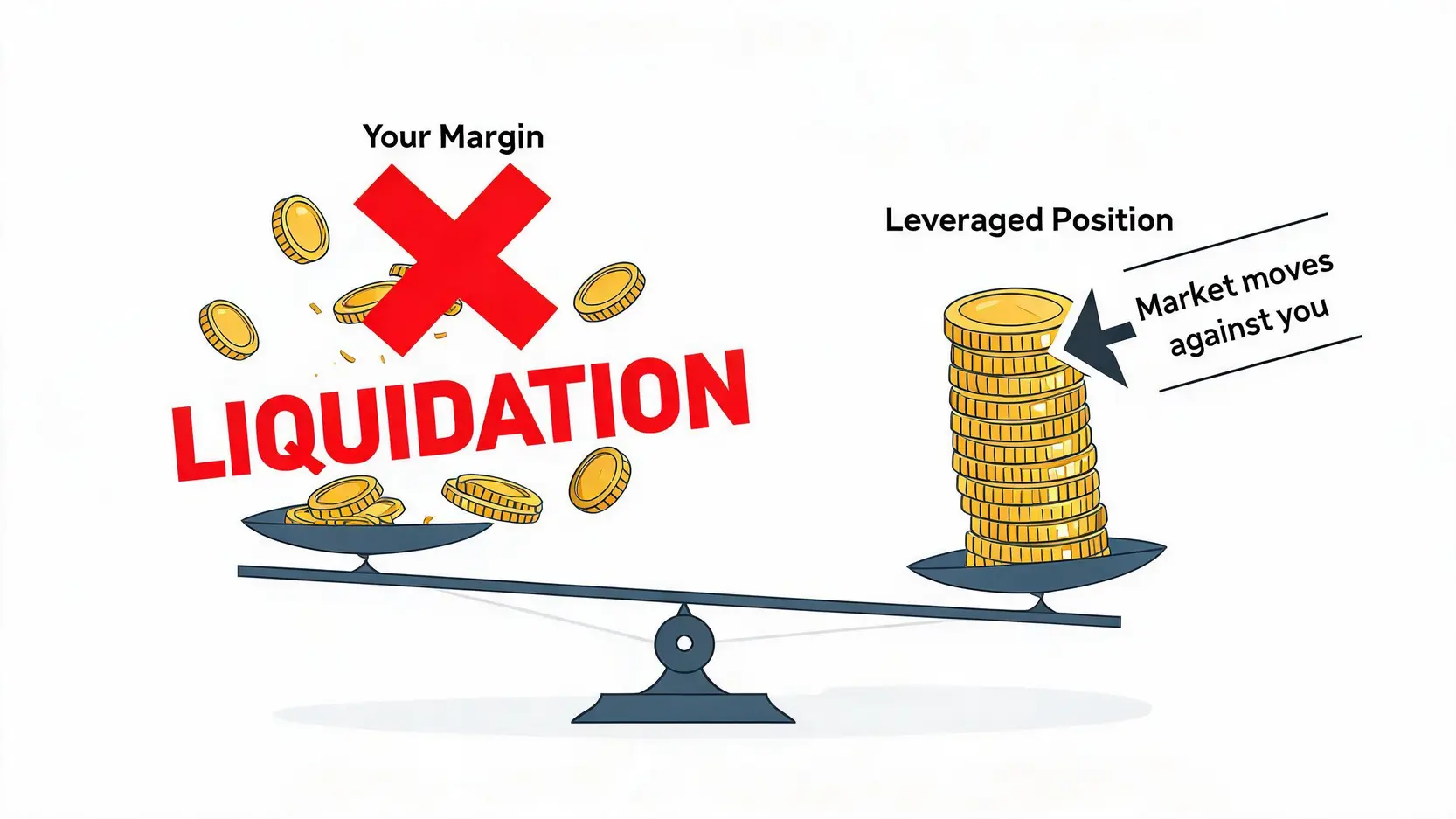
Risk warning: How leverage leads to liquidation
How to Trade XRP Contracts? 5 Steps to Your First XRP Futures Trade
Once you understand the theory, it is time for practical execution. Here is a complete 5-step process to place your first XRP contract trade.
Step 1: Choose a Suitable XRP Futures Trading Platform (Security, Fees, Liquidity)
Choosing a reliable platform is the foundation of successful trading. You need to evaluate the following factors comprehensively:
- Security and regulation: Check the platform’s security record and regulatory compliance.
- Fees: Trading fees and funding rates directly affect profitability.
- Liquidity: Higher liquidity reduces slippage and improves execution.
- User experience: A beginner-friendly interface and customer support are important.
Step 2: Account Setup, Deposit, and Fund Transfer
The typical process includes:
- Registration and verification: Register using an email address or mobile number, and complete identity verification (KYC), which usually requires uploading identification documents.
- Deposit funds: You can buy crypto via credit card, bank transfer, or transfer cryptocurrencies (such as USDT or BTC) from other wallets into your spot account.
- Fund transfer: Within an exchange, funds are typically divided into spot accounts, futures accounts, and wealth management accounts. You need to manually transfer funds from the “spot account” to the “futures account” or “derivatives account” before you can start trading.
Step 3: Understanding the Futures Trading Interface (Open/Close, Take-Profit/Stop-Loss Settings)
At first glance, the futures trading interface may feel overwhelming, but its core functions are usually very clear:
- Candlestick chart area: Displays real-time XRP price movements.
- Order panel: Where you select order types (market or limit), set leverage, and input position size.
- Position panel: Shows all your open positions, including entry price, position size, margin, and unrealized PnL.
- Order management panel: Allows you to set “take-profit” (TP) and “stop-loss” (SL) orders, which are essential tools for automated risk management.
Step 4: Live Trading Execution: How to Go Long vs. Short
This is the core of trading. Assume you analyze that XRP is about to rise:
- Long: In the order panel, select “Buy/Long”, enter your desired price and quantity, then place the order. When the XRP price rises, you can then select “Sell/Close Position” to profit from the price difference.
Conversely, if you expect XRP to fall:
- Go short: In the order panel, select “sell/short”. This means you are effectively “borrowing” XRP from the platform and selling it at the current price. When the price drops, you buy it back at a lower price and “return it” to the platform, profiting from the difference. This is a professional trading concept, and Investopedia provides a detailed explanation of short selling.
Step 5: Risk Management: How to Set Safe Leverage and Margin Levels
Beginners often make the mistake of using excessively high leverage. A practical guideline is:
- Start with low leverage: It is recommended that beginners start with 3–5x leverage to understand market behavior before gradually increasing exposure.
- Control position size: The loss on a single trade should not exceed 1–2% of your total capital. This requires calculating position size based on your stop-loss level.
- Use isolated margin mode: Most platforms offer “cross margin” and “isolated margin” modes. In isolated margin mode, the loss of a single position is limited to its allocated margin, preventing it from affecting other funds in your futures account, making it more suitable for beginners.
Further Reading (Highly Recommended)
2026 Hong Kong Cryptocurrency Exchange Ultimate Ranking: Safest Platforms for Buying Crypto with HKD
Top 5 XRP Futures Trading Platform Recommendations and Comprehensive Comparison
There are many exchanges in the market. Here, based on the needs of different users, we recommend the top platforms across five categories. This XRP futures trading platform recommendation can help you quickly find the option that best suits you.
Evaluation Criteria: Fees, Liquidity, Security, Chinese Language Support
Our selection is mainly based on the following four dimensions to ensure the recommended platforms combine practicality and reliability:
- Fees: Including Taker/Maker fees for opening and closing positions, as well as funding rates for overnight holdings.
- Liquidity: Measures market depth and bid-ask spread. The higher the liquidity, the lower the trading cost.
- Security: The platform’s historical security record, Proof of Reserves (PoR), and regulatory compliance status.
- Chinese Language Support: The localization level of the interface and app, as well as the responsiveness and professionalism of Chinese customer service.
Platform Recommendation 1: Beginner-Friendly Copy Trading Platform
Features: These platforms focus on “copy trading”, allowing beginners to one-click replicate the strategies of top traders. Their interfaces are usually very simple, lowering the learning curve. For investors who do not want to deeply study technical analysis but still want to participate in the market, this is an excellent entry-level option.
- Advantages: Simple operation, strong social features, and the ability to learn from experienced traders.
- Disadvantages: Copy trading carries execution delay risks, and it is necessary to carefully evaluate the true performance of traders. Fees may be slightly higher.
Platform Recommendation 2: Global Leading, Fully Featured Platform
Features: These are usually among the top-ranked global cryptocurrency exchanges. They offer the most comprehensive range of XRP derivatives (such as perpetual and quarterly contracts), with top-tier liquidity and extremely low slippage. In addition, they provide advanced features such as API access and grid trading bots, making them suitable for professional traders.
- Advantages: World-class liquidity, powerful features, and competitive fees.
- Disadvantages: The interface is feature-heavy and may not be very beginner-friendly.
Platform Recommendation 3: Established, Compliant, and Secure Asset Platform
Features: These platforms have a long operating history and place strong emphasis on compliance and security. They may hold financial licenses in multiple countries or regions and regularly publish Proof of Reserves. While their trading features or asset selection may not be as extensive as others, they are preferred by conservative investors who prioritize fund safety above all else.
- Advantages: Extremely high security, strong compliance, and well-protected user funds.
- Disadvantages: Leverage may be more conservative, and trading features are relatively limited.
Summary Comparison Table: Advantages and Disadvantages of Each Platform at a Glance
| Platform Type |
Core Advantages
|
Potential Disadvantages |
Suitable Users |
| Beginner Copy Trading Type |
One-click copy trading, user-friendly interface |
Relatively high fees, requires screening of traders |
Beginners, users with no time for analysis |
| Fully Featured Type |
Top-tier liquidity, rich features |
Complex interface, steep learning curve |
Professional traders, high-frequency traders |
| Security and Compliance Type |
Asset security, strict regulatory compliance |
Lower leverage, fewer trading features |
Risk-averse users, large capital investors |
Frequently Asked Questions (FAQ)
Q: How much capital is needed at minimum to trade XRP futures?
A: In theory, the starting capital can be very low. Many exchanges may allow a minimum order size of just a few US dollars. However, considering risk management and the need to maintain positions, it is recommended to prepare at least 100 USDT to start. This gives you enough room to set stop-loss orders and avoid forced liquidation due to normal market fluctuations.
Q: Is XRP derivatives trading high risk? How can risks be effectively managed?
A: Yes, due to the presence of leverage, XRP derivatives trading is considered a high-risk investment. Effective risk management includes: 1) Using reasonable low leverage; 2) Strictly setting stop-loss orders to keep single-trade losses within an acceptable range; 3) Never going all-in on a single trade; 4) Continuously learning and improving your trading strategy and mindset.
Q: Do profits from XRP futures trading need to be taxed?
A: This depends on the tax regulations of your country or region. For example, in some regions, crypto trading income may be classified as part of personal income tax. In Hong Kong, if trading is considered a business activity, it may be subject to profits tax. It is recommended to consult a local tax professional for the most accurate information.
Q: If XRP price goes to zero, how much can you earn from shorting?
A: If you short XRP and its price drops from your entry price to zero, your theoretical return would be 100% (excluding leverage). If leverage is used, for example 10x, your return would be close to 1000%. However, a complete drop to zero is an extreme scenario. A more realistic approach is to set a practical take-profit target.
Conclusion
In summary, XRP derivatives provide investors with a flexible tool to capture opportunities in a volatile market. From this complete XRP derivatives guide, analysis of Ripple futures strategies, to the final XRP futures trading platform recommendations, the core goal is to help you build a solid knowledge foundation and risk awareness. The trading journey is not achieved overnight and always involves risk. The key to success lies in choosing a safe and reliable platform and consistently prioritizing fund management and risk control. Now you can select the most suitable trading platform based on your own needs and carefully begin your first Ripple futures trade.