Coinbase TAS Guide: Trade at Settlement Strategy

Coinbase TAS Feature Complete Guide: Master the Trade at Settlement Trading Strategy in One Article
Have you ever, when executing large cryptocurrency trades, often struggled with slippage caused by sharp market price fluctuations? Or wanted to execute trades precisely at the official daily settlement price, but did not know where to start? If you relate to the above, then you should not miss Coinbase’s professional-grade feature, Trade at Settlement (TAS). This article will break down this institutional-level trading tool in detail, starting from the basic concept of “What is Trade at Settlement” to a step-by-step Coinbase TAS feature tutorial, and finally provide three tactical-level TAS trading strategy applications, helping you fully master it and use it to improve your investment win rate.
What is Trade at Settlement (TAS)? A Deep Dive into the Core Concept
For many professional traders, being able to trade at a recognized benchmark price is crucial. TAS (Trade at Settlement) is an order type designed for this purpose. It allows traders to place orders during the trading session and execute them at the official “settlement price” published by the exchange after the trading day ends. This means you are not trading at the current market price, but locking in a future price benchmark with public credibility.
Official Definition and Mechanism of TAS
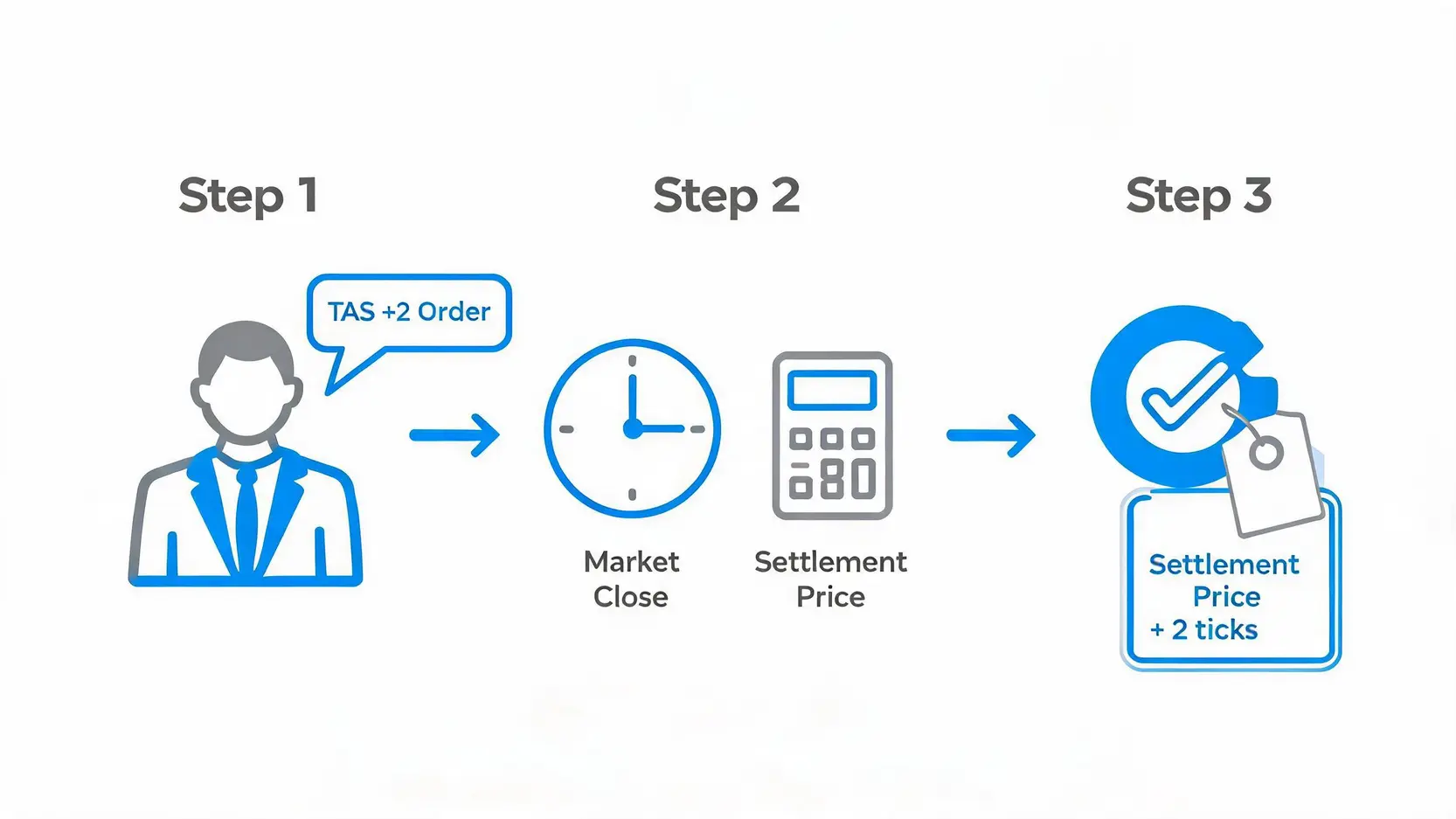
In simple terms, the mechanism of a TAS order is “place first, price later”. When placing an order, traders do not specify a concrete price. Instead, they specify a “tick” relative to the final settlement price. This tick can be positive, negative, or zero. For example:
- TAS 0: You want to execute at the final settlement price of the day.
- TAS +2: You are willing to buy or sell at “settlement price + 2 minimum tick sizes”. This is usually used when you strongly want execution.
- TAS -1: You want to buy or sell at “settlement price – 1 minimum tick size”.

Illustration: The “Place First, Price Later” Process of TAS Orders
The exchange calculates the official settlement price after market close each day based on rules such as volume-weighted average price (VWAP) during a specific time period or other predefined methods. All TAS orders are executed based on this settlement price plus or minus the tick you specified. This mechanism is especially common in futures markets. According to the definition by CME Group, one of the world’s largest derivatives exchanges, TAS trading allows parties to trade based on the yet-to-be-determined futures settlement price of the day, making it an important tool for managing price risk.
Why Do Institutional Investors Prefer TAS Trading?
You may wonder why not simply use the market or limit orders instead of a price that is only “determined in the future”. This is exactly the essence of TAS functionality, which is particularly favored by institutional investors, for three main reasons:
- Reducing Market Impact Cost: When funds or institutions need to execute a large trade (such as millions of dollars in Bitcoin contracts) using a market order can immediately consume a large amount of liquidity and cause significant slippage, increasing trading costs. TAS orders distribute execution around the settlement price formation process, effectively avoiding single-point market impact.
- Precise Benchmark Price Anchoring: Many quantitative funds, index funds, or hedge funds evaluate performance based on daily closing or settlement prices. Using TAS trading ensures their execution costs closely align with this official benchmark, making performance attribution and risk management easier.
- Simplified Execution Process: For strategies that require daily position adjustments, TAS provides a standardized execution method. Traders do not need to constantly monitor the market before close or chase prices manually. They only need to submit a TAS order, which will automatically be executed at the settlement price, greatly improving operational efficiency.
How Are TAS, Limit Orders, and Market Orders Different? One Table for Clarity
To help you better understand the differences between TAS and traditional order types, we have summarized the comparison below:

Illustration: The “Place First, Price Later” Process of TAS Orders
The exchange calculates the official settlement price after market close each day based on rules such as volume-weighted average price (VWAP) during a specific time period or other predefined methods. All TAS orders are executed based on this settlement price plus or minus the tick you specified. This mechanism is especially common in futures markets. According to the definition by CME Group, one of the world’s largest derivatives exchanges, TAS trading allows parties to trade based on the yet-to-be-determined futures settlement price of the day, making it an important tool for managing price risk.
Why Do Institutional Investors Prefer TAS Trading?
You may wonder why not simply use the market or limit orders instead of a price that is only “determined in the future”. This is exactly the essence of TAS functionality, which is particularly favored by institutional investors, for three main reasons:
- Reducing Market Impact Cost: When funds or institutions need to execute a large trade (such as millions of dollars in Bitcoin contracts) using a market order can immediately consume a large amount of liquidity and cause significant slippage, increasing trading costs. TAS orders distribute execution around the settlement price formation process, effectively avoiding single-point market impact.
- Precise Benchmark Price Anchoring: Many quantitative funds, index funds, or hedge funds evaluate performance based on daily closing or settlement prices. Using TAS trading ensures their execution costs closely align with this official benchmark, making performance attribution and risk management easier.
- Simplified Execution Process: For strategies that require daily position adjustments, TAS provides a standardized execution method. Traders do not need to constantly monitor the market before close or chase prices manually. They only need to submit a TAS order, which will automatically be executed at the settlement price, greatly improving operational efficiency.
How Are TAS, Limit Orders, and Market Orders Different? One Table for Clarity
To help you better understand the differences between TAS and traditional order types, we have summarized the comparison below:

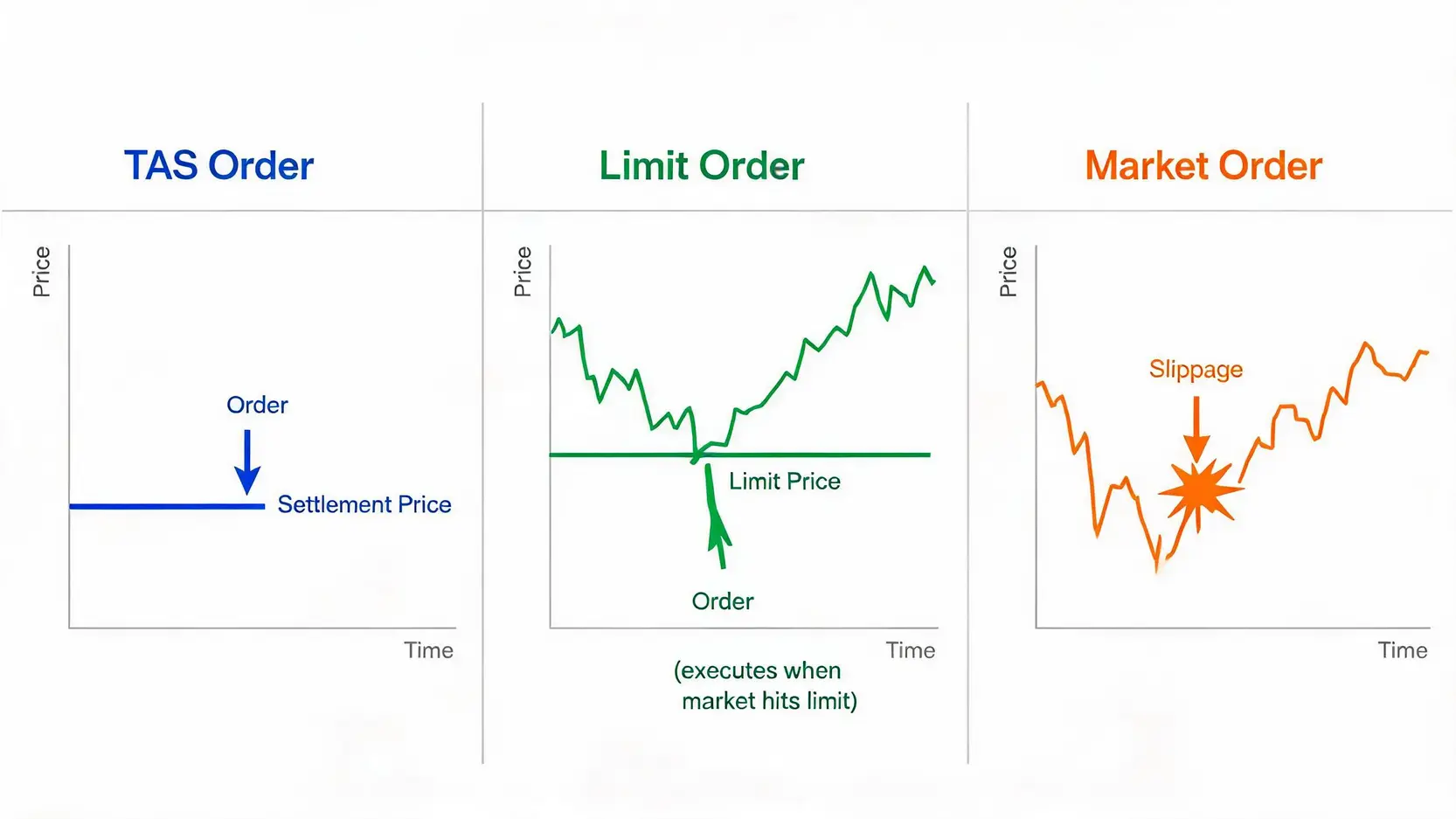
Core Differences of Three Order Types: TAS vs. Limit Order vs. Market Order
| Features | Trade at Settlement (TAS) | Limit Order | Market Order |
| Execution Price | Official daily settlement price +/- specified tick | Executed at the specified price or a better price | Executed immediately at the current best available market price |
| Execution Certainty | High (as long as a settlement price exists in the market) | Uncertain (will not execute if the price is not reached) | Very high (as long as there is market liquidity) |
| Slippage Risk | None (relative to the settlement price) | None (but there is a risk of non-execution) | High (especially during high volatility or when market depth is insufficient) |
| Use Cases | Large trades, hedging, arbitrage, anchoring to closing price | Cost-sensitive trades, not urgent to execute | Prioritizing speed, urgent execution trades |
Coinbase TAS Feature Detailed Guide: How to Enable and Operate It on the Platform?
After understanding the core concept of TAS, we will now move into the practical section and show you how to use the TAS feature on Coinbase, a top-tier cryptocurrency exchange. This feature is typically available on its derivatives platform and is an advanced tool for professional traders.
Prerequisites and Eligibility for Enabling TAS
First, you need to understand that TAS is not available to all users. Generally, the requirements include:
- Account Type: Usually requires a Coinbase Prime, Coinbase Institutional account, or a Coinbase Derivatives (formerly FairX) trading account with approved eligibility.
- KYC/AML Verification: Must complete the highest level of identity verification and compliance review.
- Trading Experience: The platform may require users to have a certain level of derivatives trading experience.
If you meet the requirements, you can usually find “TAS” in the order type selection on the trading interface. If it is not available, it is recommended to contact Coinbase customer support to confirm the activation process.
Further Reading (Highly Recommended)
Arbitrage trading strategy guide: 5 major arbitrage opportunities and core formulas explained
Step-by-Step Guide: How to Place a TAS Order on Coinbase Derivatives
Once you have confirmed your TAS trading permission, the order process is very straightforward:
- Login and Navigate: Log in to your Coinbase account and go to the “Derivatives” trading page.
- Select Contract: Choose the futures contract you want to trade from the product list, such as BTC (bitcoin) or ETH (Ethereum) perpetual or delivery contracts.
- Open Order Panel: Click the order type dropdown menu in the trading interface.
- Select TAS Type: Choose “TAS” or “Trade at Settlement” from the list.
- Set Tick Value: In the price field, enter your desired tick value. For example, “0” means you want to execute at parity (the settlement price itself), while “-1” means you want to buy one tick below the settlement price.
- Enter Quantity: Input the number of contracts you want to trade.
- Confirm and Submit: Double-check all order details, then click “buy/long” or “sell/short” to submit the order. The order will remain pending until the closing settlement price is generated and then executed.
TAS Trading Fee Structure and Settlement Timing
Fee Structure: TAS order fees are generally the same as other derivatives orders (such as limit orders) on the platform. They vary depending on your account tier and monthly trading volume. Fees are calculated based on the final executed notional value (settlement price × quantity).
Settlement Time: Each futures contract has a specific daily settlement time. For example, CME Bitcoin futures typically settle at 4 PM London time. You need to check the exact specifications of the contract you are trading on Coinbase Derivatives to confirm the precise settlement price calculation time. All TAS orders are executed after this settlement time.
Three TAS Trading Strategy Applications and Case Analysis
Now that you understand both theory and execution, where can TAS actually be used in real trading strategies? Here are three classic applications.
Strategy 1: Precise Hedging of Futures Positions
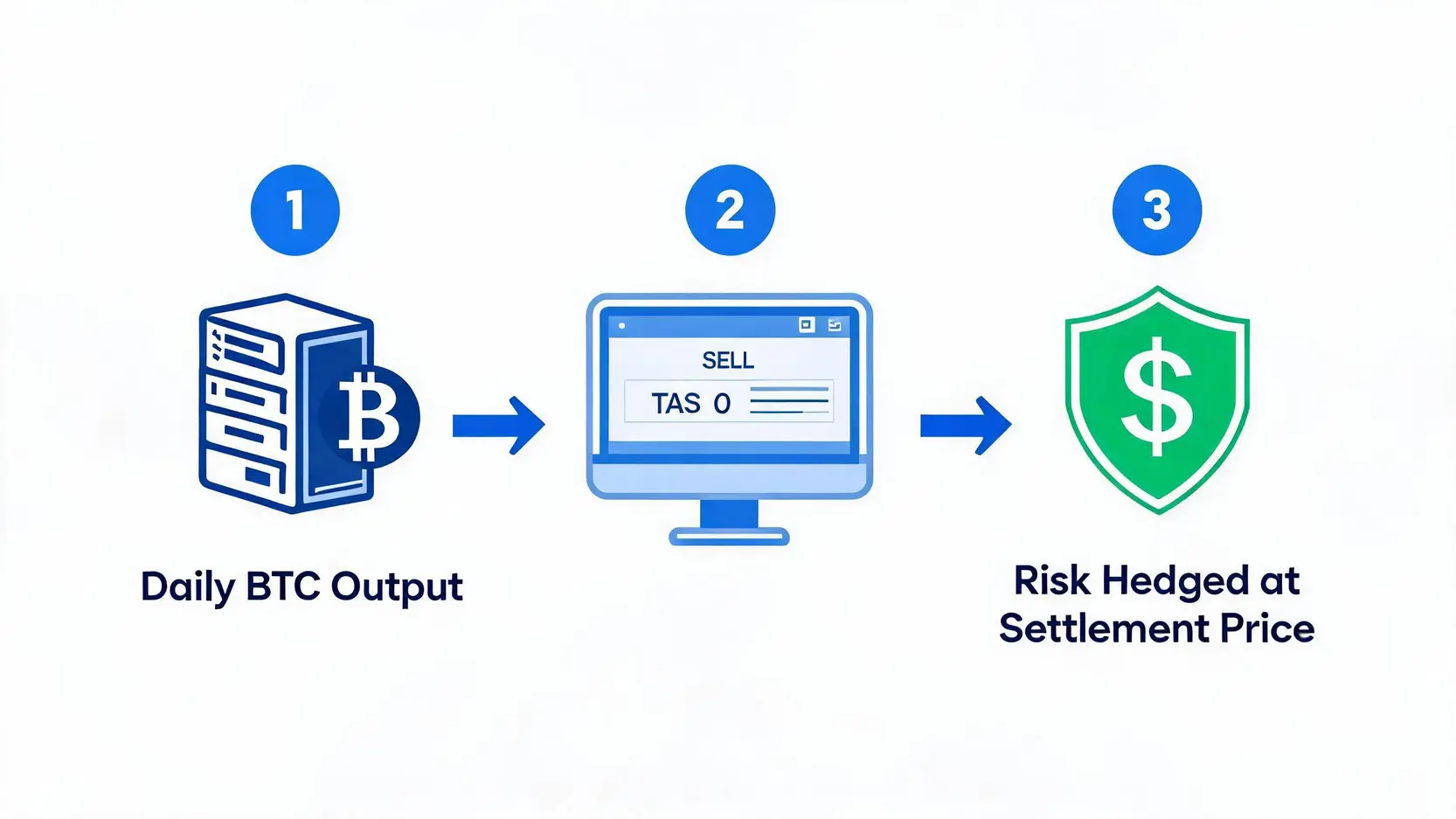
Scenario: Suppose you are a cryptocurrency miner who produces 10 BTC daily. To lock in profit and hedge against price drops, you need to sell equivalent futures contracts at a fixed time each day.
Problem with traditional methods: Using market orders before close may cause slippage due to insufficient liquidity, while limit orders may fail if price is not reached.

Strategy 1 Application: Using TAS Orders to Achieve Standardized Daily Hedging
TAS Strategy Application: You can place a fixed daily TAS 0 order to sell 10 BTC equivalent futures contracts. In this way, regardless of how the market fluctuates during the day, your hedge position can be precisely established at the official settlement price, perfectly locking in the fair value of the day and making your risk management more standardized and predictable.
Strategy 2: Executing Index Arbitrage or Basis Trading
Scenario: Basis refers to the difference between futures prices and spot prices. Many quantitative traders specialize in basis trading, which involves arbitrage when the basis is too wide or too narrow. For example, when BTC futures trade at a significant premium to spot, traders can “short futures while going long an equivalent amount of spot” to capture profits from basis convergence.
TAS Strategy Application: To precisely capture the end-of-day basis condition, traders can place a TWAP (Time-Weighted Average Price) order in the spot market targeting the closing price, while simultaneously placing a TAS 0 short order in the futures market. Since both orders are anchored to the closing/settlement price, execution price risk can be significantly reduced, allowing traders to lock in a purer basis profit. This is a professional arbitrage trading strategy.
Further Reading (Highly Recommended)
Strategy 3: Managing Market Volatility During Major News Releases
Scenario: When major economic data (such as US CPI) or significant industry news (such as Bitcoin spot ETF approval) is released, the market often experiences short-term sharp and chaotic volatility. At this time, neither market orders nor limit orders can guarantee predictable execution outcomes.
TAS Strategy Application: If you believe a piece of news is fundamentally bullish in the long term but do not want to chase prices or face chaotic spreads immediately after the announcement, you can place a TAS buy order in advance. This allows you to avoid the irrational volatility in the first few minutes or half hour after the news release and instead enter at the final settlement price after the market has absorbed the information. This is a more disciplined “wait for the market to stabilize before entering” strategy.
Advantages and Potential Risks of Using Coinbase TAS
No trading tool is perfect, and TAS is no exception. Before using it, it is important to fully evaluate its pros and cons.
Advantages: Reduced Slippage Risk and Predictable Trading Costs
- Zero slippage (relative to settlement price): Your execution price deviation from the benchmark (settlement price) is effectively zero, completely eliminating execution slippage.
- Reduced market impact: Ideal for executing large orders without creating immediate price pressure in the market.
- Predictable costs: Trading costs consist only of fees, without additional hidden costs caused by slippage.
- Simplified execution: Especially suitable for daily hedging or portfolio rebalancing strategies that require routine execution.
Risks: Settlement Price Uncertainty and Periodic Liquidity Constraints
- Unknown settlement price: At the time of placing the order, you do not know the final settlement price. If extreme market movements occur before close, the settlement price may differ significantly from expectations.
- Liquidity risk: Although TAS is designed to mitigate liquidity issues, in extreme conditions, there may not be sufficient counterparties at certain tick levels (such as TAS+2), which may result in partial execution or non-completion.
- Non-immediate execution: TAS orders are only executed after the market closes, making them unsuitable for short-term strategies that require immediate market entry opportunities.
Frequently Asked Questions (FAQ)
Q: Can all Coinbase users use the TAS feature?
A: No. TAS is typically an advanced feature designed for institutional clients, professional traders, or high-tier users who have passed specific eligibility reviews. It is mainly available on Coinbase’s derivatives platform. Regular spot trading users usually cannot access this feature.
Q: Which cryptocurrencies or futures products support TAS trading?
A: TAS is mainly supported for highly liquid major futures contracts, such as Bitcoin (BTC) and Ethereum (ETH) perpetual contracts or standard futures contracts. Not all derivatives listed on Coinbase support TAS orders. Availability depends on the options provided in the trading interface.
Q: What happens if no settlement price is generated on that day?
A: This is a very rare extreme scenario, usually occurring only during major technical failures or severe market disruptions. In such cases, the exchange will have contingency procedures. Typically, TAS orders will be canceled. The exact handling rules should refer to the official trading rule documentation of Coinbase Derivatives.
Q: Can TAS orders be placed at any time during the day?
A: Yes, you can submit TAS orders at any time during the trading session of the contract. However, these orders will only be executed after the trading session ends and the official settlement price is published. Before the settlement time, you can modify or cancel your TAS orders at any time.
Conclusion
In summary, Coinbase’s TAS feature provides professional investors and institutional participants with a powerful and precise trading tool. It effectively reduces slippage risk in large-scale transactions and allows traders to build and execute strategies around the daily settlement price as a core benchmark. From hedging and risk management to complex arbitrage strategies, TAS plays an indispensable role. Through this guide, you should now have a clear understanding of Trade at Settlement, its operating mechanism, execution process, and practical applications. If you are eligible, you may log in to your Coinbase account and explore the TAS feature to elevate your trading strategy to a new level.
Related Articles
-
Practical Applications of Volatility Surfaces: From Options Modeling to Advanced Skew Trading Strategies In options markets, implied volatility is never a flat line. Instead, it forms complex "smile" or "skew" surfaces. For advanced traders, mastering the practical applications of volatility surfaces is equivalent to possessing a lens that reveals market...2026 年 6 月 3 日
-
Building a Foreign Capital Flow Copy Trading Model: A Stock Market Indicator for Accurately Tracking Institutional Positioning In Asia-Pacific stock markets, foreign capital inflows and outflows often determine the direction of the index. However, simply looking at daily net buy and sell data is no longer enough. Only by building...2026 年 6 月 3 日
-
Options Buyer Strategies During Extreme Market Conditions: Black Swan Hedging and Cross-Market Arbitrage During Volatility Surges The most terrifying aspect of financial markets is not a gradual decline, but overnight flash crashes and cross-market capital withdrawals accompanied by volatility surges. In the highly unpredictable global macroeconomic environment of 2026, geopolitical...2026 年 6 月 3 日