Margin Liquidation: Causes & 5 Risk-Avoidance Tips

Updated: 2026/04/07  |  CashbackIsland

what-is-margin-call-liquidation

What Is Margin Liquidation? A Complete Guide to Forced Liquidation Causes and 5 Risk-Avoidance Strategies

In the investment market, especially in margin trading, the most dreaded term is “liquidation”. Many beginners and even experienced investors, unfamiliar with the meaning of liquidation and the mechanics of forced liquidation, can lose all their capital overnight. In reality, by thoroughly understanding the causes and risks of leveraged trade liquidation, you can effectively avoid disaster. This article explains in clear terms what margin liquidation is, analyzes its underlying causes, and provides five practical risk-avoidance strategies to help you navigate leveraged trading more steadily and successfully. 


What Are Liquidation and Forced Liquidation? Core Definitions at a Glance

To survive in margin trading, the first step is to understand the basic rules of the game. When a broker’s risk system detects that your account equity has fallen below a certain threshold, it triggers a protective mechanism, this is where “liquidation” and “forced liquidation” come into play. 


Meaning of Liquidation: Why Can Your Assets “Vanish”?

Liquidation (or Blown Account) refers to a situation in leveraged trading where, due to extreme market price fluctuations, the investor’s margin can no longer meet the minimum requirement for open contracts. Simply put, your losses have grown large enough to wipe out all your invested principal (or even more). At this point, your account equity drops to zero or becomes negative, effectively “exploding”, with all invested funds gone.

The essence of liquidation is that losses exceed your capacity to bear them, resulting in the cancellation of your trading privileges. It is one of the most painful outcomes in investing.


Mechanism of Forced Liquidation: How Brokers Automatically Close Your Trades

Forced liquidation (also called “forced close”) is an automated risk management measure executed by brokers or trading platforms to prevent further losses and avoid investors incurring debts beyond their account balance. It is the specific action carried out during the liquidation process.

When your “margin maintenance ratio” falls to the broker’s minimum level (for example, 20% or 0%), the system automatically sells your positions at the market price without your consent, freeing up margin and preventing your account equity from turning negative. This process is extremely fast, often occurring instantly during volatile market movements, leaving investors with almost no time to react.


Clarifying Key Terms: Liquidation vs. Forced Close vs. Margin Top-Up

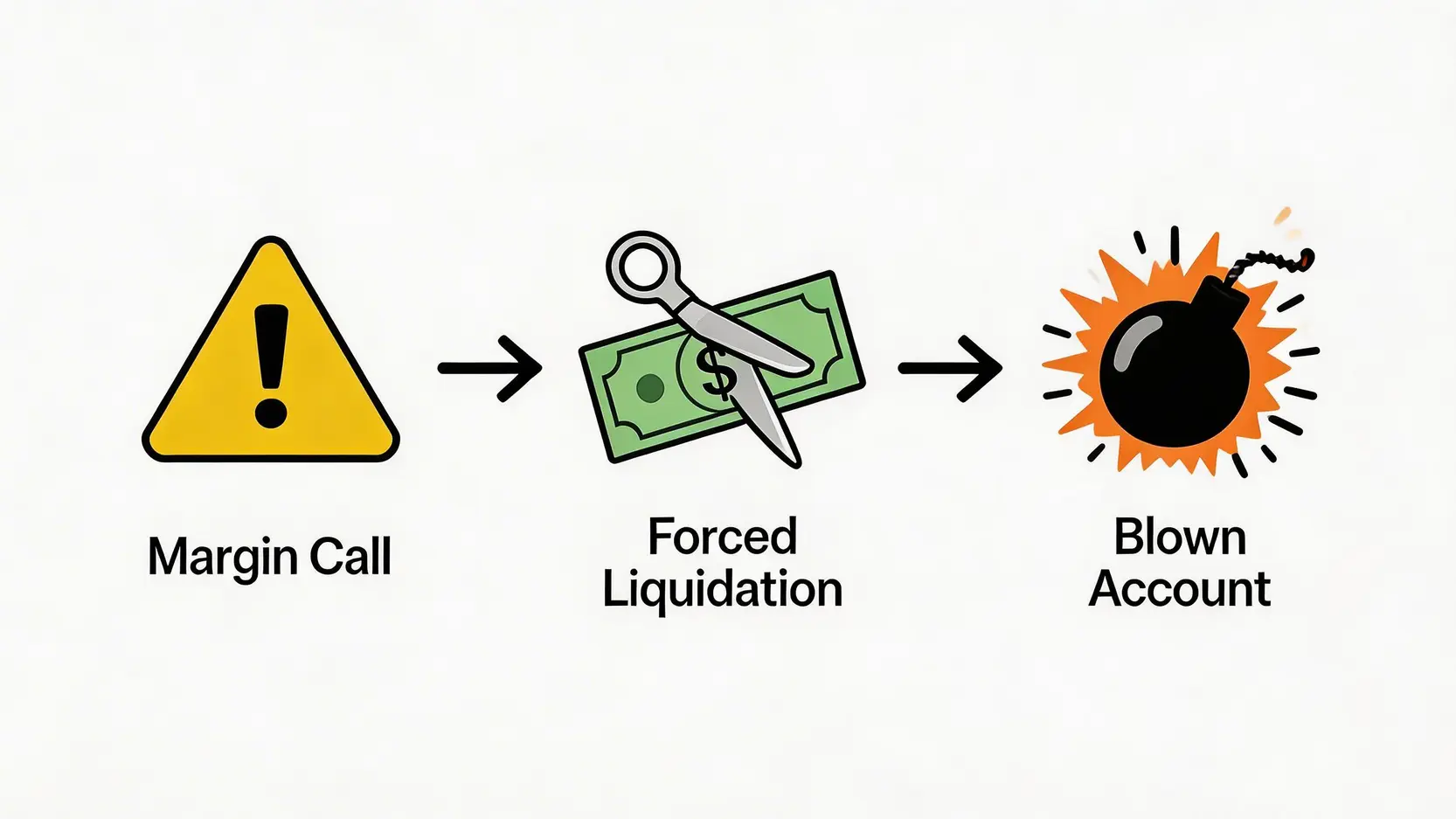
These three terms are often used interchangeably, but they represent different stages of risk escalation. Understanding their sequence and relationship is crucial for timely response.


Terminology English Stage Meaning Investor Response

Margin Top-Up (Margin Call)

Margin Call Stage One (Alert)

When account equity falls below the “maintenance margin” requirement, the broker issues a warning, requesting you to add funds or reduce positions.

Deposit additional funds or proactively close some positions.
Forced Close (Forced Liquidation) Forced Liquidation / Stop Out Stage Two (Execution) If the margin is not topped up within the deadline, or if severe market fluctuations cause account equity to reach the “forced liquidation level”, the broker’s system automatically closes positions. Usually, no action is possible, and the result must be passively accepted.
Liquidation Blown Account / Liquidation Final Outcome

All margin in the account is lost, and account equity drops to zero or becomes negative.

Investment has failed, and funds must be redeposited before trading can resume.

一張流程圖,展示從補倉通知到強制平倉再到爆倉的風險升級三階段。

From Alert to Conclusion: The Escalating Risks of Margin Trading


Why Does Margin Trading Liquidation Occur? Breaking Down the 3 Main Culprits

Liquidation rarely results from a single cause; it is usually the outcome of multiple factors combined. Understanding these risk culprits is key to avoiding repeating the same mistakes.


Further Reading (Highly Recommended)

Essential Margin Trading Guide: 5 Key Strategies to Avoid Leverage Risks and Forced Liquidation Tragedies

How to Reduce Investment Risk? 5 Risk Management Strategies and Diversified Investment Tutorials


Risk Culprit One: Overusing Leverage (High Leverage Ratio)

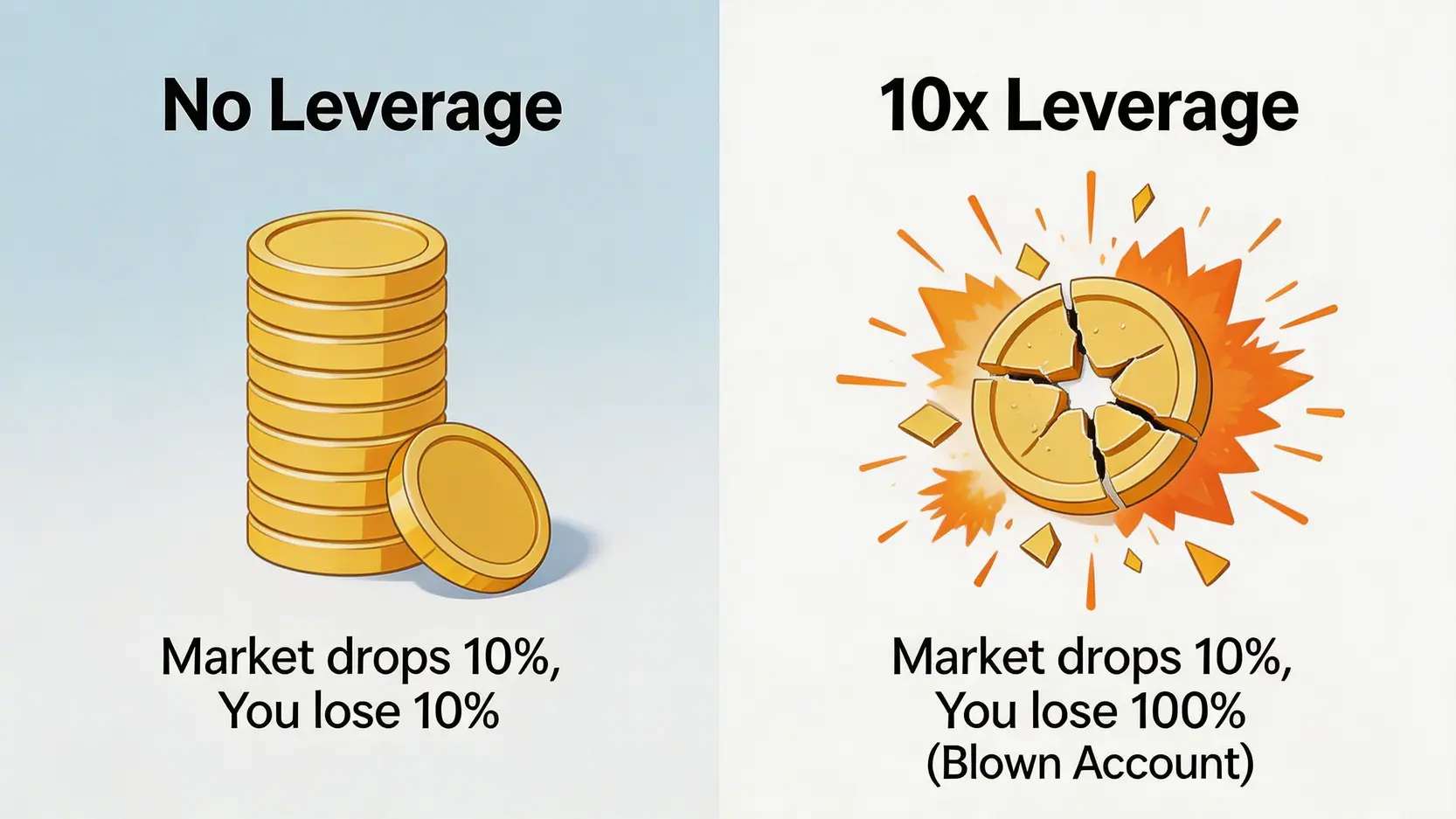
Leverage is a double-edged sword: it can amplify your potential profits but equally magnify your losses. Many novice investors get excited by high leverage (such as 10x, 20x, or higher), seeing it as a shortcut to quick wealth, while overlooking the risks. For example:

  • Scenario: You have $10,000 in capital and open a position with 10x leverage, buying assets worth $100,000.
  • Risk Analysis: In this case, the market only needs to move 10% against you (10% of $100,000 = $10,000), and your entire capital is wiped out, directly causing liquidation. Without leverage, a 10% market drop would only result in a $1,000 loss.

Overusing leverage means your positions have extremely low tolerance for small market fluctuations, making forced liquidation highly likely.

一張對比圖,顯示在市場下跌10%時,無槓桿交易僅損失10%,而10倍槓桿交易則會損失100%,導致爆倉。

Leverage as a Double-Edged Sword: The Same Market Movement, Completely Different Outcomes


Risk Culprit Two: Insufficient Margin Level and Calculation Method

Margin Level is the core indicator of your account’s health, calculated as:

Margin Level (%) = (Equity / Used Margin) x 100%

  • Equity: The real-time total value of your account, including capital and unrealized P&L.
  • Used Margin: Funds locked to maintain existing positions.

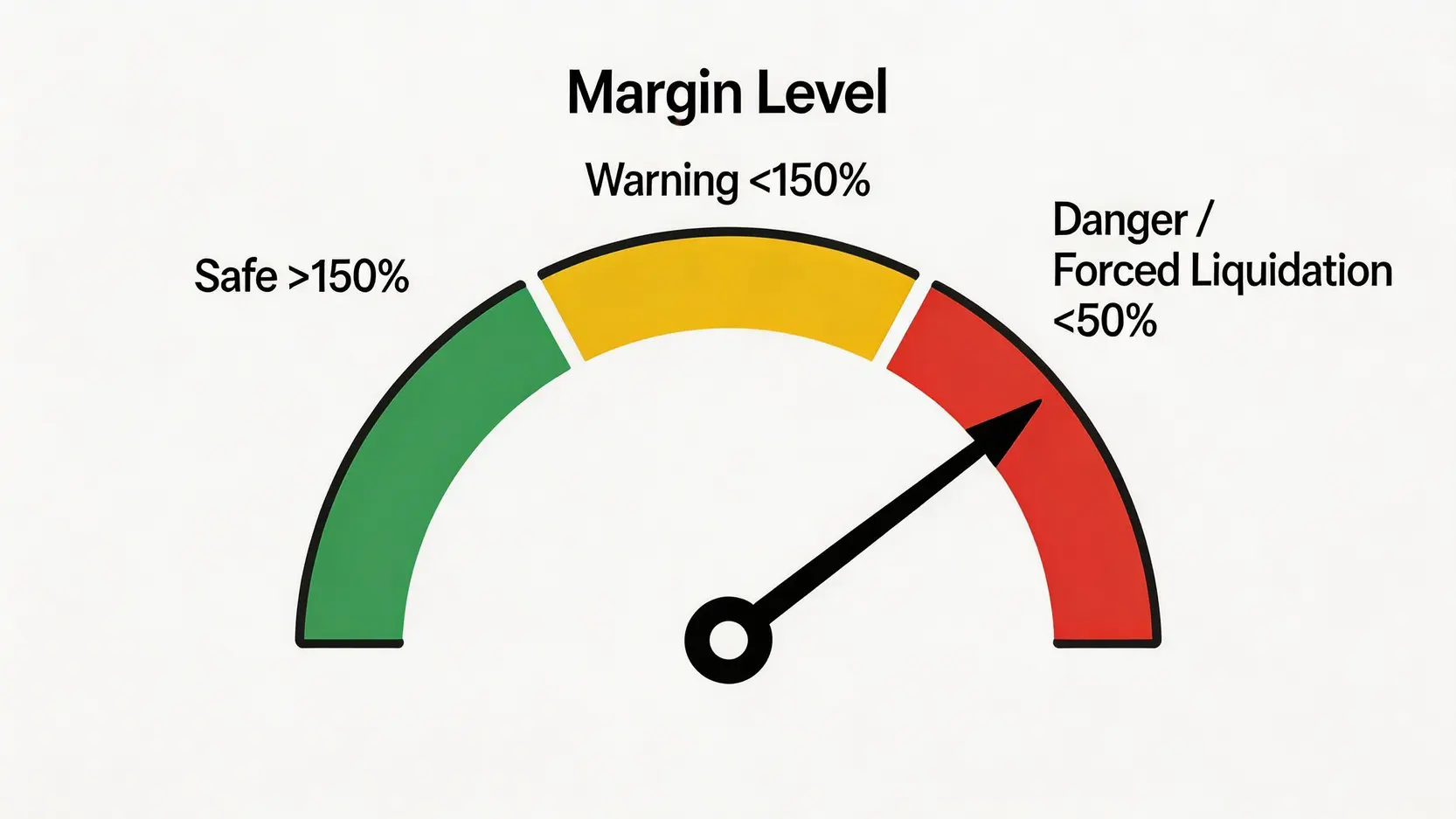
When market prices move unfavorably, your “Equity” decreases, lowering the margin level. Once this ratio falls below the broker’s forced liquidation threshold (e.g., 50%), the system starts closing your positions. Not understanding this calculation is like driving without checking the dashboard which is extremely dangerous.

一個概念示意圖,將保證金水平比喻為一個儀表盤,分為安全(綠色)、警告(黃色)和危險(紅色)三個區域。

Account “Health Bar”: Monitor Your Margin Level Constantly


Risk Culprit Three: Severe Volatility Triggered by Market Black Swan Events

Unexpected events always occur in the market. A “Black Swan Event” refers to extremely rare and unpredictable events that, once they happen, have a disruptive impact. Examples include:

  • The 2008 Financial Crisis
  • The 2015 Swiss Franc Unpeg Event
  • The 2020 COVID-19 Pandemic Triggering Global Market Circuit Breakers

In these extreme conditions, markets can experience double-digit percentage drops or spikes within minutes, sometimes with price gaps. Pre-set stop-losses may be completely bypassed, causing losses far beyond expectations and instantly triggering margin liquidation.


How to Effectively Avoid Forced Liquidation? 5 Essential Self-Rescue Strategies for Investors

Rather than panicking when receiving a margin call, it is better to establish a comprehensive risk management system from the start. The following five strategies are iron rules every margin trader should internalize.


Strategy One: Control Leverage and Position Size Reasonably

Do not be tempted by high leverage. For beginners, it is recommended to start with low leverage (e.g., 2x to 5x), and a single trade’s position should not exceed 5% of total capital. This means that even if the trade is completely lost, your loss is only a small portion of your total assets, leaving enough capital to recover. Always remember: surviving in the market is more important than chasing huge profits.


Strategy Two: Set and Strictly Follow Stop-Loss Levels

Stop-loss is the most important tool to protect yourself from catastrophic losses. Before opening any position, you must ask yourself: “If the market moves against me, what is the maximum loss I am willing to accept?” This price point is your stop-loss.

  • Setting Principle: Stop-loss should be based on technical analysis (e.g., support/resistance levels) or the maximum loss amount you can personally tolerate.
  • Strict Execution: Discipline is the hardest part. Once set, do not move or cancel the stop-loss unless there is a compelling reason. Many liquidation tragedies occur due to the mindset of “let’s wait, maybe it will rebound”.


Strategy Three: Constantly Monitor Margin Maintenance Ratio

Make it a habit to check your account’s margin level daily, especially for overnight positions or during periods of high market volatility. Most trading platforms use prominent colors (like yellow or red) to warn about margin levels. Treat it as your account’s “health bar”. Once it falls below 150%, stay alert and consider reducing positions or adding funds.


Strategy Four: Avoid Heavy Trading During High Market Volatility

During major economic data releases (e.g., US nonfarm payrolls, central bank interest rate decisions) or sudden news events, market uncertainty is extremely high, and prices fluctuate sharply. Although opportunities may exist, risks are equally significant. For investors with low risk tolerance, prudent actions include:

  • Lower trading positions
  • Temporarily stay out of the market and wait for clear direction before entering

Do not gamble on market direction in the eye of the storm; this is not investing, it is gambling.


Strategy Five: Prepare Extra Funds for Margin Calls

Always keep a reserve fund outside your trading account. This money is not for opening new positions but for quickly depositing into your account when you receive a margin call, boosting your margin level and avoiding forced liquidation. This gives you more time to reassess the market and decide whether to hold or manually close positions at a better moment. This reserve fund is your “lifeline” and should only be used when absolutely necessary.


Further Reading (Highly Recommended)

Essential Margin Trading Guide: 5 Key Strategies to Avoid Leverage Risks and Forced Liquidation Tragedies

How to Reduce Investment Risk? 5 Risk Management Strategies and Diversified Investment Tutorials


Margin Trading Liquidation FAQ

Q: Will I owe money after a liquidation?

A: It depends on whether your broker offers “Negative Balance Protection”. Brokers with this protection ensure your losses will never exceed your account balance. Even in a liquidation, your account can at most drop to zero, without owing money. However, if the broker does not have this policy, extreme market gaps may cause forced liquidation prices to deviate significantly from trigger prices, potentially resulting in a negative account balance, which you would then need to repay to the broker.

Q: How is cryptocurrency contract liquidation different from stock margin liquidation?

A: The core principle is the same forced liquidation occurs due to insufficient margin. The main differences are: 1. Volatility: Cryptocurrency markets operate 24/7 with far higher volatility than stock markets, making liquidations more frequent. 2. Leverage: Crypto contracts often offer much higher leverage than stock margin trading, up to 100x or more, greatly increasing risk. 3. Regulation: Stock markets are more strictly regulated, with tighter margin requirements, whereas crypto derivatives markets are comparatively less restricted.

Q: What should I do after receiving a margin call?

A: A margin call is a warning. You have three options: 1. Add funds: Immediately deposit enough capital to restore your margin level to a safe zone. This is the most direct solution. 2. Reduce positions: Sell part of your holdings to lower used margin and increase your margin level. Prioritize closing the largest losing or most uncertain positions. 3. Do nothing: This is the worst choice; if the market continues to move against you, forced liquidation will occur quickly.

Q: I set a stop-loss, so why was I still liquidated?

A: This usually happens during a “price gap”. For example, after a weekend closure, Monday’s opening price may jump past your stop-loss, executing it at a worse price than expected, resulting in a larger loss. Additionally, if your stop-loss is too close to the liquidation level or your position is too large, minor slippage can still trigger a liquidation.


Conclusion: Mastering Liquidation Risks for Safer Trading

Understanding the “meaning of liquidation” is essential for every margin trader. Liquidation is not unavoidable; the key is to fully comprehend the “mechanism of forced liquidation” and establish a rigorous risk management strategy. By using leverage responsibly, strictly following stop-loss rules, and constantly monitoring account health, you can significantly reduce liquidation risk, making your investments a tool for wealth growth rather than a nerve-wracking gamble. 

If you liked this article, please share it!

Related Articles

  • Volatility Surface Guide: Skew Trading Strategies
    Practical Applications of Volatility Surfaces: From Options Modeling to Advanced Skew Trading Strategies In options markets, implied volatility is never a flat line. Instead, it forms complex "smile" or "skew" surfaces. For advanced traders, mastering the practical applications of volatility surfaces is equivalent to possessing a lens that reveals market...
    2026 年 6 月 3 日
  • Foreign Capital Flow Model: Track Institutional Money
    Building a Foreign Capital Flow Copy Trading Model: A Stock Market Indicator for Accurately Tracking Institutional Positioning In Asia-Pacific stock markets, foreign capital inflows and outflows often determine the direction of the index. However, simply looking at daily net buy and sell data is no longer enough. Only by building...
    2026 年 6 月 3 日
  • Options Buying Strategies for Extreme Market Risks
    Options Buyer Strategies During Extreme Market Conditions: Black Swan Hedging and Cross-Market Arbitrage During Volatility Surges The most terrifying aspect of financial markets is not a gradual decline, but overnight flash crashes and cross-market capital withdrawals accompanied by volatility surges. In the highly unpredictable global macroeconomic environment of 2026, geopolitical...
    2026 年 6 月 3 日
返回顶部