US Stock Short Selling Guide: 4 Methods & ETFs

Updated: 2026/03/03  |  CashbackIsland

美股沽空教學:4大沽空美股方法懶人包(含反向ETF推薦)

US stocks have experienced a bull market lasting several years, but market sentiment is unpredictable, and the risk of correction always exists. Have you ever considered that profit opportunities can also be found in a falling market? Many investors are only accustomed to going long (Buy Low, Sell High), thereby missing the profit potential during market downturns, or they do not know how to effectively hedge the risk of their existing positions. This article will provide an in-depth breakdown of the core concept of “US stock short selling” and present four mainstream methods of shorting US stocks, including the most suitable US stock short selling ETF for beginners, helping you easily master investment tools in a bear market and make your portfolio both offensive and defensive. 


What Is US Stock Short Selling?

Short selling (Short Selling), also known as selling short or going short, is an investment strategy that anticipates a decline in the price of an asset. Contrary to the traditional “buy low, sell high”, the core operation of short selling is “sell high, buy low”, earning the price difference in between. It is not only a speculative tool, but also an important risk management instrument.


The Basic Principle of Short Selling: Borrow First, Sell, Then Buy Back at a Lower Price

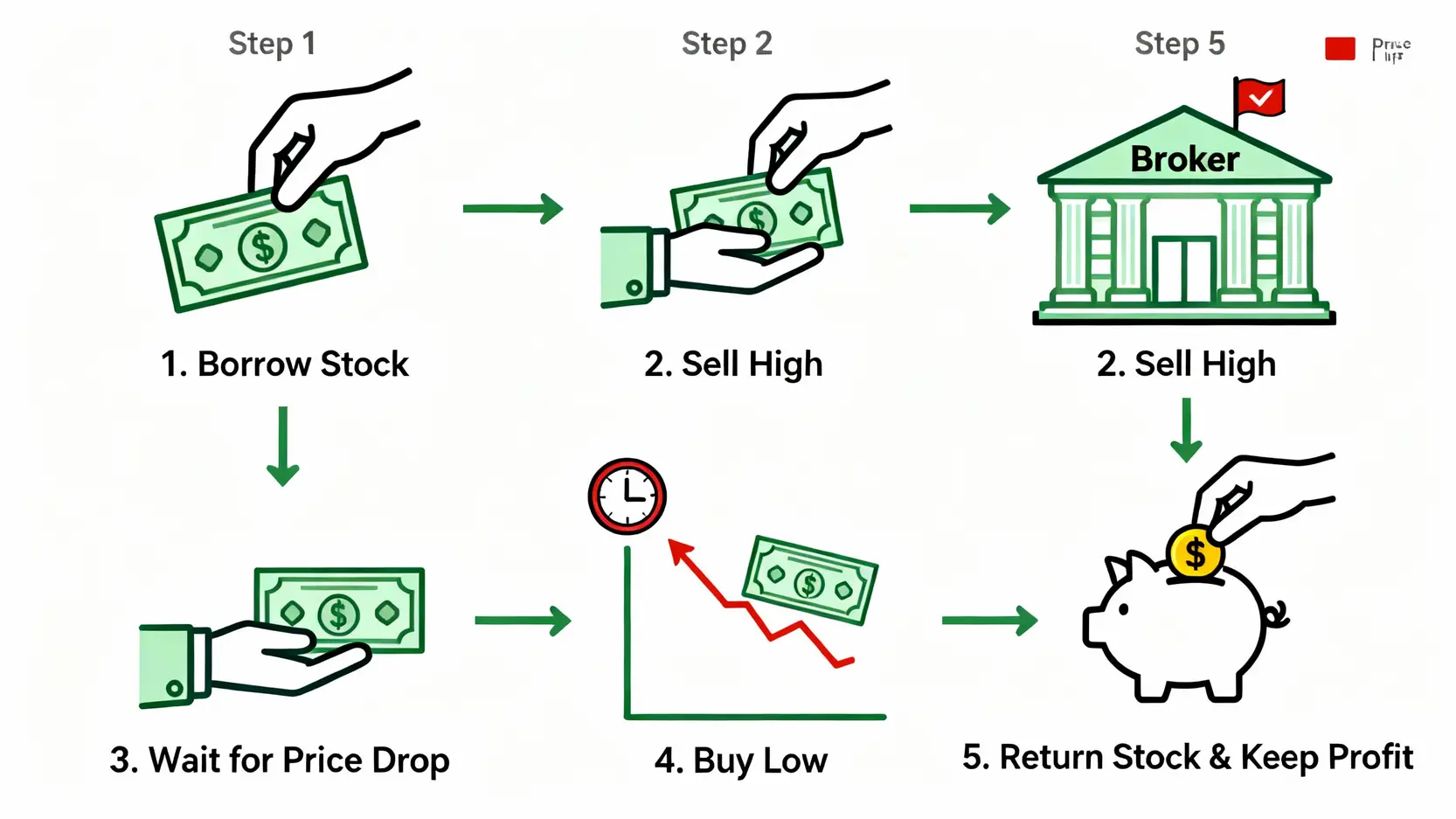
Imagine you believe that a certain stock (for example, AAPL) is currently priced too high at $200 and expect it to decline in the short term. You can proceed as follows:

  1. Borrow shares: You borrow 100 shares of AAPL from your broker. At this point, you do not actually own these shares, but have borrowed them temporarily.
  2. Sell shares: You immediately sell the 100 shares in the market at $200 per share, receiving $20,000 in cash.
  3. Wait for the price to fall: As expected, AAPL falls to $150.
  4. Buy back shares: You repurchase 100 shares of AAPL in the market at $150 per share, with a total cost of $15,000.
  5. Return shares: You return the 100 shares to the broker to complete the transaction.

In this process, your profit is the amount received from selling minus the amount spent on buying back: $20,000 – $15,000 = $5,000 (excluding transaction costs and interest). This is the basic logic of profiting from short selling.

沽空原理五步驟流程圖,從向券商借入股票,高價賣出,等待價格下跌,低價買回,到最後歸還股票賺取差價。

The Core Logic of Short Selling: Borrow First, Sell at a High Price, Then Buy Back at a Lower Price to Capture the Price Difference


Why Short US Stocks? Speculative Profit and Risk Hedging

Investors short US stocks mainly for two purposes:

  • Speculative profit: When analysis suggests that a company’s fundamentals are deteriorating, the industry outlook is bleak, or the overall market is in a bear phase, investors actively short in anticipation of profiting from a falling stock price.
  • Hedging Risk: Suppose you hold a basket of technology stocks for the long term but are concerned about a short-term market correction. In this case, you can short a technology index (such as the Nasdaq 100 Index) to hedge the downside risk of your holdings. If the market declines, the losses from your stock holdings may be partially or fully offset by the profits from your short position.


Comparison and Guide to 4 Mainstream Methods of Shorting US Stocks

To short US stocks, selling shares directly is not the only option. Below are four common methods of shorting US stocks, each with its own advantages and disadvantages, suitable for investors with different risk tolerances.


Method 1: Directly Short Individual Stocks (Securities Lending)

This is the most traditional method of short selling, namely the “borrow and sell” approach described above.

  • How it works: Investors need to open a margin account with a broker and apply to borrow specific shares for sale.
  • Advantages: Straightforward and directly linked to the performance of the individual stock.
  • Disadvantages: Extremely high risk, with theoretically unlimited losses (as stock prices can rise indefinitely). In addition, securities lending interest must be paid, and not all stocks are readily available to borrow.


Method 2: Buying Put Options (Put Options)

Buying a put option grants you the “right”, but not the “obligation”, to sell a stock at a specific price within a specified future period.

  • How it works: By paying a premium, you purchase a put option contract on a particular stock. If the stock price falls below your strike price, you may exercise the right to profit.
  • Advantages: Maximum loss is limited to the premium paid. No need to borrow shares and flexibility is high.
  • Disadvantages: Options are subject to time decay. If the stock price does not decline as expected before expiration, your premium may be entirely lost. For beginners, understanding options pricing and strategies involves a certain learning curve.


Method 3: Buying US Stock Short Selling ETFs (Inverse ETFs)

For investors who do not wish to operate complex derivatives or assume unlimited risk, purchasing inverse ETFs is an excellent choice and can be regarded as a simplified short selling method.

  • How it works: Simply buy the ticker symbol of an inverse ETF directly in your securities account, just like trading ordinary stocks.
  • Advantages: Risk is controllable, and the maximum loss is limited to your invested capital. No margin account is required, and trading is convenient. It can track broad market indices for hedging purposes.
  • Disadvantages: Most inverse ETFs track “daily” returns. Long-term holding may result in decay due to compounding effects and management fees.


Method 4: Using Contracts for Difference (CFD)

A Contract for Difference (CFD) is a financial derivative that allows you to trade on the price movement of an asset without actually owning the asset.

  • How it works: On a platform that supports CFD trading, you directly open a sell position on the relevant stock or index.
  • Advantages: High leverage ratios, efficient use of capital, and the ability to go long or short.
  • Disadvantages: High leverage implies high risk, and losses may exceed your initial margin. CFD regulation varies significantly across different regions, so investors must choose platforms carefully.

四種主流沽空美股方法的風險與複雜度對比圖,包含沽空ETF、看跌期權、直接沽空個股和差價合約。

Short Selling Method Quadrant Chart: Beginners Should Start With Low-Complexity, Limited-Risk Short Selling ETFs

Short Selling Method Maximum Risk Level of Complexity Suitable Investors
Directly Short Individual Stocks Theoretically Unlimited Moderate Professional Investors
Buy Put Options Limited (Premium) High Investors Familiar With Derivatives
Purchase Short Selling ETFs Limited (Principal) Low Beginners, Conservative Investors
Contracts for Difference (CFD) May Exceed Principal High Short-Term Traders Able to Tolerate High Risk


[Top Choice for Beginners] In-Depth Analysis of US Stock Short Selling ETFs

For most retail investors who want to profit from a falling market or hedge risk, US stock short selling ETFs are undoubtedly the most accessible tools. They simplify the short selling process, allowing you to execute it easily through a regular securities account. 

What Is an Inverse ETF?

An inverse ETF, also known as a short ETF or bear market ETF, is designed to deliver returns opposite to the index it tracks. For example, a -1x inverse ETF that tracks the S&P 500 Index, if the S&P 500 Index falls by 1% on a given day, the ETF’s net asset value will theoretically rise by 1% (excluding fees).

There are also leveraged inverse ETFs in the market, such as -2x or -3x, which aim to provide two or three times the inverse daily return of the index. For example, SQQQ is a -3x inverse ETF tracking the Nasdaq 100 Index.


Popular US Stock Short Selling ETF Recommendations

Below are some highly liquid and widely favored US stock short selling ETFs, covering the major US stock indices:

ETF Ticker

ETF Name

Tracked Index

Leverage Ratio
SQQQ ProShares UltraPro Short QQQ Nasdaq 100 Index -3x
PSQ ProShares Short QQQ Nasdaq 100 Index -1x
SH ProShares Short S&P500 S&P 500 Index -1x
SDS ProShares UltraShort S&P500 S&P 500 Index -2x
DOG ProShares Short Dow30 Dow Jones Industrial Average -1x


Advantages and Hidden Risks of Short Selling ETFs (Decay Issue)

Advantages:

  • Limited risk: The maximum loss is 100% of your invested principal, with no risk of margin calls.
  • Ease of operation: The trading method is exactly the same as ordinary stocks/ETFs.
  • High transparency: The tracked index and holdings are relatively transparent.

Hidden Risk – Volatility Decay:

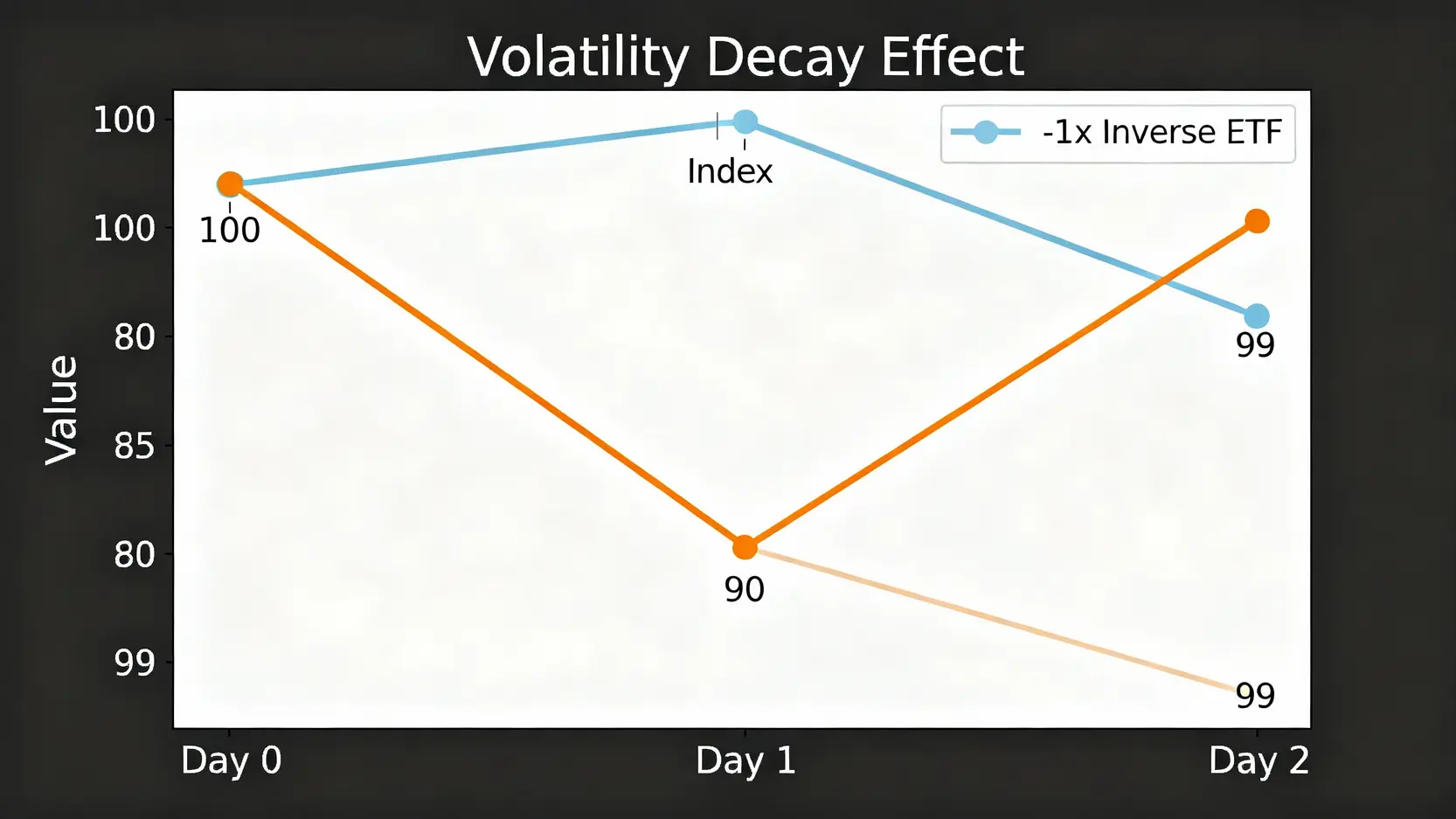
This is the most critical point to note when investing in short selling ETFs. Because ETFs rebalance daily (Daily Rebalancing) to maintain a fixed leverage ratio, long-term holding in a volatile market can result in significant value erosion. Consider a simple example:

Assume an index rises 10% on the first day and falls 10% on the second day. The index ultimately becomes 100 * (1+10%) * (1-10%) = 99, representing a 1% loss.

A -1x inverse ETF would fall 10% on the first day and rise 10% on the second day. Its net asset value becomes 100 * (1-10%) * (1+10%) = 99, also reflecting a 1% loss!

Under such back-and-forth market conditions, regardless of whether the index ultimately rises or falls, the value of an inverse ETF will gradually be eroded. Therefore, inverse ETFs are more suitable for short-term trading rather than long-term holding.

反向ETF耗損效應示意圖,展示在震盪市場中,指數和反向ETF的淨值即使在價格回歸後也會雙雙下跌。

Value Erosion in Volatile Markets: Even if the index ultimately falls by only 1%, an inverse ETF may still incur losses due to daily rebalancing.


Main Risks and Key Considerations of Shorting US Stocks

Short selling is a double-edged sword. While it can generate profits in a falling market, its potential risks are far greater than those of traditional long strategies. Before committing capital, be sure to understand the following core risks.


Risk 1: Theoretically Unlimited Losses

This is the most fatal risk associated with “directly shorting individual stocks”. When you buy a stock, the lowest it can fall is $0, and your maximum loss is 100%. However, when you short a stock, its theoretical upside is unlimited. If the price rises from $50 to $500, your loss would be an astonishing 900%.


Risk 2: Risk of a Short Squeeze

When a heavily shorted stock suddenly surges due to certain positive news, it may trigger a “short squeeze”. Short sellers, in order to limit their losses, are forced to buy back shares (cover their positions). This buying pressure further pushes the stock price higher, creating a vicious cycle that can result in substantial losses for short sellers within a short period. The 2021 GameStop (GME) incident remains the most classic example of a short squeeze.


Risk 3: Securities Lending Interest and Cost Expenses

Direct short selling requires the payment of securities lending interest. For popular short targets, due to limited supply and high demand for borrowing, interest costs may be extremely high. In addition, short positions may also need to bear the cost of stock dividends. These expenses will continuously erode your potential profits.


Conclusion

In summary, US stock short selling is an indispensable investment and hedging tool for mature investors in a declining market trend. The four main methods, directly shorting stocks, put options, inverse ETFs, and CFDs, each have their own applicable scenarios and risk-return characteristics. For the vast majority of retail investors or those unwilling to assume unlimited risk, starting with US stock short selling ETFs, which offer relatively controllable risk and simple execution, is a wise first step into short selling. Regardless of which method of shorting US stocks is adopted, one must act cautiously after fully understanding its operating principles and potential risks, and always prioritize risk management. 

FAQ – Frequently Asked Questions About Shorting US Stocks

Q: What qualifications or accounts are required to short US stocks?

A: If you wish to directly short individual stocks or engage in options trading, you typically need to open a “margin account” and may be required to meet specific asset or trading experience requirements set by the broker. If you only intend to buy and sell US stock short selling ETFs, a standard securities account is sufficient, with a relatively low threshold.

Q: Can I go long and short on the same stock at the same time?

A: Within the same trading account, directly going long and shorting the same stock position will usually offset each other. However, you may achieve a similar effect through different financial instruments. For example, you can hold the underlying shares of a stock (go long) while simultaneously purchasing a put option (Put Option) on that stock to hedge downside risk.

Q: Can short selling ETFs be held long term?

A: Long-term holding is strongly not recommended, especially for leveraged short selling ETFs. Due to the “volatility decay” caused by daily compounding effects and management fees, the net asset value of the ETF will decrease over time in a volatile market. These ETFs are designed as short-term trading instruments to capture short-term downward trends.

Q: Is short selling guaranteed to make money?

A: Absolutely not. Short selling is a high-risk investment strategy. Market movements are difficult to predict. Even companies with weak fundamentals may see their stock prices continue to rise for various reasons (such as a short squeeze or market sentiment), resulting in losses for short sellers. Before conducting any short selling operation, a well-planned stop-loss strategy should be in place.

Q: How do I select stocks to short?

A: Selecting short targets is typically based on in-depth fundamental analysis (such as deteriorating financial statements, overvaluation, or industry decline), technical analysis, (such as breaking key support levels or forming bearish patterns) or market sentiment analysis. Beginners are not advised to attempt shorting individual stocks lightly and may start with ETFs that short broad market indices to diversify risk.

If you liked this article, please share it!

Related Articles

  • Volatility Surface Guide: Skew Trading Strategies
    Practical Applications of Volatility Surfaces: From Options Modeling to Advanced Skew Trading Strategies In options markets, implied volatility is never a flat line. Instead, it forms complex "smile" or "skew" surfaces. For advanced traders, mastering the practical applications of volatility surfaces is equivalent to possessing a lens that reveals market...
    2026 年 6 月 3 日
  • Foreign Capital Flow Model: Track Institutional Money
    Building a Foreign Capital Flow Copy Trading Model: A Stock Market Indicator for Accurately Tracking Institutional Positioning In Asia-Pacific stock markets, foreign capital inflows and outflows often determine the direction of the index. However, simply looking at daily net buy and sell data is no longer enough. Only by building...
    2026 年 6 月 3 日
  • Options Buying Strategies for Extreme Market Risks
    Options Buyer Strategies During Extreme Market Conditions: Black Swan Hedging and Cross-Market Arbitrage During Volatility Surges The most terrifying aspect of financial markets is not a gradual decline, but overnight flash crashes and cross-market capital withdrawals accompanied by volatility surges. In the highly unpredictable global macroeconomic environment of 2026, geopolitical...
    2026 年 6 月 3 日
返回顶部