US Rate Cut 2026: Fed Outlook & 5 Stock Strategies

【2026 US Rate Cut Guide for Beginners】Fed Rate Cut Schedule, Full Analysis of 3 Key Conditions, and 5 Beneficiary Stock Investment Strategies
The market is closely watching the Fed’s rate cut moves, but are you confused by the complex US rate cut schedule and the specific conditions that trigger cuts? Worried about missing investment opportunities brought by rate cuts? This article provides a one-stop guide, fully analyzing the 2026 US rate cut schedule, the Fed’s core decision-making criteria for cuts, and exploring the impact on US stocks, finally presenting selected rate cut beneficiary stocks to help you develop the best investment strategy during market shifts.
US Rate Cut Schedule and Fed Key Decision Conditions
Tracking the Fed’s moves is a must for every investor. Rate cuts are not arbitrary; they are based on a series of rigorous economic data and model forecasts. Understanding the specific dates of its meetings and the decision logic behind them allows you to seize opportunities amid market fluctuations.
2026 Latest Fed Meeting Dates and Market Forecasts
The FOMC meetings are the focus of global markets. Below are the known meeting dates for 2026. Investors should closely follow post-meeting statements and speeches by Chair Powell to gain insights into future interest rate policy directions.
| Meeting Month | Meeting Date | Includes Rate Decision |
| January | 27-28 | ✔️ |
| March | 17-18 | ✔️ |
| May |
5-6 |
✔️ |
| June | 23-24 | ✔️ |
| July | 28-29 | ✔️ |
| September | 22-23 | ✔️ |
| November | 3-4 | ✔️ |
| December | 15-16 | ✔️ |
Market Forecast: Currently, the market broadly expects that, if economic data align, the Fed may initiate its first rate cut in the second half of 2026. Predictions for the total number of rate cuts throughout the year vary from one to three, depending mainly on the pace of inflation decline and the cooling of the labor market.
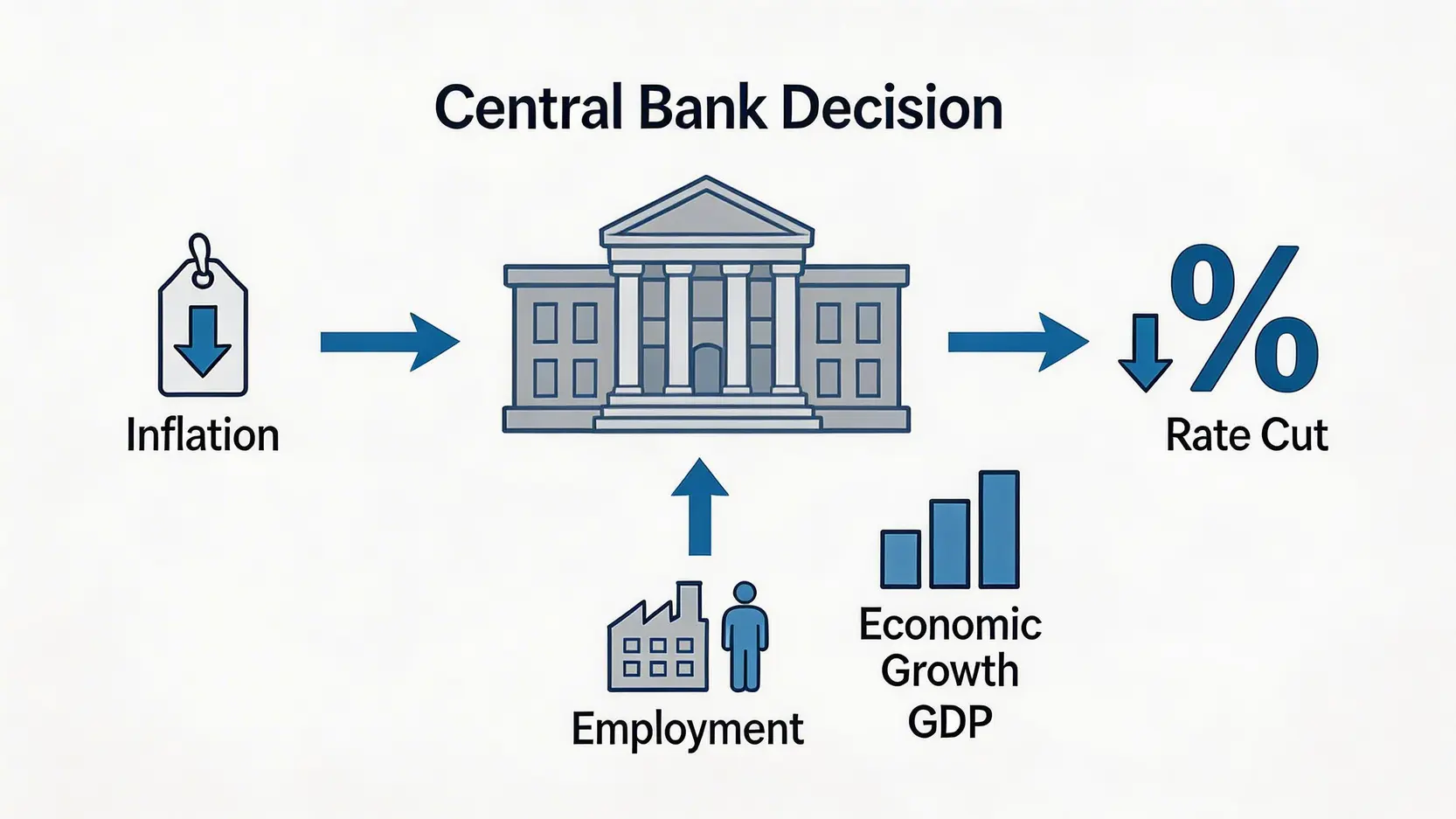
Unveiling the Fed’s Three Core Criteria for Rate Cuts: Inflation, Employment, and Economic Growth
The Fed’s monetary policy has two primary objectives: promoting maximum employment and stabilizing prices. Therefore, decisions on rate cuts focus mainly on the following three core economic indicators:

Three Pillars of the Fed’s Rate Cut Decisions
- 1. Inflation Data: This is the most important observation metric. The Fed targets a long-term inflation rate of 2%, with its preferred reference being the Personal Consumption Expenditures (PCE) price index, particularly the core PCE (excluding food and energy). Only when data clearly indicate that inflation is consistently moving toward the 2% target does the Fed have sufficient confidence to start a rate cut cycle.
- 2. Labor Market: The Fed seeks to see the labor market “normalize” from its previously extreme tightness rather than deteriorate sharply. Key data include:
- Unemployment Rate: A sustained significant rise may force the Fed to cut rates early to support the economy.
- Non-Farm Payrolls: A slowdown in new job creation to sustainable levels is a healthy signal of market cooling.
- Wage Growth: Slower wage growth helps ease the upward spiral pressure on inflation.
- 3. Economic Growth: GDP growth is a gauge of overall economic health. If GDP data indicate a recession risk, the Fed may adopt preventive rate cuts to stimulate demand even if inflation has not fully met the target, avoiding a hard landing. To understand how these macroeconomic data affect markets in depth, refer to the 2025 Forex Fundamental Analysis Ultimate Guide: From Economic Data to Central Bank Decision Practical Teaching
Impact of Rate Cuts on Markets and Investment Strategies for Beneficiary Stocks
Rate cuts are not just a change in interest numbers; they ripple throughout the financial markets, affecting equities and currencies alike. Understanding their transmission mechanism and identifying potential beneficiary stocks is key to positioning for the next bull market.

How Rate Cuts Trigger Market-Wide Reactions
Comprehensive Analysis: How Rate Cuts Affect US Stocks, Hong Kong Stocks, and the US Dollar?
- Impact on US Stocks:
- Lower Borrowing Costs: Reduced corporate financing costs help expand investment and increase profitability, supporting valuations.
- Boost Risk Appetite: Capital flows from low-yield bonds and other fixed-income assets into higher-return equities.
- Stimulate Consumption: Lower mortgage and auto loan rates effectively boost consumer spending, benefiting related companies.
- Overall, rate cut cycles are generally viewed as positive for US equities, particularly favoring growth stocks.
- Impact on Hong Kong Stocks: As the Hong Kong dollar operates under a linked exchange rate system with the US dollar, Hong Kong’s interest rate policy generally follows the US. A US rate cut typically prompts the Hong Kong Monetary Authority to guide market rates downward. This helps reduce borrowing costs for Hong Kong companies and supports the highly rate-sensitive property market, benefiting HK stocks.
- Impact on the US Dollar: Interest rates are a key factor in attracting foreign capital. A US rate cut narrows the rate differential with other major economies, reducing the attractiveness of dollar assets and potentially weakening the US dollar. A weaker dollar benefits US export-oriented companies as their products become more competitively priced overseas.
Further Reading (Highly Recommended)
2026 US Stock CFD Trading Complete Guide: Platform Comparison, Pros and Cons, and Beginner Tutorial!
Expert Recommendation: In-Depth Analysis of Five Beneficiary Stock Sectors in a Rate Cut Cycle
During a rate cut cycle, certain sectors often outperform the broader market. The following are five sectors to focus on:
- Technology: Especially growth-oriented tech companies that rely on financing for R&D and expansion (e.g., software, semiconductors). Lower rates reduce debt burden and increase the discounted value of future cash flows.
- Real Estate Investment Trusts (REITs): Highly sensitive to interest rates. Rate cuts lower financing costs and stimulate property market activity and asset prices, while their relatively high dividends become more attractive in a low-rate environment.
- Utilities: These companies have stable operations, high capital expenditure, and stable dividends. During rate cuts, their high dividend characteristics make them a safe haven for income-seeking capital, performing similarly to bonds.
- Consumer Discretionary: Examples include auto manufacturers, tourism and entertainment, luxury brands. Rate cuts reduce consumer borrowing costs, increase disposable income, and boost demand for discretionary goods and services.
- High-Dividend Stocks: In a falling interest rate environment, companies offering stable and above-average dividends attract yield-seeking investors, creating opportunities for stock price revaluation.
Frequently Asked Questions (FAQ)
Q: If the Federal Reserve cuts interest rates, will Hong Kong banks follow?
A: Most likely yes. As Hong Kong operates under a linked exchange rate system, the Hong Kong dollar is pegged to the US dollar. To maintain exchange rate stability, Hong Kong’s interest rate policy generally needs to stay broadly aligned with the US. When the US cuts rates, the Hong Kong Interbank Offered Rate (HIBOR) usually declines accordingly, and commercial banks tend to lower their Prime Rate as well.
Q: How does a rate cut affect my mortgage?
A: It depends on your mortgage type. If you have an H-plan mortgage linked to HIBOR, your monthly repayment will decrease as rates fall, directly easing your mortgage burden. If you have a P-plan (Prime Rate mortgage), your repayment will also reduce when banks lower their Prime Rate.
Q: What is a “hawkish cut” and is it good or bad for the stock market?
A: A “hawkish cut” is a market term referring to a situation where the Federal Reserve cuts rates but signals a tough stance in its statement or press conference. For example, the rate cut might be smaller than market expectations (e.g., only 0.25% instead of the expected 0.5%), or it may suggest that the cut is a one-time “preventive” measure with no guarantee of further cuts. This usually disappoints the market, as it indicates the easing policy is less aggressive and less persistent than expected, which may cause the stock market to fall instead of rise.
Conclusion
In summary, understanding the US rate cut schedule and the Federal Reserve’s decision conditions is key to investment success in 2026. As the rate cut cycle unfolds, the investment market will face new opportunities and challenges, particularly in the US stock market. This article has analyzed the deep impact of rate cuts on various asset classes and highlighted potential sectors that may benefit. Investors are advised to monitor core economic data such as inflation and employment, and to adjust their portfolios flexibly to capture potential returns from this shift in interest rate policy.
Related Articles
-
Complete Guide to Virtual Asset Trading Platform (VASP) License Applications: A 2026 Hong Kong Web3 Compliance Practical Guide At the pivotal moment of 2026, as global financial digitization accelerates at an unprecedented pace, Hong Kong has firmly established itself as a leading Web3 compliance hub in Asia and around the...2026 年 6 月 3 日
-
2026 Offshore Renminbi Range-Bound Arbitrage Trading Guide: Mastering the CNH-CNY Spread and a Profit Guide to Hedging Through Two-Way Volatility Against the combined influence of global macroeconomic developments and international trade policies, the foreign exchange market in 2026 has become increasingly complex. The Renminbi exchange rate often exhibits a pattern...2026 年 6 月 3 日
-
Friday Taiwan Index Options Buyer Strategies: Precisely Capturing Explosive Market Moves From Non-Farm Payroll Data Many investors often complain that options buyers have low win rates, frequently predicting the direction correctly but ultimately losing to time decay. However, under the new dual-settlement system, short-term volatility and event-driven trading have created...2026 年 6 月 3 日