TWD Time Deposit Rates 2026: 30+ Banks Ranked

Updated: 2026/03/19  |  CashbackIsland

twd-fixed-deposit-rate-comparison

【2026 TWD Time Deposit Interest Rate Comparison】Ranking of 30+ Banks, A Complete Guide to High-Yield Time Deposits, Risks, and Investment Strategies

Facing market volatility and looking for a safe haven for your funds? New Taiwan Dollar time deposits, with their low risk and stable returns, have become a top choice for many conservative investors. But did you know that even small differences in interest rates across banks can lead to significant variations in your interest income? When comparing TWD time deposit rates, it is also crucial not to overlook the potential risks of TWD investments. This article compiles the latest TWD time deposit rates from over 30 banks and provides an in-depth analysis of the risks behind time deposits and how to manage them, helping you choose the most suitable plan and achieve steady asset growth. 


Beginner Guide: What Is a TWD Time Deposit? How Is It Different from a Savings Account?

For beginners entering the world of personal finance, “savings accounts” and “time deposits” are two fundamental concepts. Simply put, the key difference lies in “liquidity” and “interest rates”.

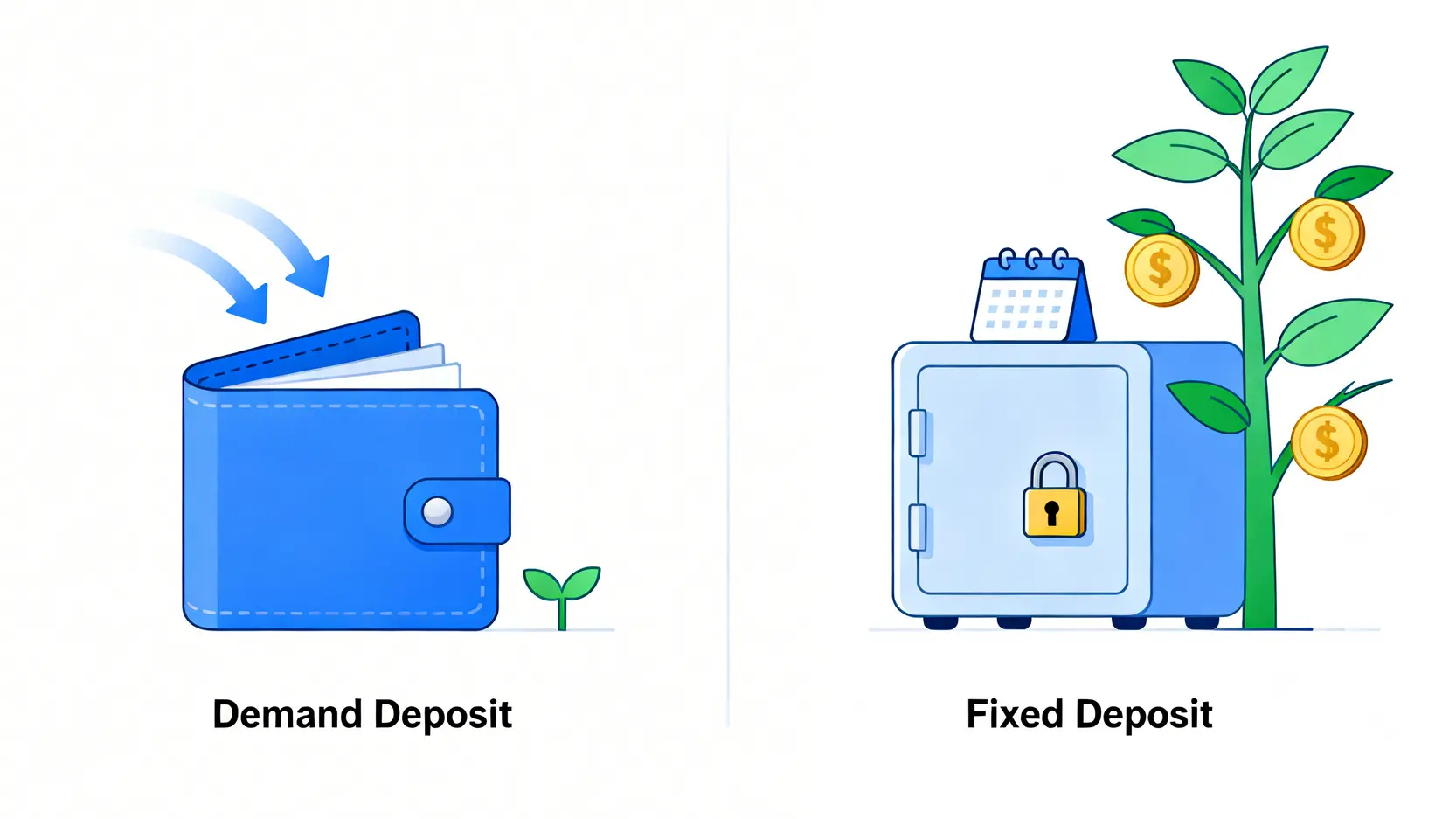
  • Savings account (demand deposit): Funds can be deposited or withdrawn at any time, offering very high liquidity, just like a wallet. However, the drawback is extremely low interest rates, which can hardly keep up with inflation.
  • TWD time deposit (fixed deposit): You agree with the bank on a fixed deposit period (such as one month, one year, or three years). During this period, the funds cannot be freely accessed. In return for “locking in your funds”, the bank offers a much higher interest rate than savings accounts. This is a disciplined way to save and earn stable interest.

活期存款與定期存款的對比圖,顯示活存的資金流動性高但利息低,而定存則是用時間鎖定資金以換取更高收益。

Illustration: Savings accounts prioritize convenience, while time deposits focus on returns, highlighting their distinct characteristics.

In summary, savings accounts emphasize “convenience”, while time deposits emphasize “returns”. Smart investors allocate emergency funds to savings accounts, while placing idle funds that will not be used in the medium to long term into time deposits to earn better interest income.


Definition Explained: Time Deposit vs. Time Savings Deposit

When applying for a time deposit at a bank, you may come across two options: “time deposit” and “time savings deposit”. Although they appear similar, they differ in deposit terms and interest calculation methods, which directly affect your final returns. Understanding the difference between these two is the first step in choosing the best option.

Item Time Deposit Time Savings Deposit
Suitable For Individuals, corporate entities, and organizations are all eligible Limited to individuals (natural persons) and non profit entities
Deposit Term Minimum 1 month, maximum 3 years Minimum 1 year, maximum 3 years
Interest Calculation Method Simple interest calculation (interest is not compounded into principal) Compound interest calculation (interest is reinvested into the principal for further interest calculation)
Interest Rate Level Generally lower Generally higher (due to compound interest calculation)

One sentence summary: If your deposit term is planned to exceed one year, choosing a “time savings deposit” will usually yield higher interest returns, as it uses compound interest and fully leverages the power of “interest on interest”.


Further reading (highly recommended)

Time Deposit Tips Revealed: 5 Ways to Maximize Your Time Deposit Returns and Easily Achieve Compound Growth!

What Is a Time Deposit? A Complete Guide to Interest Withdrawal, Types of Bank Interest, and 2025 Beginner Wealth Management Tips


Interest Rate Selection: Fixed Rate vs. Floating Rate, Which Is More Suitable for You?

After deciding on a time deposit, the next question is choosing between a “fixed rate” and a “floating rate”. This choice determines whether your interest will change when central banks raise or cut rates in the future.

  • Floating Rate: The bank’s listed interest rate will adjust in line with the central bank’s rate decisions. If the market is expected to enter a rate hike cycle, choosing a floating rate allows your deposit interest to increase accordingly, generating higher returns.
  • Fixed Rate: Regardless of future market rate changes, the interest rate remains locked at the level agreed upon at the time of deposit. If rate cuts are expected, locking in a higher current rate with a fixed rate is a smart strategy.

一張流程圖,說明如何根據對未來升息或降息的預期,來選擇固定利率或機動利率的定存方案。

Decision Guide: Choose floating rates when rate hikes are expected, and fixed rates when rate cuts are expected.

Key decision point: Assessing future interest rate trends is crucial. The simplest approach is to observe global economic trends and the stance of Taiwan’s central bank. If inflation pressures are high and rate hikes are expected, choose a floating rate. Conversely, if the economy is slowing and rate cuts are likely, choose a fixed rate. If uncertain, consider splitting your funds, allocating half to fixed rates and half to floating rates to diversify interest rate risk. For a deeper understanding, refer to this detailed analysis on choosing between fixed and floating rates.


【2026 Latest】Comprehensive Comparison Table of TWD Time Deposit Rates Across 30+ Banks in Taiwan

Comparing TWD time deposit rates is the key to maximizing returns. Interest rates vary across banks, and even a 0.1% difference can lead to a significant gap in total interest for large or long-term deposits. Below is a summary of reference rates across major banks in 2026 for your convenience. (Note: The following rates are for reference at the time of writing. Actual rates are subject to official bank announcements.) 

State-Owned Banks vs. Commercial Banks Interest Rate Comparison

In general, state-owned banks are perceived as more reputable and stable, but their interest rates tend to be more conservative. Commercial banks, on the other hand, often offer more competitive rates or promotional plans to attract customers.

Bank Type Bank Name 1 Year Time Savings (Floating) 1 Year Time Savings (Fixed)

Remarks

State-Owned Bank Bank of Taiwan 1.725% 1.750% Highest credibility, benchmark bank
Land Bank of Taiwan 1.725% 1.730% Large number of branches
Taiwan Cooperative Bank 1.715% 1.725% Extensive service network
First Bank 1.725% 1.765% Relatively advantageous fixed rates
Commercial Bank Cathay United Bank 1.700% 1.710% Strong integration of digital services
Fubon Bank 1.710% 1.720% Diverse financial products
E.Sun Bank 1.725% 1.780% Highly competitive fixed rates
Taishin Bank 1.715% 1.725% Richart digital account is well known
DBS Bank 1.730% 1.750% Foreign bank, occasional promotions


Digital Bank High-Yield Savings and Time Deposit Promotions

In recent years, digital-only banks and digital accounts from traditional banks have rapidly emerged. Their biggest selling points are “high-yield savings” and “flexible time deposits”. By saving on the operating costs of physical branches, digital banks are usually able to offer more attractive interest rates than traditional banks, making them especially suitable for younger users who seek higher returns and are comfortable with online services.

  • Next Bank: Frequently offers tiered high-yield savings promotions, where deposits within a certain amount enjoy very high interest rates, while amounts exceeding the limit revert to standard rates.
  • LINE Bank: Focuses on pocket accounts and goal-based accounts, providing short-term high-yield promotions suitable for small and short-term savings plans.
  • Rakuten Bank: Offers relatively competitive time deposit rates and integrates with its ecosystem (such as e-commerce and payments) to provide diversified financial services.
  • Taishin Richart: Although it is a digital account under a traditional bank, its high-yield savings program has long been a market benchmark and is highly popular among younger users.

Note: Promotional offers from digital banks usually come with “time limits” and “amount caps”. Be sure to carefully read the terms and conditions before applying to ensure you can fully benefit from the promotion.


Not Just Capital Preservation! 3 Major Potential Risks of TWD Time Deposits

Although TWD time deposits are considered one of the safest wealth management tools, “low risk” does not mean “no risk”. Understanding the potential risks of TWD investments can help you make more comprehensive asset allocation decisions. 

Risk 1: Inflation May Erode Your Real Returns

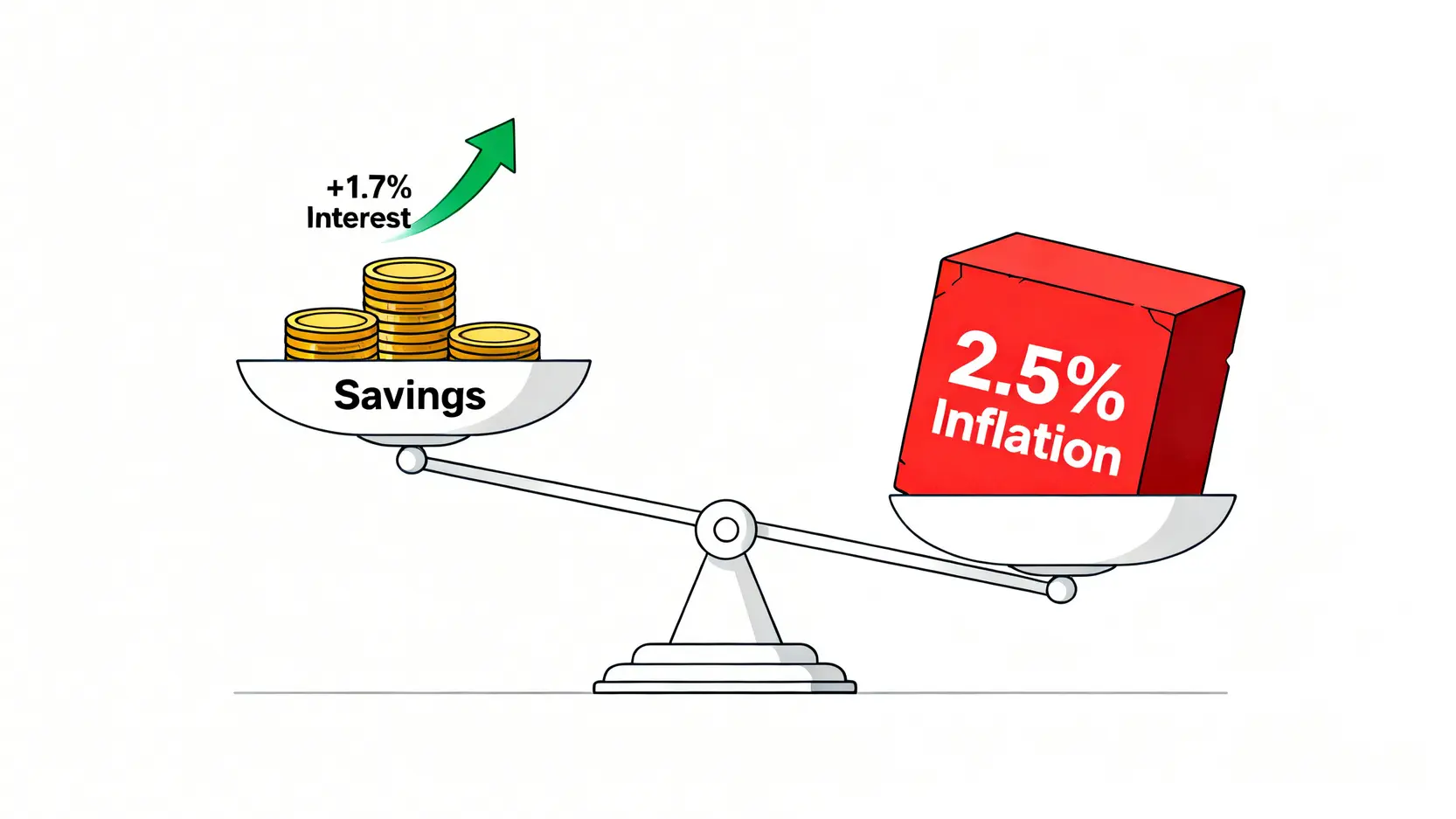
This is the biggest hidden threat to time deposits! The “real interest rate” refers to the “nominal interest rate (the rate provided by the bank) minus the inflation rate”. For example, if your time deposit offers an annual rate of 1.7% but the inflation rate is 2.5%, your real interest rate is actually 1.7% – 2.5% = -0.8%. This means that although your balance increases on paper, your actual purchasing power declines. Your money is being quietly eroded by inflation. You can monitor official inflation data on platforms such as TradingView to evaluate whether your time deposit returns are worthwhile.

一張概念圖顯示通膨對定存實際收益的影響,一個代表通膨的重物壓低了天秤,使得代表存款與利息的一端顯得更輕,象徵購買力下降。

The hidden killer of time deposits: when the inflation rate (2.5%) exceeds the time deposit rate (1.7%), your money is effectively shrinking.


Risk 2: Interest Loss from Early Termination and Key Considerations

The essence of time deposits is exchanging “time” for “interest”. If you “terminate the deposit early” due to urgent cash needs, the bank will return your principal, but the interest will not be calculated based on the original time deposit rate. Typically, the bank will treat the deposit period as a savings account or apply a discounted rate (usually around 80%) to calculate the interest. This means you will lose most or even all of the expected interest. Therefore, before placing a time deposit, ensure that the funds will not be needed during the agreed period, or consider splitting a large sum into multiple smaller deposits to retain some liquidity.


Risk 3: Opportunity Cost from Locked-In Funds

This is a form of “opportunity cost”. When your funds are locked in a three-year time deposit, if the stock market rises significantly or other higher-yield, manageable-risk investment opportunities emerge during that period, your funds cannot participate. When making long-term deposit decisions, you need to evaluate your outlook on market opportunities. For highly conservative investors, stable interest may be more attractive than uncertain opportunities. However, for those willing to take some risk, locking all funds into long-term deposits may not be the optimal choice.


Frequently Asked Questions About TWD Time Deposits (FAQ)

Do I need to pay tax on interest from TWD time deposits?

Yes. According to tax regulations, deposit interest is classified as “interest income” and must be included in personal income tax filings. However, each individual has an annual “savings and investment special deduction” of TWD 270,000. This means that if your total interest income across all financial institutions does not exceed TWD 270,000, you generally will not need to pay tax. For most salaried individuals, this threshold is more than sufficient.

Will the principal and interest automatically roll over after maturity?

This depends on the agreement you made with the bank at the time of deposit. Typically, there are three options:
1. Principal rollover: Upon maturity, the interest is credited to your savings account, and only the principal is rolled over for another term at the prevailing rate.
2. Principal and interest rollover: Upon maturity, both principal and interest are combined into a new principal and rolled over, reflecting the concept of compound interest.
3. No rollover: Upon maturity, both principal and interest are transferred to your savings account.
It is generally recommended to choose “principal and interest rollover” to maximize long-term compounding effects.

Should I choose a one-year or three-year time deposit?

The choice of deposit term should be based on your “fund usage” and expectations of “future interest rate trends”.
Fund usage: If the money may be needed within one year (e.g. for a car purchase or travel), choose a one-year term. If the funds are for long-term savings (e.g. retirement or education), consider a three-year term to lock in the rate.
Interest rate outlook: As mentioned earlier, if rate hikes are expected, opt for shorter terms (e.g. one year) so you can reinvest at higher rates later. If rate cuts are expected, choose longer terms (e.g. three years) to lock in current higher rates.

Are digital banks’ TWD time deposit rates really higher? What should I watch out for?

Yes. Digital banks often offer very attractive high-yield savings or time deposit promotions to attract new customers, with rates typically higher than traditional banks. However, these promotions usually come with “conditions”, such as:
1. Deposit cap: High rates may only apply up to a certain amount, such as TWD 100,000 or TWD 300,000.
2. Time limit: Promotional rates may only last for 3 to 6 months.
3. New customer requirement: Some high-rate offers are only available to new account holders.
Be sure to carefully review all terms and conditions before applying to ensure you can fully benefit from the promotion.


Conclusion

In summary, TWD time deposits are a stable cornerstone in asset allocation, particularly suitable for conservative investors or as a parking place for emergency funds. Through the comprehensive TWD time deposit rate comparison and TWD investing risk assessment in this article, you can see that choosing a bank with both competitive rates and strong credibility is crucial, while also being aware of potential risks such as inflation, early termination, and opportunity cost. Start planning your first high-yield time deposit today based on your financial goals and risk tolerance!

编者
Evan Lin

Evan Lin

我是Evan Lin,从大学时期开始接触外汇交易,至今已有多年实战经验,熟悉技术分析与EA策略,热衷于研究市场脉动与风险管控,喜欢分享实战经验和交易技巧,和大家一起学习、一起进步!

If you liked this article, please share it!

Related Articles

  • Hong Kong VASP License Guide 2026 for Web3 Firms
    Complete Guide to Virtual Asset Trading Platform (VASP) License Applications: A 2026 Hong Kong Web3 Compliance Practical Guide At the pivotal moment of 2026, as global financial digitization accelerates at an unprecedented pace, Hong Kong has firmly established itself as a leading Web3 compliance hub in Asia and around the...
    2026 年 6 月 3 日
  • CNH-CNY Arbitrage Guide 2026: Spread & Hedging
    2026 Offshore Renminbi Range-Bound Arbitrage Trading Guide: Mastering the CNH-CNY Spread and a Profit Guide to Hedging Through Two-Way Volatility Against the combined influence of global macroeconomic developments and international trade policies, the foreign exchange market in 2026 has become increasingly complex. The Renminbi exchange rate often exhibits a pattern...
    2026 年 6 月 3 日
  • Friday Taiwan Index Options: NFP Trading Strategy
    Friday Taiwan Index Options Buyer Strategies: Precisely Capturing Explosive Market Moves From Non-Farm Payroll Data Many investors often complain that options buyers have low win rates, frequently predicting the direction correctly but ultimately losing to time decay. However, under the new dual-settlement system, short-term volatility and event-driven trading have created...
    2026 年 6 月 3 日
返回顶部