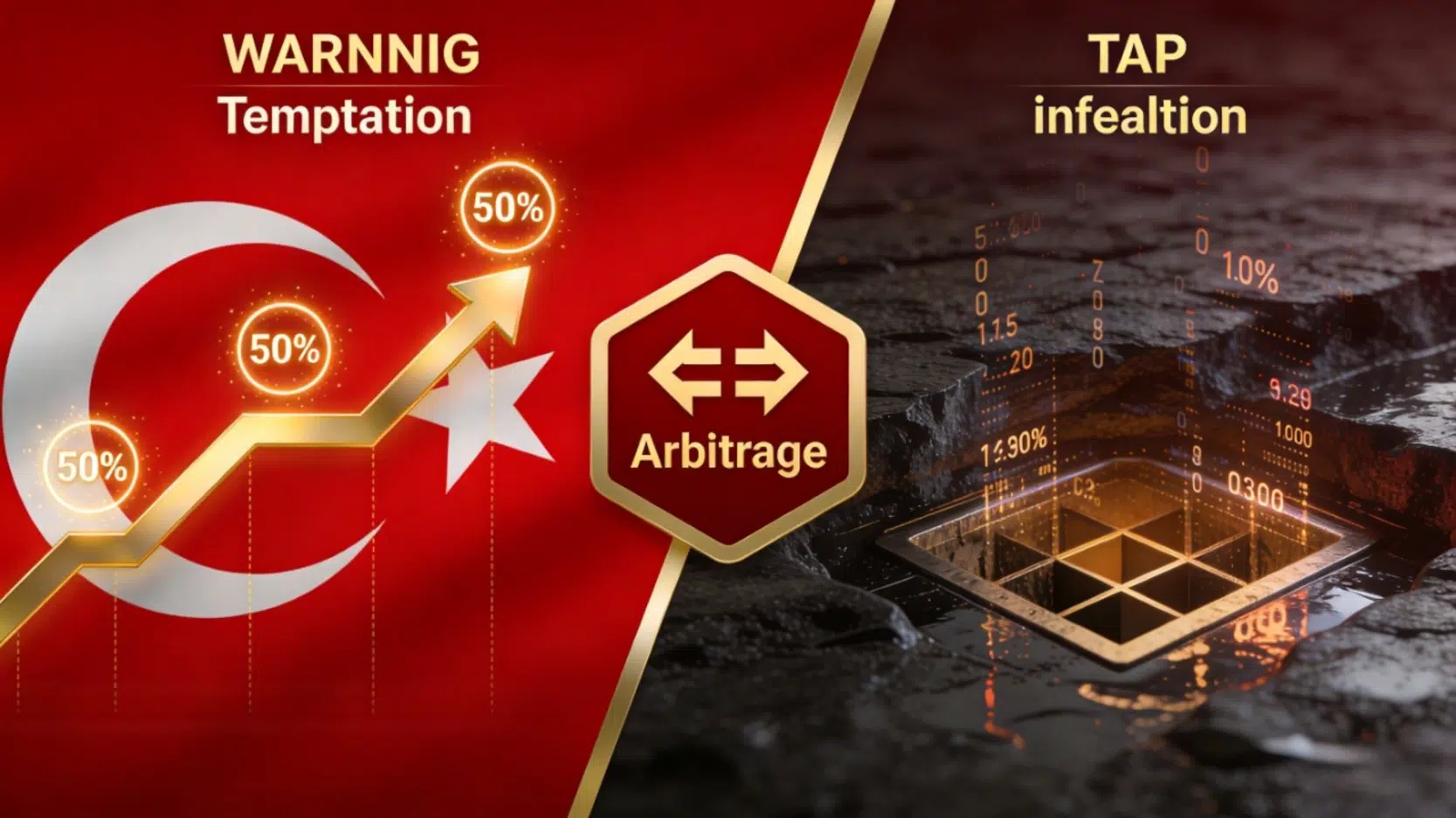
The Temptation of 50% Annual Returns? The Truth and Traps Behind Turkish Lira Inflation Arbitrage
What Is Carry Trade? Why Has the Turkish Lira Become the Main Target?
In the foreign exchange market, there is a strategy known as Carry Trade. The concept is relatively straightforward: borrow currencies with very low interest rates, such as the Japanese yen or Swiss franc, where rates are close to zero, then convert the funds into a high-interest-rate currency for investment and profit from the interest rate differential. It sounds like a guaranteed money-making strategy, and in recent years, the undisputed star of this trade has been the Turkish lira (TRY).
As of 2026, the Central Bank of the Republic of Türkiye (CBRT) has maintained its benchmark interest rate at an astonishing 50%. In theory, simply holding lira-denominated assets could generate a 50% annual interest return. In a global environment dominated by relatively low interest rates, such extraordinary yields have naturally attracted massive inflows of capital from investors worldwide seeking higher returns, making Turkish lira inflation arbitrage one of the hottest and most controversial topics in the market. However, why does Türkiye need to rely on such extreme measures to attract capital?
The Mystery Behind the Interest Rate Gap: Why Does Türkiye Maintain Such High Interest Rates?
Setting interest rates at 50% is not a sign of a strong Turkish economy. On the contrary, it is a desperate response to severe domestic economic problems. There are mainly two reasons behind it:
- Fighting Hyperinflation: In recent years, Türkiye’s Consumer Price Index (CPI) annual growth rate has remained at alarming double-digit levels. The latest 2026 data has even reached around 69%. This means the purchasing power of the lira is evaporating at an astonishing pace. To curb inflation, the central bank has been forced to adopt aggressive monetary tightening policies by sharply raising interest rates, hoping to reduce market liquidity and stabilize prices.
- Stabilizing the Lira Exchange Rate and Attracting Foreign Capital: Persistent inflation has severely undermined confidence in the lira among both domestic and foreign investors, causing the currency to remain in a long-term depreciation trend. To prevent capital outflows and attract fresh overseas capital to support the exchange rate, Türkiye has had no choice but to offer extremely attractive interest rates.
In simple terms, the 50% interest rate is like a powerful medicine prescribed by Türkiye to stabilize its economy. However, how long the medicine will remain effective and how severe its side effects may become are enormous unknowns that every investor participating in this financial game must face.
The Double-Edged Sword of High Inflation: Eroding Purchasing Power vs. Creating Arbitrage Opportunities
High inflation is both the creator of Turkish lira carry trade opportunities and its potential destroyer. The two are inseparable.
- Creating Arbitrage Opportunities: It is precisely because inflation is out of control that the central bank has been forced to implement ultra-high interest rates, creating a massive interest rate differential against low-yield currencies. This spread is the foundation of carry trade opportunities.
- Eroding Real Returns: However, the inflation driving those high interest rates is also the very force destroying the value of the lira. If the annual depreciation of the lira exceeds the interest earned, the entire trade will still result in losses. For example, even if you earn 50% interest, but the lira depreciates 60% against the US dollar during the same period, your actual loss would still be 10%. This is why Turkish lira carry trades are often described as “dancing on the edge of a knife”.
The Deadly Risks Behind Turkish Lira Carry Trades
Many beginner investors only notice the temptation of 50% annual interest rates while ignoring the deadly risks that could wipe out their principal overnight. Before committing any capital, it is essential to fully understand the following core Turkish lira exchange rate risks.
Exchange Rate Risk: A 10% One-Day Drop Can Erase All Interest Gains
This is the largest and most direct risk of all. The Turkish lira is one of the most volatile currencies in the world, with highly unstable exchange rate movements. Imagine holding the position for an entire year while waiting for a 50% interest return. However, merely a single presidential statement, an unexpected central bank decision, or a geopolitical event could cause the lira to plunge by 10% or more in a single day. Such “black swan” events are far from rare in Türkiye’s financial markets.
Historical data shows that the lira has remained in a long-term depreciation trend against the US dollar. Over a longer time horizon, interest income alone is often completely insufficient to offset exchange rate losses. Without precise entry and exit timing and strict risk management, the interest earned may be wiped out overnight by violent exchange rate fluctuations, and even the principal itself may be severely damaged.
Policy Risk: An Unpredictable Central Bank and Political Intervention
Central banks in developed economies are usually highly independent, and their monetary policies tend to follow predictable patterns. Türkiye’s situation is entirely different. The country’s monetary policy has long been heavily influenced by top-level political intervention. The president holds unconventional views on interest rate policy and has previously replaced central bank governors without warning on multiple occasions, triggering market panic and sharp lira crashes.
This extreme uncertainty means the 50% high-interest-rate policy that investors rely on could be changed suddenly at any moment. In an environment where “rule by individuals” outweighs “rule of law”, rational analysis based on economic data can quickly become meaningless, adding tremendous uncertainty to Turkish lira inflation arbitrage.
Liquidity Risk: When Crisis Hits, You May Not Be Able to Exit
Liquidity risk refers to situations where, when you want to close your position and sell the lira, there are insufficient buyers in the market, preventing you from exiting at your desired price, or even preventing you from exiting at all. This situation is especially common during panic selling.
When signs of a lira crash emerge, everyone rushes to sell simultaneously, causing buy-side liquidity to disappear instantly. Banks and brokers may sharply widen spreads. At such moments, your stop-loss orders may be executed at extremely unfavorable prices, known as slippage, or may fail to execute entirely, leaving you helpless as losses continue to expand. For large-scale traders, liquidity risk can be especially fatal.
Further Reading (Highly Recommended)
[2026 Latest] Is the Turkish Lira Worth Investing In? A Complete Guide to the 5 Major Drivers of Volatility, Exchange Rate Trends, and Risks
Forex Trading Risk Management: How Professional Traders Hedge Risks and Achieve Stable Profits
[Differentiation Highlight] Turkish Lira Carry Trade Risk Management Checklist
Given the extremely high risks involved, does this mean Turkish lira carry trades should be avoided entirely? The answer is not absolute. For highly experienced traders with extremely high risk tolerance, it may still present potential opportunities. The key lies in building a comprehensive risk management strategy. Below is a practical checklist for evaluating and managing this type of high-risk trade.
Capital Management: What Percentage of Capital Is Safe to Allocate?
This is the most important step. For highly volatile assets like the lira, the capital allocated must be money that you can fully afford to lose. Remember, this is speculation, not investment.
- Position Sizing: It is recommended to strictly limit funds allocated to Turkish lira carry trades to only 1% to 3% of your total investment portfolio. This proportion should be small enough that even if the entire position is lost, it will not affect your overall financial condition or quality of life.
- Never Use Leverage: Forex brokers typically offer high leverage, but using leverage in lira trading is effectively financial suicide. The lira’s intraday volatility can easily trigger margin calls, leading to forced liquidation and potentially wiping out your account instantly.
Stop-Loss Strategy: How to Set an Exchange Rate Floor and Avoid Unlimited Losses
Before entering any trade, you must clearly define your exit conditions, especially your stop-loss level. Trading without a stop-loss is like driving without brakes.
- Set a Price Stop-Loss: On your trading platform, define a specific exchange rate as your stop-loss level. For example, if you buy the lira when USD/TRY is at 32.0, you may place your stop-loss at 33.6, representing a 5% depreciation in the lira. Once the exchange rate reaches this level, the system will automatically close your position and lock losses within a controllable range.
- Time Stop-Loss: In addition to price-based stop-losses, you may also set a time-based exit rule. For example, if after holding the position for one month the exchange rate remains stagnant or continues to show small losses instead of stabilizing or appreciating as expected, you may choose to exit the position and wait on the sidelines.
Alternative Options: Are There Other Choices Besides Buying the Lira Directly?
If you do not want to bear direct Turkish lira exchange rate risk, there are also alternative investment instruments that provide indirect exposure to the Turkish market, although each carries different risk characteristics:
- US Dollar-Denominated Turkish Government Bonds (Eurobonds): Investors may purchase US dollar-denominated bonds issued by the Turkish government. The advantage is that you can earn relatively high US dollar interest yields while avoiding Turkish lira exchange rate risk. However, you will still bear Turkish sovereign credit risk, namely default risk.
- Turkish Equity ETFs: For example, the iShares MSCI Turkey ETF listed in the US stock market. Buying an ETF is equivalent to investing in a basket of leading Turkish listed companies, helping diversify individual corporate risk. However, equity market volatility remains extremely high, and overall performance is still closely tied to Türkiye’s macroeconomic conditions and the Turkish lira exchange rate.
- Using Options for Hedging: More sophisticated investors may hedge their Turkish lira spot positions by purchasing lira put options. When the lira depreciates sharply, profits from the put options may offset losses in the spot position. However, options trading itself is highly complex and requires paying option premiums.
FAQ: About Turkish Lira Inflation Arbitrage
Q: What Platforms Are Needed for Turkish Lira Carry Trades?
A: Most internationally recognized forex brokers offer Turkish lira trading pairs, such as USD/TRY or EUR/TRY. When choosing a platform, always verify whether its regulatory credentials are reliable, such as regulation by the FCA or ASIC, whether swap or rollover calculations are transparent, and whether trading spreads are reasonable.
Q: Where Can I Check Türkiye’s Inflation Rate?
A: The most authoritative source is Türkiye’s official statistical agency. You can directly visit the official website of the Turkish Statistical Institute (TÜİK), which regularly publishes the latest Consumer Price Index (CPI), Producer Price Index (PPI), and other core economic data.
Q: What Are Some Famous Historical Failures of Turkish Lira Carry Trades?
A: Rather than a single famous case, the history of the Turkish lira itself is a painful record of repeated crises and flash crashes. In 2018, 2021, and the following years, sharp collapses exceeding 20% occurred within short periods due to factors such as political intervention and abrupt central bank policy reversals. During these events, countless retail investors engaged in carry trades, especially those using high leverage, were eliminated by the market within an extremely short time, with their accounts wiped out completely.
Conclusion
In summary, Turkish lira inflation arbitrage is a classic high-risk, high-reward gamble. Beneath its attractive “high-interest-rate” appearance lies extremely unstable exchange rate volatility and policy risk. This is absolutely not a strategy suitable for all investors, nor should it be viewed as a stable source of returns. For inexperienced investors or those with low risk tolerance, staying away from the lira may be the wiser choice.
For experienced traders determined to participate in this game, risk management is the only survival rule. Strict capital management, ironclad stop-loss discipline, and continuous monitoring of the macroeconomic environment are all indispensable. Before chasing the illusion of 50% annualized interest returns, ask yourself one crucial question: Am I truly prepared for the possibility of losing 50% or even 100% of my principal?