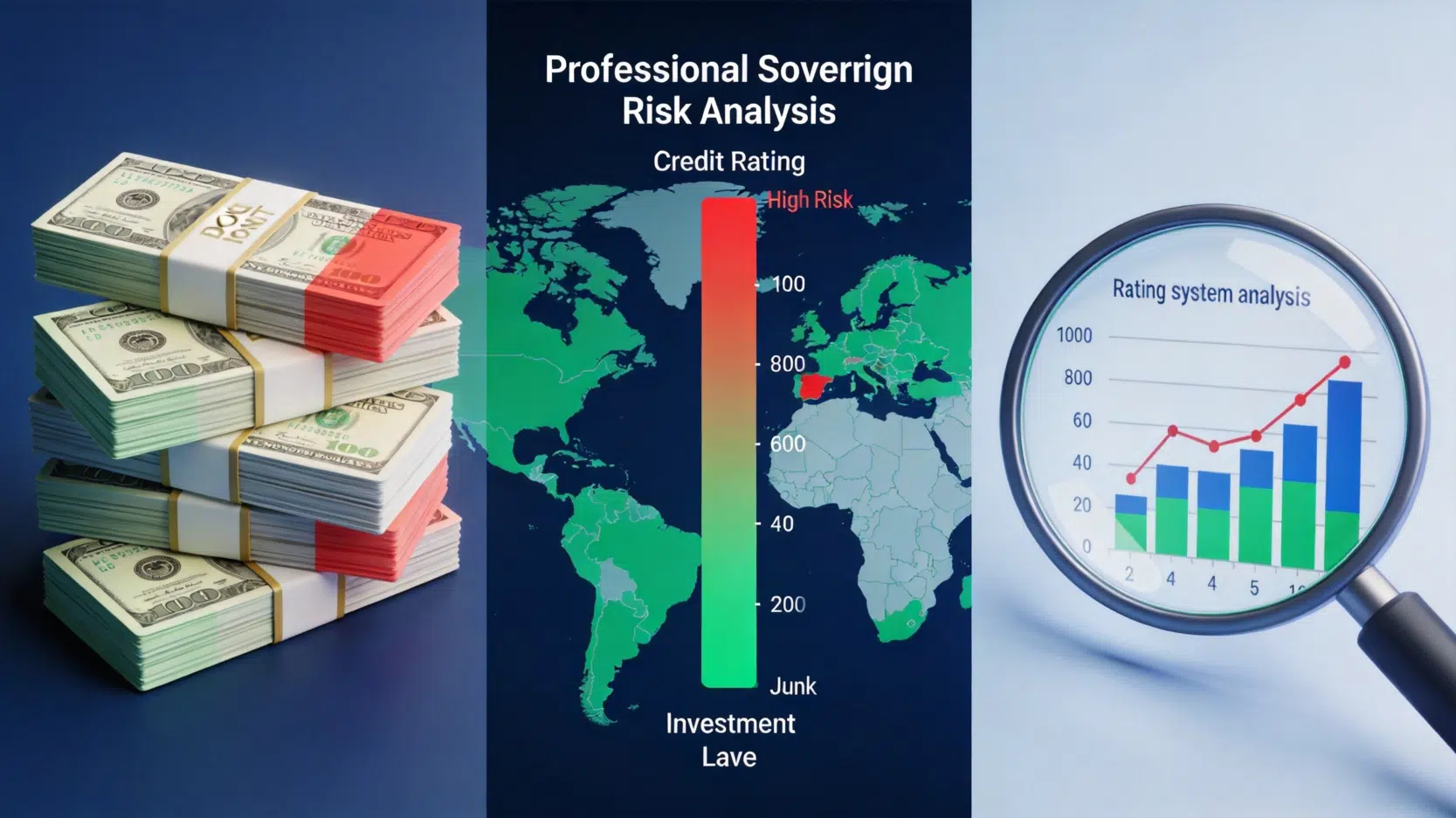
Understanding Sovereign Risk: A Complete Guide to Emerging Market External Debt Stress Rating Systems
External Debt Stress Basics: Why Do Countries Need to Borrow From Abroad?
Want to tap into the opportunities of emerging markets, but worried about stepping on a debt landmine? For investors seeking higher yields, the attractive returns offered by emerging market bonds are always tempting. However, the sovereign default risks hidden beneath the surface are like crocodiles lurking underwater, ready to swallow your principal at any moment. In recent years, sovereign debt crises have erupted repeatedly, from Sri Lanka to Zambia, making emerging market external debt stress ratings an essential subject for every prudent investor. How exactly does this rating system work? And how can investors assess sovereign risk and avoid the next potential emerging market debt crisis? This article will guide you step by step, from the basic definition of external debt to the evaluation models used by the three major credit rating agencies, ultimately helping you build your own sovereign risk radar.
Definition of External Debt: Local Currency Debt vs. Foreign Currency Debt
First, we need to understand what “external debt” actually means. Broadly speaking, a country’s debt obligations can be divided into two main categories:
- Local Currency Debt: Bonds issued by a government in its own currency. For example, Thai government bonds denominated in Thai baht. In theory, as long as the central bank can print money, the risk of default on local currency debt is extremely low, although it may trigger hyperinflation.
- Foreign Currency Debt: Bonds issued by a government in currencies other than its own, usually strong currencies such as the US dollar or euro. This is what we commonly refer to as “external debt”, and it is also the core source of sovereign risk. Since governments cannot print US dollars or euros on their own to repay debt, they must generate sufficient foreign exchange through trade surpluses, international investment, or rolling over old debt with new borrowing.
When a country can no longer secure enough foreign exchange reserves to repay maturing foreign currency debt, a “sovereign debt default” occurs.
Potential Risks of US Dollar-Denominated External Debt: The Impact of Exchange Rate Fluctuations
For emerging market countries, US dollar-denominated external debt is a double-edged sword. It can attract global capital and help finance urgent domestic development needs, but it also creates significant exchange rate risk.
Imagine a country borrows US$100 million in external debt when the exchange rate is 1 US dollar to 10 units of local currency, equivalent to a debt burden of 1 billion local currency units. But if the US dollar later strengthens sharply and the exchange rate moves to 1 US dollar to 15 units of local currency, that same US$100 million debt effectively becomes a burden of 1.5 billion local currency units. The additional 500 million local currency units arise purely from exchange rate fluctuations. This can severely damage a country’s fiscal health and may even become the final straw that breaks the camel’s back. This is why emerging markets worldwide often come under immense pressure whenever the US Federal Reserve (Fed) enters a rate-hiking cycle.
Decoding the Rating Methodologies of the Three Major International Credit Rating Agencies
No discussion of sovereign risk assessment would be complete without mentioning the three major international credit rating agencies: Moody’s, S&P Global Ratings, and Fitch Ratings. The sovereign credit ratings they publish are among the most important references global investors use to evaluate a country’s debt repayment capability.
Comparison of the Rating Systems Used by Moody’s, S&P, and Fitch
Although the rating symbols used by the three agencies differ slightly, their core logic is broadly similar. Ratings are mainly divided into two categories: “investment grade” and “speculative grade” (also known as “junk grade”). Below is a simplified comparison table:
| Rating Meaning |
Moody’s
|
S&P |
Fitch Ratings |
Investment Grade
Lower Default Risk |
Aaa, Aa, A, Baa |
AAA, AA, A, BBB |
AAA, AA, A, BBB |
Speculative Grade/Junk Grade
Higher Default Risk |
Ba, B, Caa, Ca, C |
BB, B, CCC, CC, C, D |
BB, B, CCC, CC, C, D |
Once a country’s rating is downgraded from “BBB-/Baa3” to “BB+/Ba1”, it means the country has fallen from investment grade into junk status. This can trigger forced selling by institutional investors such as pension funds and insurance funds that operate under strict investment mandates, creating enormous selling pressure.
What Are the Core Indicators They Focus On?
When conducting emerging market external debt stress ratings, these credit rating agencies act like detectives, searching through economic data for warning signs. The core indicators they focus on mainly include:
- Economic Strength and Growth Outlook: Total GDP, GDP per capita, economic growth rate, and future forecasts.
- External Debt-to-GDP Ratio: This is a fundamental indicator used to measure a country’s external debt burden. The warning threshold is generally set around 60%, although adjustments vary depending on national conditions.
- Fiscal Position: The size of the government fiscal deficit or surplus relative to GDP, as well as total government debt levels. Persistent large fiscal deficits are a danger signal.
- Foreign Exchange Reserve Adequacy: Whether the country’s foreign exchange reserves are sufficient to cover short-term external debt and import needs. This serves as a critical firewall against external shocks.
- Political Stability and Institutional Quality: Government effectiveness, policy predictability, rule of law, and geopolitical risks.
- Balance of Payments: Whether the current account is running a surplus or deficit, reflecting whether the country is “earning money” or “spending money”. A long-term deficit means the country must continue borrowing externally to fill the gap.
Further Reading (Highly Recommended)
[2025 Latest] What Is Taiwan’s Global Ranking in Foreign Exchange Reserves? A Complete Guide to Their Purpose
Complete Guide to ETF Risk Levels: Comparing ETF Investment Risks in Hong Kong and 5 Major Hedging Strategies
How Can Investors Assess External Debt Stress on Their Own?
While ratings from the three major agencies are important, they can sometimes react slowly. For proactive investors, learning how to analyze a few key indicators independently can help you stay one step ahead of the market and build your own risk warning system. Below are two simple yet highly practical indicators.
Key Indicator 1: The Ratio of Short-Term External Debt to Total External Debt
External debt is also divided by maturity. Long-term external debt, which matures in more than one year, carries relatively lower repayment pressure. In contrast, short-term external debt, which matures within one year, is like a ticking time bomb that constantly requires funding for repayment or refinancing.
If a country’s short-term external debt accounts for an excessively high proportion of total external debt, for example above 30%, it means the country is highly dependent on international capital markets in the short term. Once global markets become volatile, interest rates rise, or investor confidence collapses, the country may face the risk of a funding squeeze and fail to borrow new money to repay old debt, potentially triggering a crisis.
Key Indicator 2: Can Foreign Exchange Reserves Cover Short-Term External Debt?
This is considered the golden rule for measuring a country’s short-term debt repayment capability, also known as the “Greenspan-Guidotti Rule”. The core principle is that a country’s total foreign exchange reserves should be sufficient to provide 100% coverage for all short-term external debt maturing within one year.
The higher this ratio (foreign exchange reserves / short-term external debt), the stronger the country’s financial defense capability. If the ratio falls well below 1, it means the country’s foreign exchange reserves are “insufficient for repayment”. Once external financing dries up, default risk can rise sharply. This is one of the most important quick-screening indicators for assessing whether an emerging market economy is financially healthy.
Practical Tools: Recommended Authoritative Websites for Checking External Debt Data
To access the data mentioned above, you can refer to the following authoritative international organizations. They provide large amounts of free and reliable global economic data:
- World Bank: Provides detailed International Debt Statistics. The World Bank database is an excellent resource for researching external debt structures across countries.
- International Monetary Fund: Provides macroeconomic data, sovereign debt monitoring reports, and more for countries worldwide.
- National Central Banks or Statistics Bureau Websites: These usually publish the most up-to-date and detailed data on domestic external debt, foreign exchange reserves, and related indicators.
Frequently Asked Questions (FAQ)
Q: What Is a Sovereign Debt Default? What Are the Consequences?
A: A sovereign debt default refers to a situation where a national government is unable or unwilling to repay principal or interest to its domestic and foreign creditors on time, including foreign governments, international organizations, private banks, and investors. The consequences are extremely severe and typically include: credit ratings being downgraded to “default” status, loss of access to international borrowing markets, sharp depreciation of the domestic currency triggering hyperinflation, and potential collapse of the domestic banking system due to heavy exposure to government bonds, leading to a full-scale economic recession and social instability.
Q: What Is the Difference Between Junk Bonds and Investment Grade Bonds?
A: The main difference lies in credit risk, namely the probability that the bond issuer, whether a country or company, will fail to repay its debt obligations. Investment grade bonds, such as those rated BBB- or Baa3 and above, are considered to carry relatively low default risk and therefore offer relatively lower yields. Junk bonds, also known as high-yield bonds, carry lower credit ratings, indicating higher default risk. As a result, they must offer higher yields to attract investors willing to take on additional risk.
Q: What Happens When a Country’s Credit Rating Is Downgraded?
A: A sovereign credit rating downgrade can trigger a chain reaction. First, borrowing costs rise immediately because investors demand higher interest rates to compensate for the increased risk. Second, many international investment funds are prohibited by mandate from holding non-investment grade, or junk-rated, bonds. Therefore, a downgrade may trigger large-scale forced selling, causing the country’s bond prices to plunge and its currency to depreciate. This can further worsen the country’s fiscal position and create a vicious cycle.
Conclusion
In summary, emerging market external debt stress ratings are an indispensable analytical tool for investing in emerging markets. Developing a deep understanding of external debt structures, the transmission mechanism of exchange rate risk, and the evaluation methodologies used by institutions such as Moody’s, S&P Global Ratings, and Fitch Ratings is the first step toward avoiding investment pitfalls. However, rating reports are not infallible, and markets often change before ratings are adjusted. Truly sophisticated investors should learn to use publicly available data and build their own risk radar by monitoring key indicators such as the “short-term external debt ratio” and “foreign exchange reserve coverage ratio”. Only then can investors move steadily through the opportunities and challenges of emerging markets and achieve their desired investment returns.













