




No related articles
Trading Spread Guide: HK50, EUR/USD & HSI CFD
Updated: 2026/03/03 | CashbackIsland
Have you often been attracted by trading platforms promoting “ultra-low spreads”, yet do not truly understand the cost structure behind them? In the world of financial trading, every single “point” of movement is directly linked to your final profit. If you overlook this hidden cost, your returns may be eroded without you even realizing it. This article comprehensively breaks down HK50 spreads, EUR/USD spreads, USD/CNH spreads, and Hang Seng Index CFD spreads, from their fundamental structure to practical strategies, teaching you how to accurately interpret and compare trading costs across different financial instruments, and helping you advance from a beginner to a cost-conscious and savvy investor.
What Is a Trading Spread? Why Is It Your Hidden Trading Cost?
In any financial market, an asset always has two prices: a bid price and an ask price. A trading spread refers to the difference between these two prices and is one of the main sources of profit for brokers providing trading services. For traders, the spread is the most direct and fundamental hidden cost of every transaction. The moment you click the trade button, this cost is already incurred, meaning your position must first overcome the spread before it can begin to generate a real profit.
Ask vs Bid: The Basic Structure of a Spread
To understand spreads, you must first clarify two fundamental prices:
- Ask Price: The price you pay when buying an asset from the market, also known as the offer price. It is always the higher of the two prices.
- Bid Price: The price you receive when selling an asset to the market, also known as the quoted price. It is always the lower of the two prices.
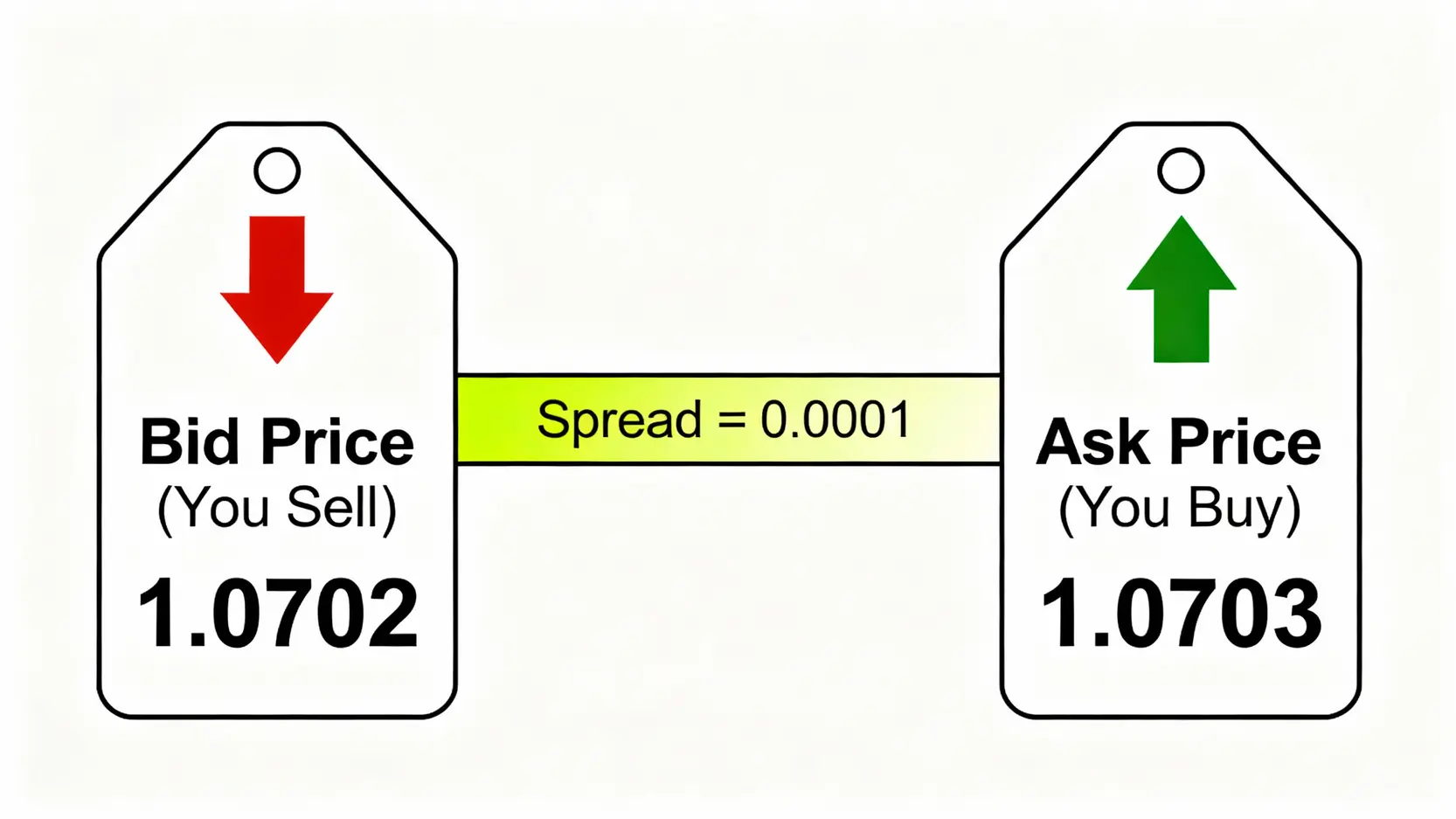
The formula for calculating the spread is straightforward: Spread = Ask Price – Bid Price
For example, if the quote for EUR/USD is 1.0702 / 1.0703:
- Ask Price = 1.0703
- Bid Price = 1.0702
- Spread = 1.0703 – 1.0702 = 0.0001, which equals 1 pip.
This small difference, multiplied by your trade size, becomes the spread cost of your transaction.
How Is a “Pip” Calculated? Using EUR/USD Spread as an Example
A “pip” (Pip, Price Interest Point) is the smallest unit used to measure price movements in currency pairs. For most US dollar-quoted currency pairs, such as EUR/USD and GBP/USD, one pip refers to a change in the fourth decimal place. Using the previous EUR/USD example, if the price moves from 1.0702 to 1.0703, it has risen by 1 pip.
Understanding the value of a pip is crucial because it determines the actual monetary amount of your spread cost. The formula for calculating pip value is:
Pip Value = (One Pip Movement / Exchange Rate) × Trade Size
Assume you trade 1 standard lot (100,000 units) at an EUR/USD rate of 1.0702:
- One Pip Movement = 0.0001
- Pip Value = (0.0001 / 1.0702) × 100,000 ≈ 9.34 US dollars
If the EUR/USD spread at that time is 1.5 pips, then your total spread cost would be 1.5 × 9.34 ≈ 14.01 US dollars. For a deeper understanding of detailed calculation methods, you may refer to Five Ultimate Strategies to Reduce Trading Costs: A Complete Guide From Forex to Stocks.
Fixed Spreads vs Floating Spreads: Which Should You Choose?
Brokers generally offer two main types of spreads. Understanding their differences will help you select a platform that best matches your trading style.
| Type |
Advantages |
Disadvantages | Suitable For |
| Fixed Spread | ✅ Costs are predictable, and the exact cost is known before placing a trade | ❌ Spreads are usually wider, and requotes may occur | Beginner traders, scalping strategy users |
| Floating/Variable Spread |
✅ Spreads can be extremely low when the market is stable, potentially resulting in lower trading costs |
❌ Spreads can widen sharply during high volatility or data releases, making costs difficult to predict | Day traders, news traders, traders using EAs |
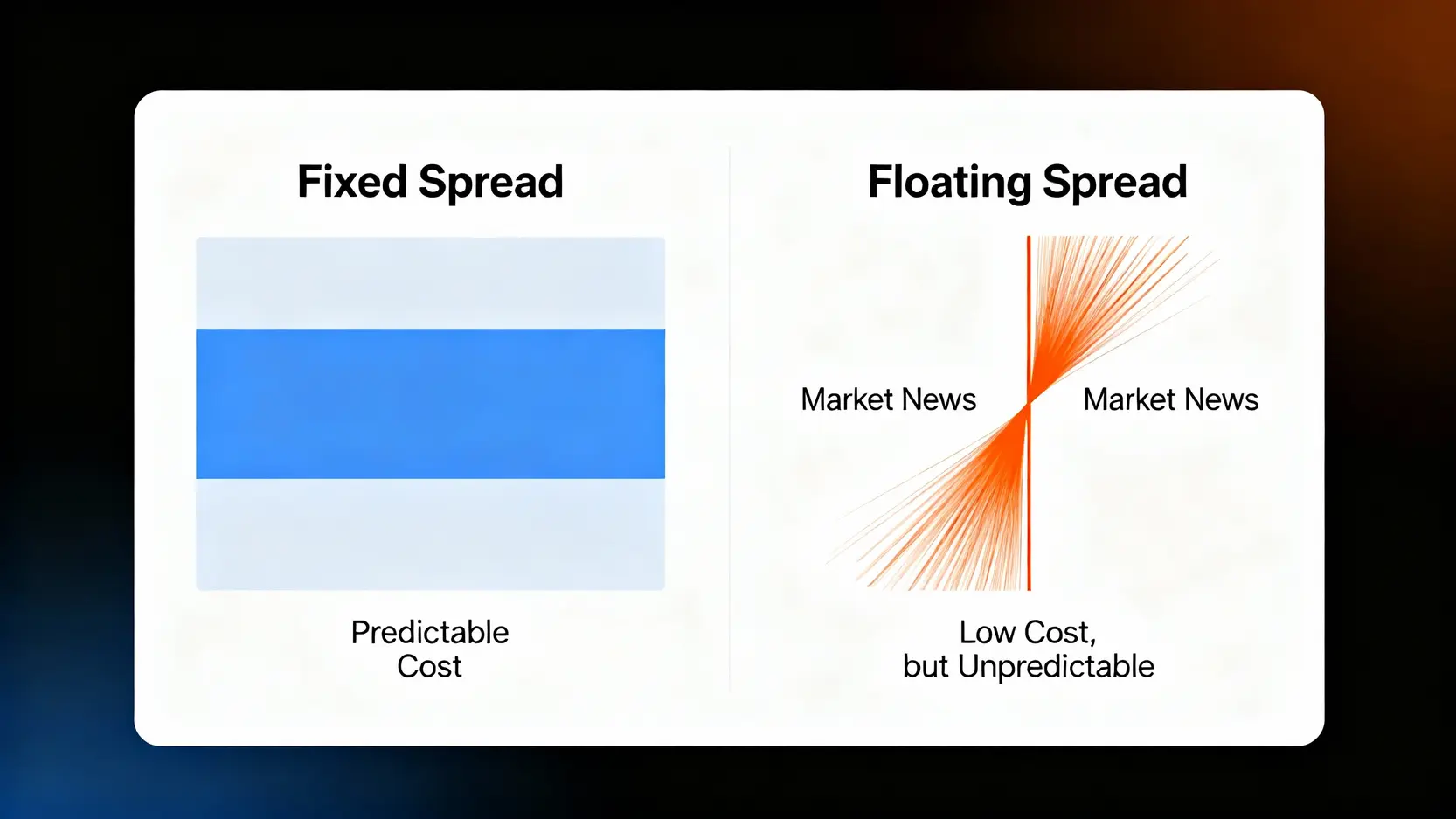
Overall, there is no absolute better or worse. If you pursue cost certainty, a fixed spread is more suitable. If you can tolerate spread changes caused by market volatility and want to enjoy lower costs most of the time, a floating spread is the better choice. Authoritative financial website Investopedia provides a more in-depth academic explanation of spreads.
A Major Spread Comparison of Popular Products: Factors That Affect Index and Forex Spreads
Different financial products have very different spread characteristics. This is mainly influenced by liquidity, volatility, and trading sessions. Next, we will take a closer look at several products that are highly popular in Asian markets.
Index CFD Spread Analysis: Using HK50/Hang Seng Index CFD as an Example
The Hang Seng Index (HK50) is an important indicator of Hong Kong stock market performance. Its CFD product is favored by short-term traders due to high volatility and high leverage. Hang Seng Index CFD spreads have the following characteristics:
- High Volatility: The Hang Seng Index has large daily price swings. Especially during the market open (09:30 HKT) and the afternoon session (13:00 HKT), there are many market participants and spreads are relatively stable.
- Strong News Sensitivity: It is significantly affected by economic data and policy news from mainland China and Hong Kong. Around related news releases, spreads may widen instantly.
- Trading Hours: Its main trading sessions are concentrated in the Asian time zone. During the US and European sessions, liquidity drops significantly, causing spreads to widen.
Generally, on regulated platforms, Hang Seng Index CFD spreads during the main trading sessions are about 2 to 5 index points. When trading, you should pay close attention to active market hours to obtain more favorable trading costs.
Major Forex Pair Spread Analysis: Using EUR/USD as an Example
EUR/USD is the most traded and most liquid currency pair in the world, so its spread is among the lowest of all forex products.
- Excellent Liquidity: Daily trading volume in the trillions of US dollars ensures sufficient bids and offers, allowing EUR/USD spreads to remain extremely tight. On many ECN platforms, the spread can even be below 1 pip.
- Best Trading Time: During the overlap of the London and New York sessions, (approximately 20:00 to 24:00 HKT), the market is most active and spreads are the tightest.
- Data Sensitivity: It reacts extremely quickly to major economic data releases in the US and the eurozone (such as the Non-Farm Payrolls report and interest rate decisions). Spreads can widen sharply at the moment of release.
Emerging Market Currency Spread Analysis: Using USD/CNH as an Example
USD/CNH represents the exchange rate between the US dollar and the offshore renminbi traded outside mainland China. Compared with major pairs, it has different spread characteristics.
- Lower Liquidity: Although trading volume continues to grow, liquidity remains lower than major pairs such as EUR/USD. This results in a relatively wider baseline USD/CNH spread.
- Policy-Driven: Its movement is strongly influenced by the People’s Bank of China (PBOC), the daily fixing mechanism, and macroeconomic data. Any change in policy signals may trigger sharp price swings and spread widening.
- Higher Trading Costs: Due to liquidity and volatility factors, the spread costs and overnight interest for trading USD/CNH are usually higher than those of major pairs.
Further Reading (Highly Recommended)
【Forex Tutorial 2024】The Ultimate Beginner’s Guide: Master Forex Trading Skills From 0 to 1!
Three Professional Tips to Reduce Real Trading Spread Costs
Understanding spreads is only the first step. More importantly, you need to learn how to reduce this cost as much as possible in actual trading. Below are three techniques commonly used by professional traders that can effectively help you save money.
Choose the Right Trading Time: Avoid Low-Liquidity Periods
Market liquidity directly determines how wide or tight the spread is. Within a day, certain periods always have much higher trading volume than others. For example:
- Forex Market: The overlap of the London and New York sessions (approximately 8:00 pm to 12:00 am Hong Kong time) is the most active period in the global forex market, and spreads for major pairs are the lowest. You should avoid trading during early Asian hours, late at night, or around weekends before and after market closure, as liquidity dries up and spreads can widen abnormally.
- Index CFDs: The best time to trade HK50/Hang Seng Index CFDs is during the opening hours of the corresponding stock market, when participation is highest and quotes are most favorable.
How to Compare Spreads and Commission Structures Across Platforms
When choosing a trading platform, do not be misled by “zero spread” advertising. You need to comprehensively evaluate total trading costs, which are usually composed of two parts: “spread” and “commission”.
- Standard Account: Usually does not charge an additional commission, but spreads are wider because the broker’s profit is included in the spread.
- ECN/RAW Account: Provides raw market spreads that can be very low (even zero), but charges a fixed commission per lot for each trade.
Total Cost = (Spread x Pip Value) + Commission
A savvy trader will calculate their average trading frequency and lot size, then compare the total costs of different account types to choose the most cost-effective option.
Make Good Use of Pending Orders (Limit Orders) to Avoid the Slippage Cost of Market Orders
When you use a market order (Market Order) to trade in a fast-moving market, the final execution price may differ from the price you saw when you clicked the mouse. This phenomenon is called “slippage”. Slippage is an additional, unpredictable trading cost.
To avoid this, you can use pending orders (Limit Order or Stop Order) more often:
- Buy Limit: Set a specific price below the current price at which you are willing to buy.
- Sell Limit: Set a specific price above the current price at which you are willing to sell.
Using pending orders ensures your order is executed only at your specified price or better, effectively controlling entry costs and avoiding paying a higher-than-expected “hidden spread” due to slippage.
Frequently Asked Questions About Trading Spreads (FAQ)
Q: Is the platform with the lowest spread always the best?
A: Not necessarily. Ultra-low spreads are indeed attractive, but they are not the only standard for evaluating a broker. You also need to consider the platform’s regulatory credentials, fund security, order execution speed, server stability, and customer service quality. If a platform executes slowly or experiences frequent slippage, your actual trading costs may be higher even if the spreads are low.
Q: How does the spread cost of trading Hang Seng Index CFDs compare with futures?
A: Each has its own advantages and disadvantages. Hang Seng Index futures typically have a spread of only 1 index point, which is narrower than CFDs, but they have a higher entry threshold, larger contract value, and require exchange fees and commissions. Although Hang Seng Index CFD spreads are slightly wider, contract sizes are flexible (such as trading 0.01 lots), leverage is higher, and they are more suitable for retail investors with smaller capital.
Q: Why do EUR/USD spreads suddenly widen during news releases?
A: This is because when major economic data (such as the US Non-Farm Payrolls report or the Federal Reserve interest rate decision) is released, uncertainty about the market outlook increases sharply. To avoid potentially huge risks, liquidity providers (usually large banks), may temporarily withdraw part of their quotes or significantly widen bid-ask differences. As a result, the spread you see on the trading platform widens noticeably. This phenomenon is very common in highly volatile markets.
Q: Which is better, floating spreads or fixed spreads?
A: It depends on your trading strategy. For beginners or scalpers who seek stable costs and do not want spreads to get out of control during data releases, fixed spreads may feel more reassuring. For day traders or algorithmic traders who can tolerate volatility and want to enjoy extremely low trading costs most of the time, floating spreads are usually a more economical choice.
Conclusion
In summary, deeply understanding and knowing how to analyze trading spreads is the key first step to controlling trading costs and enhancing profit potential. Whether you focus on highly volatile Hang Seng Index CFD spreads or highly liquid EUR/USD spreads, mastering the analysis techniques and practical strategies in this article can help you make more informed decisions when choosing platforms and executing trades. Start reviewing your trading account now, evaluate your true trading costs, choose the low-cost solution that best fits your strategy, and begin your journey toward smarter investing.
If you liked this article, please share it!
Related Articles
Table of contents
Ongoing Activities




Popular Posts
-
US Oil Inventories Fall 13 Weeks: Will Prices Surge?
-
WTI Crude Oil at $80: 5 Key Drivers and Strategies
-
NOK/USD Analysis: How Energy Prices Drive the Krone
Tags
