Trading Discipline: 5 Ways to Improve Execution

Updated: 2026/05/18  |  CashbackIsland

trading-discipline-training-guide

Trading Discipline Training Methods: 5 Key Ways to Improve Execution and Eliminate Emotional Losses

Do you face the same struggle: despite learning various analytical techniques and creating seemingly perfect strategies, the moment real market volatility appears, you cannot resist impulsive trades, chasing rallies and panic selling, eventually leading to losses? This is almost an unavoidable stage for every trader. The root problem is not that you have not learned enough, but that you lack the bridge that transforms knowledge into action: “trading discipline” and “execution”. Many people believe trading is purely a technical skill, but what truly determines success or failure is often psychological strength. This article will deeply break down the importance of building a trading system and provide five proven trading discipline training methods to teach you how to improve trading execution, from creating rigorous trading plans to executing them thoroughly, truly achieving unity between knowledge and action while moving toward stable profitability. 


Why Is Building a System the First Step Toward Success?

Before diving into the training methods, you must first understand why having a clear “trading system” is so important. It is not merely a set of entry and exit rules, but also your compass and anchor in a chaotic market, helping you handle all types of challenges.


Overcoming Human Weaknesses: Fighting Against Emotions and Cognitive Biases

The essence of the market is uncertainty, and uncertainty triggers humanity’s most primitive emotions: greed and fear. When you are profitable, greed makes you unwilling to close positions, fantasizing about endlessly expanding profits. When you are losing money, fear causes you to exit too early or stubbornly hold onto losses, refusing to accept them. A complete trading system can pull your actions away from emotion and back toward rationality. Since every decision is based on clear rules, you no longer trade based on “feelings”. Instead, like a pilot following a checklist, you respond systematically to market changes and effectively reduce emotional interference.

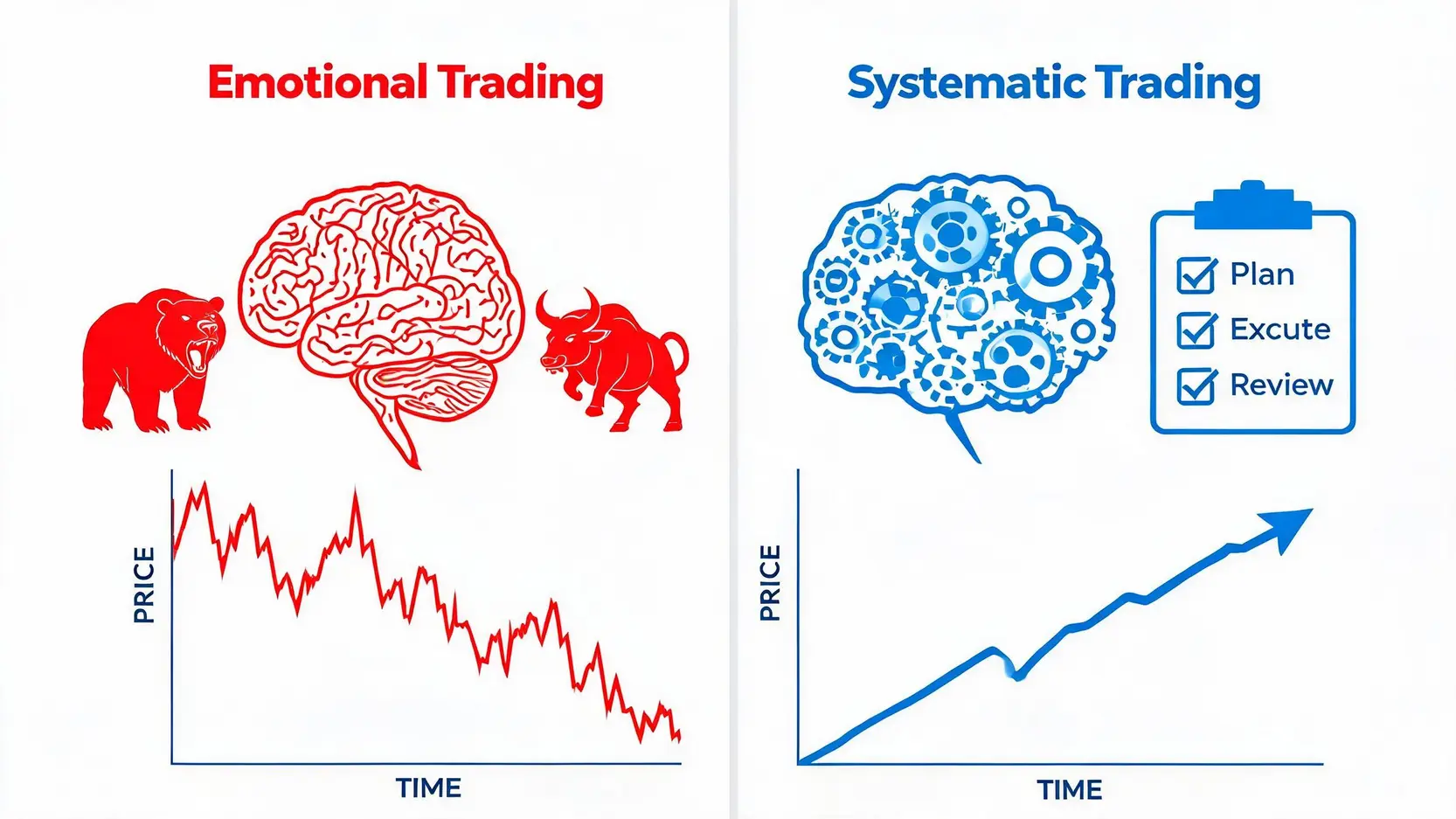
一張對比圖,左邊是代表情緒化交易的混亂大腦和下跌圖表,右邊是代表系統化交易的有序大腦和上漲圖表。

A trading system is the key to overcoming emotional decision-making and achieving consistency.


Providing Objective Decision-Making Standards: Standardizing Trading to Avoid Improvisation

One of the biggest problems among beginner traders is “improvisation”. Today they use one indicator because it looks good, tomorrow they follow an expert’s opinion, lacking consistency altogether. This approach can never accumulate meaningful experience. Building a trading system means standardizing your trading behavior, including:

  • Entry Conditions: Under what signals will I consider entering a trade?
  • Exit Conditions: At what target or reversal signal should I exit?
  • Stop-Loss Rules: At what price level must I admit I was wrong and exit unconditionally?
  • Capital Management: How much capital should I allocate to each trade? What is the maximum risk?

When all of these become part of your trading DNA, every action you take is grounded in logic rather than random gambling.


Measurable and Optimizable: Only With a System Can You Review and Continuously Improve Your Strategy

Without a system, there is no foundation for review. If every trade is entered for different reasons, you can never determine which part of the process caused the problem. Was the entry wrong? Or was the stop loss set too wide? A fixed trading system provides consistent trading records. When conducting trading strategy backtesting and reviews, you can analyze your performance like a scientist conducting experiments, controlling variables, identifying strengths and weaknesses within the strategy, and making targeted improvements. This is the only way to truly learn from losses and continue improving.

一張展示交易持續改進循環的流程圖,包含執行交易、記錄結果、複盤分析和優化策略四個步驟。

Without reviews, there is no progress. A trading system makes continuous optimization possible.


5 Highly Effective Trading Discipline Training Methods

Now that you understand the importance of a system, the next step is learning how to internalize it into discipline through deliberate practice. The following five methods are highly effective training approaches suitable for everyone from beginners to professional traders.


Method 1: Create and Strictly Follow Your Trading Plan

A trading plan is your battle blueprint. It is more comprehensive than a trading system, covering your goals, strategy, risk management, and psychological preparation. A complete trading plan should resemble a business plan, detailing exactly how you will respond to the market. Executing your trading plan is the core of discipline. Before the market opens each day, spend 15 minutes reviewing your plan and reminding yourself of your goals and rules for the day. When temptation or fear appears during trading hours, revisit your plan. It will become your calmest decision-making advisor.

Item

Description

Trading Motivation Why do you trade? Is it for short-term profits or long-term capital growth?
Trading Goals Specific and measurable goals (for example: a 2% monthly return).
Trading Instruments and Markets Focus on the markets you understand best (for example: forex or indices).
Detailed Strategy Include specific technical indicators or pattern-based rules for entries and exits.
Risk and Capital Management Maximum loss per trade, total position risk, stop-loss strategies, etc.


Method 2: Use a Trading Journal for “Deliberate Practice”

A trading journal is not just a transaction record. It is your best tool for self-reflection and growth. After every trade, regardless of profit or loss, you should document it in detail. The focus is not only on the numbers, but also on your psychological state at the time.

  • Record Emotions: Were you impulsive, hesitant, or fully confident when entering the trade? Were you anxious or calm while holding the position?
  • Analyze Decisions: Did this trade fully comply with your trading plan? If not, which part deviated from the plan?
  • Summarize Patterns: Regularly review your journal (for example, weekly) and identify the mistakes you make most often. Do you take profits too early? Or hold losing trades without stopping out? Only by identifying patterns can you make targeted improvements.

Through this form of “deliberate practice”, every mistake you make will become fuel for future profitability.


Method 3: Practice With a Demo Account and Test Strategies Without Pressure

Many people underestimate demo accounts, believing that “fake money” provides no real training value. This is a misunderstanding. The greatest value of a demo account lies in pressure-free strategy testing and building operational muscle memory. Whenever you have a new strategy idea, run it on a demo account for at least one or two months to verify its viability. At the same time, it is also the best place to practice “strict execution”. Try achieving 100% compliance with your trading plan in the demo account and treat it exactly like real trading. If you can develop discipline without financial pressure, you will be far more likely to maintain your principles when facing real-market pressure later. 

Method 4: Practice Mindfulness Meditation to Improve Focus and Emotional Control

Trading is a high-intensity psychological battle. The constant flow of information and rapid price fluctuations during trading hours can easily push people into a “fight-or-flight” stress response, leading to irrational decisions. Mindfulness Meditation has become a training method adopted by many professional traders in recent years. Spend just 10-15 minutes each day focusing on your breathing while observing thoughts as they come and go without judgment. This practice helps:

  • Improve Focus: Better concentrate on key market information while filtering out noise.
  • Enhance Emotional Awareness: Become more aware of impulsive thoughts the moment they arise and choose not to be controlled by them.
  • Reduce Stress Levels: Maintain a calm and clear mind to make higher-quality decisions.


Method 5: Establish Clear Risk Management Rules and Automate Execution

The hardest part of discipline is often “admitting mistakes”, which means stopping out. Human nature makes it difficult to personally close a losing trade. Therefore, the best method is to “automate” risk management.

  • Set Hard Stop Losses: Every trade must have a Stop Loss Order set at the moment of entry. Treat it like insurance, a necessary cost of trading.
  • Follow the 1% Rule: No matter how confident you are in a trade, the loss on a single trade should never exceed 1-2% of your total capital. This ensures that even after consecutive mistakes, you can still survive in the market.
  • Use Tools for Assistance: Make good use of broker tools such as Trailing Stops, allowing the system to help lock in profits and control risk.

Transforming risk control from subjective judgment into objective rules is the most effective line of defense for protecting your account and building trading discipline.


How to Improve Trading Execution and Truly Achieve Unity Between Knowledge and Action?

Once you have systems and training methods in place, the final step is improving “execution”, ensuring your plans are implemented without compromise. Below are several practical techniques.


Pre-Market Preparation: Rehearse All Possible Market Scenarios

Professional traders never enter battle unprepared. Before the market opens each day, spend time anticipating several possible market scenarios (for example: breaking above key resistance, falling below major support, or moving within a range), and prepare your response plan for each one. “If price reaches Point A, I will execute Plan B. If Signal C appears, I will execute Plan D.” When you are mentally prepared for various possibilities, no matter how the market changes during trading hours, you will be able to respond quickly and calmly instead of panicking.


Simplify Your Decision-Making Process and Reduce Hesitation

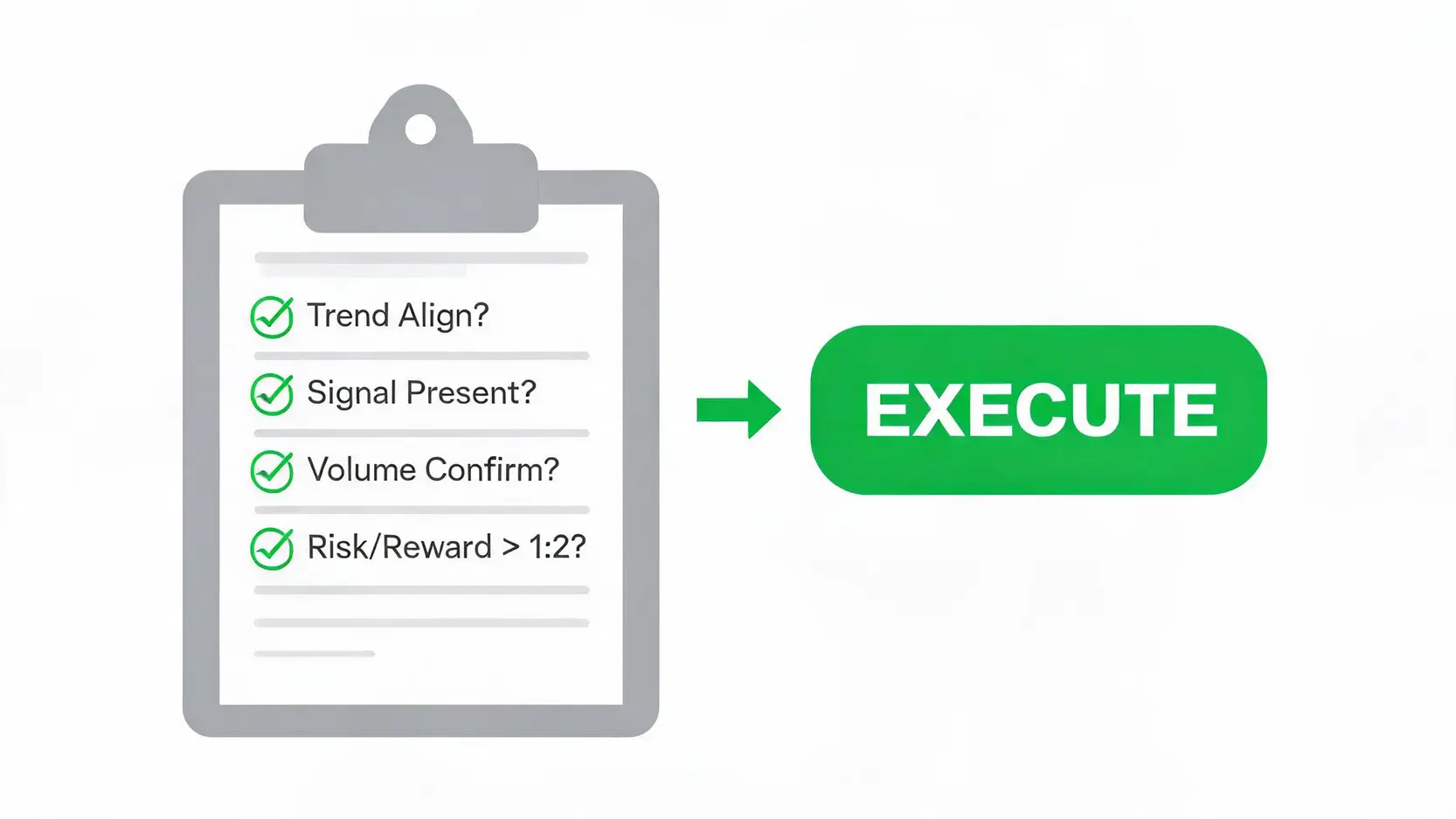
“Analysis Paralysis” is one of the biggest enemies of execution. When your decision-making process becomes overly complicated and requires monitoring more than ten indicators simultaneously, hesitation easily appears at critical moments, causing missed opportunities. Review your trading system and ask yourself whether you can simplify your entry decisions into a clear checklist. For example:

  1. Does the trend align? (✅)
  2. Has a key candlestick signal appeared? (✅)
  3. Does volume confirm the move? (✅)
  4. Is the risk-reward ratio greater than 1:2? (✅)

Only place a trade when all conditions are met. The clearer and simpler the process becomes, the stronger your execution will be.

一張示意圖,展示一份清晰的交易決策檢查清單,旁邊有一個執行的按鈕,象徵著簡化流程能提升執行力。

Turning your decision-making process into a checklist is an effective way to overcome “Analysis Paralysis”.


Find Trading Partners or Mentors to Build Accountability

Fighting alone makes it easy to create excuses for breaking discipline. Finding one or several like-minded trading partners and regularly sharing trading journals and experiences with each other can provide strong accountability. When you know someone else will review your trading records, you become more likely to follow the rules. If you can find an experienced mentor, it will help you avoid many unnecessary detours, because they can identify blind spots in your trading from a much higher perspective.


Frequently Asked Questions (FAQ)

Q: What should I do if I cannot control myself and break my trading plan?

A: First, do not blame yourself excessively. This is part of trading. The key lies in how you handle it afterward. Immediately record it in your trading journal: Why did you break the plan? What emotions were you experiencing at the time? What triggered your impulsive behavior? Then, set a “cooling-off period” for yourself, such as stopping trading for the rest of the day or reducing your position size by half for the next three trades. The focus is on learning from the mistake and building a mechanism to prevent repeating it.

Q: How long does it take to build a complete trading system?

A: It varies from person to person, but generally speaking, a beginner usually needs at least 6 months to 1 year to learn, design, test, and roughly finalize a trading system. This process includes extensive reading, studying, backtesting, and demo trading. Do not pursue shortcuts. Trading is a professional skill that requires time and patience to refine. A system that has been tested by the market is far more valuable than a hastily created “money-making secret”.

Q: Does trading discipline mean I cannot be flexible at all?

A: This is an excellent question. Discipline does not mean rigidity. The market changes dynamically, and your system must evolve accordingly. Discipline means strictly following predefined rules “during trading hours” to avoid emotional decisions. Flexibility, however, should be applied “after trading hours”. When reviews reveal that market structure has fundamentally changed, or your strategy clearly no longer adapts to the market, you can and should adjust and optimize your system. These adjustments should be based on data and rational analysis, not impulsive decisions made during live trading.

Q: How should I start my first trading journal?

A: Start simple. You can use an Excel spreadsheet or dedicated trading journal software. At a minimum, your journal should include the following fields: date, trading instrument, entry price, exit price, stop-loss price, final profit or loss, reason for entry (with chart screenshots), reason for exit, and emotional notes during the trade. The most important part is the “emotional notes”. Honestly recording your feelings is the key to improving your trading psychology

Conclusion

In summary, the secret to achieving stable profitability in the market has never been about finding a magical indicator or an unbeatable strategy. The true holy grail lies in perfectly combining an “effective trading system”, “iron trading discipline”, and “decisive trading execution”. The five training methods provided in this article — creating a trading plan, using a trading journal, practicing with a demo account, mindfulness meditation, and automated risk management — are all foundational pillars on the path toward professionalism. This process will not happen overnight. It requires significant time and perseverance to practice consistently. However, as long as you persist, you will gradually overcome your inner psychological barriers and truly transform your analysis and plans into steadily growing profits in your account. Starting today, stop searching for the next “guaranteed winning strategy” and begin building and executing your own trading plan. This is the first step toward becoming a professional trader, and also the most important one.

If you liked this article, please share it!

Related Articles

  • Volatility Surface Guide: Skew Trading Strategies
    Practical Applications of Volatility Surfaces: From Options Modeling to Advanced Skew Trading Strategies In options markets, implied volatility is never a flat line. Instead, it forms complex "smile" or "skew" surfaces. For advanced traders, mastering the practical applications of volatility surfaces is equivalent to possessing a lens that reveals market...
    2026 年 6 月 3 日
  • Foreign Capital Flow Model: Track Institutional Money
    Building a Foreign Capital Flow Copy Trading Model: A Stock Market Indicator for Accurately Tracking Institutional Positioning In Asia-Pacific stock markets, foreign capital inflows and outflows often determine the direction of the index. However, simply looking at daily net buy and sell data is no longer enough. Only by building...
    2026 年 6 月 3 日
  • Options Buying Strategies for Extreme Market Risks
    Options Buyer Strategies During Extreme Market Conditions: Black Swan Hedging and Cross-Market Arbitrage During Volatility Surges The most terrifying aspect of financial markets is not a gradual decline, but overnight flash crashes and cross-market capital withdrawals accompanied by volatility surges. In the highly unpredictable global macroeconomic environment of 2026, geopolitical...
    2026 年 6 月 3 日
返回顶部