Stock Hedging Guide: 5 Risk Management Strategies

Updated: 2026/03/03  |  CashbackIsland

股票對沖教學:5大投資避險方法,看懂對沖交易策略(附工具比較)

Stock Hedging Guide: 5 Investment Risk Management Methods to Understand Hedging Trading Strategies (With Tool Comparison)

With markets experiencing intense volatility, are you worried that the investment portfolio you painstakingly built could evaporate overnight? Many investors share the same anxiety. In fact, learning “hedging investment is a crucial step in protecting your assets. This strategy is not mysterious or overly complex, but rather an essential risk management skill used by mature investors. This article will clearly explain what hedging trading is and provide practical stock hedging guidance and investment risk management methods, enabling you to effectively manage risk and move forward steadily even in a market downturn or bear market. 


What Is Hedging Investment? Why Is It an Important Investment Risk Management Method?

The term hedge originates from the idea of a “fence” or “barrier”. In finance, it refers to a strategy designed to reduce or offset investment risk. Rather than being a tool for making profits, it is better understood as an “insurance strategy” aimed at protecting your existing assets from adverse market fluctuations. This is why it is regarded as a key investment risk management method.


Definition of Hedging: Not to Earn More, but to Lose Less

Many novice investors mistakenly believe that the goal of every trade is to maximize profit, yet the core mindset of hedging investment is the opposite. Its primary objective is “risk minimization”. Imagine that you hold a large amount of stocks and anticipate a market correction. Instead of rushing to sell all your stocks (which may cause you to miss a subsequent rebound), you establish a position opposite to your stock holdings. If the market does decline, the losses from your stock holdings will be partially offset by gains from the new position. In simple terms, hedging sacrifices part of the “potential excess” return in exchange for “certainty” and “security” of assets.

一張概念圖,解釋對沖投資如何像安全網一樣保護資產免受大幅下跌的影響。

The core of hedging: sacrifice part of the upside potential to add a layer of “safety” to your assets.


Core Objectives of Hedging Trading: Lock in Profits and Reduce Downside Risk

The main objectives of hedging trading can be summarized into two points:

  • Lock in existing profits: When your investment portfolio has accumulated substantial gains, hedging can be used to secure those gains and prevent them from being wiped out by a sudden market reversal.
  • Reduce downside risk: When anticipating market turbulence or the onset of a bear market, establishing hedging positions in advance is like purchasing insurance for your assets, effectively mitigating potential losses. Downside risk refers to the possibility of asset price decline, and hedging is an effective tool to address this risk.

In summary, when market uncertainty increases, hedging investment becomes a stabilizing anchor for your portfolio. It provides investors with greater composure in turbulent markets.


Five Common Stock Hedging Strategies and Tools

After understanding the importance of hedging, we now move to practical guidance by introducing several hedging trading strategies and tools widely used in the stock market. These are common investment risk management methods employed by professional investors.


Strategy 1: Using Futures Contracts for Reverse Positions

A futures contract is a standardized financial agreement in which both parties agree to trade a specific quantity of an underlying asset at a predetermined price at a specified time in the future. In stock hedging, stock index futures (such as S&P 500 index futures or Hang Seng Index futures) are most commonly used.

  • Method of operation: When you hold multiple stocks and are concerned about an overall market decline, you can “sell” or “short” stock index futures contracts.
  • Hedging effect: If the market declines as expected, the value of your stock holdings may decrease, but the short stock index futures position will generate profits, thereby offsetting part of the stock losses.
  • Advantages: Relatively low transaction costs and significant leverage effect.
  • Disadvantages: Futures involve margin requirements and expiration dates. Leverage is a double-edged sword. If the market moves contrary to expectations, losses will also be magnified. Investors unfamiliar with futures contract instruction should proceed with caution.


Strategy 2: Buying Put Options to Insure Stocks

Options grant the holder the “right”, but not the “obligation” to buy (meaning call options) or sell (meaning put options), an asset at a specified price in the future. Buying put options is one of the most direct ways to hedge downside risk of individual stocks or an entire portfolio and is often compared to “buying insurance for stocks”.

  • Method of operation: Purchase put options corresponding to the stock you hold (or to an index ETF that is highly correlated with your portfolio).
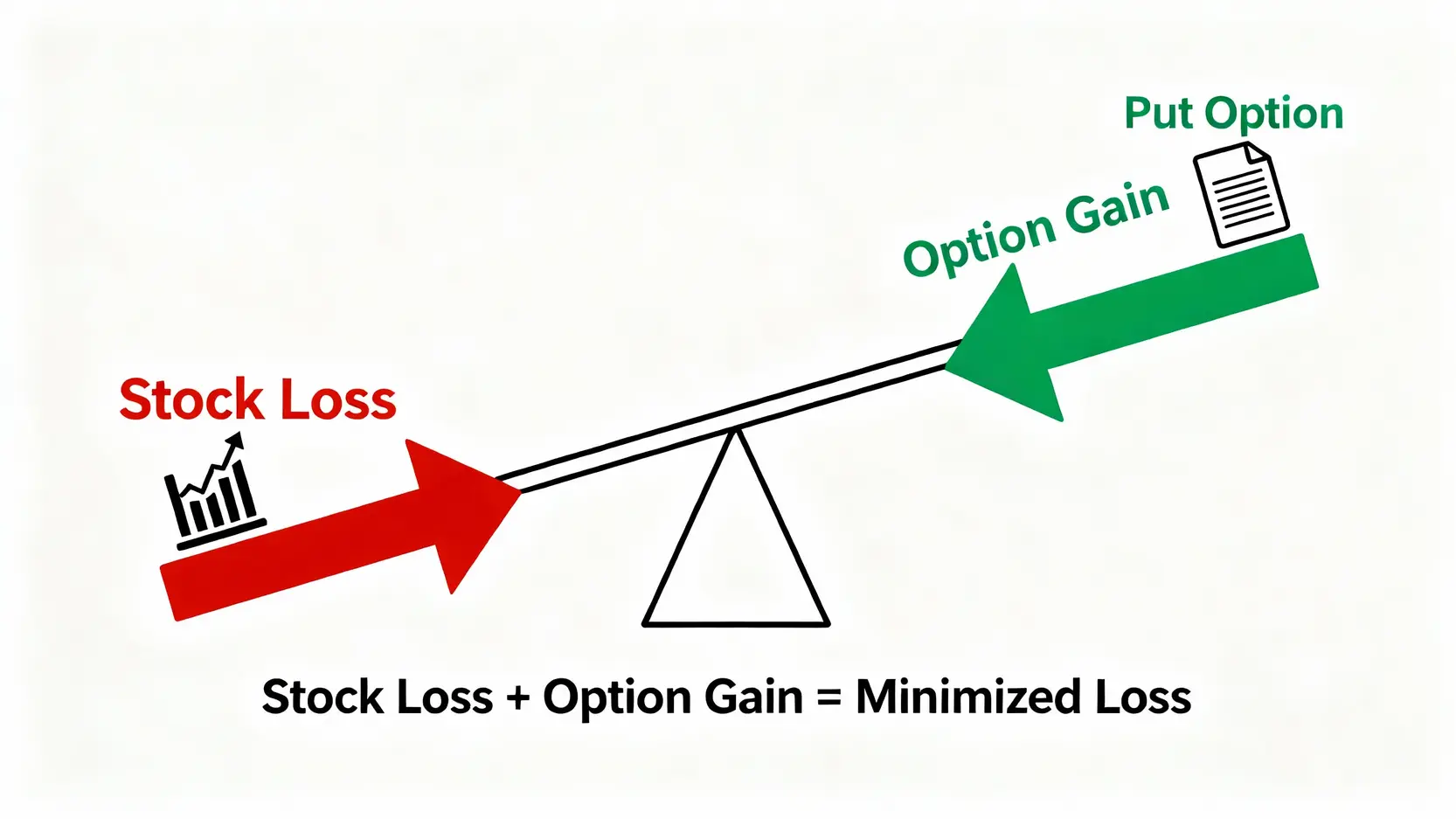
  • Hedging effect: When the stock price falls below the “strike price” of the put option you purchased, the value of the option rises, and its profit can offset the stock losses. Even if the stock price continues to decline sharply, your maximum loss is locked within a certain range.

一張圖解,展示買入認沽期權如何像保險一樣,在股價下跌時產生收益以對沖虧損。

How a Put Option Works: It is like buying insurance for stocks. When the stock price declines, the profit from the option compensates for the stock losses.

  • Advantages: Limited risk, as the maximum loss is the option premium paid (meaning the insurance cost). Flexible operation, allowing precise hedging for individual stocks.
  • Disadvantages: The option premium is a direct cost. If the stock price does not decline by expiration, the premium is lost. Option pricing is complex and influenced by multiple factors such as time value and volatility.


Strategy 3: Hedging Market Risk Through Inverse ETFs

An inverse ETF is a fund designed to track the daily “inverse” performance of an index. For example, if the S&P 500 index declines by 1 percent in a day, a one-times inverse S&P 500 ETF (such as SH), would theoretically rise by approximately 1 percent.

  • Method of operation: When you expect the market to decline, directly purchase an inverse ETF related to your portfolio’s market exposure through your stock account.
  • Hedging effect: When the market declines, the net asset value of the inverse ETF rises, and its gains can compensate for losses in your overall stock portfolio.
  • Advantages: Simple operation, as convenient as trading ordinary stocks, with no margin or expiration concerns, making it highly suitable for retail investors.
  • Disadvantages: Inverse ETFs track “daily” inverse returns. Long-term holding may result in tracking errors due to compounding effects and management fees, making them unsuitable as long-term hedging tools.


Further Reading (Highly Recommended)

What Are ETF Risks? A Comprehensive Analysis of ETF Risk Levels and Investment Management Strategies 

Strategy 4: Building a Portfolio of Negatively Correlated Assets (Such as Stock and Bond Allocation)

This is a more macro and fundamental hedging strategy, also known as “asset allocation hedging”. Its core idea is to include assets in the portfolio that exhibit “negative” or “low correlation” with the stock market.

  • Method of operation: A traditional example is a “balanced stock and bond allocation”, holding a certain proportion of government bonds or high-grade bonds alongside stocks.
  • Hedging effect: During economic recessions or stock market panic, funds typically flow into bonds considered safe havens, pushing bond prices higher and offsetting part of the decline in stock assets. Gold and the US dollar sometimes play a similar role.
  • Advantages: Simple and stable strategy, forming the foundation of a long-term robust investment portfolio.
  • Disadvantages: Asset correlations are not constant. In certain extreme situations, (such as the simultaneous decline of stocks and bonds in 2022), traditional negative correlations may temporarily fail. This requires investors to have a certain understanding of macroeconomics and to master sound portfolio management strategies.


Strategy 5: Application of Pairs Trading

Pairs trading is a market-neutral strategy aimed at profiting from “short-term price differences” between two highly correlated stocks while hedging overall systemic market risk.

  • Method of operation: Within the same industry, identify two companies with highly correlated fundamentals and price movements. When you determine that Company A is overvalued and Company B is undervalued, you can simultaneously “short Company A” and “go long Company B”.
  • Hedging effect: Regardless of whether the overall market rises or falls, as long as the price spread between Companies A and B returns to its normal level, you can profit from the convergence. The overall market movement has minimal impact on your long and short combination.
  • Advantages: Effectively avoids directional market risk and represents an absolute return strategy.
  • Disadvantages: Requires a very high level of analytical ability, accurate assessment of stock correlations and valuation levels, and involves complex execution, making it unsuitable for beginners.


Hedging vs Arbitrage: What Is the Difference Between the Two Strategies?

In financial markets, “hedging” and “arbitrage” are frequently mentioned, yet their concepts are fundamentally different. Understanding the distinction helps you apply various investment risk management methods more precisely.


Difference in Objectives: Risk Avoidance vs Risk-Free Profit

The most essential difference lies in their objectives:

  • Hedging: The objective is risk avoidance. You already have a risk exposure (such as holding stocks) and you establish an opposite position to “neutralize” that risk. The success of hedging is not measured by how much profit is made, but by whether potential losses are effectively reduced.
  • Arbitrage: The objective is risk-free profit. Arbitrageurs exploit small price differences of the same asset across different markets by simultaneously buying and selling to earn profit. In theory, this is a risk-free process because the trades are executed instantly.

一張對比圖,左邊顯示對沖是為了平衡風險,右邊顯示套利是為了賺取無風險價差。

Hedging vs Arbitrage: One raises a protective umbrella for assets (by avoiding risk), while the other identifies and captures market price differences (for risk-free profit).


Comparison Table of Operational Logic

To help you understand more clearly, a comparison table is organized below:

Characteristics Hedging Arbitrage
Primary Objective Reduce or eliminate existing risk Exploit market inefficiencies to earn risk-free price differences
Risk Exposure Accept lower returns in exchange for lower risk Theoretically risk-free, but execution risk exists
Operational Prerequisite Already hold a risk position

Identify temporary pricing imbalances in the market

Duration Can be short-term or long-term Usually instantaneous or extremely short-term
Example Hold stocks while simultaneously selling stock index futures

Stock price is 99 on Exchange A and 100 on Exchange B, buy simultaneously on A and sell on B


Three Major Risks to Consider Before Executing Hedging Trading

Although hedging trading is a powerful risk management tool, it is not flawless. Before actual execution, you must understand its potential risks and costs to avoid falling into new difficulties.


Risk 1: Hedging Costs May Erode Your Returns

There is no free lunch, and hedging also involves costs. These costs directly affect your final investment returns.

  • Direct costs: For example, purchasing options requires paying option premiums, and trading futures or ETFs incurs commissions and spreads.
  • Indirect costs: If the hedging instrument lacks sufficient liquidity, bid-ask spreads may be wide, increasing transaction costs.

If hedging costs are too high, they may significantly erode your original investment profits and may even lead to losses in stable market conditions. Therefore, before executing hedging, you must carefully calculate and evaluate the cost-benefit ratio.


Risk 2: Mistiming May Cause You to Miss Potential Gains

This is the most common “opportunity cost” in hedging trading. After establishing a hedging position, if the market does not decline as expected but continues to rise, your hedging position (such as short futures or long inverse ETFs) will generate losses and at the same time drag down the gains from your core stock holdings.

For example, you hedge your stock portfolio out of concern for a market correction, but the market then enters a strong bull run. Although your stocks generate profits, the losses from the hedging position may cause you to miss most of the upward gains. This feeling of “the index rises but you do not profit accordingly” is the price of incorrect timing.


Risk 3: Liquidity and Leverage Issues From Improper Tool Selection

Different hedging tools vary in complexity and risk. Choosing inappropriate instruments may lead to unexpected problems.

  • Liquidity risk: Some less popular options contracts or ETFs may have low trading volume, making it difficult to close positions or forcing you to accept unfavorable prices.
  • Leverage risk: Futures and certain leveraged ETFs provide high leverage. While they allow you to hedge large asset values with less capital, unfavorable market movements can rapidly magnify losses and may even trigger margin calls, resulting in additional losses.
  • Complexity risk: The pricing and trading rules of derivatives such as options and futures are far more complex than those of stocks. Using them without full understanding may easily result in losses due to operational errors.


Frequently Asked Questions (FAQ)

Q: Does hedging mean guaranteed profit without loss?

A: Absolutely not. This is a very common misconception. The core purpose of hedging is “risk management”, not “guaranteed profit”. Its function is to reduce losses and make portfolio performance more stable, but usually at the cost of sacrificing part of the potential return. In a bull market, a hedged portfolio often underperforms an unhedged one.

Q: Can retail investors conduct stock hedging on their own?

A: Yes. With the increasing availability of financial instruments, retail investors can independently implement hedging strategies. The simplest and most direct method is to purchase inverse ETFs to hedge overall market risk. Investors with some experience may also open futures or options accounts to carry out more precise hedging using derivatives. However, the prerequisite is to devote time to learning the relevant knowledge and fully understanding the associated risks.

Q: Besides stocks, can forex or cryptocurrency also be hedged?

A: Of course. Hedging is a universal financial concept applicable to almost all types of assets. In the foreign exchange market, traders can hedge by establishing opposite positions in a pair of currency pairs (such as going long EUR/USD while simultaneously going long USD/JPY to hedge US dollar risk). In the cryptocurrency market, futures contracts can be used to short Bitcoin to hedge against the downside risk of holding various cryptocurrency spot positions.

Q: How Much Capital Is Required for Hedging?

A: The required capital depends on the hedging tool selected and the size of the assets to be hedged. For example, using options for hedging generally involves relatively low cost, as you only need to pay the option premium. Using stock index futures requires posting a certain percentage of margin. Inverse ETFs are the most flexible, as you may purchase any number of shares according to your needs.


Conclusion

In summary, hedging investment is a risk management technique that every mature investor should learn. It is not a foolproof guarantee of profit, but a strategic investment risk management method aimed at reducing the impact of market uncertainty. Through this stock hedging guide, it is hoped that you can grasp the key concepts and tools of hedging trading, from futures and options to inverse ETFs, so that when facing market volatility in the future, you can protect your investment portfolio with greater confidence. Start reviewing your holdings now and consider how to apply these strategies to make your investment journey more stable and sustainable.

If you liked this article, please share it!

Related Articles

  • Volatility Surface Guide: Skew Trading Strategies
    Practical Applications of Volatility Surfaces: From Options Modeling to Advanced Skew Trading Strategies In options markets, implied volatility is never a flat line. Instead, it forms complex "smile" or "skew" surfaces. For advanced traders, mastering the practical applications of volatility surfaces is equivalent to possessing a lens that reveals market...
    2026 年 6 月 3 日
  • Foreign Capital Flow Model: Track Institutional Money
    Building a Foreign Capital Flow Copy Trading Model: A Stock Market Indicator for Accurately Tracking Institutional Positioning In Asia-Pacific stock markets, foreign capital inflows and outflows often determine the direction of the index. However, simply looking at daily net buy and sell data is no longer enough. Only by building...
    2026 年 6 月 3 日
  • Options Buying Strategies for Extreme Market Risks
    Options Buyer Strategies During Extreme Market Conditions: Black Swan Hedging and Cross-Market Arbitrage During Volatility Surges The most terrifying aspect of financial markets is not a gradual decline, but overnight flash crashes and cross-market capital withdrawals accompanied by volatility surges. In the highly unpredictable global macroeconomic environment of 2026, geopolitical...
    2026 年 6 月 3 日
返回顶部