Complete Hedging Guide: Forex, Stocks & Futures

[Complete Guide to Hedging] Master Forex, Stock, and Futures Hedging Strategies at Once to Easily Navigate Market Volatility
In the face of ever-changing financial markets, do you often worry that the value of your investment portfolio, such as stocks or forex, may shrink overnight? In fact, professional investors make good use of “hedging” strategies to manage risk. This article provides a comprehensive analysis of the core concepts of forex hedging and explores in depth the specific operational methods and advanced hedging strategies for stock hedging and futures hedging, helping you stabilize assets and make more informed investment decisions in uncertain markets. Whether you are an international trader, a stock investor, or a commodity futures trader, this guide will serve as your blueprint for risk management.
What Is Hedging? Essential Core Concept Before Investing
Before exploring specific hedging strategies, it is necessary to establish a correct understanding of “hedging”. Many novice investors mistakenly believe that hedging is a sophisticated profit-making technique, but in essence, it is more like purchasing insurance for your assets. The goal is to “lock in risk and reduce losses” rather than to generate excess returns.
The True Definition of Hedging: Not Only Risk Avoidance, but the Art of Asset Stability
Hedging, also known as risk avoidance or risk offsetting, refers to making another related investment in order to reduce the potential loss risk of an existing investment. Simply put, it involves establishing a position opposite to your main asset exposure. Ideally, when your primary investment incurs losses due to unfavorable market movements, the hedging position will generate profits to offset part or even all of the losses.📉
Imagine that you are a farmer expecting to harvest a large quantity of wheat in three months. You are concerned that wheat prices may fall by then, affecting your income. You can sell an equivalent amount of wheat futures contracts in advance in the futures market. In this way, regardless of how the market price of wheat changes three months later:
- If the price falls: Your revenue from physical wheat decreases, but your short futures position generates profits, compensating for the loss.
- If the price rises: Your revenue from physical wheat increases, but your short futures position incurs losses, offsetting the additional profit.
The final result is that you have locked in the stability of your future income in advance. This is the essence of hedging: sacrificing potential excess returns in exchange for predictable certainty. It is an art of balance and asset stability.

The core of hedging: use profits from derivatives (such as futures) to compensate for losses in physical assets, thereby locking in returns.
Why Is Hedging Necessary? Three Main Objectives of Hedging Trading and Analysis of Advantages and Disadvantages
Investors adopt hedging strategies mainly for the following three purposes:
- Reduce downside risk: This is the primary objective. Markets always carry unpredictable black swan events. Through hedging, even in the event of a market crash, your investment portfolio can receive a certain degree of protection.
- Protect unrealized profits: When a position has accumulated substantial gains but you do not wish to close it and miss further upside, you can establish a hedging position to lock in part of the profit and prevent a sudden market reversal from erasing all gains.
- Address specific risks: For example, multinational corporations may conduct currency hedging to prevent exchange rate fluctuations from eroding profits, while fund managers may use stock hedging to manage systemic risk across the entire portfolio.
Of course, hedging is not flawless. The following is an analysis of its main advantages and disadvantages:
| Advantages |
Disadvantages |
| Risk control: Effectively reduce losses caused by unfavorable movements in market prices, interest rates, or exchange rates. | Cost incurred: Establishing a hedging position requires paying transaction costs, such as commissions, spreads, or option premiums. These costs will erode your potential returns. |
| Enhance portfolio resilience: Enable assets to perform more steadily during market turbulence and reduce significant fluctuations in net asset value. | Limit potential gains: While hedging protects you from losses, it also limits the excess profits you may achieve. Like buying insurance, if nothing happens, the premium becomes a net expense. |
| Increase trading flexibility: Allow investors to manage short-term risks flexibly without closing existing positions. | Operational complexity: Effective hedging requires precise calculation of the hedge ratio and selection of appropriate instruments. For beginners, there is a certain threshold, and improper hedging may result in basis risk. |
Before executing any hedging operation, you should carefully evaluate its costs and benefits. You may refer to What Are ETF Risks? A Comprehensive Analysis of ETF Risk Levels and Investment Management Strategies to understand a more comprehensive risk management framework.
Comprehensive Analysis of Mainstream Hedging Tools and Their Applications in Stock Hedging and Other Markets
After understanding the core concepts of hedging, we will now explore how to apply specific hedging tools across different asset classes to manage risk, particularly the most common hedging methods in the forex, stock, and futures markets.
Forex Hedging (Also Known as Currency Hedging): How to Lock in Exchange Rate Risk in International Trade and Overseas Investments?
Forex hedging, or currency hedging, is essential for any enterprise engaged in cross-border business or individuals investing in overseas assets. Exchange rate fluctuations may instantly erode your profits. For example, a Hong Kong company exporting goods to the US receives payment in US dollars. If the Hong Kong dollar appreciates against the US dollar, the actual income converted back into Hong Kong dollars will decrease.
Common forex hedging tools include:
- Forward contracts: Agreements with banks to buy or sell a specified amount of foreign currency at a pre-locked exchange rate on a future date. This is the most direct and commonly used corporate risk management tool.
- Currency futures: Standardized forward contracts traded on exchanges with high liquidity, suitable for general investors.
- Currency options: Grant the holder the “right”, but not the “obligation” to buy or sell a currency at a specified price in the future. By paying an option premium, you can lock in the worst exchange rate while retaining the benefit of favorable exchange rate movements, offering greater flexibility.
- Currency ETFs: Purchase ETFs that move opposite to the foreign currency exposure you hold. For example, if you hold substantial US dollar assets, you may buy ETFs that are long the Japanese yen or euro to diversify single-currency risk.
Regarding exchange rate risk management, the guidance issued by the Hong Kong Monetary Authority also emphasizes its importance.
Stock Hedging: Three Practical Strategies to Protect Assets in a Bear Market
When stock market prospects are uncertain or entering a bear market, investors can adopt stock hedging strategies to protect the value of their portfolios without panic-selling all stocks.
The following are three practical stock hedging methods:
- Shorting stock index futures: If your stock portfolio is highly correlated with the overall market (such as holding multiple blue-chip stocks), you can sell an equivalent amount of stock index futures contracts (such as Hang Seng Index futures or S&P 500 index futures). When the market declines, losses in your stocks can be offset by profits in stock index futures.
- Buying inverse ETFs: Inverse ETFs are designed to provide the opposite daily return of the index they track. For example, when the S&P 500 index declines by 1 percent, an inverse ETF tracking the index (such as SH), theoretically rises by approximately 1 percent. This is one of the simplest and most direct hedging tools, suitable for retail investors. To further understand ETFs, you may read What Is a VIX ETF? Can You Profit From the Fear Index? VIX ETF Investment Guide and Comprehensive Risk Analysis.
- Buying put options: You can purchase put options on individual stocks you hold or on the overall market index. A put option grants you the right to sell the asset at a specified price in the future. If the stock price drops significantly, the value of the put option increases sharply, and its profit can cover your stock losses. This is equivalent to purchasing downside insurance for your stocks.
Futures Hedging: A Powerful Risk Management Tool for Commodity and Index Investors (Also Known as Hedging)
Futures hedging is a core tool used by commodity producers, consumers, and financial institutions to lock in future prices and manage costs and revenue. In finance, this is referred to as “hedging”.
Futures hedging is divided into two types:
- Short hedge: Entities that will sell physical goods in the future (such as farmers or miners), sell futures contracts in advance to prevent price declines.
- Long hedge: Entities that will purchase physical goods in the future (such as airlines requiring fuel or food processors needing soybeans), buy futures contracts in advance to prevent price increases.
Example Illustration
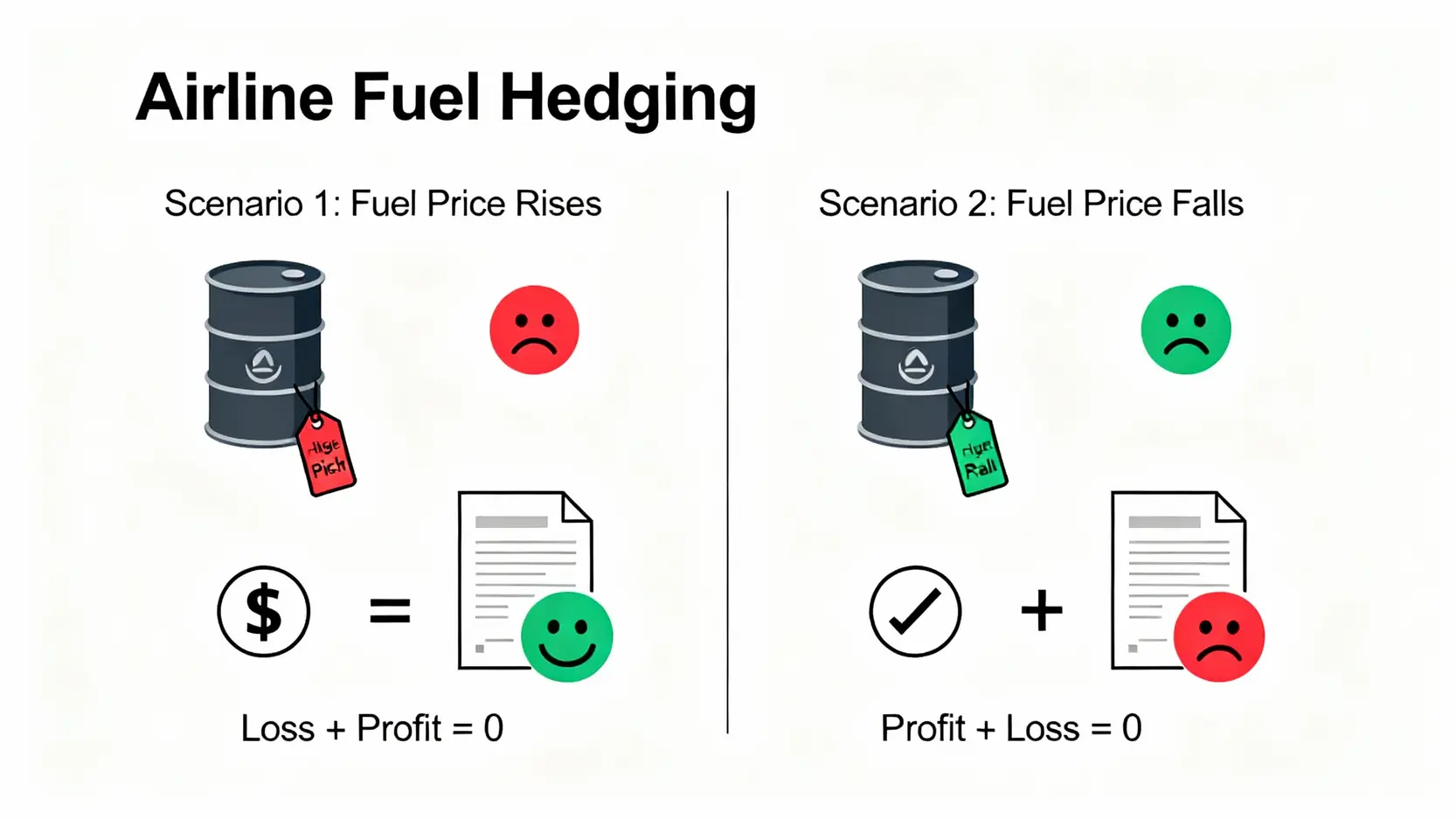
An airline expects to purchase 100,000 barrels of aviation fuel in six months and is concerned that rising oil prices will significantly increase operating costs. The current crude oil futures price is 80 US dollars per barrel.
- Operation: The company buys 100 crude oil futures contracts in the futures market, (with each contract representing 1,000 barrels), locking in a cost of 80 US dollars.
- Scenario 1: Oil price rises to 90 US dollars in six months
– Spot market: The company must purchase fuel at the higher price of 90 US dollars, increasing cost by (90-80) × 100,000 = 1,000,000 US dollars.
– Futures market: The futures contract increases in value, generating profit of (90-80) × 100,000 = 1,000,000 US dollars.
– Net result: The futures profit fully offsets the increased spot cost, and the effective cost remains 80 US dollars per barrel. - Scenario 2: Oil price falls to 70 US dollars in six months
– Spot market: The company purchases at the lower price of 70 US dollars, saving (80-70) × 100,000 = 1,000,000 US dollars.
– Futures market: The futures contract declines in value, incurring loss of (80-70) × 100,000 = 1,000,000 US dollars.
– Net result: The futures loss offsets the savings in the spot market, and the effective cost remains 80 US dollars per barrel.

Through futures hedging, the airline successfully fixes its future costs within a predictable range, eliminating uncertainty from oil price fluctuations.
Further Reading (Highly Recommended)
What Are ETF Risks? A Comprehensive Analysis of ETF Risk Levels and Investment Management Strategies
Three Must-Learn Hedging Strategies With Practical Guidance
In addition to direct hedging for specific assets, there are also more comprehensive and sophisticated hedging strategies in the market. They not only provide risk protection, but can sometimes also generate additional alpha returns.
Strategy 1: Pairs Trading: Identifying Relative Value in the Market
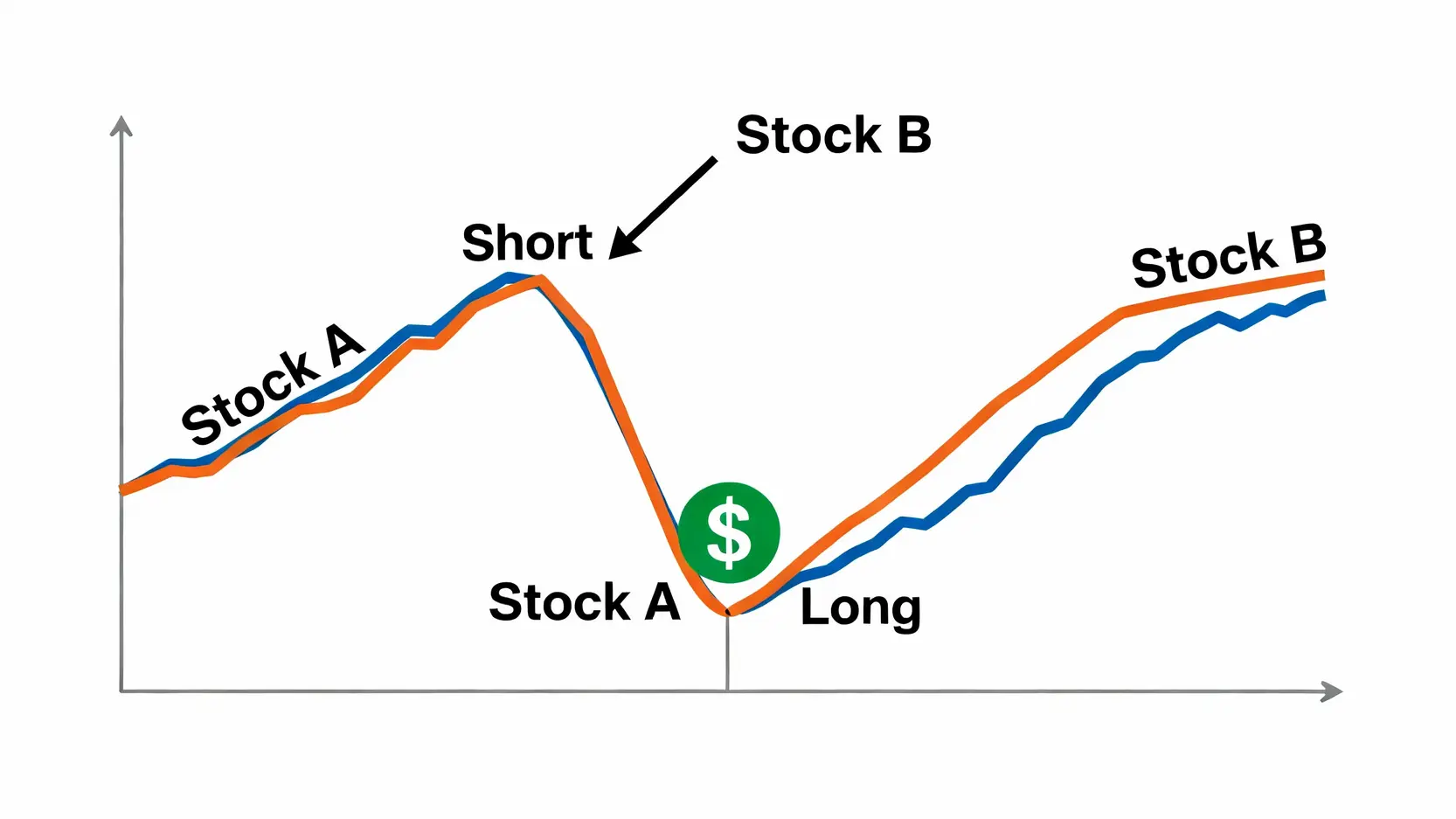
Pairs trading is a market-neutral strategy. Its core idea is to profit from temporary price discrepancies between two highly correlated assets (usually stocks of two companies in the same industry). Investors simultaneously go long the relatively underperforming asset and short the relatively outperforming asset.
- Basic principle: Identify a pair of “twin” stocks, such as Coca-Cola (KO) and PepsiCo (PEP). Their long-term price trends are highly correlated, but short-term deviations may occur due to certain factors.
- Method of operation: When you observe PepsiCo’s share price rise abnormally exceeding Coca-Cola’s, you can short PepsiCo while simultaneously going long Coca-Cola with an equivalent market value.
- Profit mechanism: When the spread between the two returns to normal levels, you can profit from this “paired” long and short position regardless of whether the overall market rises or falls. This strategy hedges away most of the market’s systemic risk.

Strategy 2: Using Derivatives (Options and Futures) for Precise Risk Protection
Options and futures are the most efficient and precise hedging tools. They allow you to conduct “surgical” risk protection against specific exposures. For example, you hold shares of a company that is about to release its earnings report and are concerned that disappointing results may cause the stock price to plunge.
- Using put options: Before the earnings release, buy put options on the stock. If the earnings report is negative and the share price falls sharply, your stock losses can be covered by substantial profits from the put options. If the earnings report is positive and the share price rises, your maximum loss is only the option premium paid, while your stock continues to rise. This is a strategy with limited cost and potentially unlimited protection.
- Using futures: As mentioned earlier, stock index futures can hedge the beta risk of an entire portfolio. A more advanced application is “delta-neutral hedging”, which involves precisely calculating the delta value of an options position and establishing an opposite stock or futures position so that the portfolio value remains unchanged under small movements in the underlying asset price. To learn more about options, you can start with an introduction to options trading.
Strategy 3: The Natural Hedging Effect of Diversified Asset Allocation
The simplest and most frequently overlooked hedging strategy is diversified asset allocation. This is a passive and macro hedging mindset. By allocating capital across different asset types, different regions, and asset classes with relatively low correlation, you can naturally smooth the volatility of the entire portfolio.
A classic diversified portfolio may include:
- Stocks: Provide long-term capital appreciation potential.
- Bonds: Often remain stable or rise when stock markets decline, providing a hedging function.
- Gold and commodities: Often serve as safe havens during high inflation or geopolitical instability.
- Real estate and REITs: Provide stable cash flow and have relatively low correlation with stock and bond markets.
When the stock market weakens, the bonds and gold you hold may rise, offsetting part of the losses in stocks. This built-in automatic stabilizer is the “natural hedging effect” of diversification and is the foundation of all prudent investment strategies.
Frequently Asked Questions About Forex, Stock, and Futures Hedging
Q: Is hedging suitable for beginners? What are the risks?
A: For beginners, directly using derivatives such as futures and options for hedging can be relatively complex and risky. The main risk lies in “imperfect hedging”, such as miscalculating the hedge ratio, poor timing, or choosing the wrong instrument. These mistakes may cause the hedging position itself to generate significant losses, or even amplify total losses. It is recommended that beginners start by understanding “diversified asset allocation” and using simpler tools such as “inverse ETFs”, then gradually move to more advanced strategies. Before attempting complex approaches, thorough learning and simulated trading are essential.
Q: Will hedging significantly reduce my potential returns?
A: Yes, this is the inevitable trade-off of hedging. The core principle of hedging is to “sacrifice potential high returns in exchange for controllable risk”. When the market rises as expected, your hedging positions (such as short futures or put options) will generate losses and reduce your overall return. Therefore, hedging is a defensive strategy. Whether to adopt it depends on your market outlook and personal risk tolerance.
Q: What are the most commonly used hedging tools?
A: The most commonly used hedging tools vary by asset class:
- Forex market: Forward contracts, currency futures, currency options.
- Stock market: Stock index futures, individual stock or index options, inverse ETFs.
- Commodity market: Commodity futures and options.
In addition, Contracts for Difference (CFDs) are also widely used by traders as short-term hedging tools due to their flexibility and ease of taking both long and short positions.
Q: What is the difference between a hedge fund and the hedging I do myself?
A: A hedge fund is a professional investment institution. Although its name originates from “hedging”, its objective is to pursue absolute returns using a variety of complex strategies, (including leverage, short selling, and derivatives trading) regardless of market direction. In contrast, the hedging conducted by individual investors is usually more straightforward. The primary purpose is to protect existing portfolios and reduce specific risks, rather than actively seeking high profits through complex strategies.
Conclusion
In summary, whether it is forex hedging, stock hedging, or futures hedging, the core objective is to reduce unpredictable market risk rather than simply pursue profit. Mastering effective hedging strategies enhances the resilience of your portfolio during market turbulence and helps prevent devastating losses from single events. From basic diversified asset allocation to precise risk protection using futures and options, every mature investor should incorporate hedging thinking into their decision-making framework. Hopefully, this guide helps you build a solid risk management mindset and move forward on your investment journey with greater stability and confidence.
Related Articles
-
Practical Applications of Volatility Surfaces: From Options Modeling to Advanced Skew Trading Strategies In options markets, implied volatility is never a flat line. Instead, it forms complex "smile" or "skew" surfaces. For advanced traders, mastering the practical applications of volatility surfaces is equivalent to possessing a lens that reveals market...2026 年 6 月 3 日
-
Building a Foreign Capital Flow Copy Trading Model: A Stock Market Indicator for Accurately Tracking Institutional Positioning In Asia-Pacific stock markets, foreign capital inflows and outflows often determine the direction of the index. However, simply looking at daily net buy and sell data is no longer enough. Only by building...2026 年 6 月 3 日
-
Options Buyer Strategies During Extreme Market Conditions: Black Swan Hedging and Cross-Market Arbitrage During Volatility Surges The most terrifying aspect of financial markets is not a gradual decline, but overnight flash crashes and cross-market capital withdrawals accompanied by volatility surges. In the highly unpredictable global macroeconomic environment of 2026, geopolitical...2026 年 6 月 3 日