2026 Silver Outlook: Price Drivers & Investment Timing

Updated: 2026/02/27  |  CashbackIsland

【2026白銀未來走勢】影響白銀價格的5大關鍵,現在是投資好時機嗎?

2026 Silver Outlook: Five Key Factors Affecting Silver Prices, Is Now a Good Time to Invest?

Silver, an asset that combines both industrial metal and precious metal attributes, has recently stirred significant market attention. Many investors are closely watching the sharp fluctuations in silver prices and questioning whether now is the right time to enter the market. What factors are driving silver price movements behind the scenes? Amid a complex global economic environment, where is the future direction of silver headed? This article provides an in-depth analysis of the five core factors influencing silver prices, from macroeconomic conditions to industrial demand and specific investment strategies, helping you understand the investment logic of the silver market in one comprehensive read. 


In-Depth Analysis: Five Key Factors Affecting Silver Prices

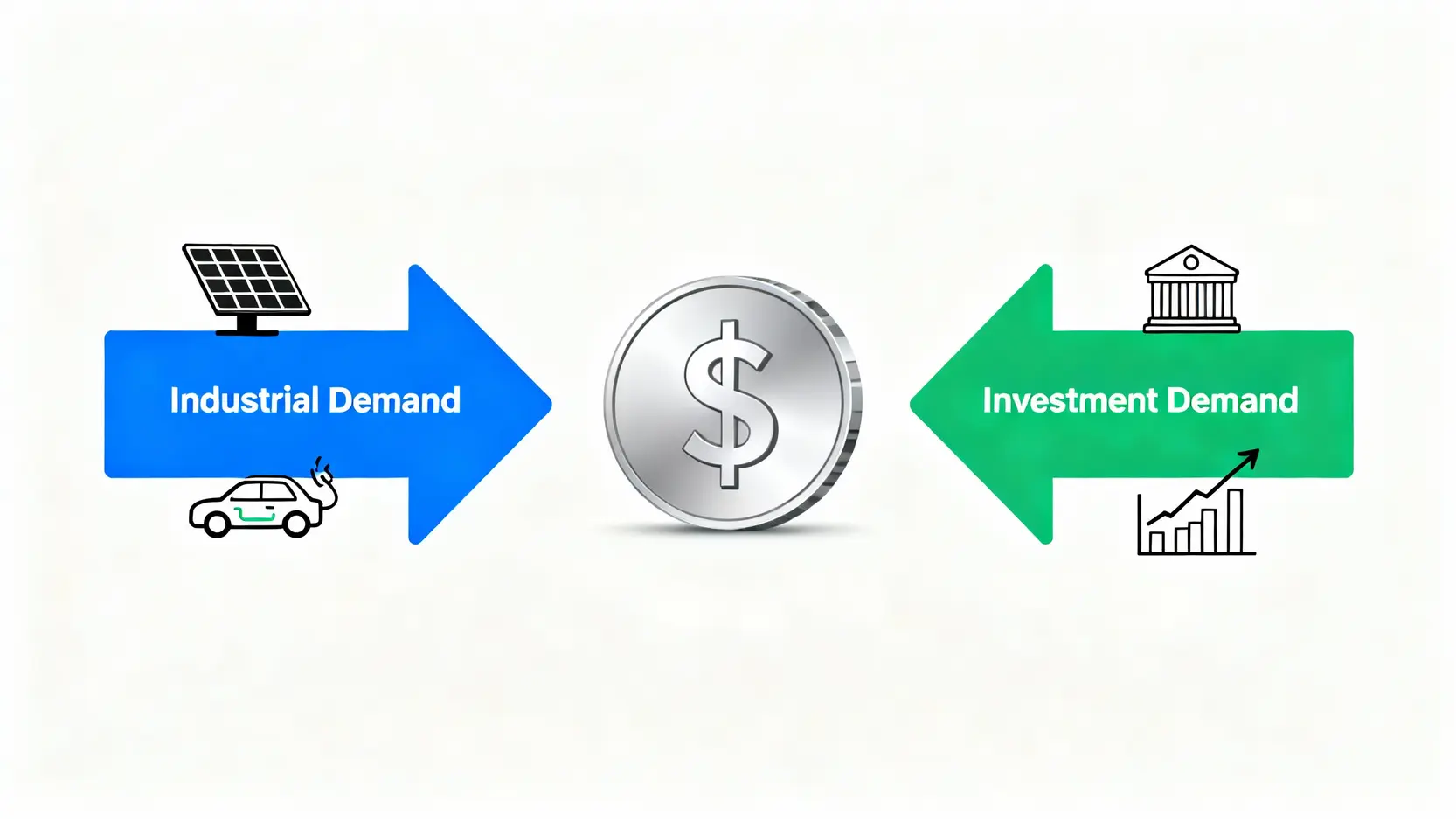
To accurately anticipate the direction of silver prices, it is essential to first understand the underlying driving forces. Unlike gold, which is primarily influenced by its financial attributes, silver prices are jointly determined by industrial demand and investment demand, making its volatility more complex. Below, we break down the five most important influencing factors.一張圖解釋影響白銀價格的兩大驅動力:工業需求(太陽能、電動車)與投資需求(金融避險)。

Silver prices are jointly determined by industrial demand and investment demand, making their movements more complex than those of gold.


Industrial Demand: The Driving Force of the Solar Energy and Electric Vehicle Industries

Silver has the highest electrical and thermal conductivity of all metals, making it nearly irreplaceable in industrial applications. In recent years, as the world pushes to combat climate change and accelerate the transition to green energy, industrial demand for silver has experienced explosive growth.

  • Solar Energy Industry: Conductive silver paste used in solar photovoltaic (PV) panels is one of the primary industrial applications of silver. As governments worldwide heavily subsidize green energy, installations of solar panels continue to reach record highs, directly driving substantial demand for silver.
  • Electric Vehicle (EV) Industry: Silver is used in electronic components, batteries, and charging infrastructure for electric vehicles. As the EV market expands rapidly, demand for silver from the automotive industry is expected to double over the next decade.

According to reports from the authoritative organization The Silver Institute, global industrial demand for silver remains robust, particularly in the green energy sector. This structural growth in demand provides solid long-term support for silver prices. 

US Dollar Index and Interest Rates: Why Do They Move in an Inverse Relationship With Silver Prices?

In global markets, silver is primarily priced in US dollars. Therefore, the strength of the US dollar directly affects silver prices. This relationship can be understood through a simple logic:

  • US Dollar Index (DXY) Strengthens: When the US dollar appreciates, the cost of purchasing silver increases for investors holding other currencies. This suppresses some demand and places downward pressure on silver prices.
  • US Dollar Index Weakens: Conversely, when the US dollar depreciates, silver becomes relatively cheaper, attracting more capital inflows and pushing prices higher.

In addition, interest rates are another critical variable. Silver itself is a non-yielding asset. When major central banks such as the Federal Reserve (Fed) raise interest rates, holding cash or purchasing fixed-income products like government bonds becomes more attractive. Capital may then flow out of the silver market, leading to price declines. Conversely, during rate-cutting cycles or low-interest-rate environments, the opportunity cost of holding silver decreases, and its value preservation and inflation-hedging characteristics become more prominent.

一張蹺蹺板圖示,說明美元指數及利率上升時,白銀價格通常會下跌的反向關係。

The US dollar, interest rates, and silver prices often exhibit a seesaw effect: when one strengthens, the other may weaken.


Gold Price Correlation: Investment Signals Revealed by the Gold-Silver Ratio

Gold and silver are both precious metals and exhibit a high degree of correlation in their price movements, but silver is typically more volatile than gold. Investors often use the “Gold-Silver Ratio” as an indicator to assess the relative value between the two.

Gold-Silver Ratio = Gold Price / Silver Price

This ratio indicates how many ounces of silver are required to purchase one ounce of gold. By observing historical data, certain patterns can be identified:

  • Gold-Silver Ratio at Historically High Levels: This suggests that silver may be undervalued relative to gold. At such times, some strategy-driven traders may sell gold and buy silver, anticipating that the ratio will revert to more normal levels.
  • Gold-Silver Ratio at Historically Low Levels: This may indicate that silver is overvalued relative to gold.

For investors seeking to capture medium-term trading opportunities, the gold-silver ratio is a highly practical reference tool for assessing silver price trends, helping to determine relatively favorable entry and exit timing.


Global Inflation and Safe-Haven Demand: A Value Preservation Role Under Economic Uncertainty

When the global economy faces uncertainty, such as geopolitical conflicts, financial crises, or severe inflation, investors seek assets that can preserve value, known as “safe-haven assets” (Safe-Haven Assets). Like gold, silver also plays this role.

During periods of rising inflation, the purchasing power of fiat currencies declines. To counter inflation’s erosion of wealth, investors shift capital into physical assets. Silver, due to its intrinsic value and limited supply, becomes a popular choice. As a result, when inflation expectations rise or safe-haven sentiment strengthens, silver prices are often driven higher.


Mining Supply: How Does Tight Supply Push Prices Higher?

Finally, the price of any commodity ultimately depends on the relationship between supply and demand. Silver supply mainly comes from mining, with more than 70 percent of silver produced as a byproduct of mining other metals (such as copper, lead, and zinc). This means silver’s supply elasticity is relatively low and cannot quickly respond to sudden surges in demand.

Factors affecting supply include:

  • Political stability of major producing countries: Mexico, Peru, and China are the world’s largest silver producers. Any political unrest, strikes, or changes in environmental regulations in these regions may affect global silver supply.
  • Mining costs: Rising energy prices and labor costs increase mining difficulty and expenses, thereby impacting miners’ output.

In recent years, the global silver market has remained in a state of supply deficit, providing strong fundamental support for silver prices.


A Comprehensive View of Silver Trends: From Historical Data to Future Forecasts

After understanding the influencing factors, let us review history and look ahead to assess current investment value.


Historical Silver Price Review: Key Highs, Lows, and Turning Points

Looking back at silver price movements over the past several decades, there are several important historical moments worth noting:

  • The 1980 peak: Due to the Hunt brothers’ attempt to corner the market, silver prices once surged to a historical high of nearly USD 50 per ounce, before collapsing rapidly.
  • The 2011 peak: Following the global financial crisis, central banks worldwide adopted large-scale monetary easing policies, triggering inflation concerns. Silver once again surged to nearly USD 49 per ounce.
  • From 2020 to the present: Driven by the pandemic, supply chain disruptions, and demand from green energy, silver prices rebounded from lows and have remained at relatively elevated levels with ongoing volatility.

History shows that explosive moves in silver prices are often closely linked to dramatic macroeconomic changes (such as severe inflation or currency depreciation).


2026 Silver Outlook Forecast: Expert Views and Market Potential

Looking ahead to 2026 and beyond, most analysts hold an optimistic view on the future outlook for silver. The main driving force comes from its indispensable industrial attributes.

  • Bullish Case: As the global energy transition accelerates, the widespread adoption of solar energy and electric vehicles will continue to generate strong structural demand. At the same time, if global central banks enter a rate-cutting cycle and the US dollar weakens, this would further provide upward momentum for silver prices. Some optimistic forecasts even suggest that, amid worsening supply-demand imbalances, silver prices have the potential to challenge historical highs.
  • Bearish Case: If the global economy falls into a deep recession, industrial demand may be temporarily suppressed. In addition, if inflation is effectively brought under control and the Federal Reserve maintains high interest rates for longer than expected, this could also place pressure on silver prices.

Overall, silver’s long-term fundamentals remain solid. Its core position in the green technology revolution gives it unique growth potential that goes beyond traditional safe-haven assets.


Is Silver Worth Investing In? A Comprehensive Evaluation of Pros and Cons

So, for ordinary investors, is silver a good investment? Let us use a table to make an objective assessment:

Advantages (Pros) 👍 Disadvantages (Cons) 👎
Lower Entry Threshold: Compared with gold, silver has a much more affordable unit price, allowing participation with relatively small amounts of capital. Extremely High Volatility: The silver market is smaller in scale, making prices more susceptible to the influence of large capital flows, with fluctuations far greater than those of gold.
Strong Industrial Demand: Benefiting from green energy and technological development, it offers long-term growth potential. Storage and Safekeeping Costs: Physical silver has a larger volume. If held in large quantities, secure storage must be taken into consideration.
Safe-Haven and Inflation Hedge: Similar to gold, it is an effective tool for diversifying investment portfolios and countering currency depreciation. Higher Transaction Costs: The bid-ask spread for physical silver is typically wider than that of gold.


Beginner’s Guide: How to Start Investing in Silver?

Optimistic about silver’s future potential and want to start investing? There are many channels available in the market, suitable for investors with different needs and risk preferences.

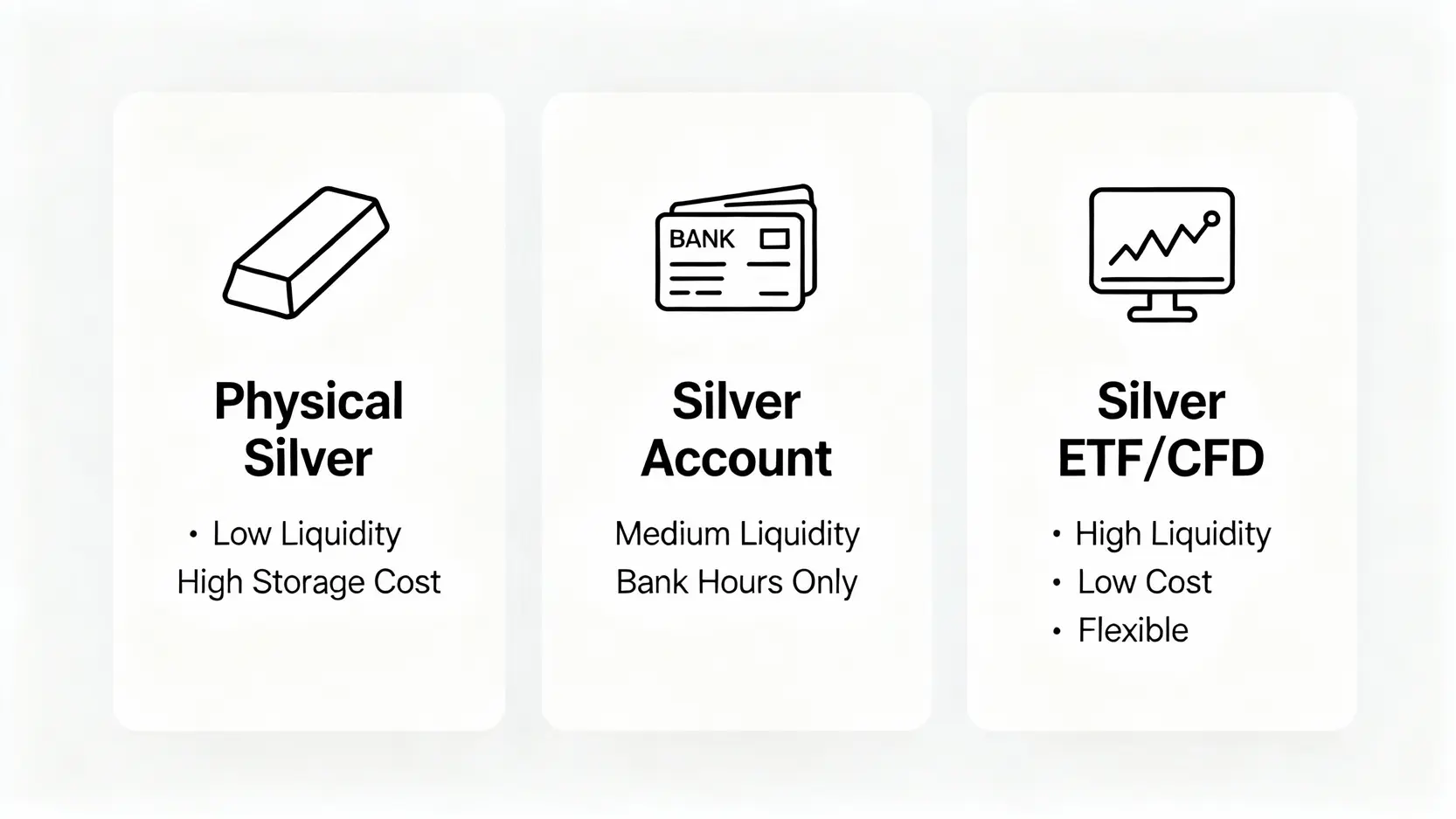
一張對比圖,比較實體白銀、白銀存摺和白銀ETF/CFD三種投資管道的優缺點。

Comparison of Different Silver Investment Channels: Liquidity, Costs, and Convenience Vary


Comparison of Investment Channels: Physical Silver, Silver Passbook, Silver ETFs

Below are the three most common ways to invest in silver:

  • Physical Silver (Silver Bars, Silver Coins): Directly holding silver offers the strongest sense of ownership. It is suitable for long-term investors who focus on asset value preservation and are not concerned about short-term volatility. The advantages are the absence of counterparty risk, while the disadvantages include relatively lower liquidity, bid-ask spreads, and storage issues.
  • Silver Passbook (Paper Silver): Applied for through banks, allowing investors to buy and sell silver via a passbook account without physical delivery. The advantages are convenient trading and a low entry threshold, while the disadvantage is that trading hours are limited by bank business hours.
  • Silver ETFs, Contracts for Difference (CFD): Traded on securities markets or CFD platforms, these are financial derivatives that track silver prices. This approach offers the best liquidity and the lowest transaction costs, making it suitable for short-term traders or investors seeking flexible operations. By investing in silver ETFs, investors do not need to worry about physical storage and can also use leverage to amplify returns (which may also amplify losses).


Risk Management: Three Common Mistakes Beginners Should Avoid

The silver market is full of opportunities, but it also comes with risks. Beginner investors should pay particular attention to avoiding the following mistakes:

  1. Chasing Highs and Selling Lows: Silver prices are highly volatile. Buying impulsively when prices surge due to FOMO can easily result in buying at the top. Establishing investment discipline and buying in batches is a more prudent strategy.
  2. Overconcentration: Never allocate all your funds to silver. It should be part of your overall investment portfolio, used for risk diversification, with a suggested allocation of no more than 5 to 10 percent.
  3. Ignoring the Overall Economy: Focusing only on price charts while ignoring macroeconomic factors that influence silver prices (such as Federal Reserve policy and US dollar trends) can cause you to miss critical market turning points.


Frequently Asked Questions (FAQ)

Why Is Silver More Volatile Than Gold?

There are two main reasons. First, the silver market is much smaller than the gold market, so the same amount of capital inflows or outflows has a greater impact on silver prices. Second, silver has both industrial and financial attributes. It is influenced not only by investment sentiment, but also by global economic conditions and changes in industrial orders. The combination of these factors makes its price movements more complex and more volatile.

What Is the Price of Silver per Ounce, and How Is It Converted?

Silver is internationally quoted in “US dollars per troy ounce”. Prices fluctuate in real time, and you can check the latest quotes on major financial websites. Common conversion units are as follows:
1 troy ounce ≈ 31.1035 grams
1 kilogram ≈ 32.15 troy ounces

Which Factor Is the Most Important in Affecting Silver Prices?

This question has no standard answer, because the dominant factor varies across different periods. However, in the long term, “industrial demand” is the foundation supporting silver’s value, especially under the global trend of energy transition, where its importance continues to grow. In the short term, the “US dollar index” and “market safe-haven sentiment” are the main catalysts triggering sharp price fluctuations.

Do You Need to Pay Tax When Investing in Silver?

Tax rules vary by region. In Taiwan, profits from buying and selling physical silver are classified as property transaction income and must be included in personal comprehensive income tax filings. If silver ETFs or CFDs are traded through overseas brokers, they are considered overseas income and are subject to the alternative minimum tax system. In Malaysia, the situation differs. It is recommended to consult a professional tax advisor before investing to understand the specific regulations applicable in your location.


Conclusion

In summary, the factors influencing silver prices are diverse and complex, ranging from industrial demand driven by cutting-edge technology, to global central bank monetary policy, and investor market sentiment. Looking ahead to future silver price trends, its key role in the green energy revolution injects strong long-term growth potential. However, investors must also be aware of its highly volatile nature. Before making any investment decisions, it is essential to fully understand these core influencing factors and, based on one’s own risk tolerance and investment objectives, choose the most suitable investment channel. Only then can investors move forward steadily in this highly attractive silver market and capture potential profit opportunities.

If you liked this article, please share it!

Related Articles

  • Volatility Surface Guide: Skew Trading Strategies
    Practical Applications of Volatility Surfaces: From Options Modeling to Advanced Skew Trading Strategies In options markets, implied volatility is never a flat line. Instead, it forms complex "smile" or "skew" surfaces. For advanced traders, mastering the practical applications of volatility surfaces is equivalent to possessing a lens that reveals market...
    2026 年 6 月 3 日
  • Foreign Capital Flow Model: Track Institutional Money
    Building a Foreign Capital Flow Copy Trading Model: A Stock Market Indicator for Accurately Tracking Institutional Positioning In Asia-Pacific stock markets, foreign capital inflows and outflows often determine the direction of the index. However, simply looking at daily net buy and sell data is no longer enough. Only by building...
    2026 年 6 月 3 日
  • Options Buying Strategies for Extreme Market Risks
    Options Buyer Strategies During Extreme Market Conditions: Black Swan Hedging and Cross-Market Arbitrage During Volatility Surges The most terrifying aspect of financial markets is not a gradual decline, but overnight flash crashes and cross-market capital withdrawals accompanied by volatility surges. In the highly unpredictable global macroeconomic environment of 2026, geopolitical...
    2026 年 6 月 3 日
返回顶部