Illustration of Short Selling: Borrow First, Sell, and Earn From the Price Decline Through the Complete Process.
The Two Main Purposes of Short Selling: Speculation and Hedging
Learning how to short sell generally serves two primary purposes:
- Speculative profit: This is the most direct objective. When analysis indicates that the market or a particular stock is about to enter a downward trend, investors can execute short selling to generate profits during a bear market or price correction, “achieving gains even in a declining market”.
- Hedging risk: For investors holding long positions (holding shares), short selling is an excellent risk management tool. For example, you hold a basket of technology stocks for the long term but expect a short-term correction in the entire technology sector. In this case, you may short a related technology index ETF. If the sector declines, profits from the short position can offset part of the losses in your holdings, thereby protecting your portfolio.
Core Tutorial: A Complete 5-Step Guide to Short Selling Operations
After covering the theory, we now move into practical instruction. By mastering the following five short selling steps, you can clearly execute a complete short selling transaction. This process applies to most short selling operations in the Hong Kong and US stock markets.
Step One: Choose a Broker That Provides Short Selling Services and Open a Margin Account
Not all brokerage accounts support short selling. To short sell, you must open a “Margin Account” rather than a standard cash account. This is because short selling involves “borrowing shares”, and the broker requires you to deposit margin as collateral to cover potential losses. When selecting a broker, you should compare margin requirements for US stock accounts, the list of shortable stocks, borrowing rates, and trading commissions. Reputable large brokers with stable platforms are the preferred choice.
Step Two: Check the List of Shortable Stocks and the Borrowing Rate
Not every stock can be short sold. Exchanges in different markets publish a “Designated Securities Eligible for Short Selling List”. Generally, only stocks with larger market capitalization and higher liquidity are eligible for short selling. On the broker’s trading platform, you can easily check whether a stock is available for short selling and review its “Stock Borrowing Rate“. This rate is calculated annually and fluctuates based on market demand for shorting the stock. The higher the demand, the higher the borrowing rate.
Step Three: Execute the “Sell” Order and Successfully Borrow Shares to Short Sell
On the trading platform, select the stock you wish to short sell, enter the quantity, and choose the “Sell” or “Short Sell” instruction. The system will automatically handle the borrowing and selling process. Once the order is successfully executed, your holdings will display a negative number of shares (such as -100 shares), indicating that you hold a short position.
Step Four: Monitor Market Conditions and “Buy” to Close at the Target Price
After successfully short selling, the most important task is to closely monitor market movements. When the stock price falls to your target level, or when you judge that the trend is about to reverse, you can execute a “Buy” order to close the position, also known as Buy to Cover. For example, if you short sold 100 shares, you must now buy 100 shares to complete the transaction.
Step Five: The System Automatically Returns the Shares and Completes Settlement
After you execute the buy order to close the position, the broker’s system will automatically return the shares you repurchased. Your short selling transaction is then completed, and the related profit or loss will be settled in your account.
Further Reading (Highly Recommended)
Foreign Exchange Tutorial 2024: The Ultimate Beginner’s Guide From 0 to 1 to Master Foreign Exchange Trading Skills!
Is Averaging Down a Savior for Stocks? The Latest 2025 Guide: Averaging Calculator, Pros and Cons Explained at a Glance
Comparison of Mainstream Short Selling Methods: What Other Options Exist Besides Direct Short Selling?
Directly short selling individual stocks is the most traditional short selling method, but the market also provides other tools for investors who are bearish on the outlook. Understanding different short selling methods can help you choose the strategy that best matches your risk preference and market outlook.
Method One: Direct Short Selling of Individual Stocks
This is the core method explained earlier, which involves borrowing and selling shares of a single company through a margin account. The advantage of this method is its straightforward execution and high return potential if stock selection is accurate. However, the disadvantages are equally evident: risk is highly concentrated, and there is the possibility of unlimited losses.
Method Two: Buying a Put Option
Options are financial derivatives. Purchasing a Put Option gives you the “right” to sell an asset at a specified price (known as the strike price) before a specified date in the future. If the stock price falls below the strike price, your put option increases in value, generating profit. The greatest advantage of using options for short exposure is limited risk, as the maximum loss is restricted to the premium paid. However, options have an expiration date, and their value declines over time due to time decay, making the strategy relatively more complex.
Method Three: Investing in an Inverse ETF
An Inverse ETF is an exchange-traded fund designed to deliver returns opposite to those of its underlying index. For example, a -1x inverse ETF tracking the Hang Seng Index (such as FI South China Hang Seng) is structured so that when the Hang Seng Index falls by 1%, its net asset value theoretically rises by 1%. Investing in an inverse ETF is as simple as trading ordinary stocks, does not require opening a margin account, and involves limited losses (at most to zero). It is particularly suitable for ETF beginners who prefer not to use leverage or derivatives.
Table Analysis: Comparison of the Advantages, Risks, and Suitable Investors for the Three Short Selling Methods
| Comparison Criteria |
Direct Short Selling of Individual Stocks |
Buying a Put Option |
Investing in an Inverse ETF |
| Method of Operation |
Borrow Shares Through a Margin Account and Sell |
Purchase a Put Contract in the Options Market |
Purchase Directly Like Trading Stocks |
| Maximum Risk |
Theoretically Unlimited |
Limited (Premium Paid) |
Limited (Invested Capital) |
| Potential Return |
High (Until the Stock Price Falls to Zero) |
Very High (Leverage Effect) |
Proportional to the Index Decline |
| Advantages |
Highly Targeted and Direct Returns |
Controllable Risk and High Leverage |
Simple Operation, No Margin Required |
| Disadvantages |
Extremely High Risk With Margin Call Risk |
Subject to Time Decay and More Complex Strategy |
Management Fees Apply and Long-Term Holding May Result in Tracking Error |
| Suitable Investors |
Experienced Investors Who Can Tolerate High Risk |
Advanced Investors Familiar With Derivative Instruments |
Beginners or Investors Seeking to Hedge Overall Market Risk |
The Key to Short Selling Education: Understanding Three Core Risks and Response Strategies
Any short selling tutorial must emphasize risk management, because the risk structure of short selling is fundamentally different from the traditional buy-and-hold strategy. Ignoring these risks may lead to catastrophic losses.
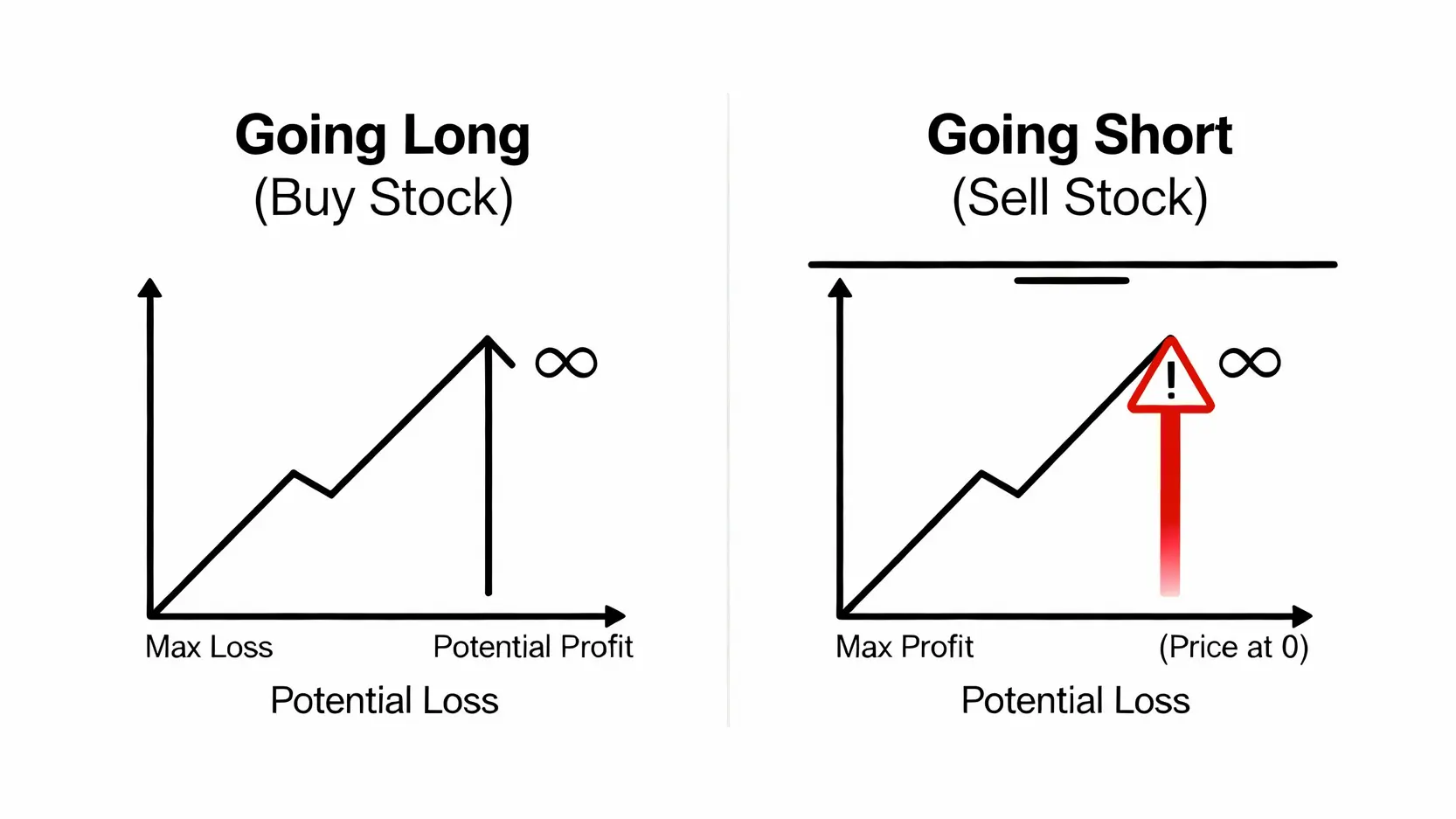
Risk One: The Possibility of Unlimited Losses (Stock Prices Can Theoretically Rise Without Limit)
This is the most frightening risk of short selling. When you buy a stock, the maximum loss is your entire principal (if the price falls to zero). However, when you short a stock, its price can theoretically rise without limit. If the price rises instead of falls, your losses have no ceiling. Therefore, setting a stop loss is a strict rule in short selling operations and must be rigorously enforced.