Check Broker Regulation: SFC Warning List Guide

Updated: 2026/03/26  |  CashbackIsland

sfc-alert-list-broker-check-guide

[Investment Risk Prevention Guide] How to Check Broker Regulation? Learn in 3 Steps to Use the SFC Warning List to Identify Fake Licenses!

Investment scams are occurring frequently in the market, with fraudsters often using counterfeit regulatory licenses to deceive investors, resulting in total losses. To safeguard your hard-earned money, learning how to check broker regulation is an essential skill for every investor. This article will guide you step by step on how to make good use of the SFC warning list and verify fake regulatory licenses through official tools. With just three simple steps, you can quickly identify potential investment traps and scam trading platforms, allowing you to invest with peace of mind and stay away from scams. 


What Is the SFC Warning List? Why Is It Crucial for Investors?

Before making any investment, verifying the compliance of a platform is the first line of defense in protecting your assets. The “Warning List” established by the Hong Kong Securities and Futures Commission (SFC) is precisely a key tool designed for this purpose. It is not just a blacklist, but a dynamically updated database aimed at alerting the public to companies that may pose risks.


Definition of the Warning List: Specifically Exposing Unlicensed Operations and Suspicious Entities

The SFC warning list is a public database that specifically lists suspicious companies, websites, and individuals that target Hong Kong investors without the required licenses or claim to have a connection with Hong Kong. The activities of these entities have raised concerns with the SFC, such as involvement in false promotions or unauthorized collective investment schemes. Being included on the warning list is a clear signal from the SFC to the public that dealing with these platforms carries extremely high risk.


4 Main Categories of the Warning List: Unlicensed Companies, Suspicious Websites, Impersonated Regulators, etc.

To help investors more clearly identify different types of risks, the warning list typically categorizes suspicious entities into the following main groups:

Category Name Detailed Description
Unlicensed Companies and Suspicious Websites The most common category, covering companies and websites that provide financial services or investment products to the Hong Kong public without being licensed by the SFC.
Impersonation Companies

Fraudulent entities that impersonate legitimate licensed financial institutions or their affiliates, misusing the names, logos, and even license numbers of legitimate companies.

Suspicious Investment Product Websites Websites that specifically promote investment products that may involve scams, such as investment schemes with unrealistically high returns.
Impersonated Regulatory Authority Websites Fraudsters set up fake regulatory authority websites to “prove” the legitimacy of their fake platforms, making them highly deceptive.


Case Analysis: Characteristics of Virtual Asset Trading Platforms Recently Listed on the Warning List

In recent years, with the rise of virtual assets such as cryptocurrencies, related investment scams have also emerged one after another. Taking “HOUNAX” and “JPEX”, which were once included on the warning list, as examples, they share several typical characteristics: aggressively promoting through influencers (KOLs) or social media, promising unrealistically high returns or “arbitrage” opportunities, and using complex referral bonus schemes to attract new users. These platforms are often ultimately exposed as not holding the required licenses to provide virtual asset services in Hong Kong, and investors’ funds are extremely difficult to recover. Such cases highlight the importance of checking the SFC warning list before investing any funds. 


[Practical Guide] Complete Fake Regulatory License Verification in Three Steps

三步驟查證券商監管牌照的流程圖,包含查詢持牌紀錄冊、核對警示名單、驗證海外監管。

Three-Step Verification Process to Easily Identify Scam Trading Platforms.

After understanding the importance of the warning list, the next step is to learn how to conduct verification yourself. This three-step verification process can help you systematically filter out most non-compliant trading platforms and is a core skill for safeguarding your investment security.

Step One: Check the “Public Register of Licensed Persons and Registered Institutions” to Confirm Licensing Status

This is the most basic and important step. Any company or individual legally conducting regulated activities in Hong Kong (such as securities trading or asset management) must be registered with the SFC and hold the appropriate license. You can verify this through the official Public Register of Licensed Persons and Registered Institutions.

  • Search method: Enter the company or individual’s Chinese or English name on the search page.
  • Key verification points: Confirm whether the name, Central Entity Number (CE No.), and permitted regulated activities match the business they claim to conduct. In particular, be aware that some fraudsters use names very similar to licensed companies, so every detail must be checked carefully.

If no information about the company can be found in this register, it is an extremely dangerous signal, and you should immediately stop any interaction with the platform.


Further Reading (Highly Recommended)

2026 Hong Kong US Stock Investment Guide, Fees and Account Opening Explained, Beginners Can Easily Get Started!


Step Two: Cross-Check the “SFC Warning List” to Avoid Known Blacklisted Entities

Even if a company is not listed in the licensed register, it is still recommended to take an additional step by searching the “SFC warning list”. This helps confirm whether the platform has already been publicly identified as a suspicious entity by the SFC.

  • Cross-verification: Search the company name and website information in the warning list.
  • Why it matters: Some platforms may be newly established and not yet listed, but in many cases, numerous active scam platforms are already included. Completing this step can effectively help you avoid many known “risks”.


Step Three: Use Overseas Regulatory Websites to Verify International Broker Regulation (Using US FINRA as an Example)

Many investors choose international brokers, including well-known US stock brokers. For platforms claiming to be regulated by overseas authorities, their regulatory information must also be verified. In the US, all legitimate securities brokers must be members of the Financial Industry Regulatory Authority (FINRA).

  • Verification tool: You can use FINRA’s official free tool, BrokerCheck.
  • Procedure: Enter the broker’s name or CRD Number on the BrokerCheck website to review its registration history, business scope, and any disciplinary records.
  • Apply the same approach: The same verification logic applies to regulators in other countries or regions, such as the UK Financial Conduct Authority (FCA) and the Australian Securities and Investments Commission (ASIC), both of which provide similar public databases.


Common Tactics Used by Fake Brokers and Investment Scams

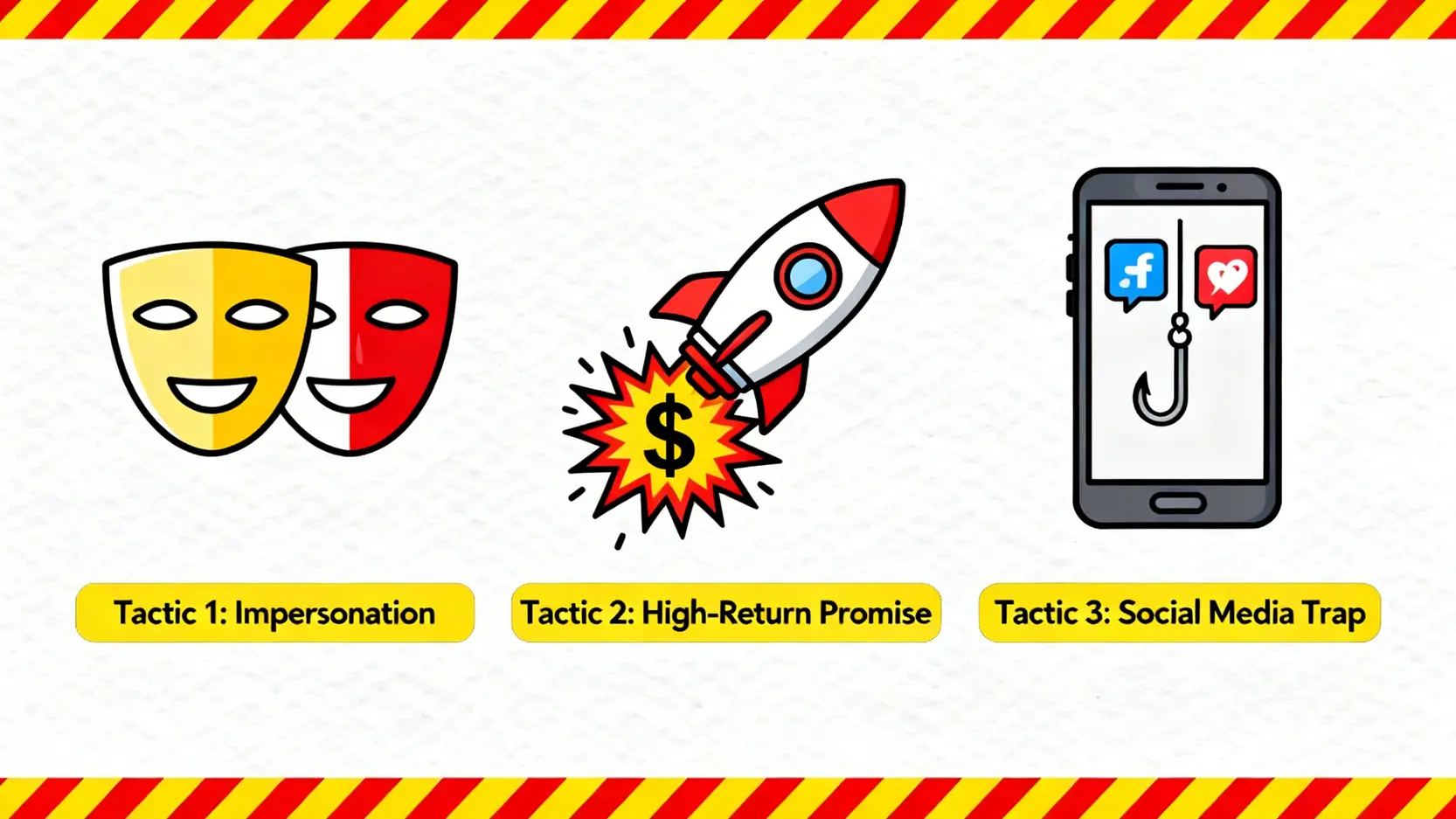
識別投資騙局的三大常見手法:偽冒機構、保證高回報、社交媒體陷阱。

Be Alert to Three Major Investment Scam Tactics to Protect Your Assets.

In addition to learning how to use verification tools, understanding common scam tactics can further enhance your awareness. When encountering the following situations, you should immediately raise a red flag:


Tactic One: Impersonating Well-Known Institutions or Misusing Genuine License Numbers

This is the most common and highly deceptive tactic. Fraudsters create websites or apps that closely resemble those of well-known brokers or banks, and may even directly misuse the names and license numbers of legitimate licensed companies, displaying them prominently on their own websites. The only clues often lie in minor details, such as slight differences in the domain spelling (for example, replacing “o” with “0”) or providing only instant messaging as customer contact.


Tactic Two: Exaggerated Claims of High Returns and Zero Risk

“Guaranteed 20% monthly returns”, “risk-free insider information”, “AI quantitative trading for effortless profits”… these are all typical scam claims. Legitimate financial institutions clearly state that investments involve risk. Any promotion that promises fixed high returns violates basic financial principles and is almost certainly a scam.


Tactic Three: Approaching Potential Victims Through Social Media or Messaging Apps

Modern fraudsters rarely use traditional methods and instead turn to social media platforms (Facebook, Instagram) or messaging apps (WhatsApp, Telegram, LINE). They disguise themselves as “investment experts”, “financial advisors”, or even “wealthy and attractive individuals”, first building trust with you (commonly known as “pig butchering scams”), and then luring you to invest on their designated fake platforms.


FAQ

Q: If a broker is not on the warning list, does that mean it is absolutely safe?

A: Not necessarily. The warning list has a time lag. It takes time for a new scam platform to be investigated by the SFC and added to the list. Therefore, not being on the warning list does not mean it is 100% safe. The most reliable method is still to refer to the “Public Register of Licensed Persons and Registered Institutions” to confirm whether the platform holds a valid license. This is the gold standard for determining compliance.

Q: Besides the SFC website, what other third-party tools can assist with verification?

A: Although official channels are the most authoritative, some third-party financial information websites or apps also aggregate data from major global regulatory authorities and provide one-stop search services. For example, some forex information websites offer broker regulatory verification tools. However, it should be noted that these third-party tools may not be updated as promptly as official sources, and the final verification should always rely on the official regulator’s website.

Q: If I unfortunately encounter a fake platform, how should I seek help and report it?

A: If you suspect that you have encountered an investment scam or an unlicensed platform, you should immediately stop investing further funds and take action as soon as possible. First, report the case to the Hong Kong Police. Second, you can submit all relevant information about the suspicious platform (such as website links, conversation records, and company details) through the SFC’s online complaint form. This helps the regulator follow up with investigations and warn more potential victims.

Q: Are licenses from overseas regulatory authorities valid in Hong Kong?

A: This depends on the specific situation. Generally, if an overseas broker wants to provide services to the Hong Kong public, it still needs to obtain the appropriate license from the Hong Kong SFC. Simply holding an overseas license (such as from US FINRA or UK FCA) is not sufficient for legal operation in Hong Kong. Therefore, even if a broker claims to hold overseas licenses, you should still prioritize verifying whether it appears on the SFC’s licensed register.


Conclusion

Spending a few extra minutes on verification before investing can greatly reduce the risk of falling into scams. In summary, learning how to check broker regulation is a fundamental skill for every investor. Be sure to incorporate the three steps mentioned in this article into your investment checklist: checking the licensed register, cross-checking the SFC warning list, and verifying overseas regulation. Bookmark official verification tools and remain vigilant at all times to protect your assets and achieve real wealth growth in the complex financial market.

If you liked this article, please share it!

Related Articles

  • June Blacklist: 17 Brokers Flagged by Regulators
    Week Two of June Blacklist: 17 Platforms Named by Regulators, FCA, BCSC, and Others Issue Warnings According to the latest industry monitoring data, from June 8 to June 14, 2026, global financial regulators stepped up their crackdown on illegal trading platforms. This week, a total of 17 trading platforms were...
    2026 年 6 月 24 日
  • May Forex Scam Alert: 30 High-Risk Brokers Exposed
    May Forex Scam Broker Alert: 30 High-Risk Platforms Exposed, CashBack Island Reminds You to Stay Away From the Traps In forex and CFD trading, choosing a regulated broker is the first line of defense for protecting your funds. Recent industry monitoring data shows that another 30 suspected scam brokers were...
    2026 年 6 月 5 日
  • Equiti Profit Wipeout: B-Book Broker Risk Exposed
    Beware of the Equiti Platform: US$410,000 in Profits Wiped Out Overnight, Exposing the Harvesting Tactics of “B-Book” Scam Brokers In the forex and CFD trading market, what investors fear most is not normal market volatility, but having their massive profits forcibly wiped out by the platform under the pretext of...
    2026 年 5 月 22 日
返回顶部