Beginner’s Guide: Quant Trading for Stocks & Crypto

Updated: 2026/04/07  |  CashbackIsland

quantitative-trading-guide

Beginner’s Guide to Quantitative Trading: Master Automated Trading for Hong Kong Stocks, US Stocks, and Cryptocurrencies in One Article!

Do you want to improve your investment efficiency through automated trading but do not know where to start? Faced with the unique rules of Hong Kong stock quantitative trading, the abundance of data in US stock quantitative trading, and the round-the-clock volatility of cryptocurrency quantitative trading, are you feeling discouraged from this efficient investment approach? Do not worry. This comprehensive beginner’s guide to quantitative trading will take you from core concepts to the strategic differences across the three major markets, as well as recommendations for the best quantitative trading platforms, helping you master the key to successful automated trading in one go.


What Is Quantitative Trading? Core Concepts Every Beginner Must Understand

Quantitative trading is not some mysterious high-tech concept. Its essence is the use of mathematical models and computer technology to transform investment ideas into executable trading strategies. Simply put, it uses data and algorithms to replace human judgment in market analysis, decision-making, and order execution, with the goal of identifying trading opportunities that can deliver consistent and stable profits. This approach minimizes the impact of human emotions, allowing investing to return to rationality and data.


Quantitative Trading vs Algorithmic Trading: What Is the Difference?

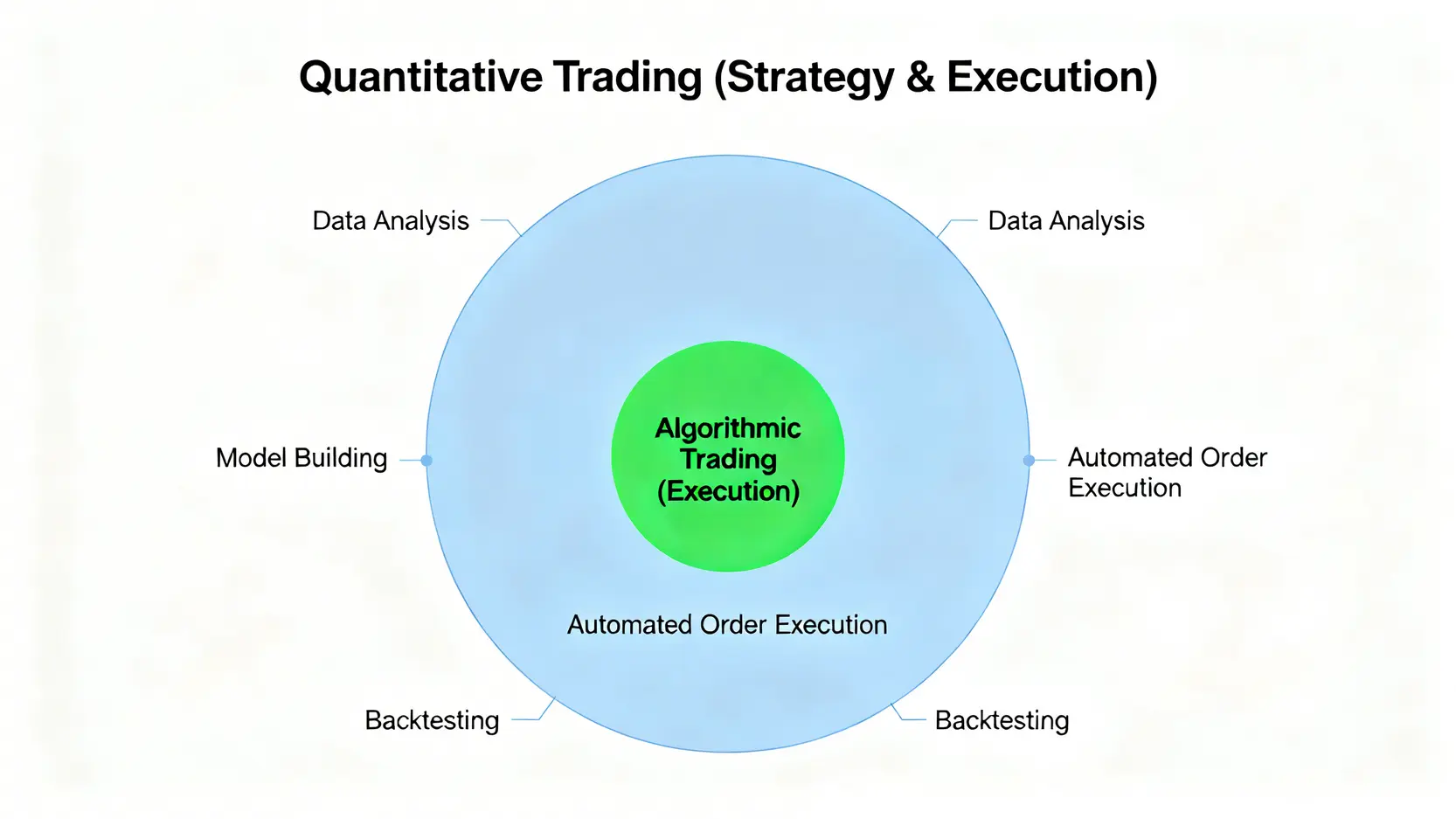
Many people confuse quantitative trading with algorithmic trading, but there are actually differences in scope between the two. Algorithmic trading focuses more on “execution”, while quantitative trading encompasses both “strategy” and “execution”.

  • Quantitative trading: Focuses on “why to trade”. It involves data analysis, model building, and strategy backtesting to identify statistical patterns in the market and form a complete investment logic.
  • Algorithmic trading: Focuses on “how to trade”. It is the tool used to implement quantitative strategies, responsible for automating trade execution, such as splitting large orders to reduce market impact or executing buy and sell orders automatically when specific price conditions are met.

It can be said that all quantitative trading requires algorithmic trading for execution, but not all algorithmic trading is based on complex quantitative models. A simple instruction such as “sell when the stock price falls below the 20-day moving average” can be considered algorithmic trading, but may not qualify as a complete quantitative trading strategy.

量化交易與程式交易關係圖,展示量化交易包含策略與執行,而程式交易側重於執行。

Quantitative Trading vs Algorithmic Trading: The Former Is the Brain, the Latter Is the Arms


Why Do You Need Quantitative Trading? Three Major Advantages to Overcome Human Weaknesses

The biggest enemy in traditional trading is often yourself. Greed, fear, hesitation…these human weaknesses always influence decisions at critical moments. Quantitative trading is a powerful tool designed to overcome these issues.

  1. Strict discipline: Once a strategy is set, the computer executes it without emotion. You will no longer sell prematurely due to panic or miss the best selling point because of greed.
  2. Extreme speed and efficiency: The market changes in an instant, and human reaction speed cannot match that of computers. Quantitative trading systems can capture trading signals and execute orders within milliseconds, offering a significant advantage, especially in short-term or high-frequency trading.
  3. Data-driven objective decision-making: Every quantitative strategy must undergo rigorous backtesting using historical data to verify its performance in past markets. This ensures that every trading decision is supported by data rather than intuition.

量化交易的優勢圖,左邊是焦慮的人類交易員,右邊是冷靜高效的交易機器人。

Quantitative Trading: Using Machine Rationality to Overcome Human Weaknesses


Further Reading (Highly Recommended)

Interactive Brokers (IB) Funding Guide: 2025 Latest Full Guide to 5 Methods Including Wire Transfer and WISE


Cross-Market Quantitative Trading Strategies: Practical Differences Between Hong Kong Stocks, US Stocks, and Cryptocurrencies

Applying the same quantitative model directly across different markets often produces vastly different results. Understanding the unique characteristics of each market is the first step in developing effective automated trading strategies.


Hong Kong Stock Quantitative Trading: Market Characteristics and Common Strategy Analysis

The Hong Kong stock market has a unique structure and is heavily influenced by mainland China policies and capital flows, creating distinct opportunities and challenges for quantitative trading.

  • Market characteristics:

    • Short trading hours: 9:30–12:00 in the morning and 13:00–16:00 in the afternoon, with no pre-market or after-hours trading, requiring strategies to adapt to intraday volatility.
    • T+2 settlement system: Stocks bought on the same day can only be sold after at least two trading days, limiting the flexibility of intraday high-frequency trading.
    • High sensitivity to policy changes: Economic policies and industry regulations from mainland China often trigger significant volatility in related sectors.
  • Common strategies:

    • Event-driven strategies: Build models based on predictable events such as financial reports and policy announcements to capture arbitrage opportunities.
    • Statistical arbitrage (pairs trading): Identify two highly correlated stocks, (such as A/H shares) and execute buy and sell operations when their price spread deviates from the normal range.
    • Factor investing: Construct portfolios based on factors such as value, growth, and momentum for medium- to long-term positioning.


US Stock Quantitative Trading: Data Sources, Backtesting Tools, and Popular Indicators

The US stock market is mature, data-rich, and well-equipped with tools, making it the primary battlefield for quantitative traders worldwide.

  • Market characteristics:

    • Abundant data sources: A large number of high-quality historical data APIs are available, forming the foundation for strategy backtesting and model training.
    • Extended trading hours: Includes pre-market and after-hours trading sessions, providing more trading opportunities.
    • Wide selection of stocks and ETFs: Tens of thousands of stocks and ETFs offer diverse trading instruments suitable for various complex strategies.
  • Popular tools and indicators:

    • Backtesting frameworks: Zipline and Backtrader are widely used backtesting tools in Python.
    • Technical indicators: RSI (Relative Strength Index), MACD (Moving Average Convergence Divergence), and Bollinger Bands are fundamental components for building strategies.
    • Broker APIs: Brokers such as Interactive Brokers (IB) provide powerful API interfaces, making it convenient for traders to execute automated trading.


Cryptocurrency Quantitative Trading: Opportunities and Risk Management in a 24/7 Market

The cryptocurrency market, with its extremely high volatility and round-the-clock trading nature, has become an ideal testing ground for quantitative trading, while also carrying higher risks.

  • Market characteristics:

    • 24/7 trading: The market never closes, placing extremely high demands on system stability and the level of strategy automation.
    • High volatility: Significant intraday price fluctuations provide profit opportunities for strategies such as grid trading and martingale, but also amplify risks.
    • Numerous exchanges: Price differences between exchanges create opportunities for cross-platform arbitrage.
  • Common strategies and risk management:

    • Grid trading: Continuously buy low and sell high within a defined price range, suitable for ranging markets.
    • Cross-exchange arbitrage: Take advantage of price differences of the same asset across different exchanges for arbitrage.
    • Risk management: Due to extreme volatility, strict stop-loss levels and position control must be implemented to avoid liquidation under extreme market conditions.


First Step in Practice: How to Choose the Right Quantitative Trading Platform and Tools for You?

Choosing the right tools is half the success in quantitative trading. Whether you are a programming beginner or a developer, you can find a solution that suits you.


Comparison of Popular Broker Platforms (Futu, Tiger Brokers, IB, etc.)

A good broker platform should not only offer low trading fees, but more importantly provide stable and fast API access.

Platform

API Support

Market Coverage Suitable Users
Futu Provides FutuOpenD interface with user-friendly documentation Hong Kong stocks, US stocks, A-shares API beginners, investors trading across multiple markets
Tiger Brokers Provides TigerBrokers API with comprehensive features US stocks, Hong Kong stocks, Australian stocks US stock traders, users who value community features
Interactive Brokers Most powerful and professional TWS API Global markets Professional quantitative traders, institutional investors


Professional Charting and Scripting Tools (TradingView Script Tutorial)

For investors who are not comfortable writing complex programs, TradingView is an excellent starting point. Its built-in Pine Script language is easy to learn and can be used to:

  • Write custom indicators: Transform your trading ideas into visual chart indicators.
  • Create strategy alerts: Automatically send email, app notifications, or webhook alerts when market conditions meet your criteria.
  • Conduct strategy backtesting: Visually observe how your strategy performs on historical data directly on the chart.

You can send TradingView alert signals to your trading robot via webhook to achieve a “semi-automated” quantitative trading workflow.

使用圖表平台實現半自動化交易的流程圖,從觸發警報到發送Webhook,再到機器人下單。

Illustration of Semi-Automated Trading Workflow on a Charting Platform


Preferred Choice for Algorithmic Trading (Introduction to Common Python Libraries)

For developers seeking greater flexibility and performance, Python is the dominant language in quantitative trading. Its powerful ecosystem provides a wide range of libraries:

  • Pandas: A powerful tool for processing and analyzing time series data (such as stock prices and trading volume) and the core of data handling.
  • NumPy: Provides efficient numerical computation capabilities and serves as the foundation for mathematical modeling and statistical analysis.
  • Matplotlib / Seaborn: Used for data visualization, helping you better understand data and backtesting results.
  • Scikit-learn: A machine learning library used to build more advanced predictive models.
  • Broker/Exchange API libraries: `futu-api`, `ib-insync` or `ccxt` (for cryptocurrencies), which encapsulate complex API calls and allow you to focus more on strategy development.

Frequently Asked Questions (FAQ)

Q: Do I need to write my own code for quantitative trading?

A: Not necessarily. Beginners can use platforms like TradingView for strategy development and signal alerts, or use quantitative platforms that provide strategy subscription services. However, if you want to achieve fully customized and automated strategies, learning programming languages such as Python is essential.

Q: How much starting capital is required for quantitative trading?

A: It depends. You can start with a few hundred US dollars in the cryptocurrency market or test with a few thousand US dollars in the US stock market. The key is not the amount of capital, but the effectiveness of the strategy itself and strict risk control. It is recommended to use small amounts of capital or a demo account for thorough testing in the early stages.

Q: Which market is most suitable for beginners in quantitative trading: Hong Kong stocks, US stocks, or cryptocurrencies?

A: Each has its advantages and disadvantages. The US stock market has the most comprehensive data and tools, making it suitable for learning and testing; the cryptocurrency market has a low entry barrier and operates 24/7, making it suitable for rapid strategy iteration with small capital; the Hong Kong stock market has relatively complex rules and is more suitable for investors with a deeper understanding of the market.

Q: Can quantitative trading guarantee profits?

A: No. No investment method can guarantee 100% profits. The advantage of quantitative trading lies in improving the win rate and achieving stable long-term expected returns. Markets change, and strategies that worked in the past may not remain effective in the future, so continuous optimization and adjustment of models are essential.


Conclusion

In summary, quantitative trading is a modern investment approach that combines rigorous investment logic with powerful technology. Whether you want to participate in the Hong Kong stock, US stock, or cryptocurrency markets, the key to success lies in deeply understanding the characteristics of each market, choosing matching strategies and tools, and conducting extensive and objective data backtesting. From using charting tools like TradingView to learning Python for algorithmic trading, this path is both challenging and full of opportunities. We hope this guide helps you take the first step toward success and begin your journey into intelligent investing.

If you liked this article, please share it!

Related Articles

  • Volatility Surface Guide: Skew Trading Strategies
    Practical Applications of Volatility Surfaces: From Options Modeling to Advanced Skew Trading Strategies In options markets, implied volatility is never a flat line. Instead, it forms complex "smile" or "skew" surfaces. For advanced traders, mastering the practical applications of volatility surfaces is equivalent to possessing a lens that reveals market...
    2026 年 6 月 3 日
  • Foreign Capital Flow Model: Track Institutional Money
    Building a Foreign Capital Flow Copy Trading Model: A Stock Market Indicator for Accurately Tracking Institutional Positioning In Asia-Pacific stock markets, foreign capital inflows and outflows often determine the direction of the index. However, simply looking at daily net buy and sell data is no longer enough. Only by building...
    2026 年 6 月 3 日
  • Options Buying Strategies for Extreme Market Risks
    Options Buyer Strategies During Extreme Market Conditions: Black Swan Hedging and Cross-Market Arbitrage During Volatility Surges The most terrifying aspect of financial markets is not a gradual decline, but overnight flash crashes and cross-market capital withdrawals accompanied by volatility surges. In the highly unpredictable global macroeconomic environment of 2026, geopolitical...
    2026 年 6 月 3 日
返回顶部