Protective Put Guide: Hedge Stocks with Options

Updated: 2026/05/08  |  CashbackIsland

protective-put-option-guide

Protective Put Tutorial: How to Use a “Protective Put” to Buy Insurance for Your Stocks?

Facing market uncertainty, are you worried that the stocks you hold for the long term could suffer significant losses due to sudden price declines? Many investors hope to find a way to protect their assets without giving up future upside potential. This article will provide a detailed introduction to the “Protective Put” strategy, a powerful options hedging tool that can lock in downside risk just like buying insurance. Through this Protective Put tutorial, you will learn how to use options hedging, allowing you to hold stocks with confidence even in volatile markets and no longer fear the arrival of bear markets. 


What Is a Protective Put?

A Protective Put is a simple and effective options hedging strategy. For investors who already hold a particular stock and remain optimistic about its long-term prospects, this strategy can provide protection against potential downside risk without requiring them to sell their shares.


Strategy Definition: Buying “Downside Insurance” for Your Stocks

Imagine you own a valuable house (representing your stocks) and you worry that a fire, (representing a stock market crash) could occur. What would you do? Most people would purchase home insurance. If a fire really happens, the insurance company compensates for the losses. The concept of a Protective Put is exactly the same: you pay an “insurance premium” (known as the option premium) to purchase a “put option contract”. If the stock price falls sharply, the value of the contract rises, offsetting the losses in your stock holdings. If the stock price continues rising, your only loss is the premium originally paid, while all stock gains still belong to you. This is why it is called a “protective” strategy, because its core purpose is defense rather than offense.

一張示意圖,展示了一位投資者用一把藍色的傘保護著一個正在上漲的綠色股票圖,抵擋著代表虧損的紅色箭頭雨,象徵保護性認沽期權策略。

The Protective Put strategy is like buying “downside insurance” for your stocks.


Strategy Structure: 100 Shares of Stock + 1 Long Put Option

Building a Protective Put position is very straightforward. It consists of two parts:

  • Long Stock: You must already hold (or simultaneously purchase) at least 100 shares of the target stock. In the US stock options market, one standard options contract represents 100 shares.
  • Long Put Option: Purchase one (or more put option contracts, depending on your share holdings) for the stock you own.

When these two positions are combined, they form a complete Protective Put strategy. Your downside risk becomes capped at a specific level while upside potential remains intact.


Further Reading (Highly Recommended)

How to Reduce Investment Risk? 5 Major Risk Management Strategies and Practical Diversification Tutorials


Why and When Should You Use the Protective Put Hedging Strategy?

After understanding how the strategy is structured, it is even more important to understand the motivation and ideal timing for using it. Protective Put is not suitable for every situation. It is a risk management tool designed for specific needs.


Main Objective: Lock in Downside Risk While Retaining Unlimited Upside Potential

The greatest attraction of this strategy lies in its payoff structure of “limited downside, unlimited upside”. Once you buy a put option, you gain the “right” to sell your shares at a specific price (known as the strike price). This means that no matter how far the stock price falls, your maximum loss is fixed. On the other hand, if the stock price surges, your stock holdings continue generating profits with unlimited upside potential, minus only the original cost of purchasing the option.


Best Timing to Use It: When You Remain Bullish on a Stock Long Term but Worry About Short-Term Pullbacks or Uncertainty

The Protective Put strategy is particularly suitable in the following situations:

  • Before Earnings Announcements: A company is about to release earnings results. You remain optimistic long term but worry that disappointing short-term performance could trigger a sharp decline.
  • Before Major Decisions or Events: Events such as Federal Reserve interest rate decisions or changes in industry regulations may cause significant market volatility.
  • At the Beginning of a Bear Market or During Market Panic: You believe the broader market may enter a correction phase, but you do not want to sell your high-quality core holdings.
  • Protecting Large Unrealized Profits: A stock you hold has appreciated substantially, and you want to lock in most of the gains without selling the shares, avoiding missed upside potential or potential tax consequences.


[Practical Example] How a Protective Put Protects Your Assets During a Stock Price Decline?

Let us look at a concrete example to understand the power of a Protective Put. Suppose you purchased 100 shares of Apple Inc. (AAPL) at $150 per share, for a total investment cost of $15,000. You remain bullish on Apple long term, but you worry that the upcoming product launch event next month may disappoint the market and trigger a stock price pullback.

You therefore decide to implement a Protective Put strategy:

  • Hold: 100 shares of AAPL stock (Cost: $150 per share)
  • Buy: 1 AAPL put option contract expiring next month with a strike price of $145, paying a premium of $3 per share. Total cost = $3 × 100 = $300.

Scenario 1: Stock Price Falls Sharply to $120

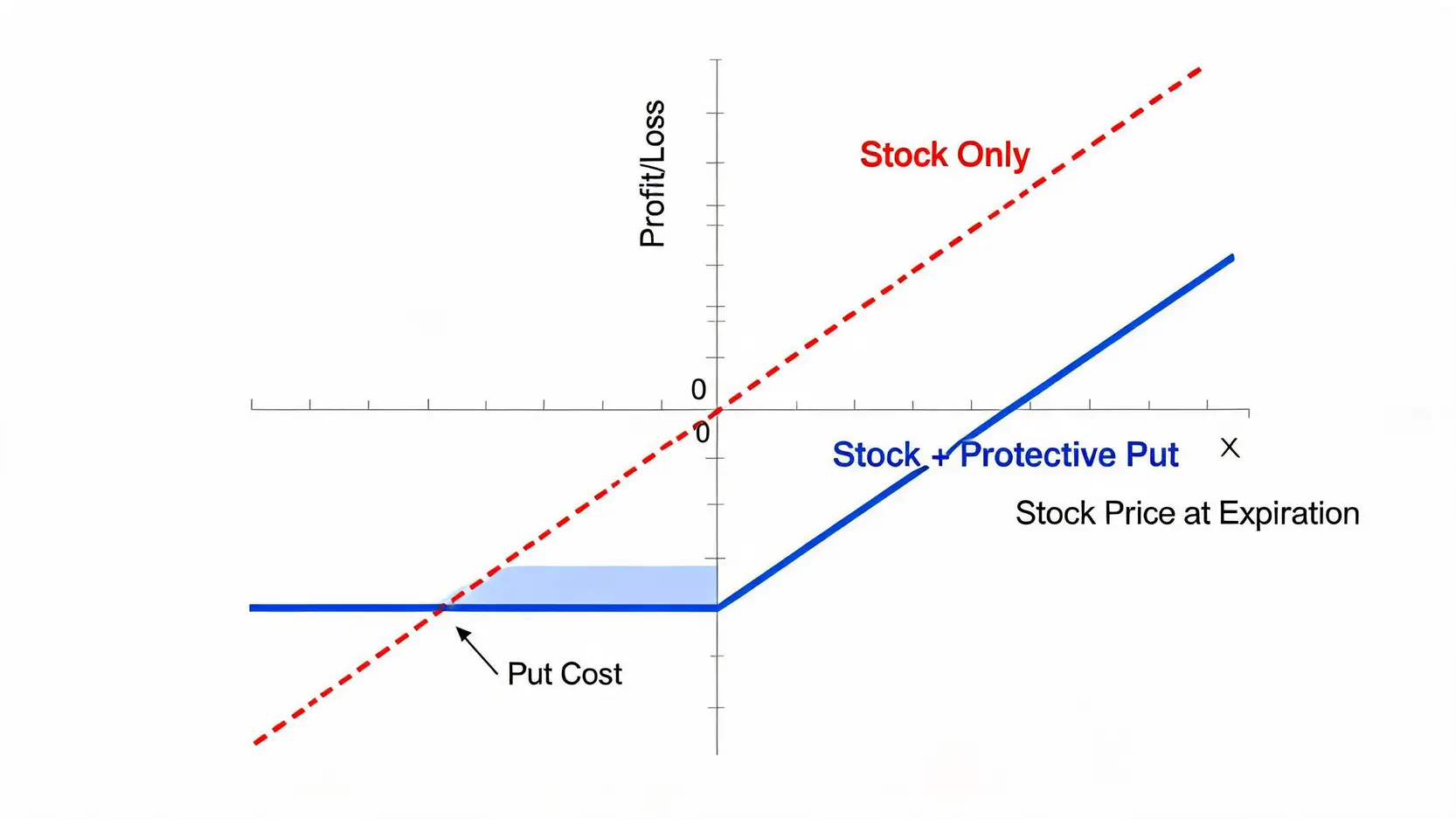
Without protection, your stock loss would be ($150 – $120) × 100 = $3,000. However, because you hold the put option, you have the right to sell the stock at $145. Your total loss is therefore capped:

  • Stock Loss: ($150 – $145) × 100 = $500
  • Option Cost: $300
  • Maximum Total Loss: $500 + $300 = $800

Even if the stock price falls to $100 or $80, your maximum loss remains limited to $800. This is the true meaning of “insurance”.

Scenario 2: Stock Price Rises to $180

Your put option becomes worthless, resulting in the loss of the $300 premium. However, your stock holdings generate substantial profits:

  • Stock Profit: ($180 – $150) × 100 = $3,000
  • Option Cost: $300
  • Total Net Profit: $3,000 – $300 = $2,700

By paying a relatively small cost, you successfully avoided catastrophic downside risk while still enjoying most of the upside gains from the stock price increase.

一張保護性認沽期權策略的損益圖,對比了「僅持有股票」和「股票 + 認沽期權」兩種情況下的盈虧曲線,清晰展示了後者如何鎖定最大虧損。

Protective Put payoff structure: downside risk is capped while upside profits remain open.


How to Hedge With Options? 5 Steps to Build Your First Protective Put Position

The theory is simple, and the actual execution is not complicated either. Below are five steps to help you establish a Protective Put position and easily get started with this important stock downside hedging strategy.

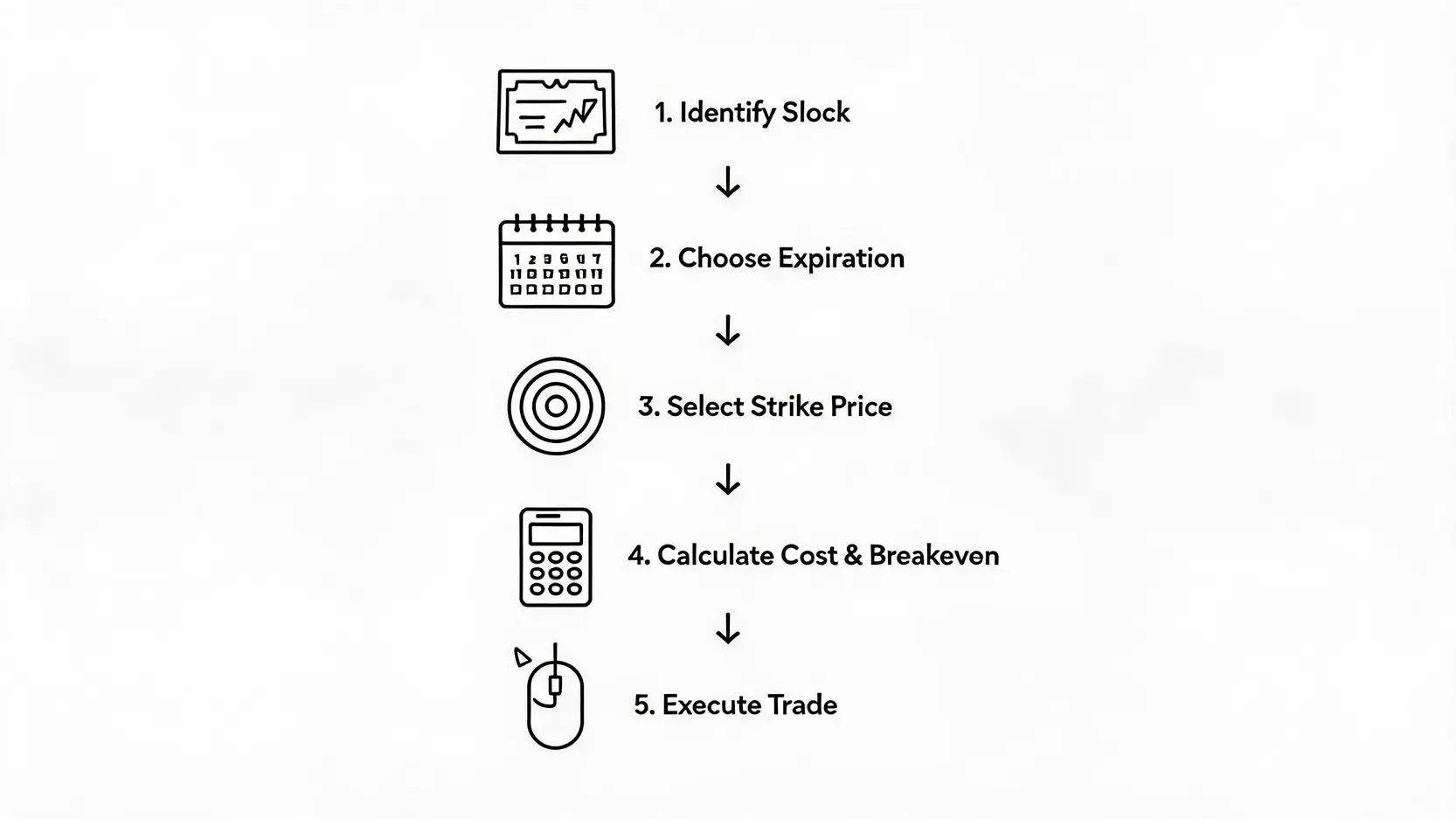
一張流程圖,展示了建立保護性認沽期權倉位的五個步驟:確認持股、選擇到期日、選擇行使價、計算成本、下單執行。

The Five Key Steps to Building a Protective Put Position


Step 1: Identify the Stock You Want to Hedge

First, determine which stock you want to protect. This is usually a core holding that represents a large portion of your portfolio or one you believe faces greater short-term risk. Remember that one options contract represents 100 shares, so you need to decide how many put options to purchase based on the number of shares you own.


Step 2: Choose the Appropriate Expiration Date

The expiration date determines how long your “insurance” remains valid. The general principles are:

  • Short-Term Protection: If you only want to hedge a specific event (such as an earnings announcement), you may choose contracts expiring in 30-45 days.
  • Long-Term Protection: If you want protection against uncertainty over the next few months or even half a year, you may choose contracts expiring in 90-180 days or longer.

Keep in mind that the longer the protection period, the more expensive the option premium (cost) becomes, just like purchasing insurance.


Step 3: Choose the Ideal Strike Price

The strike price determines your “claim threshold”, meaning the price level at which you want to lock in risk. Choosing a strike price involves a trade-off:

  • In-the-Money (ITM) or At-the-Money (ATM) Options: The strike price is equal to or above the current stock price. These provide the strongest protection but are also the most expensive.
  • Out-of-the-Money (OTM) Options: The strike price is below the current stock price. These are cheaper, but protection only becomes effective once the stock price falls below the strike price. This is more like insurance against extreme downside events.

For beginners, choosing a slightly out-of-the-money strike price is often a good starting point, balancing cost and protection.


Step 4: Calculate the Total Strategy Cost and Break-Even Point

Before placing the trade, make sure you calculate two critical figures:

  • Maximum Loss = (Stock Purchase Price – Put Option Strike Price) + Option Premium
  • Break-Even Point = Stock Purchase Price + Option Premium Per Share

Your strategy only begins generating a net profit once the stock price rises above the break-even point.


Step 5: Execute the Strategy on a Trading Platform

On your preferred options trading platform, locate the option chain for the stock you wish to trade. Then select “Buy a Put”, enter your chosen expiration date, strike price, and quantity, and place the order after confirming the pricing. If you do not already own the stock, you may also purchase the stock and the put option simultaneously.


Advantages and Disadvantages of the Protective Put Strategy

Every investment strategy has both strengths and weaknesses. Understanding the advantages and disadvantages of a Protective Put can help you use it more effectively.


Advantages: Controlled Maximum Loss, Simple Execution, and No Need for Constant Monitoring

Controlled Maximum Loss: This is the core advantage of the strategy. No matter how severe market panic becomes, your maximum loss is fixed, allowing you to navigate bear markets with greater peace of mind.
Unlimited Upside Potential: Unlike selling your stock directly, you do not miss out on any potential bull market gains.
Simple Execution: Compared with more complex options combination strategies, the logic and execution of a Protective Put are straightforward, making it suitable for beginners learning options trading.
No Need for Constant Monitoring: Once the protection is established, you do not need to worry about everyday price fluctuations and can focus more on your long-term goals.


Disadvantages: Option Premium Costs Reduce Potential Profits and the Impact of Time Decay (Theta Decay)

Premium Costs Reduce Profits: The cost of purchasing put options is a real expense. If the stock price remains flat or rises, the premium paid is lost, reducing your total return. This is why it is considered “insurance” rather than a free benefit.
Time Decay (Theta Decay): Option value decreases as time passes, a phenomenon known as Theta Decay. This means that even if the stock price remains unchanged, the value of your put option gradually declines every day. The closer the option gets to expiration, the faster this decay occurs. As a result, continuously using this strategy over the long term can become expensive.
Impact of Volatility: During periods of high market volatility, option premiums can become extremely expensive, making protection costs potentially too high and less cost-effective.


Further Reading (Highly Recommended)

How to Reduce Investment Risk? 5 Major Risk Management Strategies and Practical Diversification Tutorials


FAQ: Common Questions About Protective Put

Q: How Is the Cost of a Protective Put Calculated?

A: The total cost of the strategy is simply the option premium paid for purchasing the put options. The calculation formula is: Option Premium Per Share × 100 × Number of Contracts Purchased. For example, if you purchase 2 put option contracts priced at $2.50, your total cost would be $2.50 × 100 × 2 = $500.

Q: What Will I Lose if the Stock Price Rises at Expiration?

A: If the stock price is above the strike price of your put option at expiration, the option will expire worthless and lose all value. Your loss will therefore be the entire option premium originally paid. However, your stock holdings themselves will be profitable, and the stock gains may partially or fully offset the option cost.

Q: What Is the Fundamental Difference Between This Strategy and Using a Stop Loss Order?

A: This is an excellent question. A stop loss order triggers a market sell order once the stock price reaches a specified level. However, during a sharp gap down opening, the actual execution price may be far below your preset level, resulting in greater-than-expected losses. In contrast, a Protective Put guarantees your right to sell at the strike price regardless of how severely the stock gaps down, providing more reliable protection. In addition, once a stop loss order is triggered, your shares are sold, causing you to miss any subsequent rebound opportunity. With a Protective Put, you continue holding the stock and can still benefit from a potential recovery.

Q: Can I Use This Strategy to Protect My Entire Portfolio?

A: Yes. You can purchase put options on broad market indices (such as SPY for the S&P 500 or QQQ for the Nasdaq 100) to hedge the systemic risk of your overall stock portfolio. This is a common and highly effective macro hedging approach, although it requires more precise calculations based on your portfolio’s beta value.


Conclusion

In summary, the Protective Put strategy is a highly suitable stock risk management method for long-term investors. It allows you to provide effective downside protection for your portfolio at a relatively low cost, truly achieving “unlimited upside with limited downside”. Although paying option premiums may slightly reduce your final returns, it provides valuable peace of mind in uncertain markets and helps prevent emotional selling decisions driven by panic. Hopefully, this Protective Put tutorial has helped you understand how to hedge with options and build a more stable investment journey.

If you liked this article, please share it!

Related Articles

  • Volatility Surface Guide: Skew Trading Strategies
    Practical Applications of Volatility Surfaces: From Options Modeling to Advanced Skew Trading Strategies In options markets, implied volatility is never a flat line. Instead, it forms complex "smile" or "skew" surfaces. For advanced traders, mastering the practical applications of volatility surfaces is equivalent to possessing a lens that reveals market...
    2026 年 6 月 3 日
  • Foreign Capital Flow Model: Track Institutional Money
    Building a Foreign Capital Flow Copy Trading Model: A Stock Market Indicator for Accurately Tracking Institutional Positioning In Asia-Pacific stock markets, foreign capital inflows and outflows often determine the direction of the index. However, simply looking at daily net buy and sell data is no longer enough. Only by building...
    2026 年 6 月 3 日
  • Options Buying Strategies for Extreme Market Risks
    Options Buyer Strategies During Extreme Market Conditions: Black Swan Hedging and Cross-Market Arbitrage During Volatility Surges The most terrifying aspect of financial markets is not a gradual decline, but overnight flash crashes and cross-market capital withdrawals accompanied by volatility surges. In the highly unpredictable global macroeconomic environment of 2026, geopolitical...
    2026 年 6 月 3 日
返回顶部