What Is a Market Maker? Role & How Markets Work

Updated: 2026/03/18  |  CashbackIsland

做市商全攻略:Market Maker係咩?一文看懂莊家角色與股票市場運作

The Complete Guide to Market Makers: What Is a Market Maker? Understanding the Role of the Dealer and How the Stock Market Operates in One Article

People often say that “dealers” manipulate the market, but in the real financial world, especially in the stock market, an even more important role is actually the “Market Maker”. What exactly does Market Maker mean? How do they influence your daily trading? Many people confuse them with the “dealer” in a casino, but in reality their role and purpose are completely different. This article will comprehensively explain what a market maker is, clarify their responsibilities, profit model, and their real impact on ordinary investors, allowing you to better understand how stock market market makers operate. 


What Is a Market Maker? A Clear and In-Depth Core Definition

A market maker, abbreviated as MM, refers to a financial institution or company that simultaneously quotes a bid price and an ask price in the financial market and commits to executing trades at those prices. You can think of them as the “intermediary” or “wholesaler” of the financial market. Their existence ensures that there is always someone willing to buy and someone willing to sell in the market.


Core Responsibility: The Key Role of Providing “Liquidity” to the Market

The most important responsibility of a market maker is to provide “liquidity” to the market. Liquidity may sound abstract, but the meaning is simple: the ability to buy when you want to buy and sell when you want to sell.

  • Imagine this situation: if a market had no market makers, when you want to buy an unpopular stock, you might have to wait a long time before someone is willing to sell. Likewise, when you want to sell, you may not be able to find a buyer. Trading would become very difficult, slow, and expensive.
  • The role of market makers: they continuously place buy and sell orders using their own capital. Even if there are temporarily no other investors trading with you in the market, the market maker will still take your order. This ensures that transactions can proceed smoothly and that the market does not become “silent” because no one is buying or selling. This role is extremely important for maintaining a healthy and active stock market market maker ecosystem.

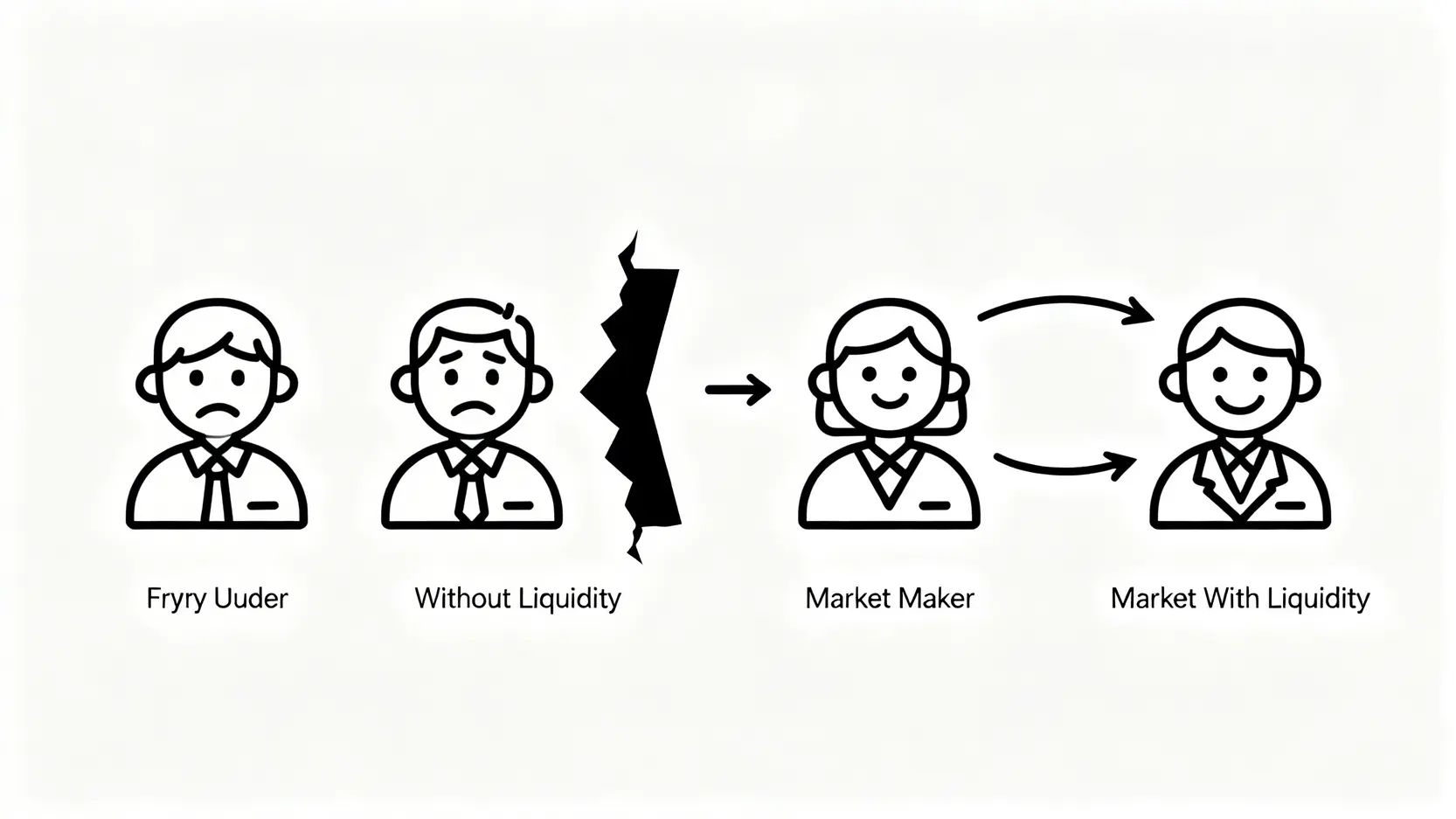
一張對比圖,展示了有做市商和沒有做市商的市場流動性差異。

As the bridge of the market, market makers ensure that buyers and sellers can always find a counterparty, thereby providing critical liquidity.


What Is the Difference From a Casino “Dealer”? Breaking the Misunderstanding of Financial Terminology

When many people hear the word “dealer”, they immediately think of the role in a casino that bets against players and believe that they make money by manipulating outcomes. This is a very big misunderstanding. Market makers in financial markets and casino dealers are fundamentally different:

Characteristics

Financial Market Maker (Market Maker)

Casino Banker (Casino Banker)
Role Positioning The “Lubricant” of the Market, Facilitating Trading The “Participant” in the Game, Betting Against Players
Profit Model Mainly Earns the Bid-Ask Spread Uses Probabilistic Advantage to Profit From Players’ Losses
Market Impact Improves Market Efficiency and Stabilizes Price Fluctuations Controls the Odds to Ensure Its Own Profit
Level of Regulation Subject to Strict Financial Regulatory Oversight, Such as the Securities and Futures Commission Subject to Regulation Under Gambling Ordinances

Simply put, the goal of a market maker is to facilitate more trading and earn stable fees (the spread) from it; the goal of a casino banker is to win your principal under the rules of the game. The role of the “dealer” in the two cases can be said to be completely different.

How Do Market Makers Operate and Make Money in the Stock Market?

After understanding the basic definition of a market maker, the next step is to explore their actual operations and profit model. They do not make money by predicting whether stock prices will rise or fall, but through a more stable mechanism.


Main Source of Profit: Bid-Ask Spread

The main and most stable source of income for market makers is the bid-ask spread. This is the “reward” they earn for providing liquidity services.

  • Bid price: The price at which the market maker is willing to buy stocks from you.
  • Ask price: The price at which the market maker is willing to sell stocks to you.

The ask price will always be higher than the bid price, and the difference in between is the spread. For example:

Assume a market maker quotes a certain stock as follows:

  • Bid Price (Bid): $10.00
  • Ask Price (Ask): $10.05

The difference is $0.05. When investor A buys one share from the market maker at $10.05, and another investor B sells one share to the market maker at $10.00, the market maker earns a spread of $0.05 from this buy and sell transaction. Although the profit from a single trade is very small, market makers process thousands of trades every day. As small amounts accumulate, the total profit becomes very considerable. If you want to understand the concept of spreads in greater depth, you can refer to The Truth About Bank Foreign Exchange Spreads: Should You Choose a Bank or a Broker? A Complete Money-Saving Guide.

一張示意圖,解釋做市商如何通過買入價(Bid)和賣出價(Ask)之間的差價來獲利。

The Core Profit Source of Market Makers: Bid-Ask Spread.


Inventory Management and Risk Hedging Strategies

Market makers need to use their own capital to hold a certain number of stocks as “inventory” in order to meet market buying and selling demand. However, holding inventory means bearing the risk of stock price fluctuations. If the stock price falls sharply, the value of their inventory will decline.

To manage this risk, market makers adopt a series of hedging strategies, such as:

  • Maintaining neutral positions: Try to balance the number of buy orders and sell orders to avoid excessive one-sided holdings.
  • Using derivative instruments: Hedge the risk of the underlying stock by trading derivatives such as futures and options.
  • Algorithmic trading: Use high-speed computer programs to automatically adjust quotes and inventory levels and respond quickly to market changes.

Excellent risk management is the key to whether market makers can continue operating, and it is also an important difference between professional institutions and ordinary retail investors.


What Are the Advantages and Disadvantages of Market Makers for Ordinary Investors?

The existence of market makers is a double-edged sword for retail investors. Understanding their advantages and disadvantages helps us operate more wisely in the market.


Advantages: Improving Trading Efficiency and Reducing Transaction Costs

Instant execution: As market makers are always ready to trade, your buy and sell orders can be executed almost immediately, without waiting for a counterparty to appear.

Lower hidden costs: competition among market makers narrows the bid-ask spread. The narrower the spread, the lower the trading cost for investors.

Price stability: during periods of high market volatility, continuous quotes from market makers help stabilize prices and prevent irrational price gaps or crashes.


Potential Risks: Market Price Influence and Regulatory Issues

Short-term price influence: although subject to regulation, large market makers with huge capital and trading volume can theoretically influence prices in the short term, especially for low-liquidity penny stocks.

Information asymmetry: market makers can access a large amount of order flow data, giving them a better understanding of market buying and selling intentions than ordinary investors. This information advantage may be used.

Regulatory loopholes: although there is regulation, grey areas always exist in financial markets. In the past, there have also been cases where market makers used their position to conduct improper operations, but these are extreme situations.


Further Reading (Highly Recommended)

How to Buy Apple Stock? A 5-Step Beginner Guide: From Exchanging US Dollars to Placing an AAPL Order, a Complete Strategy

How to Reduce Investment Risk? Five Major Risk Management Strategies and Diversified Investment Practical Guide


New Trend: What Is an Automated Market Maker (AMM)?

With the rise of blockchain technology and decentralized finance (DeFi), a new concept, the automated market maker (Automated Market Maker, AMM), has emerged, disrupting the operating model of traditional market makers.


AMM vs Traditional Market Makers: Innovation in Decentralized Finance

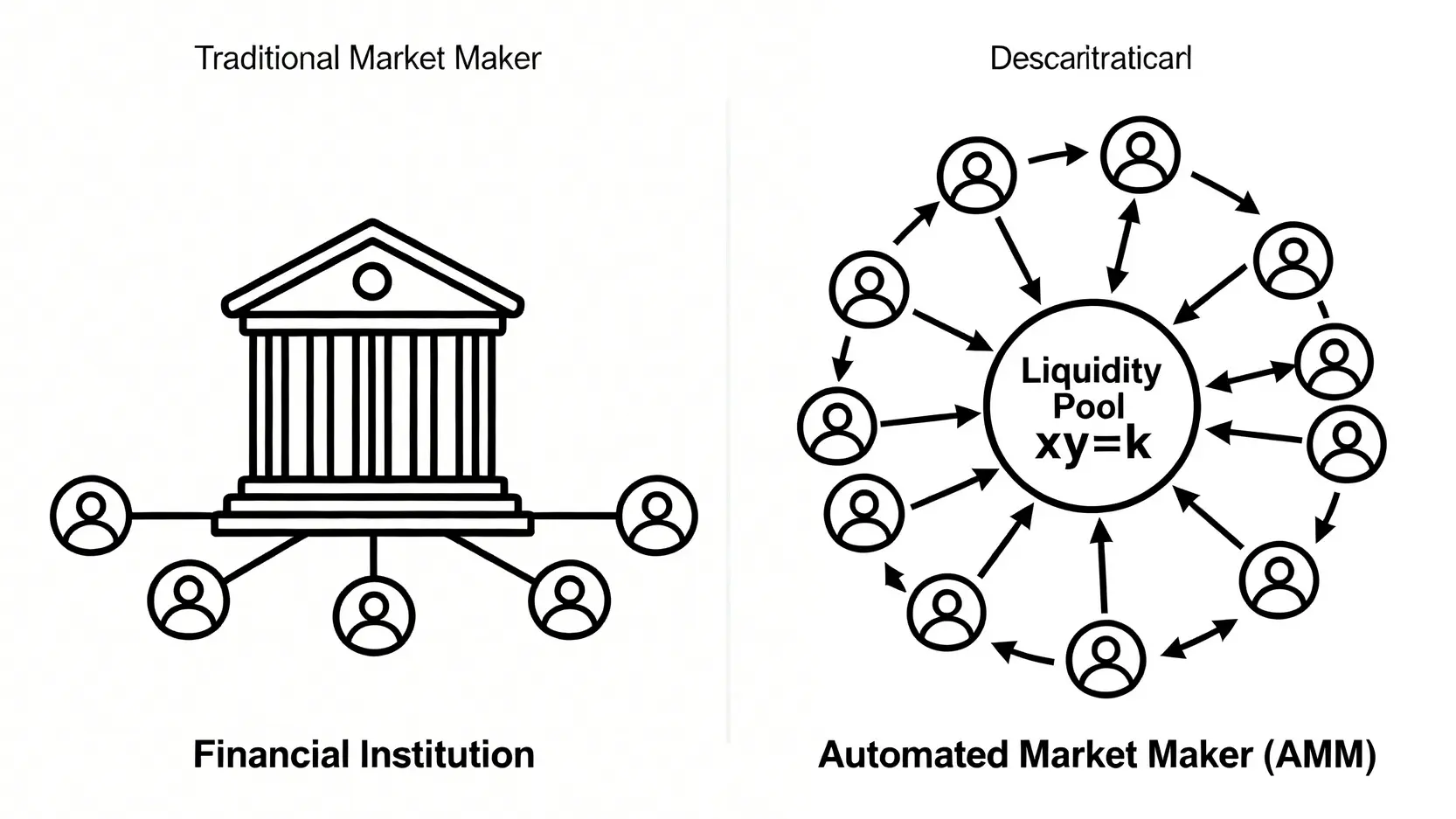
Traditional market makers are centralized financial institutions, while AMM is a set of smart contracts running on the blockchain. Its operation is entirely driven by algorithms without human participation.

一張對比圖,展示傳統做市商的中心化模式與自動化做市商(AMM)的去中心化模式。

Comparison of Operating Models Between Traditional Market Makers and Automated Market Makers (AMM)

  Traditional Market Maker (Traditional MM)

Automated Market Maker (AMM)

Operating Entity Financial institutions, companies Smart contracts (algorithms)
Source of Funds Company’s own capital User-provided liquidity pool (Liquidity Pool)
Pricing Method Actively quoted based on market supply and demand and risk models Passively priced based on a fixed mathematical formula (such as x*y=k)
Transparency Relatively low, internal operations are not publicly disclosed Extremely high, all transactions and rules are verifiable on-chain


Main Application: The Core Engine of the Cryptocurrency Market

AMM is currently the core engine of most decentralized exchanges (DEX), such as Uniswap and Sushiswap. It allows anyone to become a liquidity provider, depositing their own cryptocurrency into liquidity pools in order to earn a share of transaction fees. This model greatly lowers the barrier to market making and is also an important foundation that enables the cryptocurrency market to trade 7×24 without interruption.


Conclusion

In summary, a market maker (Market Maker) is not a mysterious market manipulator but a key component that maintains the healthy operation of the stock market. Through professional quoting and risk management, they inject essential liquidity into the market, making trading for ordinary investors smoother, more efficient, and lower in cost. Understanding the role of market makers in the stock market helps you gain a deeper insight into the market’s microstructure and make smarter investment decisions in the complex financial world.

FAQ Frequently Asked Questions

Q: Are market makers legal?

A: Absolutely legal. Market makers are a formal role in financial markets that is strictly regulated. In major exchanges around the world, such as the New York Stock Exchange (NYSE) and the Nasdaq (NASDAQ), there are designated market maker or liquidity provider systems to ensure the normal operation of the market. They must comply with the rules established by securities regulatory authorities (such as the Securities and Futures Commission SFC in Hong Kong or the SEC in the US).

Q: Can retail investors become market makers?

A: In the traditional sense, it is difficult for retail investors to become market makers in the stock market. This is because it requires substantial capital, complex technical systems, and strict regulatory licenses. However, in the cryptocurrency sector, through automated market maker (AMM) protocols, any retail investor can deposit funds into liquidity pools to become a “liquidity provider” (LP), indirectly playing the role of a market maker and earning transaction fees, while also bearing specific risks such as impermanent loss.

Q: Which well-known market makers operate in the Hong Kong stock market?

A: In Hong Kong, many large investment banks and securities firms act as market makers, especially in the derivatives market (such as warrants and callable bull/bear contracts) and the ETF market. Although there is no official list of “well-known market makers”, international investment banks such as Goldman Sachs, J.P. Morgan, UBS, and Société Générale are all very active liquidity providers in the market.

Q: Will market makers intentionally cause me to lose money?

A: The primary goal of market makers is to earn the bid-ask spread rather than causing individual investors to lose money. Their business model is built on high-frequency trading rather than betting against you. However, the bid-ask spread they provide is itself a form of transaction cost for investors. Market price fluctuations are determined by overall market supply and demand. Although the trading activities of market makers may influence short-term liquidity, they cannot unilaterally determine the long-term trend of a stock.

If you liked this article, please share it!

Related Articles

  • Volatility Surface Guide: Skew Trading Strategies
    Practical Applications of Volatility Surfaces: From Options Modeling to Advanced Skew Trading Strategies In options markets, implied volatility is never a flat line. Instead, it forms complex "smile" or "skew" surfaces. For advanced traders, mastering the practical applications of volatility surfaces is equivalent to possessing a lens that reveals market...
    2026 年 6 月 3 日
  • Foreign Capital Flow Model: Track Institutional Money
    Building a Foreign Capital Flow Copy Trading Model: A Stock Market Indicator for Accurately Tracking Institutional Positioning In Asia-Pacific stock markets, foreign capital inflows and outflows often determine the direction of the index. However, simply looking at daily net buy and sell data is no longer enough. Only by building...
    2026 年 6 月 3 日
  • Options Buying Strategies for Extreme Market Risks
    Options Buyer Strategies During Extreme Market Conditions: Black Swan Hedging and Cross-Market Arbitrage During Volatility Surges The most terrifying aspect of financial markets is not a gradual decline, but overnight flash crashes and cross-market capital withdrawals accompanied by volatility surges. In the highly unpredictable global macroeconomic environment of 2026, geopolitical...
    2026 年 6 月 3 日
返回顶部