ETF Dealer Cheat Sheet: Understanding in One Article How Hong Kong ETF Market Makers, Liquidity Providers, and Participating Dealers Operate
Want to invest in exchange-traded funds (ETF) but hesitate when you see low trading volume? Or curious why the market price of an ETF always stays close to its net asset value (NAV)? Behind this is a group of invisible market drivers, “ETF market makers”. They are the key role that ensures market liquidity. This article will clearly explain how ETF market makers (dealers) operate and clarify the roles of ETF liquidity providers and ETF participating dealers, explaining their actual operating model within the Hong Kong ETF dealer ecosystem, so you can fully understand the source of ETF liquidity and invest with greater confidence.
The Invisible Heart of ETFs: Why ETF Market Makers (Dealers) Are Needed
ETF market makers (commonly known as dealers) play an indispensable role in the ETF ecosystem. They are like the lubricant of the market, ensuring that the entire trading mechanism operates smoothly. Without them, the trading experience of ETFs would be completely different. Their core functions are mainly twofold:
Maintaining ETF Liquidity: Ensuring There Is Always Someone to Buy or Sell
Imagine this situation: when you want to buy an ETF but there happens to be no seller in the market, or when you want to sell but cannot find a buyer. This situation causes trades to be unable to complete immediately or even fail to execute, which is the problem of “insufficient liquidity”.
The responsibility of ETF market makers is to continuously provide “bid quotes” (Bid) and “ask quotes” (Ask) in the market. Regardless of market conditions, they are willing to take or sell positions within a reasonable spread range. This means that even if the daily trading volume of an ETF appears low, investors can still buy or sell at any time based on the dealer’s quoted price without worrying about the situation of “having a price but no market”. They provide a constant source of trading counterparties for the market and are an important foundation of confidence for retail investors.
Stabilizing Market Prices: Narrowing the Bid-Ask Spread and Preventing Prices From Deviating Significantly From Net Asset Value
The value of an ETF is determined by the “net asset value” (NAV) of the basket of assets it holds. However, the price traded in the public market (market price) is influenced by supply and demand. Without the adjustment of market makers, when large buy or sell orders appear in the market, the market price can easily deviate significantly from NAV, creating large premiums or discounts that harm investors’ interests.
Market makers use a sophisticated arbitrage mechanism (explained later) to continuously monitor the gap between the market price and NAV. Once the gap becomes large enough to cover trading costs and generate profit, they enter the market to intervene, bringing the market price back close to NAV. At the same time, competition among market makers also narrows the bid-ask spread, reducing investors’ trading costs. For a healthy ETF, the bid-ask spread is usually very small, and market makers play an important role behind this.
Role Breakdown: What Is the Difference Between Market Makers, Liquidity Providers, and Participating Dealers?
In the operation of ETFs, the terms “participating dealer”, “liquidity provider”, and “market maker” are often mentioned. They work closely together but have different roles. Simply put, they are like different participants in the chain from the “production” to the “retail” of ETFs.
Participating Dealer (PD): The Creator and Redeemer in the Primary Market
Participating dealers (abbreviated as PD) are the only institutions that can deal directly with ETF issuers (fund companies). They are the players in the “primary market” and are responsible for the “creation” and “redemption” of ETF units.
Creation (creation units): when market demand for an ETF increases, PD prepares a basket of corresponding stocks (or cash) according to the ETF’s structure and delivers it to the ETF issuer in exchange for a batch of newly created ETF units (usually tens of thousands of shares per unit).
Redemption (redemption units): when market supply is excessive, PD collects enough ETF units from the market and returns them to the issuer in exchange for the corresponding basket of stocks or cash.
PD can be understood as the “wholesaler” of ETFs. They do not serve retail investors directly but are responsible for adjusting the total supply of ETFs in the market.
Liquidity Provider (LP) / Market Maker (MM): The Quoting Specialists in the Secondary Market
Liquidity providers (LP) and market makers (MM) play very similar roles and in the Hong Kong market are often considered synonymous. They are the players in the “secondary market”, which is the market where we trade on the stock exchange. Their main responsibility is to provide quotes for ETFs and ensure market liquidity.
They obtain ETF units from PD (or buy them directly in the market) and then place buy and sell orders on the exchange to earn a small spread in between. They are the “retailers” of ETFs, directly serving ordinary investors like us. Every ETF listed on the exchange must have at least one market maker providing quotes.
Diagram of Their Relationship: From Issuance to Trading, How They Cooperate Within the Hong Kong ETF Ecosystem
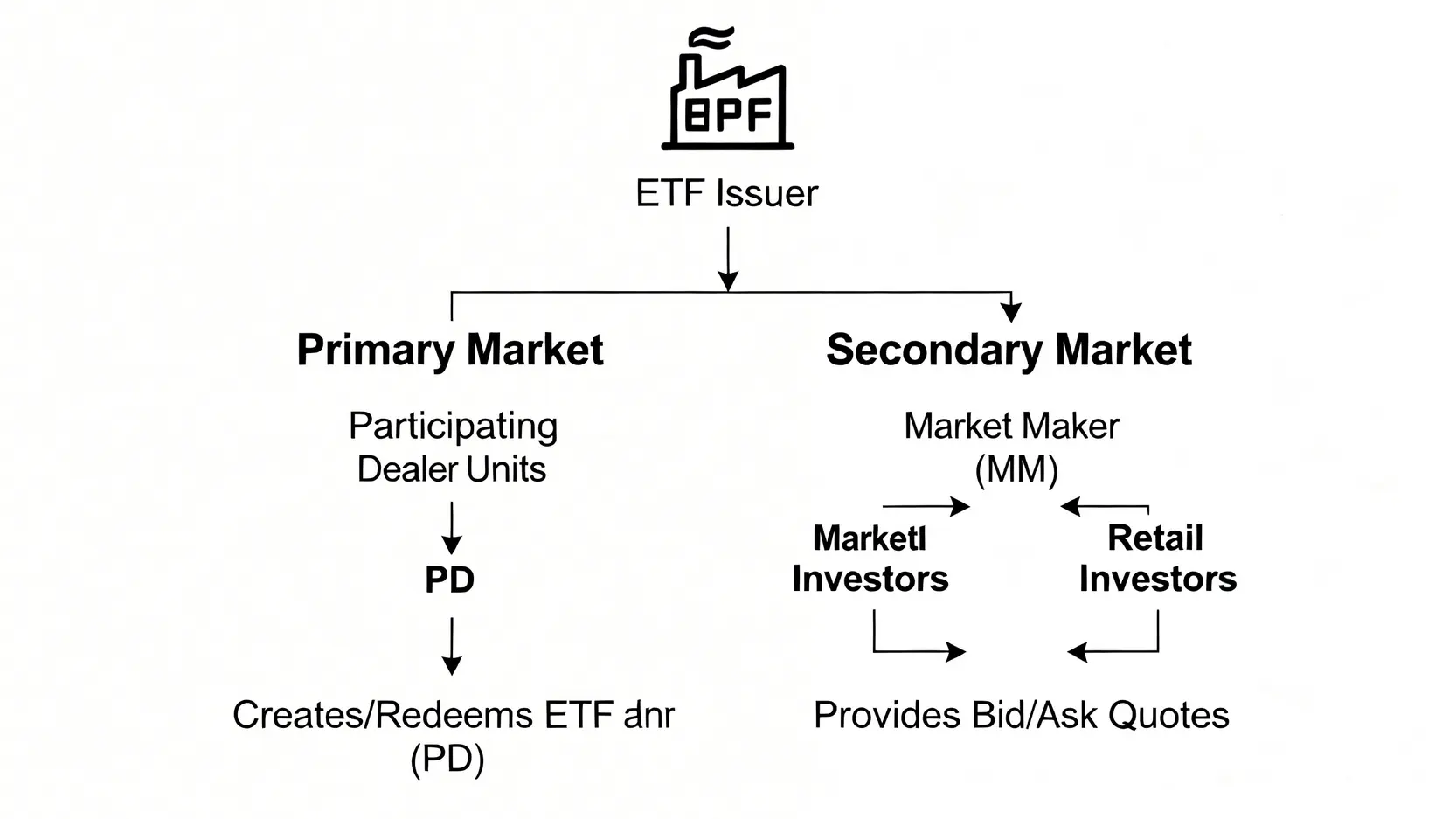
To understand more clearly, the entire process can be summarized as follows:
ETF ecosystem explained: Division of roles from the primary market to the secondary market.
ETF issuer: Designs and manages the ETF product, like the brand owner.
Participating dealer (PD): Acts as the wholesaler, responsible for creating or redeeming large quantities of ETF units with the issuer in the primary market to ensure stable total supply.
Market Maker / Liquidity Provider (MM / LP): Acts as the retailer, providing continuous buy and sell quotes for retail investors in the secondary market (Hong Kong Exchanges and Clearing) to ensure retail investors can trade at any time.
It is worth noting that many large financial institutions hold both PD and MM qualifications at the same time and play multiple roles. This allows them to conduct arbitrage operations more efficiently and maintain market stability.
Role
Primary Market
Main Responsibility
Trading Counterparty
Participating Dealer (PD)
Primary Market
Create and redeem ETF units, adjust total supply
ETF issuer
Market Maker (MM) / Liquidity Provider (LP)
Secondary Market
Provide continuous bid and ask quotes, ensure market liquidity
General investors
How Do ETF Dealers Operate? Revealing the Arbitrage Mechanism Between the Primary and Secondary Markets
ETF dealers (mainly institutions that simultaneously act as PD and MM) are able to stabilize market prices not out of goodwill but because a powerful “arbitrage mechanism” operates behind the scenes. This mechanism ensures that the market price of an ETF does not deviate significantly from its true value (NAV) for long periods. This process is known as ETF arbitrage.
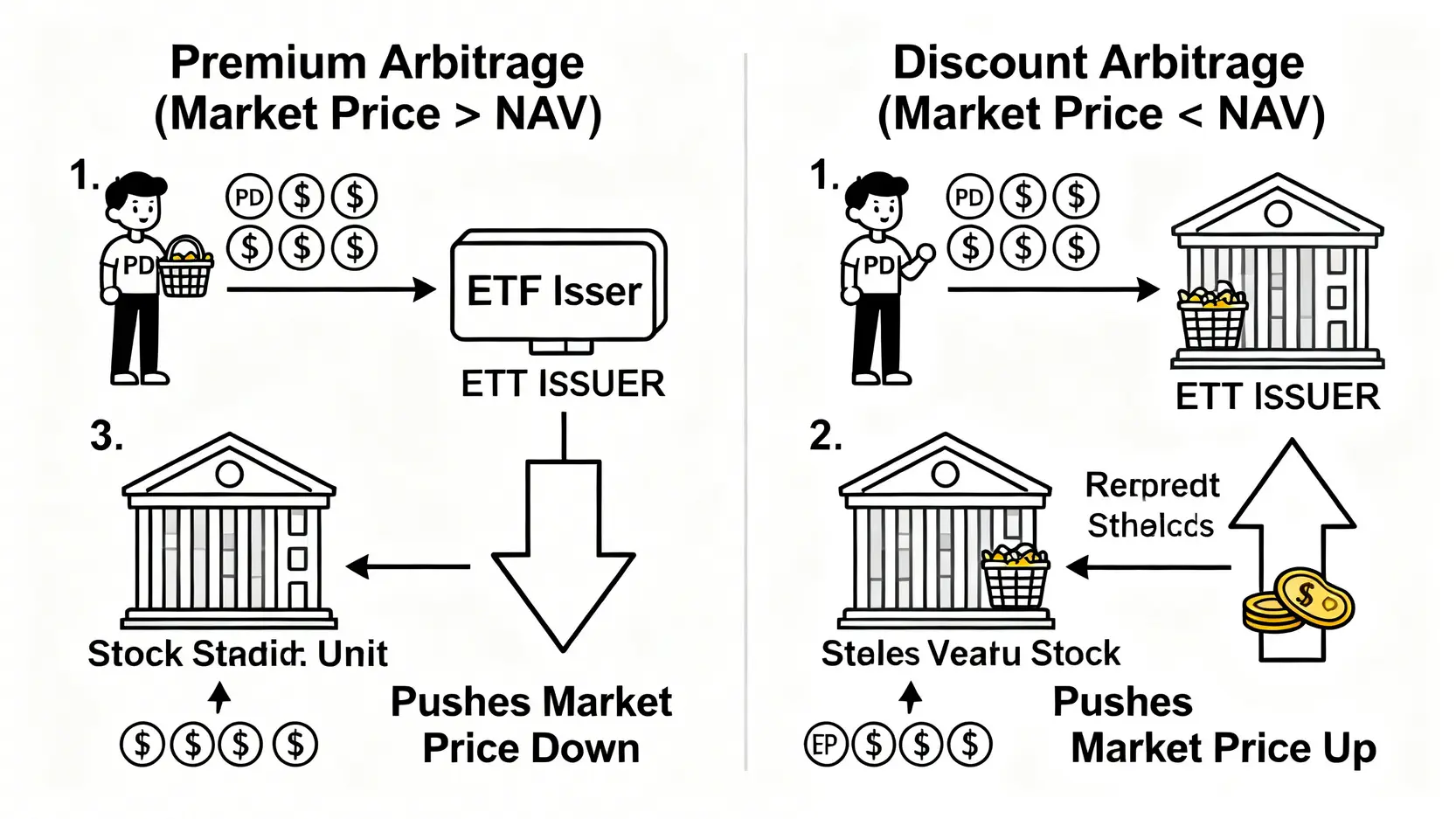
ETF dealer arbitrage mechanism: create and sell when there is a premium, buy and redeem when there is a discount, thereby stabilizing the market price close to net asset value.
When an ETF Trades at a Premium (Market Price > NAV): How Dealers Create ETF Units and Sell Them in the Market for Arbitrage
Assume an ETF tracking the Hang Seng Index has an NAV of HKD 100, but due to strong market demand, the market price has been driven up to HKD 101. This is called a “premium”.
The arbitrage process is as follows:
Discover the opportunity: The dealer notices that the market price (HKD 101) is higher than the NAV (HKD 100).
Created in the primary market: Acting as a PD, the dealer prepares a basket of Hang Seng Index component stocks worth HKD 100 and delivers it to the ETF issuer to create a batch of new ETF units. At this point, the cost per unit is HKD 100.
Sell in the secondary market: The dealer immediately sells these newly obtained ETF units on the exchange at the market price of HKD 101.
Lock in profit: Through this buy and sell process, the dealer earns a risk-free profit of (HKD 101 – HKD 100) = HKD 1 (excluding transaction costs).
This process not only brings profit to the dealer but also increases the supply of ETF units in the market through their selling activity, helping to push the overheated market price back toward the NAV level of HKD 100.
When an ETF Trades at a Discount (Market Price < NAV): How Dealers Buy From the Market and Redeem ETF Units for Arbitrage
Conversely, assume market panic selling causes the ETF market price to fall to HKD 99 while its NAV remains HKD 100. This is called a “discount”.
The arbitrage process is as follows:
Discover the opportunity: The dealer notices that the market price (HKD 99) is lower than the NAV (HKD 100).
Buy in the secondary market: Acting as an MM, the dealer purchases a large number of ETF units on the exchange at the lower price of HKD 99.
Redeem in the primary market: After accumulating a sufficient number of ETF units, the dealer returns them to the ETF issuer as a PD to redeem a basket of Hang Seng Index component stocks worth HKD 100.
Lock in profit: The dealer can choose to sell these stocks, locking in a profit of (HKD 100 – HKD 99) = HKD 1.
Similarly, the dealer’s buying activity in the market absorbs excess selling pressure, helping to push the undervalued market price back toward the NAV level of HKD 100.
Focus on the Hong Kong Market: Understanding Major ETF Dealers and the Role of HKEX
After understanding the theory, let us look at the actual situation in the Hong Kong market. As one of Asia’s leading ETF markets, Hong Kong has a mature market maker system that ensures efficient market operation.
List of Major ETF Participating Dealers and Dealers in Hong Kong
In Hong Kong, institutions acting as ETF dealers and participating dealers are usually large international investment banks and local securities firms. They possess strong capital, advanced trading systems, and professional teams. Common market participants include:
Goldman Sachs
J.P. Morgan
UBS
CLSA
Haitong International
This list is not fixed. For investors who wish to check the market maker of a specific ETF, the most authoritative source of information is the official website of Hong Kong Exchanges and Clearing (HKEX). HKEX regularly publishes the list of exchange-traded product securities dealers for each ETF, ensuring that the information is public and transparent.
What Investors Must Learn: Three Indicators to Evaluate the Liquidity of an ETF
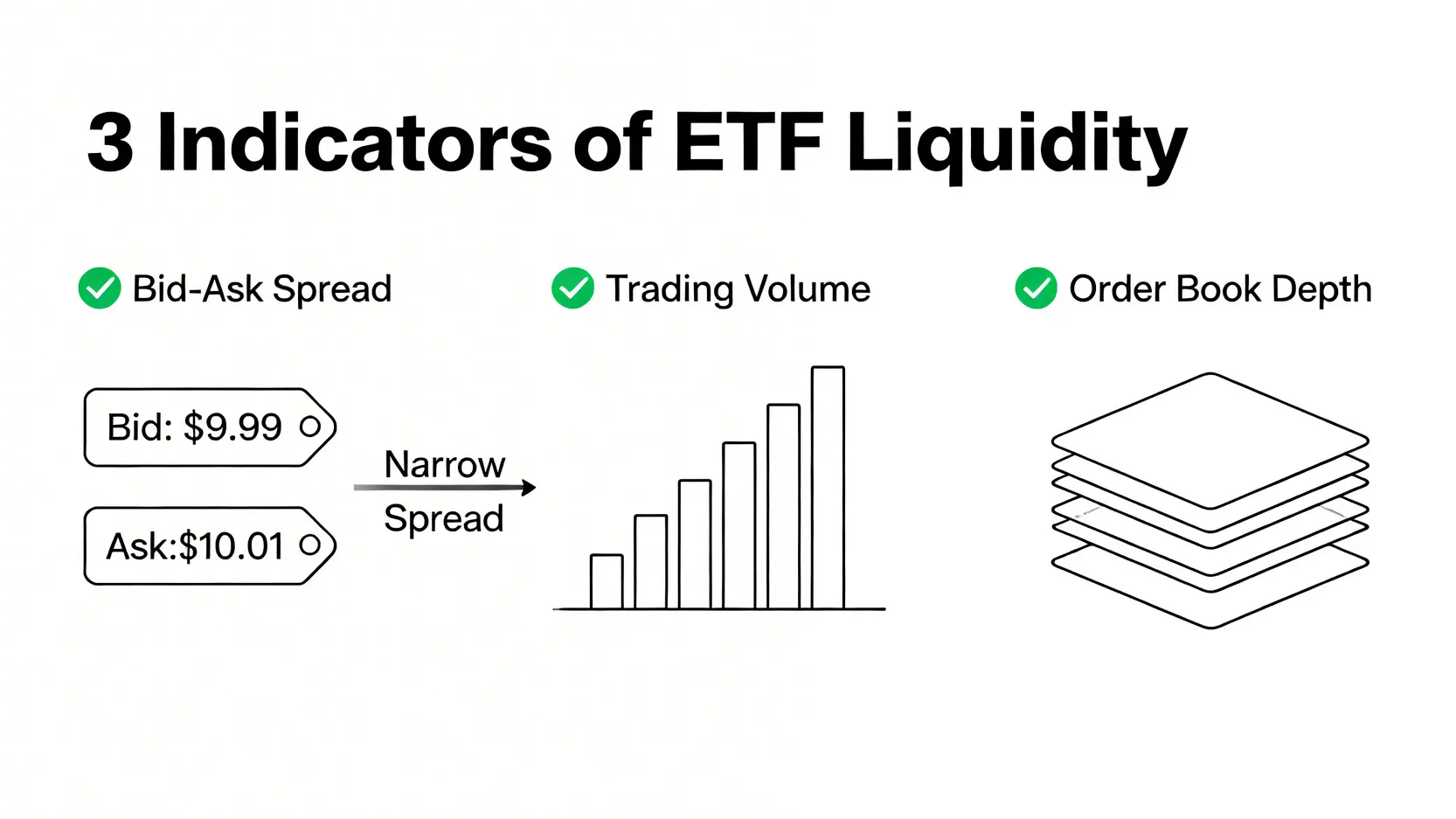
Although dealers ensure basic liquidity, the trading activity and efficiency of different ETFs still vary. As a smart investor, you can evaluate the liquidity of an ETF through the following three indicators.
Three steps to assess ETF liquidity: narrow spread, high volume, deep order book.
Bid-Ask Spread This is the most direct indicator of liquidity. The narrower the spread, the lower the trading cost and the better the liquidity. For some popular large-cap ETFs, the spread may be only 0.1% or even lower.
Trading Volume Although trading volume should not be considered alone, high trading volume usually means there are many market participants, active trading beyond dealers, and higher price discovery efficiency. This serves as an important supporting reference.
Order Book Depth The order quantities displayed in trading software from “bid one / ask one” to “bid five / ask five” reflect market depth. If the order quantities at various price levels are large, it indicates that the market can absorb large transactions without causing significant price fluctuations, which means better liquidity.
FAQ Frequently Asked Questions About ETF Market Makers
Q: If an ETF Has No Dealer or Low Trading Volume, Will It Be Impossible to Sell?
A: According to the regulations of Hong Kong Exchanges and Clearing, all listed ETFs must appoint at least one market maker. Therefore, in theory there is no situation of “no dealer”. Even if an ETF has very low trading volume, the market maker still has the responsibility to provide bids and ask quotes to ensure that investors can enter and exit the market. Of course, under extreme market conditions, liquidity may decline and the bid-ask spread may widen, but the risk of being completely “unable to sell” is extremely low.
Q: What Is the Main Source of Profit for ETF Market Makers?
A: The profit of ETF market makers mainly comes from two sources: first, earning the bid-ask spread by providing quotes in the secondary market; second, profiting from arbitrage between the primary and secondary markets when the market price deviates from NAV. Their profit model relies on accumulating small but stable gains through high trading volume.
Q: As a Retail Investor, Can I Trade Directly With Participating Dealers?
A: No. Participating dealers (PD) only conduct large-scale creation and redemption transactions with ETF issuers in the primary market. The trading threshold is extremely high, (usually tens of thousands or even hundreds of thousands of ETF units). As retail investors, all our trades are conducted in the secondary market (the Hong Kong Exchange). The counterparty may be other investors, or more commonly, an ETF market maker.
Q: If a Market Maker Provides Passive Quotes, Will There Be Penalties?
A: Yes. Hong Kong Exchanges and Clearing has strict regulatory requirements for ETF market makers, including the duration of quotes, maximum bid-ask spread, and minimum quote size. If a market maker fails to fulfill its responsibilities, HKEX may issue warnings or even impose penalties. This regulatory mechanism ensures that market makers must actively fulfill their responsibilities and maintain market quality.
Conclusion
In summary, ETF market makers, liquidity providers, and participating dealers are the fundamental pillars that maintain the healthy operation of the ETF market. Through sophisticated creation, redemption, and arbitrage mechanisms, they ensure ETF liquidity and price stability, allowing investors to participate in the market conveniently and at low cost. For smart Hong Kong investors, understanding how ETF dealers operate helps you more accurately evaluate the trading efficiency and hidden costs of the ETF you are interested in, move beyond the misconception of “judging only by trading volume”, and make better investment decisions.
How to Get Started with Bitcoin? The Complete 2026 Bitcoin Buying Guide for Beginners After watching Bitcoin repeatedly reach new highs in recent years and successfully pass spot ETF reviews in the US and Hong Kong in 2024, officially entering mainstream financial markets, many investors have turned their attention to...
Is Gold’s V-Shaped Rebound a Bottom-Fishing Signal? A Complete Guide to Trading Strategies Amid “$100 Price Swings” What Is a Gold V-Shaped Rebound? More Than Just a Technical Pattern The gold market has recently experienced sharp rises and falls, with prices frequently displaying dramatic “gold V-shaped rebounds”. Single-day “$100 price...
What Is PPI Data? 2026 Latest Analysis: Understand the Differences from CPI and How It Affects Stock Market Trends With market information constantly changing, do you always hold your breath while waiting for CPI data to be released? But did you know that a more forward-looking inflation indicator, PPI data...