Straddle vs Strangle: Key Differences & Guide

Updated: 2026/04/17  |  CashbackIsland

long-straddle-vs-long-strangle

Straddle Strategy vs Strangle Strategy: 5 Key Differences and Practical Trading Guide for Earnings Plays

Earnings season is always a love-hate moment for investors. Stock prices can surge or plunge sharply, but the direction is often unpredictable. If you are struggling with the “wrong direction equals heavy loss” problem, then this options straddle strategy tutorial is exactly what you need. This article provides a deep dive into two volatility-focused earnings options strategies: Long Straddle and Long Strangle. Their core advantage is simple: as long as the stock moves strongly in either direction, you have the opportunity to profit. Next, we will break down Long Straddle vs Long Strangle from definitions, payoff structures, to real-world applications. 


What Is a Long Straddle Strategy?

A Long Straddle is a neutral options strategy that focuses on betting on “large movement” rather than a “specific direction”. It is ideal when you expect a sharp move in an underlying asset (such as a stock) in the short term, but you are unsure whether it will go up or down. This is especially useful before earnings announcements, investor presentations, or major policy decisions.


Definition and Setup: How to Build a Long Straddle Position?

Building a Long Straddle position is straightforward. You need to execute two trades simultaneously:

  • Buy one at-the-money (ATM) call option
  • Buy one at-the-money (ATM) put option with the same strike price and expiration date

Key elements:

  • Strike price: Both call and put must have the same strike price, usually closest to the current stock price.
  • Expiration date: Both options must share the same expiration date.
  • Premium paid: The total cost of the position is the combined premiums of both options, which also represents your maximum possible loss.


Payoff Structure: Profit, Risk, and Break-Even

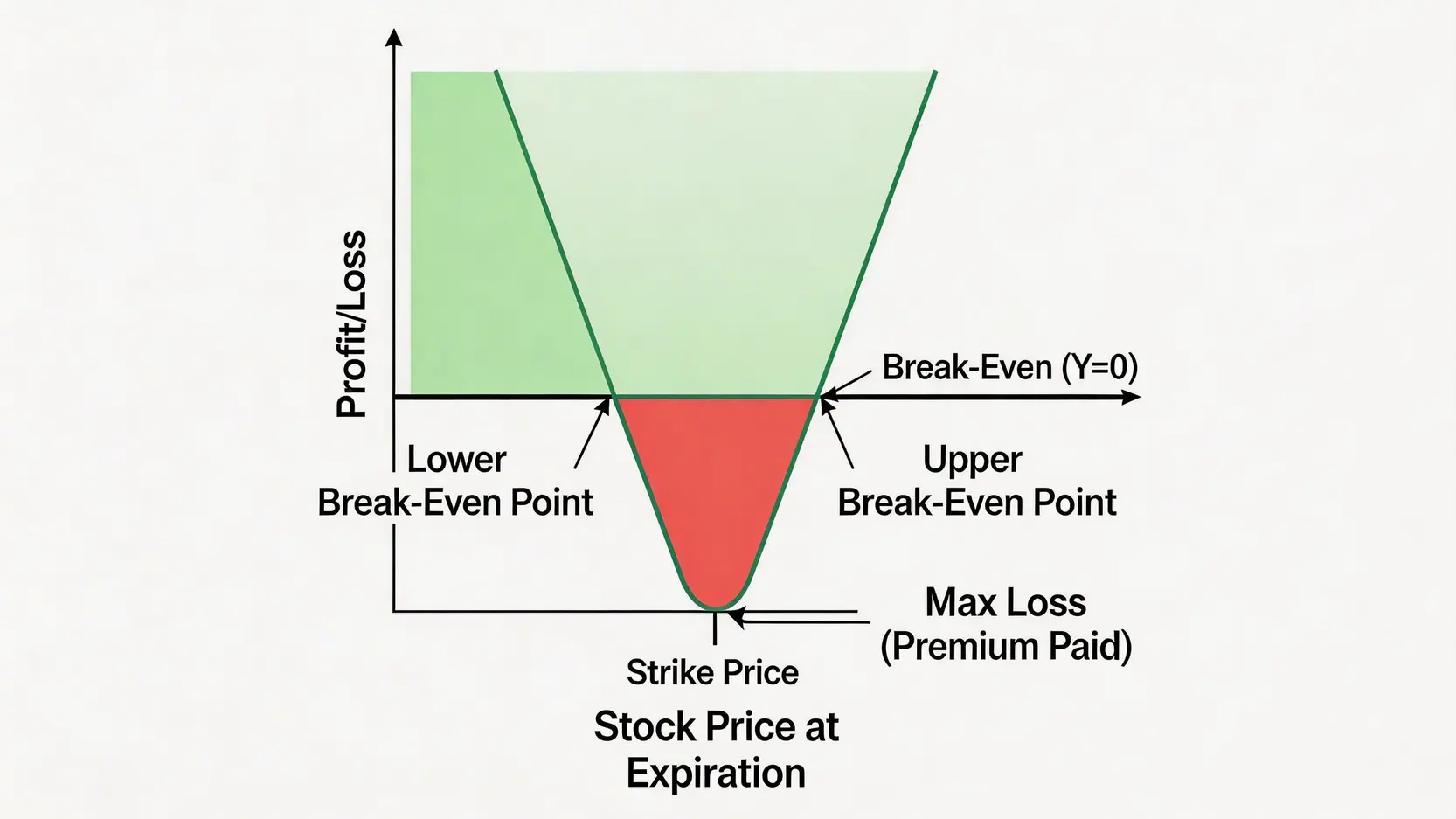
The Long Straddle payoff profile forms a clear “V” shape:

買入跨式 (Long Straddle) 策略的損益圖,呈現一個 V 字形,標示出履約價、最大虧損以及兩個損益兩平點。

Long Straddle Payoff Diagram

  • Profit potential: Theoretically unlimited. The more the stock moves up or down, the higher the profit.
  • Advantage: No need to predict direction, only magnitude of movement matters.
  • Maximum risk: Limited to the total premium paid. Worst case is when the stock stays at the strike price at expiration, causing both options to expire worthless.
  • Break-even points: There are two break-even points:
    • Upper break-even = Strike price + total premium
    • Lower break-even = Strike price – total premium

If the stock moves beyond either break-even point, the position becomes profitable.


Further Reading (Highly Recommended)

Options Trading Basics: From 0 to 1, Master Options Trading Operations and 4 Core Strategies (2025 Beginner Guide)

Options Spread Strategy Ultimate Guide: Understanding Straddle and Iron Condor Combinations in One Go | Cashback …


What Is a Long Strangle Strategy?

A Long Strangle is also a strategy that bets on large market volatility. It can be viewed as the “economical version” of a Long Straddle. While it shares a similar logic with the straddle strategy, it differs in cost and profit threshold, which makes it more attractive in certain scenarios.


Definition and Execution: How Is It Different from a Straddle?

Building a Long Strangle position requires buying both a call option and a put option, but the key difference compared to a Straddle lies in strike price selection:

  • Buy one out-of-the-money (OTM) call option
  • Buy one out-of-the-money (OTM) put option

Key differences:

  • Strike price: The call strike is above the current stock price, while the put strike is below it. The two strikes are different, forming a price range.
  • Expiration date: Both options must still have the same expiration date.


Payoff Structure: Why Lower Cost Requires Larger Movement?

The Long Strangle payoff diagram looks like a wider “U” or “bathtub”, reflecting its core characteristics:

  • Profit potential: Theoretically unlimited.
  • Advantage: Lower cost. Because OTM options are cheaper than ATM options, the total premium required to build a Long Strangle is usually much lower than a Long Straddle.
  • Maximum risk: Limited to the total premium paid.
  • Break-even points: Due to the separated strike prices, the distance between break-even points is wider, meaning a larger price move is required before the position becomes profitable.
    • Upper break-even = Call strike price + total premium
    • Lower break-even = Put strike price – total premium

In simple terms, you pay less upfront in exchange for a higher profit threshold. This is a classic risk-reward trade-off.


Ultimate Comparison: Long Straddle vs Long Strangle

Now that the fundamentals are clear, this Straddle vs Strangle comparison helps you choose the most suitable strategy based on different scenarios. Below are the five most important differences.

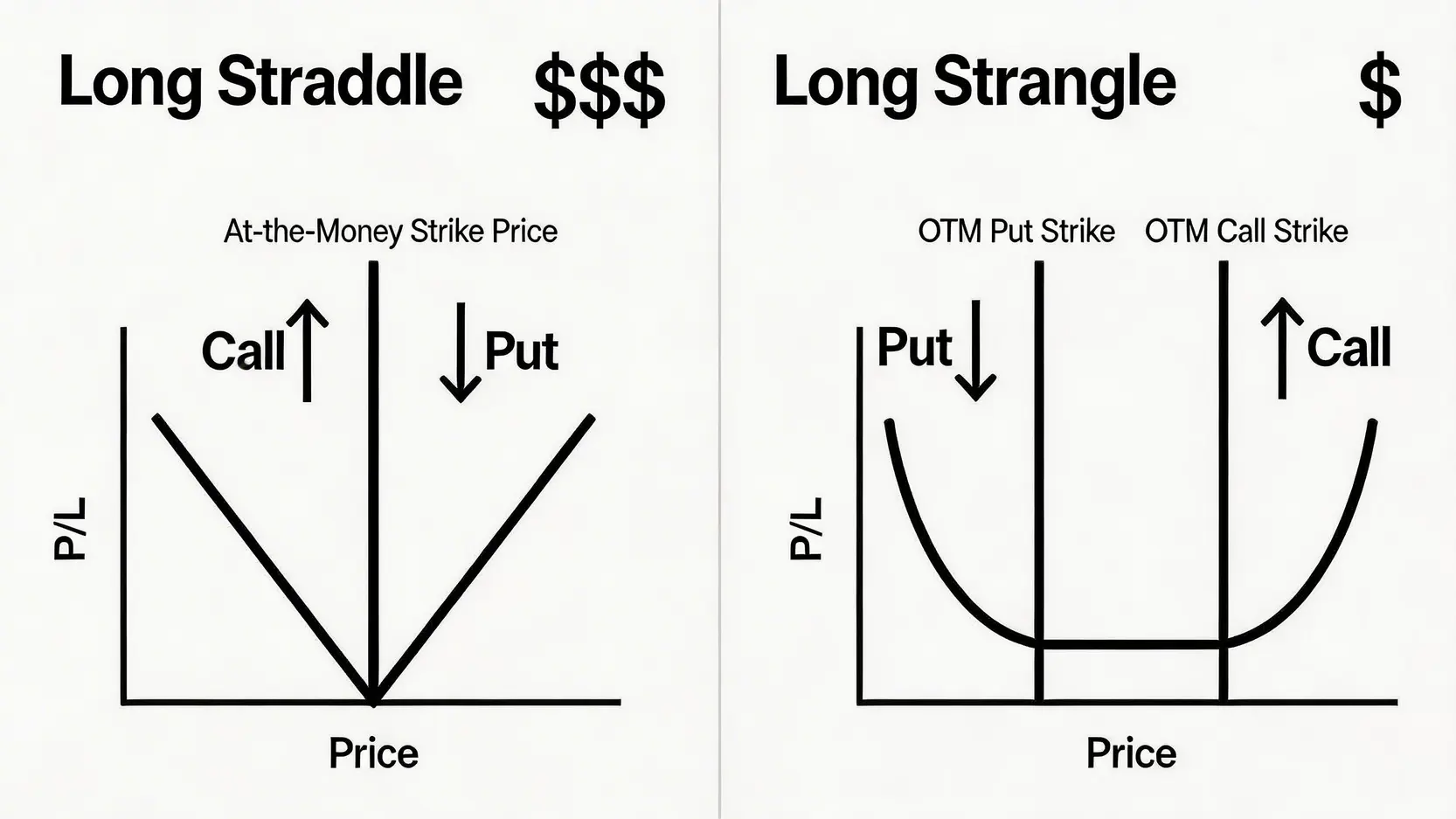
買入跨式 (Long Straddle) 與買入寬跨式 (Long Strangle) 的結構對比圖,顯示了履約價選擇和成本上的差異。

Straddle (Long Straddle) vs Strangle (Long Strangle) Core Structural Differences


1. Premium Cost: Which Strategy Is Cheaper?

Conclusion: Long Strangle is cheaper.

This is the most significant difference between the two strategies. A Long Straddle uses at-the-money (ATM) options, which have higher intrinsic and time value, making them more expensive. In contrast, a Long Strangle uses out-of-the-money (OTM) options, whose value consists almost entirely of time value, making them significantly cheaper. For investors with limited capital or those seeking to reduce maximum risk, the Strangle is clearly more advantageous.


2. Break-Even Points: Which Strategy Is Easier to Profit From?

Conclusion: Long Straddle has a lower profit threshold.

Because the Straddle concentrates both strikes at the same point (current stock price), its break-even range (strike price ± total premium) is relatively narrow. The Strangle, however, uses two different strike prices, creating a wider distance between break-even points. This means that under a Straddle strategy, the stock does not need to move as much to start generating profit.


3. Profit Potential: Differences in Payoff Curves

Conclusion: Both have theoretically unlimited profit potential, but different starting points.

Although both strategies have theoretically unlimited maximum profit, their payoff curves differ. The Straddle has a sharper “V” shape, meaning profits accelerate rapidly once the break-even point is crossed. The Strangle has a flatter “U” shape, meaning losses remain steady before the price breaks the strikes, and only after crossing the break-even points does profit begin.


4. Volatility Sensitivity: Impact of IV on the Strategy

Conclusion: Both are extremely sensitive to implied volatility (IV).

Long Straddle and Long Strangle are both “long volatility” strategies, and their value is highly dependent on market expectations of future volatility, namely implied volatility (IV).

  • IV increase: Beneficial for both strategies. Even if the stock price does not move, an increase in expected volatility can raise option prices and potentially generate profit.
  • IV crush: Extremely unfavorable for both strategies. This is the biggest trap in earnings trades and will be discussed in detail later.


5. Summary Comparison Table: A Quick Way to Understand Which Strategy to Use

Comparison Dimension Long Straddle

Long Strangle

Structure Buy ATM Call + Buy ATM Put (same strike price) Buy OTM Call + Buy OTM Put (different strike prices)
Cost Higher Lower
Profit Threshold Lower (break-even points are closer) Higher (break-even points are further apart)
Maximum Risk Total premium paid (higher amount) Total premium paid (lower amount)
Suitable Scenario Expecting large volatility but uncertain direction Expecting extremely large volatility and wanting to control cost
Sensitivity to IV Crush Very high Very high


【Practical Guide】How to Apply It in Earnings Options Strategies?

Earnings season is the ideal time to apply these two strategies. When a company’s results or guidance significantly exceed or fall short of expectations, the stock often experiences intraday gaps of 10%, 20%, or even more. This kind of sharp but uncertain volatility is exactly where Straddle and Strangle strategies come into play.


Why Is Earnings Season Suitable for Volatility Strategies?

Before earnings are released, the market is filled with uncertainty, causing implied volatility (IV) in options to rise significantly. Investors are willing to pay higher premiums to hedge risk or speculate. This creates an ideal environment for volatility strategies. When you buy a Straddle or Strangle, you are essentially buying this “uncertainty”. As long as the actual post-earnings move exceeds market expectations, you have the opportunity to profit. For more basic options knowledge, you can refer to this Options Beginner Guide

Practical Steps: How to Choose the Right Strike Price and Expiration Date

  1. Choosing the expiration date: Select the expiration date immediately after the earnings announcement. For example, if a company reports earnings after market close on Wednesday, you may choose options expiring on Friday of the same week. This allows you to capture the earnings impact while minimizing time decay (Theta).
  2. Choosing the strike price:
    • Long Straddle: Choose the strike price closest to the current stock price (ATM).
    • Long Strangle: Choose out-of-the-money (OTM) strike prices. A common approach is to reference the expected move implied by the options chain (usually provided by brokers), and set the call and put strikes at the edges of that expected range.
  3. Calculate cost and break-even points: Before entering the trade, always calculate your total cost (maximum risk) and both break-even points. Ask yourself: “Do I really expect the stock to move beyond this range?”


The Biggest Trap: How to Manage the Risk of Post-Earnings IV Crush (Implied Volatility Collapse)

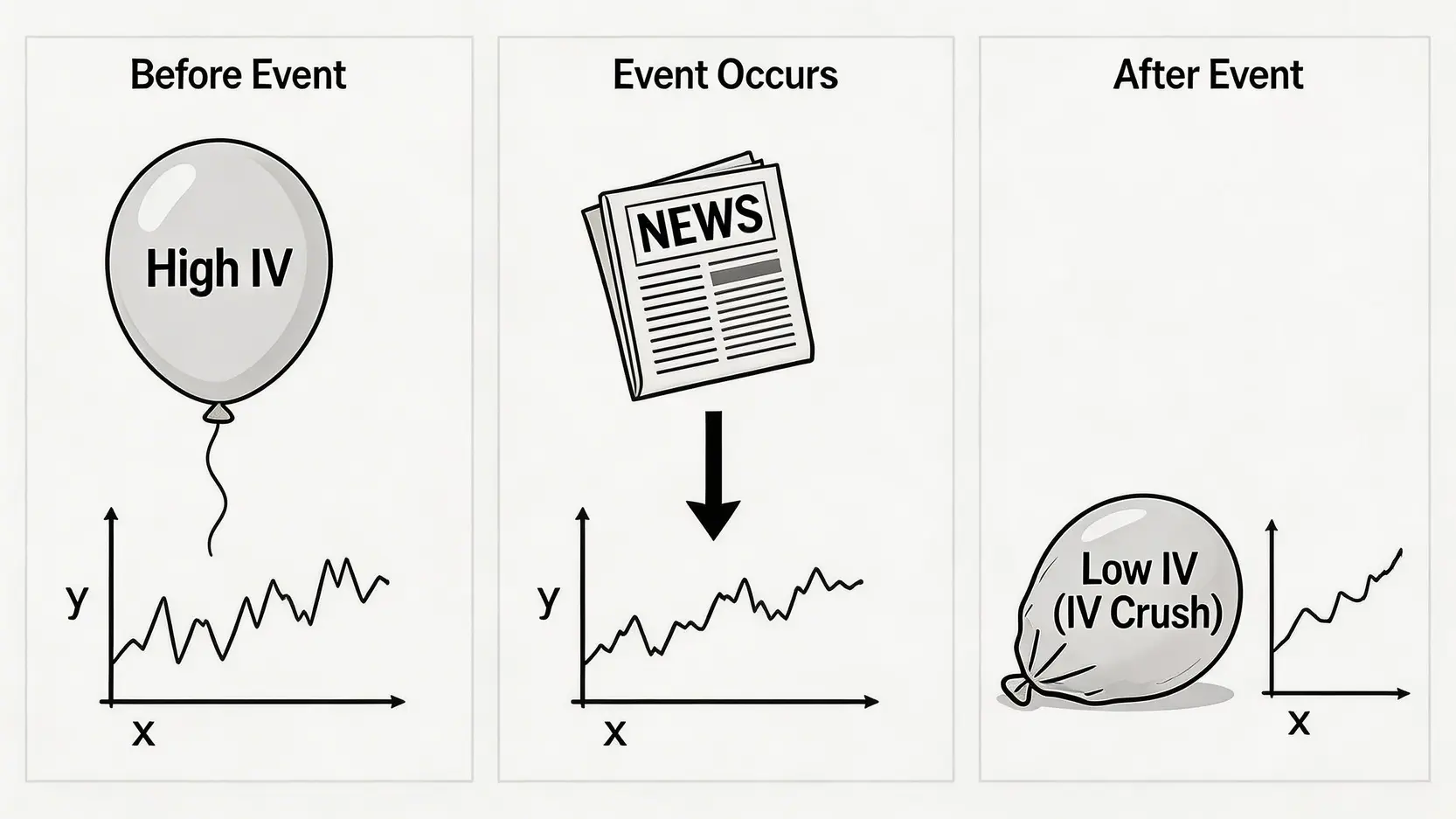
IV Crush is the biggest enemy of all earnings strategies. Once earnings are released and uncertainty is removed, implied volatility (IV) collapses rapidly like a deflating balloon, regardless of whether the result is good or bad. This causes both call and put option prices to drop sharply.

隱含波動率暴跌 (IV Crush) 的概念示意圖,顯示了財報等事件後,不確定性消除導致期權隱含波動率下降的過程。

IV Crush: The Biggest Risk in Earnings Strategies

Many beginners experience this situation: they correctly predict the direction, and the stock moves significantly up or down, but still lose money because the move was not large enough. This happens because the impact of IV Crush outweighs the profit from price movement. For more risk management knowledge in options, you can read the Options Spread Strategy Guide.

Mitigation Strategies:

  • Evaluate expected move: Before establishing a position, analyze the stock’s historical average post-earnings volatility and compare it with the expected move implied by current IV. If IV is already too high, it indicates elevated market expectations, making profitability more difficult.
  • Early exit: In some cases, you can close the position a few hours or one day before earnings, when IV reaches its peak, capturing the profit from rising IV and completely avoiding IV Crush risk.
  • Convert to spreads: For advanced traders, a Long Straddle/Strangle can be converted into an Iron Condor or Iron Butterfly, shifting from long volatility to short volatility to profit from IV Crush. However, this requires higher skill and stronger risk management capability.


Extended Reading (Highly Recommended)

Options Trading Guide: From 0 to 1 Master Options Trading Operation and 4 Major Strategies (2025 Beginner Tutorial)

Options Spread Strategy Ultimate Guide: Understand Straddle and Iron Condor Combinations in One Go | Cashback …


Frequently Asked Questions (FAQ)

What is the maximum risk of buying a Straddle or Strangle strategy?

The maximum risk is limited and predictable, equal to the total premium paid to establish the position. If at expiration the stock price closes between the two break-even points (for a Strangle, between the two strike prices), you will lose part or all of the premium. In the worst case, if the stock does not move at all, the options expire worthless and you lose 100% of the invested capital.

What happens to my position if the stock does not move after earnings?

This is almost the worst-case scenario. Not only will time decay (Theta) continuously erode your premium, but more critically, IV Crush will cause the option value to collapse instantly. Even if the stock only moves slightly and does not reach break-even levels, IV Crush can still lead to significant losses.

Is selling a Straddle (Short Straddle) suitable for earnings trading?

Absolutely not for beginners. A Short Straddle or Short Strangle is a strategy that bets on the stock “staying flat”. Although it can profit from IV Crush, the potential risk is unlimited. Post-earnings price gaps are extremely common, and a large move can cause catastrophic losses that far exceed the premium collected. These strategies require advanced risk management skills and strong capital.

How do I calculate the required move to be profitable?

It is very simple: look directly at the break-even points. For example, if you establish a Long Straddle on a stock priced at 100 USD with a total premium cost of 5 USD, your break-even points are 95 USD and 105 USD. This means the stock must fall below 95 USD or rise above 105 USD for the strategy to become profitable. This also implies the market is pricing in at least a 5% move.

Which is more suitable for beginners, Long Straddle or Long Strangle?

For first-time volatility strategy traders, the Long Strangle may be more beginner-friendly. The main reason is its lower cost, meaning lower maximum potential loss. Although it requires a larger move to become profitable, the concept of “risking less capital to capture larger moves” is a good starting point for risk control and psychological preparation.


Conclusion

In summary, both Long Straddle and Long Strangle are extremely powerful earnings-season strategies in high-volatility events. The choice between them is essentially a trade-off between cost and profit threshold. A Long Straddle has a lower break-even requirement but higher entry cost, while a Long Strangle uses lower cost in exchange for requiring a larger price movement. In any practical application of Straddle strategy teaching models, it is crucial to deeply understand and evaluate the potential impact of IV Crush. Ultimately, the choice depends on your expectation of potential price movement and your personal risk tolerance.

If you liked this article, please share it!

Related Articles

  • Volatility Surface Guide: Skew Trading Strategies
    Practical Applications of Volatility Surfaces: From Options Modeling to Advanced Skew Trading Strategies In options markets, implied volatility is never a flat line. Instead, it forms complex "smile" or "skew" surfaces. For advanced traders, mastering the practical applications of volatility surfaces is equivalent to possessing a lens that reveals market...
    2026 年 6 月 3 日
  • Foreign Capital Flow Model: Track Institutional Money
    Building a Foreign Capital Flow Copy Trading Model: A Stock Market Indicator for Accurately Tracking Institutional Positioning In Asia-Pacific stock markets, foreign capital inflows and outflows often determine the direction of the index. However, simply looking at daily net buy and sell data is no longer enough. Only by building...
    2026 年 6 月 3 日
  • Options Buying Strategies for Extreme Market Risks
    Options Buyer Strategies During Extreme Market Conditions: Black Swan Hedging and Cross-Market Arbitrage During Volatility Surges The most terrifying aspect of financial markets is not a gradual decline, but overnight flash crashes and cross-market capital withdrawals accompanied by volatility surges. In the highly unpredictable global macroeconomic environment of 2026, geopolitical...
    2026 年 6 月 3 日
返回顶部