Vega Risk Guide: 5 Volatility Hedging Strategies

Updated: 2026/04/17  |  CashbackIsland

vega-risk-management-guide

Vega Risk Management Ultimate Guide: 5 Strategies to Effectively Hedge Volatility and Improve Options Trading Win Rate

Has market volatility intensified, causing your options positions to fluctuate significantly? The main reason behind this is often the lack of proper “Vega risk management”. Many traders focus on direction (Delta) while ignoring the impact of volatility, leading to unexpected losses during market turbulence. Do you want to know what Vega exposure is? It actually measures how sensitive your portfolio is to changes in the market fear index (VIX). This article will provide a clear explanation of the positive and negative impacts of option Vega, and present 5 practical, real-world strategies on “how to hedge Vega risk”, helping you build a complete Vega risk management system and achieve more stable profits in uncertain markets. 


What Is Vega? Why Every Options Trader Must Understand It

Among the five core Options Greeks, Vega is often the most overlooked by beginners, yet it has a significant impact on profit and loss. Unlike Delta, which measures price direction, Vega focuses on market “sentiment” which is volatility.


Definition of Vega: Sensitivity to “Implied Volatility”

Vega measures the sensitivity of an option’s price to changes in the implied volatility (IV) of the underlying asset. In simple terms, it tells you how much the option price will change when implied volatility changes by 1%.

For example, if an option has a Vega of 0.15, this means that when implied volatility rises by 1%, the theoretical price of the option increases by $0.15; conversely, if implied volatility falls by 1%, the option price decreases by $0.15. Vega acts like a magnifier of market sentiment for your options position.


Why Vega Is Crucial in Options Pricing?

The value of an option consists of “intrinsic value” and “time value”. For at-the-money or out-of-the-money options, their value is entirely derived from time value. Within time value, the most important and mysterious driver is implied volatility. Higher implied volatility indicates that the market expects greater future price movement, which increases the option premium. Vega quantifies this relationship, allowing traders to evaluate how changes in volatility affect their positions. Especially during earnings seasons, major economic data releases, or black swan events, implied volatility can fluctuate dramatically, making Vega even more important than Delta in some cases.


Relationship and Differences Between Vega and Other Greeks (Delta, Gamma, Theta)

To better understand Vega’s uniqueness, we can compare it with other major Greeks:

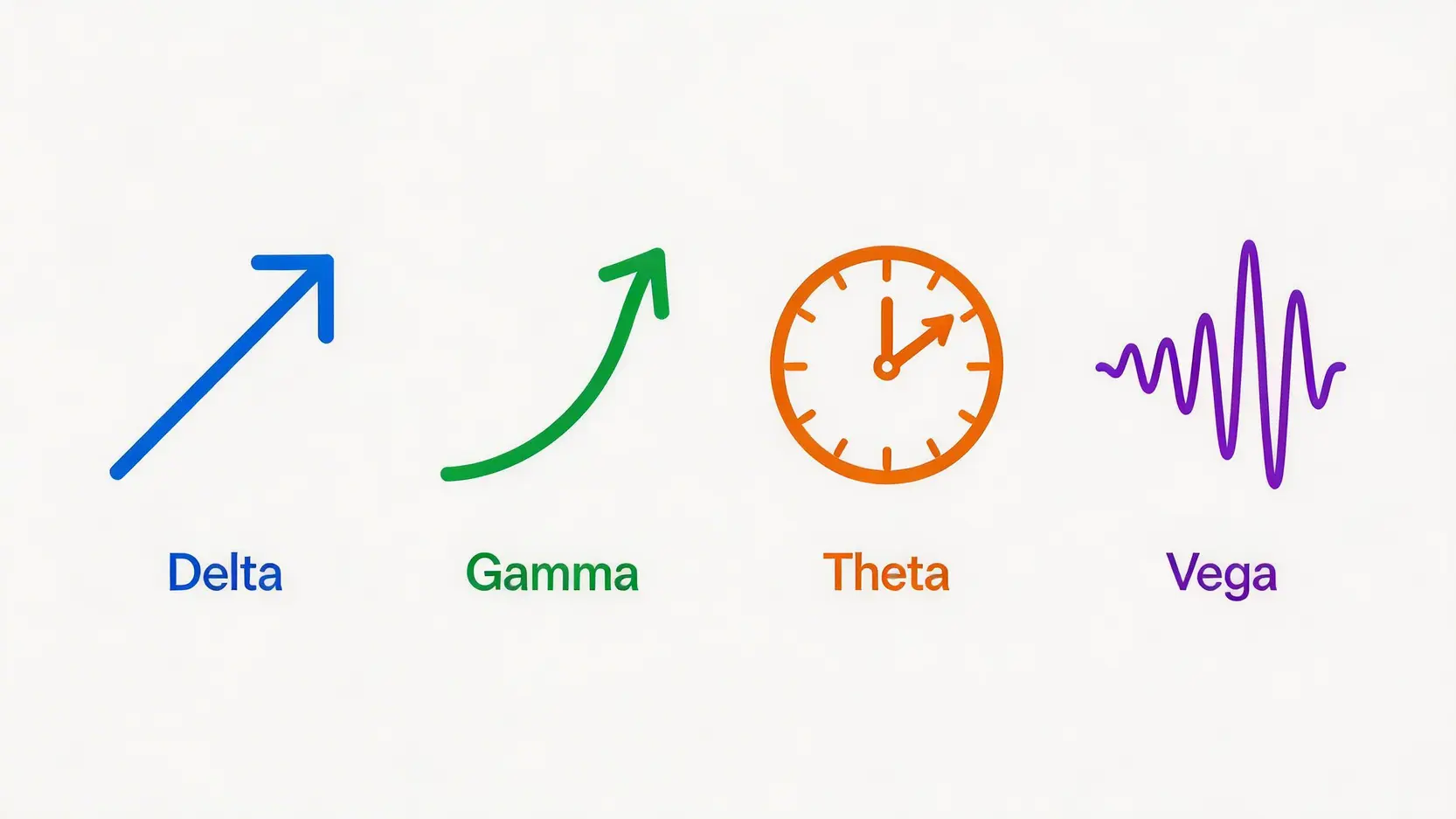
  • Delta (Δ): Measures sensitivity of option price to changes in the underlying asset price. It focuses on “direction”.
  • Gamma (Γ): Measures the rate of change of Delta relative to the underlying price. It focuses on “acceleration”.
  • Theta (Θ): Measures the rate of time decay of an option’s price. It focuses on “time”.
  • Vega (ν): Measures sensitivity of option price to changes in implied volatility. It focuses on “volatility”.

四個期權希臘字母(Delta, Gamma, Theta, Vega)的概念圖標,分別用指向上方的箭頭、加速的曲線、時鐘和波動的線條來表示它們各自的功能。

The Four Major Options Greeks: Direction, Acceleration, Time, and Volatility

A complete trading strategy must take all these dimensions into account. Trading based only on Delta is like driving while only looking ahead, ignoring road conditions (volatility) and fuel consumption (time decay). A deep understanding of the Options Greeks (Delta, Gamma, Theta, Vega) is a necessary step toward becoming a professional trader.


Further Reading (Highly Recommended)

Ultimate Guide to Zero-DTE Options: From Weekly Options, Out-of-the-Money Options to Practical Rolling Strategies, 5 Steps to Learn High-Leverage Trading

[2025 Options Beginner Guide] Call vs Put Options Explained: Master Buying and Selling Strategies in 5 Minutes


Decoding Vega Exposure: How Much Risk Does Your Position Carry?

After understanding Vega, the next step is evaluating your “Vega exposure”. This refers to your portfolio’s risk exposure to changes in volatility. Will your position profit when volatility rises, or suffer when it falls? This depends on whether you are “positive Vega” or “negative Vega”.


Positive Vega vs Negative Vega: Impact on Positions

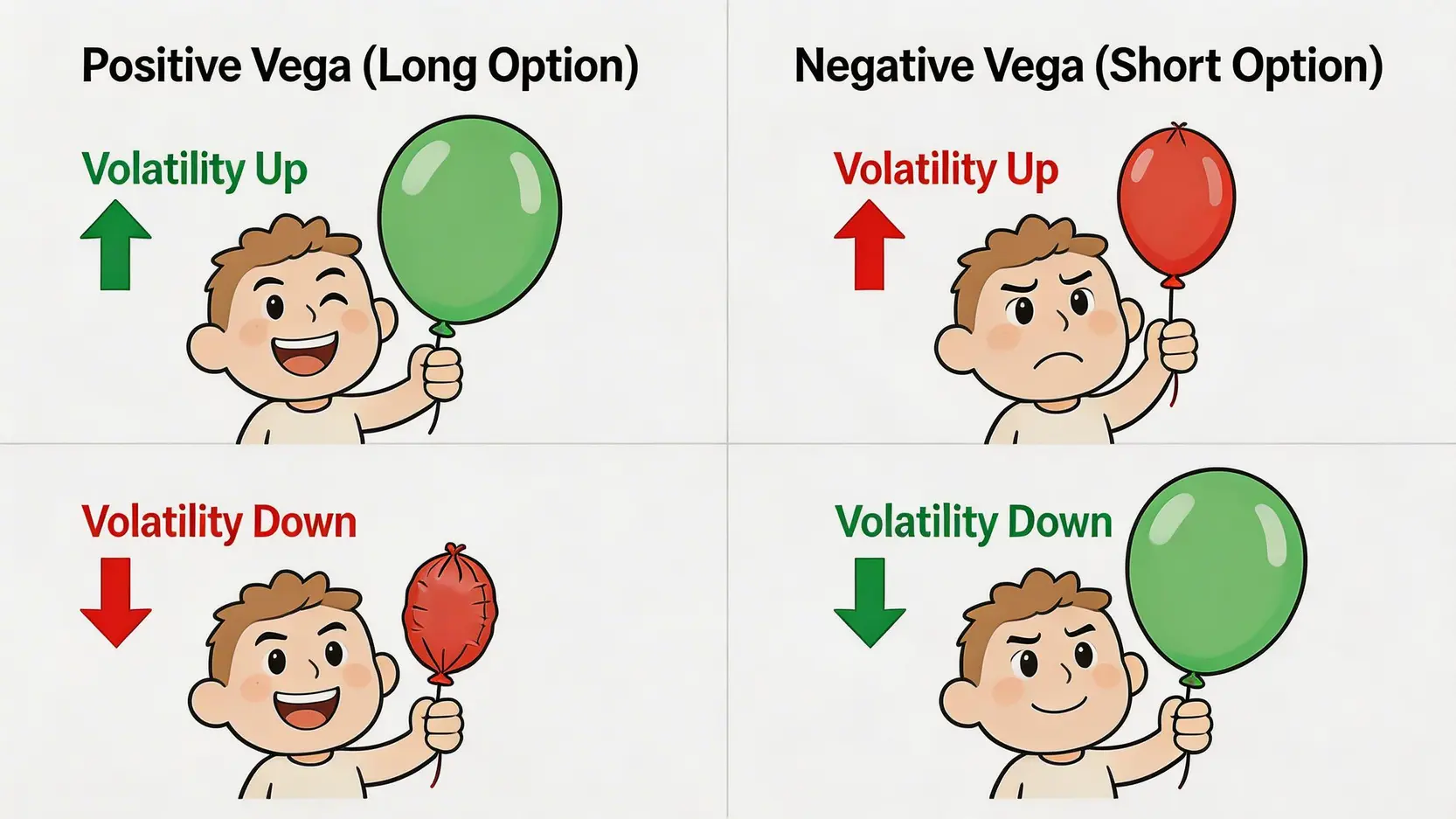
Simply put, long options positions are positive Vega, while short options positions are negative Vega. The logic behind this is: buyers benefit from increased volatility because it raises the probability of the underlying price reaching the strike price; sellers, on the other hand, prefer a calm market, where options are more likely to expire worthless, allowing them to collect the premium.

Position Type Vega Sign Expectation of Volatility Change Impact on Profit and Loss
Positive Vega (Long Vega) Positive (+) Expects implied volatility (IV) to rise When IV rises, the position value increases; when IV falls, the position value decreases.
Negative Vega (Short Vega) Negative (-) Expects implied volatility (IV) to decline When IV rises, the position value decreases; when IV falls, the position value increases.

正 Vega 與負 Vega 對比圖。左側顯示正 Vega 倉位在波動率上升時獲利,右側顯示負 Vega 倉位在波動率上升時虧損。

Positive Vega is like a balloon, expanding as volatility rises; negative Vega behaves in the opposite way and fears volatility.


Example Explanation: What Is Vega Exposure in a Long Call Option

Let’s use a concrete example to understand Vega exposure. Suppose you believe Apple Inc. (AAPL) stock will rise, so you buy a call option (Long Call) on AAPL with the following details:

  • Current stock price: $170
  • Strike price: $175
  • Expiration date: 30 days later
  • Option price: $5.00
  • Vega: 0.20
  • Implied volatility (IV): 25%

You are holding a positive Vega position. This means:

  • Scenario 1: Earnings are approaching, market expects higher volatility, and IV rises to 30%.
    IV increases by 5% (30% – 25%). Your option price will increase due to the Vega effect: 5 * 0.20 = $1.00. Even if the AAPL stock price does not move, your option value will increase to $6.00 ($5.00 + $1.00).
  • Scenario 2: Earnings result is neutral, uncertainty disappears, and IV drops to 20%.
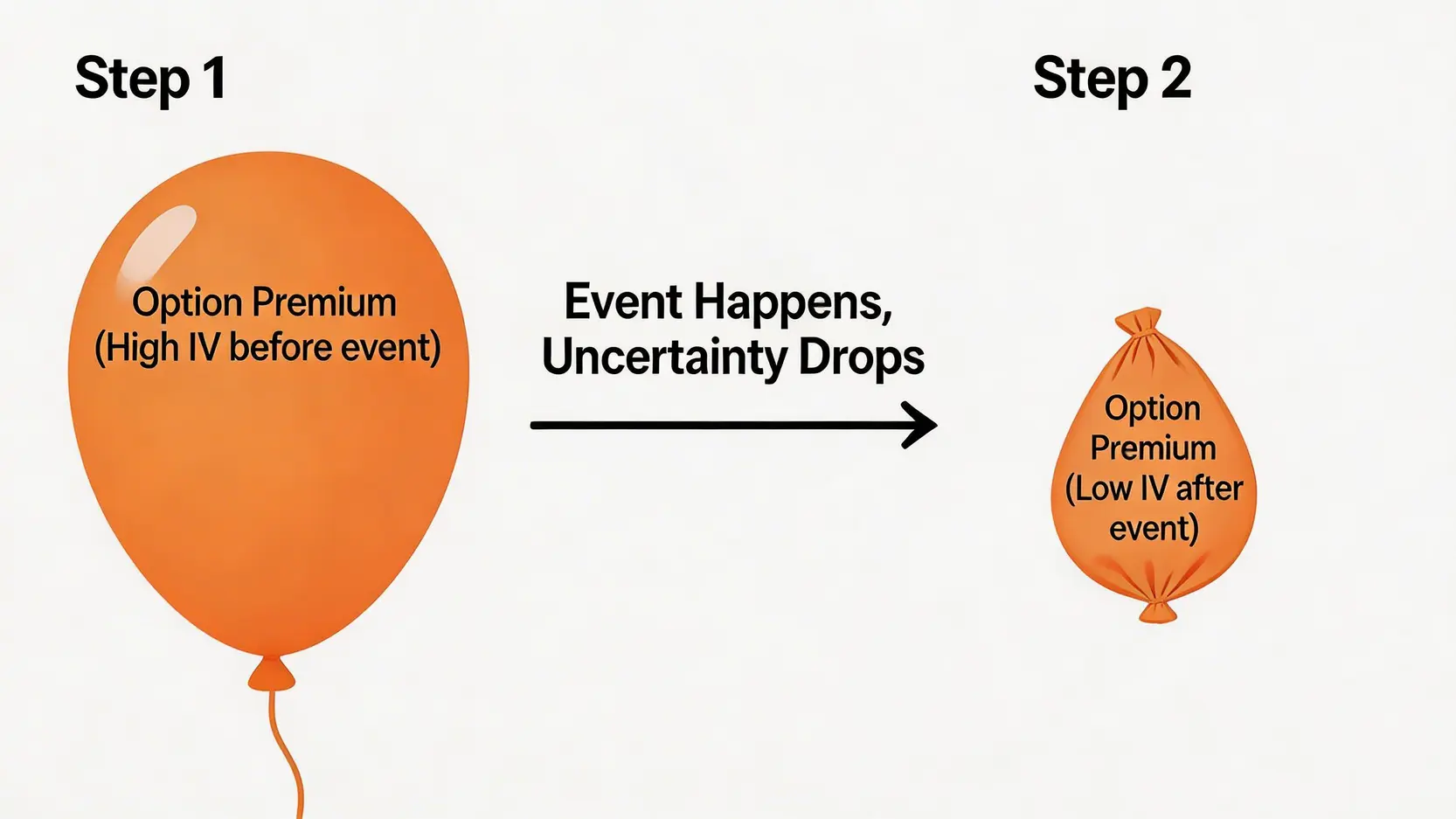
    IV decreases by 5% (25% – 20%). Your option price will decrease due to Vega: 5 * 0.20 = $1.00. Even if the AAPL stock price does not move, your option value will fall to $4.00 ($5.00 – $1.00). This is known as “IV Crush”.

波動率擠壓(IV Crush)概念圖,展示一個期權的價值(以膨脹的氣球表示)在事件發生後,因隱含波動率(IV)下降而大幅縮水。

After earnings or major events, uncertainty disappears, leading to a drop in implied volatility, which “compresses” option value.


How to Quickly Assess the Total Vega Risk of Your Portfolio

Assessing total Vega risk is very straightforward. You simply sum up the Vega values of all option positions in your portfolio. For example:

  • Position A (Long Call): Vega = +50
  • Position B (Long Put): Vega = +30
  • Position C (Short Call): Vega = -40
  • Position D (Short Put): Vega = -25

Total Vega = 50 + 30 – 40 – 25 = +15

This result tells you that your overall portfolio is “positive Vega”. In general, when implied volatility increases by 1%, your portfolio value is expected to increase by $15. Conversely, when volatility decreases, your portfolio value decreases accordingly. Understanding this total helps you determine whether you are net long or short volatility and decide whether Vega risk management is needed.


Core Vega Risk Management: 5 Practical Hedging Strategies

When you find that your Vega exposure is too high, or you do not want your positions to be heavily affected by volatility changes, you need to apply hedging strategies. Below are five practical methods ranging from basic to advanced to help you effectively manage Vega risk.


Strategy 1: Reverse Option Hedging

This is the most direct hedging method. If you hold too much positive Vega (e.g., you have many options), you can sell some options (adding negative Vega) to neutralize the risk. Conversely, if you are negative Vega (e.g., you have sold many uncovered options), you can buy options to reduce risk.

  • Objective: Adjust total Vega to a comfortable range rather than eliminating it completely.
  • Advantages: Simple, intuitive, and flexible.
  • Disadvantages: May increase transaction costs and introduce other Greeks risk (such as Delta and Gamma).


Strategy 2: Spread Strategies (e.g., Vertical Spreads) to Limit Vega Exposure

A single long or short option can have unlimited Vega exposure, but option spread strategies combine buying and selling positions to effectively limit Vega risk. For example, a Bull Call Spread involves buying a lower strike call while selling a higher strike call. The long call contributes positive Vega, while the short call contributes negative Vega, partially offsetting each other and significantly reducing total Vega exposure compared to a standalone call option.

  • Objective: Control Vega risk to a very small range at the time of entry.
  • Advantages: Risk and maximum profit are predefined, suitable for conservative traders.
  • Disadvantages: Limits potential profit.


Strategy 3: Using VIX Futures or Options to Directly Hedge Volatility

The VIX index, often called the “fear index” measures expected market volatility over the next 30 days. When you expect volatility to rise and potentially harm your negative Vega positions, you can buy VIX call options or VIX futures. In this way, even if your main positions lose value due to rising IV, the VIX hedge may generate profits to offset losses.

  • Objective: Macro-level hedging against overall market volatility.
  • Advantages: High hedging efficiency and precise volatility targeting.
  • Disadvantages: VIX derivatives are complex and involve futures contango/backwardation issues, making them unsuitable for beginners.


Strategy 4: Dynamic Delta-Neutral Adjustments to Balance Vega

For more advanced traders, especially market makers, Delta-neutral strategies (such as Iron Condor and Straddle) are used not to profit from price direction, but from time decay (Theta) or volatility changes (Vega). In such strategies, if Vega exposure deviates from the target, traders dynamically adjust strike selection or contract size to rebalance the position. This is a more active and precise form of Vega risk management.


Strategy 5: Using Calendar Spreads for Cross-Maturity Hedging

A calendar spread is a pure volatility strategy involving selling a near-term option while buying a longer-term option (at the same strike price). Since longer-dated options typically have higher Vega than near-term options, this structure naturally creates a positive Vega position. Therefore, when you hold a core negative Vega position, adding a calendar spread can increase positive Vega and achieve hedging. It leverages differences in volatility sensitivity across expirations to manage risk.


Frequently Asked Questions (FAQ)

Q: Is Vega always a positive number?

A: No. The sign of Vega depends on your position. In general, any purchased option (Long Call or Long Put) has positive Vega because it benefits from an increase in volatility. Conversely, any sold option (Short Call or Short Put) has negative Vega because an increase in volatility is unfavorable to the seller and increases the risk of the option being exercised. The Vega of spread strategies depends on the relative size of long and short positions within the structure.

Q: How does time to expiration affect Vega value?

A: The farther an option is from its expiration date, the higher its Vega value is usually. This is because longer-dated options contain more time value and uncertainty, making their prices more sensitive to changes in implied volatility. In contrast, options close to expiration (such as zero-DTE options) have very low Vega because there is little time left, and changes in volatility have minimal impact on price. At this stage, Gamma risk becomes dominant.

Q: What is the difference between Vega risk and Gamma risk?

A: Both relate to significant market movements, but they focus on different factors. Vega risk concerns changes in implied volatility, which can affect your profit and loss even if the underlying asset price does not move. On the other hand, Gamma risk concerns the acceleration of the “underlying asset price” movement and measures how quickly your Delta changes. A high Gamma position experiences very rapid P&L changes during large price swings. In simple terms, Vega manages “expected” volatility, while Gamma manages “actual” price movement. 

Conclusion

In summary, Vega is a double-edged sword in options trading. If ignored, you may suffer significant losses from sudden changes in implied volatility. If properly understood and managed, volatility can become an advantage. Effective Vega risk management is not about eliminating risk entirely, but about strategically controlling your Vega exposure so that it aligns with your market outlook. We hope the hedging strategies in this article help you improve your trading performance and achieve more stable results. Start reviewing your positions now and incorporate Vega management into your daily trading routine!

If you liked this article, please share it!

Related Articles

  • How to Buy Bitcoin in 2026: A Beginner’s Guide
    How to Get Started with Bitcoin? The Complete 2026 Bitcoin Buying Guide for Beginners After watching Bitcoin repeatedly reach new highs in recent years and successfully pass spot ETF reviews in the US and Hong Kong in 2024, officially entering mainstream financial markets, many investors have turned their attention to...
    2026 年 7 月 20 日
  • Gold V-Shaped Rebound: Bottom Signal or Bull Trap?
    Is Gold’s V-Shaped Rebound a Bottom-Fishing Signal? A Complete Guide to Trading Strategies Amid “$100 Price Swings” What Is a Gold V-Shaped Rebound? More Than Just a Technical Pattern The gold market has recently experienced sharp rises and falls, with prices frequently displaying dramatic “gold V-shaped rebounds”. Single-day “$100 price...
    2026 年 7 月 20 日
  • 2026 PPI Guide: PPI vs CPI and Stock Market Impact
    What Is PPI Data? 2026 Latest Analysis: Understand the Differences from CPI and How It Affects Stock Market Trends With market information constantly changing, do you always hold your breath while waiting for CPI data to be released? But did you know that a more forward-looking inflation indicator, PPI data...
    2026 年 7 月 20 日
返回顶部