The higher the leverage, the more fragile the position’s risk capacity.
Many beginners chase excitement and blindly use high leverage, ignoring that normal market fluctuations can easily exceed 1–2%. This makes their positions vulnerable even to minor market noise, which is one of the most common causes of liquidation.
Cause 2: Black Swan Events and Extreme Market Volatility
“Black Swan events” are unpredictable, high-impact occurrences such as wars, financial crises, or sudden regulatory policies. These events can trigger extreme market panic in a short time, causing prices to surge or plummet by tens of percentage points within minutes. In such extreme conditions, even low leverage can lead to liquidation if prices instantly breach your liquidation point, making timely reactions impossible. Effective risk management for leverage trading is crucial for leveraged trading in these scenarios.
Cause 3: Poor Capital Management and Position Control
Professional traders never go “all-in”. They strictly control the size of individual trades to ensure that even if losses occur, they only affect a small portion of total funds. However, many retail traders favor “heavy positions” or “full positions”, putting all their eggs in one basket. This is extremely dangerous because a single wrong judgment can severely damage the account or trigger immediate liquidation.
Cause 4: Fatal Habit of Never Setting Stop-Losses
Setting a stop-loss is the most basic risk control tool in trading. It acts as a safety net, automatically closing positions when the market moves against you, limiting losses to an acceptable range. Many people avoid setting stop-losses out of fear of “small losses” or hoping “prices will rebound”. As a result, small losses can snowball into significant losses, ultimately triggering forced liquidation with irreparable consequences.
Cause 5: Ignoring the Warning of the Maintenance Margin Ratio
Most trading platforms provide a real-time “maintenance margin ratio” or “risk ratio” indicator. This number is a lifeline for your account’s health. When it falls to a dangerous level, the platform usually issues a warning (Margin Call). Ignoring this warning without promptly adding margin or reducing positions will result in forced liquidation by the system. Ignorance of this ratio is often the final step leading to liquidation.
Detailed Explanation of Liquidation Point Calculation (With Example Tutorial)
Knowing how to calculate liquidation points is a core skill for avoiding liquidation. It allows you to clearly understand your risk threshold before opening a position. Before learning the formulas, you must first grasp two key concepts.
Core Concepts: Initial Margin vs. Maintenance Margin
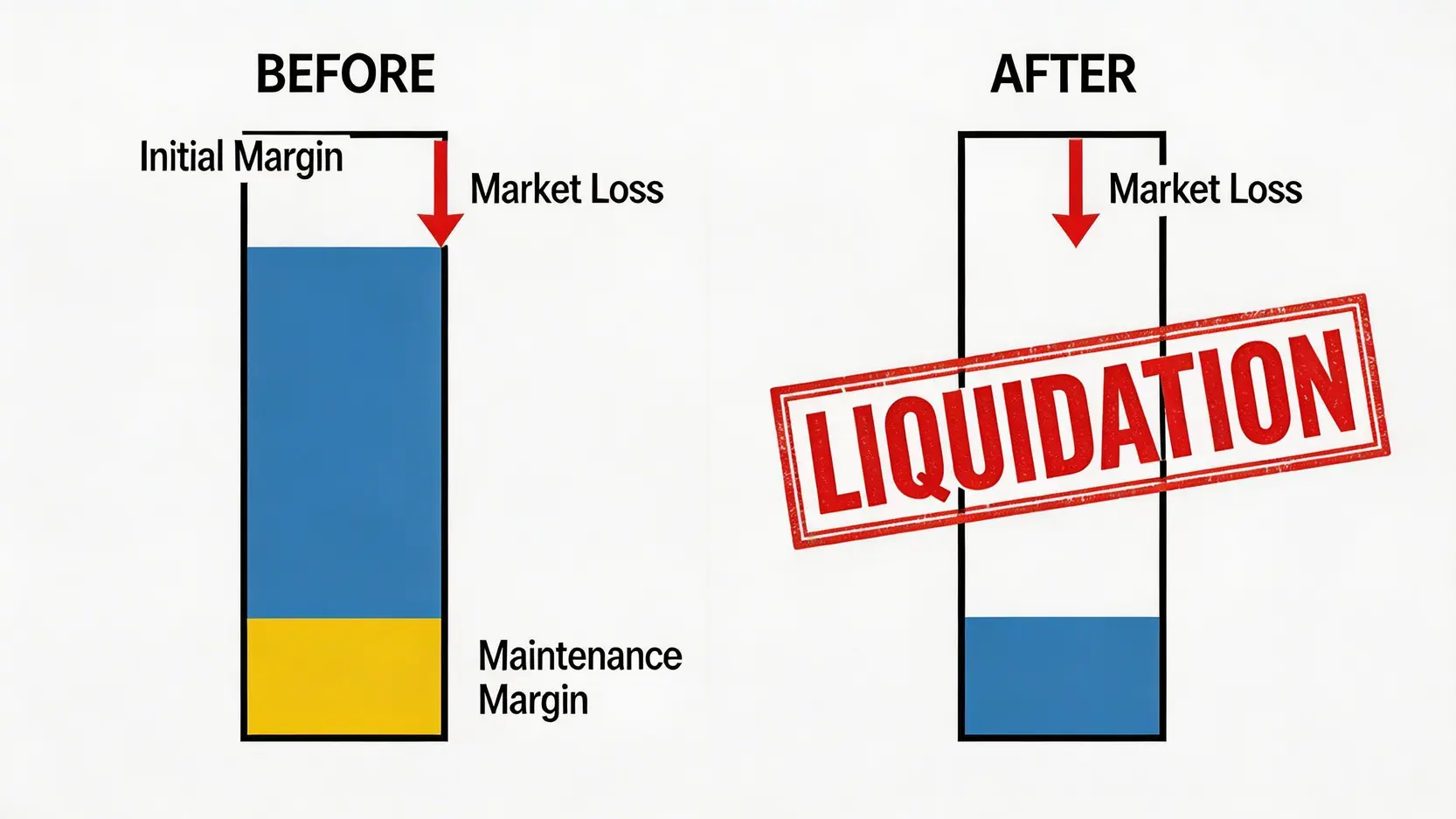
- Initial Margin: The minimum funds required when opening a position. It equals the position value divided by the leverage. For example, opening a position worth 10,000 USD with 10x leverage requires an initial margin of 1,000 USD.
- Maintenance Margin: The minimum margin level that must be maintained in your account to avoid forced liquidation. This ratio is set by the exchange, usually as a percentage of the position value (e.g., 0.5% or 1%). You can refer to the definition of maintenance margin on reputable financial websites like Investopedia to understand its common application in financial markets.
Liquidation occurs when your account equity (including unrealized P&L) falls below the maintenance margin level.
Long Position (Buy) Liquidation Price Formula and Example
When going long, the concern is a price drop. Calculating the liquidation price can be complex, but we can simplify it:
Simplified Formula:
Long Liquidation Price ≈ Entry Price × (1 – Initial Margin Rate + Maintenance Margin Rate)
A more precise formula considering all variables:
Precise Formula:
Long Liquidation Price = (Entry Price × Position Size – Account Balance + Maintenance Margin) / (Position Size × (1 – Maintenance Margin Rate))
Example Tutorial:
Assume you go long 1 BTC at a Bitcoin price of 50,000 USD using 10x leverage, with 5,000 USD in your account (as the initial margin). The exchange’s maintenance margin rate is 0.5%.
- Entry Price: 50,000 USD
- Position Size: 1 BTC
- Initial Margin: 50,000 / 10 = 5,000 USD
- Position Value: 50,000 USD
- Maintenance Margin: 50,000 × 0.5% = 250 USD
Liquidation occurs when your losses reduce your account to 250 USD. This means the maximum loss you can bear is 5,000 – 250 = 4,750 USD. Therefore, the corresponding liquidation price is approximately 50,000 – 4,750 = 45,250 USD.
Short Position (Sell) Liquidation Price Formula and Example
When going short, the concern is a price increase. The calculation logic is the opposite of a long position.
Simplified Formula:
Short Liquidation Price ≈ Entry Price × (1 + Initial Margin Rate – Maintenance Margin Rate)
Precise Formula:
Short Liquidation Price = (Entry Price × Position Size + Account Balance – Maintenance Margin) / (Position Size × (1 + Maintenance Margin Rate))
Example Tutorial:
Assume you short 1 BTC at a Bitcoin price of 50,000 USD using 10x leverage, with an initial margin of 5,000 USD and a maintenance margin rate of 0.5%.
The maximum loss you can bear is still 4,750 USD. Liquidation occurs when the price rises by 4,750 USD. Therefore, the corresponding liquidation price is approximately 50,000 + 4,750 = 54,750 USD.
Use Tools Wisely: 3 Recommended Online Liquidation Calculators
Although manual calculation helps you understand the principles, using online tools is more efficient in fast-paced trading. Many free “liquidation calculators” or “forced liquidation price calculators” are available. Simply input the entry price, leverage, position size, and other parameters to instantly get the liquidation price. It is recommended to simulate with these tools before opening a position to be fully aware of the risks.
Further Reading (Highly Recommended)
Essential Reading for Margin Trading: 5 Key Strategies to Avoid Leverage Risks and Liquidation Tragedies
[Forex Tutorial 2024] Ultimate Beginner’s Guide: Master Forex Trading from 0 to 1!
Defend Your Line — In-Depth Analysis of the “Maintenance Margin Ratio”
If the liquidation point is your last line of defense, the “maintenance margin ratio” is the warning system in front of it. Constant monitoring of this ratio is key for professional traders to avoid disasters.
What Is the Maintenance Margin Ratio and How Does It Work?
Maintenance Margin Ratio (MMR) is a percentage that measures the health of your account equity relative to the minimum margin required for your positions.
Formula:
Maintenance Margin Ratio = Account Equity / Maintenance Margin
When this ratio is 100%, your account equity exactly equals the minimum margin required for the position. If it falls below 100%, forced liquidation is triggered.
What Happens When the Ratio Falls Below the Warning Line?
Trading platforms typically set a warning line above 100%, such as 120% or 150%. When your ratio reaches this level, you receive a “Margin Call”, alerting you that your position is at risk and action is needed.
You have several options:
- Add Margin: Deposit more funds to increase your account equity.
- Partial Position Closure: Reduce your position size to lower the required maintenance margin.
- Close All Positions: Exit if you believe the market will continue to move against you.
Ignoring a Margin Call and allowing the ratio to fall to the 100% red line will result in automatic forced liquidation by the system.
Difference Between Cross Margin and Isolated Margin in Maintenance Margin Ratio
Platforms usually offer two margin modes: Cross Margin and Isolated Margin, which calculate the maintenance margin ratio differently.
- Isolated Margin:
The margin allocated to a specific position is independent. If that position is liquidated, only the margin assigned to it is lost, without affecting other funds or positions in the account. This risk isolation is suitable for beginners testing strategies.
- Cross Margin:
All available balance in the account is used as total margin for all positions. Profits from one position can automatically support losses in another, increasing the overall maintenance margin ratio and making positions more resilient to market fluctuations. However, in extreme conditions, liquidation could result in losing all account funds.