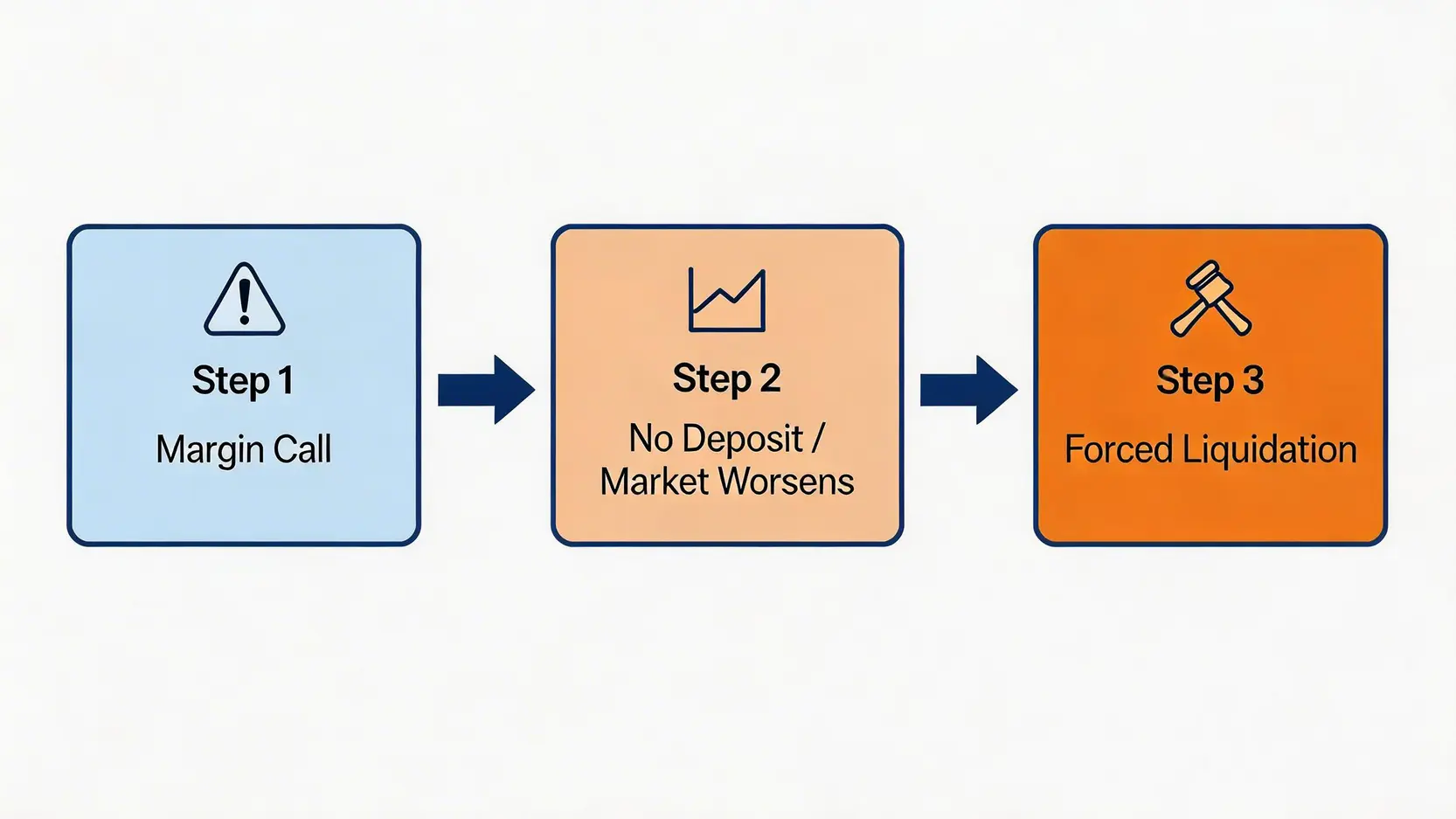
Leverage is a double-edged sword: it can let you soar or wipe you out instantly.
- Cause 2: Poor Position Management
Known as “heavy positions” or “all-in”. Placing most of your funds on a single trade without diversification. If the market moves against you, there is no buffer to absorb fluctuations.
- Cause 3: Never Setting a Stop-Loss
One of the deadliest mistakes! A stop-loss is your “escape door” set before entering a trade. Trading without it is like driving without brakes, letting losses expand infinitely until hitting the wall of liquidation.
- Cause 4: Extreme Market Conditions (Black Swan Events)
Sudden major news or data (e.g., war, central bank surprise rate hikes) can cause rapid price gaps. In such cases, your stop-loss may be bypassed, resulting in losses far beyond expectations and instant liquidation.
- Cause 5: Stubborn Trading Mindset
Some traders “hold on to the bitter end” or add positions against the trend, hoping for a market reversal. This behavior, based on wishful thinking rather than strategy, is often the final straw pushing the account to ruin.
Full Analysis of Liquidation Consequences: What Happens to My Money?
After understanding the causes, let’s address the most terrifying question: what are the consequences of liquidation? Where does the money go, and do you need to repay it?
Consequence 1: Principal Wiped Out
The most direct and certain consequence is that all your margin (principal) is lost. Any floating profit accumulated disappears, and the account equity drops near zero at the moment of liquidation. This is a devastating blow every trader should strive to avoid.
Consequence 2: Negative Balance Risk — The Truth About “Do I Owe Money After Liquidation?”
This is the critical issue. The answer: it is possible, but very rare. This situation is called “negative balance”.
Negative balance occurs in extreme market conditions when price movements are so severe and rapid that the system executes forced liquidation at a price far from the intended closing price, leaving the account equity “negative”. This means you lose all principal and may owe the broker money. This is the true source of the “do I owe money after liquidation?” question.
Example:
Suppose your account has $1,000 and you go long at a certain price. The liquidation threshold is a $950 loss. If the market gaps sharply, the system may only close the position at a $1,200 loss, leaving your account at -$200. This $200 is a debt owed to the broker.
Fortunately, many reputable brokers now offer “Negative Balance Protection”, ensuring clients cannot lose more than deposited funds. Even if negative balance occurs, the broker absorbs the loss and resets your account to zero. Always confirm whether a platform provides this policy before trading.
Consequence 3: Potential Impact on Credit Record and Future Investments
If negative balance occurs and the platform lacks protection, the debt becomes a real civil obligation. Ignoring it allows the broker to pursue legal action, potentially affecting your credit record and hindering future loan or credit card applications. A catastrophic liquidation can also psychologically traumatize investors, creating market fear and impairing future investment decisions.
How to Rescue Yourself? 3 Practical Strategies to Avoid Liquidation
Instead of worrying about the consequences of liquidation, learn to prevent it at the source. The core of avoiding liquidation is effective risk management. The following three strategies are essential for every trader using leverage.
Extended Reading (Highly Recommended)
Strategy 1: Set Stop-Loss Precisely to Control Potential Losses
Make “setting a stop-loss” a reflex every time you place a trade. A stop-loss represents the maximum loss you are willing to accept for a trade. A rational stop-loss should be based on technical analysis (e.g., support and resistance levels), not wishful thinking. It allows you to decisively cut losses when the market proves you wrong, protecting most of your capital and leaving room to recover. Remember: preserving capital ensures you can trade another day.
Strategy 2: Manage Leverage and Position Size
Beginners often have unrealistic expectations about leverage. Remember, professional traders focus on controlling risk, not using maximum leverage. Beginners should use leverage below 10x and ensure each trade risks no more than 1%–2% of total capital. Learning to use a position size calculator to plan each trade is the first step toward professionalism. Proper position sizing is far more important than attempting “perfect market predictions.”
Strategy 3: Monitor Margin Levels and Learn to Add Margin
Develop a habit of regularly checking your account’s margin ratio, especially before holding positions overnight or during major market announcements. Understand how much market movement your account can withstand. When receiving a margin call, stay calm. Assess the current market: if the trend still favors you and risk is manageable, you may add margin; if the trend has clearly reversed, manually closing the position to accept the loss is wiser than risking more funds to save a losing trade.
Common Questions About Liquidation (FAQ)
Q: What is the difference between liquidation and negative balance?
A: Liquidation occurs when losses reach the margin limit, forcing positions to close and wiping out your principal. Negative balance is an extreme case, where a gap in market prices causes losses to “exceed” your principal, leaving your account balance negative and owing money to the broker.
Q: Are liquidation mechanisms the same across exchanges (e.g., Binance, CFD platforms)?
A: They are broadly similar but differ in details. All are triggered by margin ratio. Differences include: 1. The maintenance margin level for forced liquidation; 2. The formula for calculating the liquidation price (e.g., mark price vs. last price); 3. Whether negative balance protection is offered. Always read the platform’s help documents and user agreements before trading.
Q: Can a hedged position still be liquidated?
A: Yes. Hedging involves opening equal and opposite positions on the same asset. While this temporarily locks in floating losses, you still pay two positions’ overnight fees and spreads. If costs erode account equity or margin requirements rise due to spread widening, your net equity may fall below the maintenance margin, causing liquidation.
Q: Can you avoid repaying negative balance after liquidation?
A: Not recommended. If trading on a regulated broker, the debt is a legal civil obligation. Brokers can pursue legal collection. Avoiding repayment may harm your credit record and expose you to legal risk. The best approach is to choose platforms with “Negative Balance Protection” from the start to prevent owing money.
Conclusion
In summary, understanding the causes and consequences of liquidation is essential for every trader using leverage. Liquidation is not an inevitable fate—it is the result of poor risk management. It reminds us that markets are inherently uncertain, and respect for the market and strict discipline are key to long-term survival. By applying the strategies in this guide, you can effectively reduce liquidation risk and trade without constantly worrying about “what happens if I get liquidated” or “do I owe money after liquidation?” Review your strategies and position sizing today, implement robust safeguards, and become a savvy trader capable of long-term, stable profitability.