HK Fund Picks 2026: 5 Popular Funds Compared

[2026 Fund Recommendations] Integrating LIHKG Users’ Investment Insights: Comparison of 5 Popular Hong Kong Funds and a Guide to Avoid Pitfalls
Want to start investing in funds but worried about making the wrong choice due to information overload? Many Hong Kong investors turn to forums like LIHKG to explore firsthand fund investment insights. However, with so many scattered discussions, finding key takeaways can feel like searching for a needle in a haystack. If you are looking for a reliable summary of LIHKG fund recommendations, this article is designed for you. It compiles key insights from major Hong Kong fund discussion platforms, covering popular fund recommendations, platform selection, and practical tips to avoid common pitfalls, providing you with a clear investment guide to help you take your first step steadily.
Why Refer to LIHKG? The Real Value of Hong Kong Fund Discussion Forums
LIHKG, as one of the most active online communities in Hong Kong, has a stock and investment discussion forum (Finance Board) that brings together a large number of investors, ranging from beginners “learning and exchanging ideas” to experienced “stock masters”. The value of referring to Hong Kong fund discussion forums like LIHKG lies in the “authenticity” and “timeliness” of the information. Compared to official fund sales documents, discussions here are more down-to-earth and filled with real experiences from retail investors, including success stories and lessons from being “scammed”.
- First-hand information: You can see real-time reactions from other investors to specific funds, such as changes in fund managers or sudden dividend adjustments. These insights are often faster than traditional media.
- Retail investor perspective: Fund companies’ materials often highlight positives while downplaying risks. In contrast, forums provide concentrated discussions on fund drawbacks, such as hidden fees or underperformance, helping you assess risks more comprehensively.
- Strategy sharing: Users frequently share investment strategies, including experiences with monthly investment plans and timing for profit-taking or stop-loss, which are especially valuable for beginners.
However, information on forums is mixed in quality and should not be fully trusted. Some opinions may be biased, outdated, or even intentionally misleading. Therefore, learning to filter information, applying independent thinking, and using it as a reference rather than the sole basis for decisions is the most prudent approach.
The Most Discussed Fund Types on LIHKG: Dividend, Money Market, and Index Funds Compared
On LIHKG’s finance section, three types of funds consistently attract high attention, each catering to different investor needs: “Income-focused investors” seeking stable cash flow, conservative investors looking for low-risk capital parking options, and those aiming to follow overall market growth with a steady investment approach.
| Fund Type | Investment Objective | Suitable Investors | Advantages | Disadvantages |
| Dividend-Paying Funds | Generate regular cash flow (monthly, quarterly, or annually) | Retirees, those seeking passive income | Provide stable cash income and improve liquidity | Dividends may erode principal (dividends do not equal profit), fund price volatility can be relatively high |
| Money Market Funds | Capital preservation with potential returns higher than demand deposits | Conservative investors, short-term capital parking | Very low risk, high liquidity (typically T+1 settlement), low entry threshold | Relatively low returns, difficult to keep up with inflation |
| Index Funds / ETF | Track the performance of a specific market index (such as the Hang Seng Index or S&P 500) | Beginners, passive investors | Low management fees, diversified holdings, high transparency | Cannot outperform the market and will decline along with it |
Banks vs Brokerages: How Should Hong Kong Investors Choose the Most Cost-Effective Platform?
“Should I buy funds through banks or brokers?” is a perennial hot topic on LIHKG. Traditionally, investors are used to subscribing to funds through banks, but in recent years, emerging online brokerages and fund platforms have risen rapidly due to their fee advantages. Choosing a good Hong Kong fund platform has a direct impact on long-term returns.
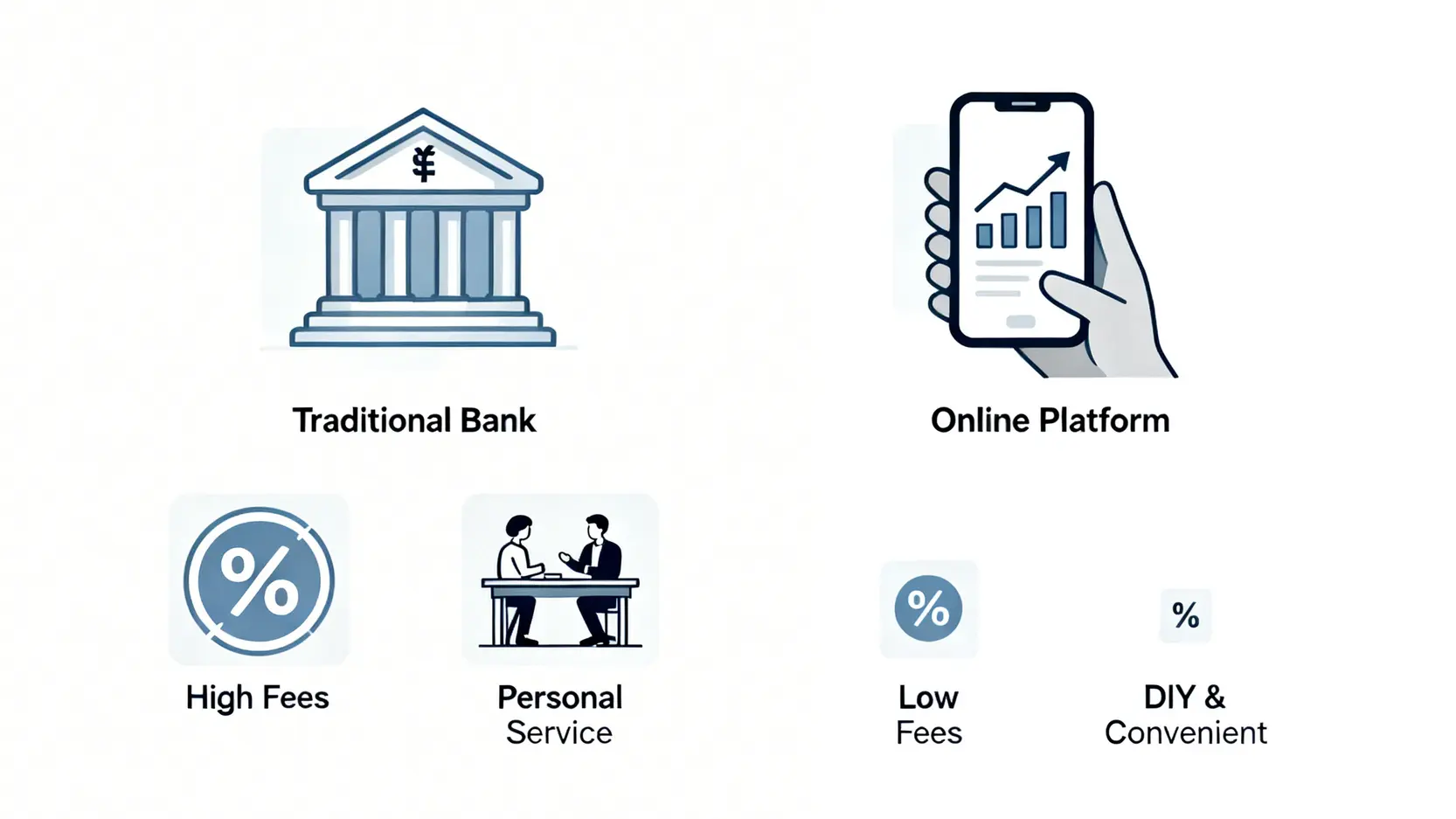
Simply put, banks offer the advantage of “convenience” and “one-stop service”. You can manage your investments while handling daily banking needs, and relationship managers are available to provide advice. However, the drawbacks are equally clear: high fees. Banks generally charge 1–3% subscription fees, and some also impose switching fees and redemption fees. In contrast, online brokerages and fund platforms such as Futu and uSMART promote “zero subscription fees” or very low platform fees, significantly reducing investment costs. For investors who trade frequently or invest regularly over the long term, the savings can be reinvested to generate a considerable compounding effect. Therefore, unless you rely heavily on relationship manager services, choosing a lower-cost online platform is generally more cost-effective.
Banks vs Online Platforms: A Quick Comparison of Fees and Services
Further Reading (Highly Recommended)
Top LIHKG Picks for 2026! 5 Popular Hong Kong Funds and Analysis
Based on discussions across major Hong Kong fund forums and market trends, here are 5 funds gaining attention in 2026, along with objective analysis to help you understand their potential and risks.
High-Income Choice: Allianz Income and Growth Fund
Known among LIHKG users as the “A Set”, the Allianz Income and Growth Fund is a star in the dividend fund category. It mainly invests in US convertible bonds and high-yield bonds, while allocating a portion to equities, aiming to provide attractive income and capital growth. Its historically stable dividend payout makes it popular among “income-focused investors”. However, investors should note that its high-yield bond component is sensitive to interest rates and credit risk, and price volatility can be significant during economic downturns.
Safe Haven Option: Money Market Funds Such as Futu Cash Fund
When the stock market is volatile or outlook is uncertain, funds often flow into money market funds for safety. Products such as Futu Cash Fund and uSMART SmartSave are among the most popular. These funds invest in very low-risk short-term debt instruments, such as bank deposits and commercial papers, making them extremely low risk. Their annualized returns are generally higher than demand deposits, and they offer flexible redemption, making them ideal for managing idle funds and waiting for investment opportunities.
Track the Market: Tracker Fund of Hong Kong (2800.HK) and Other Index ETFs
For investors who do not want to spend time researching individual stocks but still want market exposure, “just buy 2800” (Tracker Fund of Hong Kong) is a classic LIHKG recommendation. It tracks the Hang Seng Index, meaning one lot gives exposure to a basket of Hong Kong’s most representative companies, offering strong diversification. In addition, ETFs such as VOO (tracking the S&P 500) and QQQ (tracking the Nasdaq 100) are also frequently discussed. These passive investment tools have very low management fees and are suitable for long-term monthly investment strategies.
Thematic Growth: Popular Technology or ESG Funds
In recent years, thematic funds focusing on specific sectors such as AI, electric vehicles, and clean energy have become increasingly popular. These funds capture major global trends and offer high potential returns, but risks are also more concentrated. Investing in such funds requires a certain level of understanding of the industries involved, as well as readiness for significant price fluctuations. Common examples discussed on LIHKG include funds investing in global tech giants or those focused on ESG (Environmental, Social, and Governance) themes.
Global Allocation: Global Equity Funds
“Do not put all your eggs in one basket”. Investing in a single market (such as Hong Kong stocks) carries higher risk. A high-quality global equity fund allows exposure to leading companies across the US, Europe, and Asia, effectively diversifying regional risks. These funds are suitable for investors who want simple global asset allocation without the need to study individual markets.
Must-Learn for Beginners! Key Fund Investment Strategies from LIHKG Users
After understanding fund and platform selection, the next step is execution. Here are two core strategies distilled from LIHKG fund investment discussions, especially suitable for beginners.
Is “Monthly Investment” Better Than “Lump Sum”? The Power of Dollar-Cost Averaging
“Monthly fund investment” refers to dollar-cost averaging, the most recommended beginner strategy on LIHKG. It helps overcome emotional biases and avoids “buy high, sell low”. The method is simple: invest a fixed amount on a fixed date each month into the same fund. When prices are high, you buy fewer units; when prices are low, you buy more. Over time, this averages out your cost, a strategy known as “dollar-cost averaging”.

The Power of “Dollar-Cost Averaging”: Smoothing Entry Prices
This approach does not require precise market timing and is especially suitable for volatile equity or index funds. For young professionals with limited capital, monthly investment is an effective way to accumulate wealth.
Common Fund Investment Pitfalls: Fees, Hidden Costs, and How to Avoid Them
Fund fees are numerous and can significantly erode returns, making them a common “trap” for beginners. In addition to subscription fees mentioned earlier, you should also pay attention to:
- Management Fee: Annual fee charged by the fund company based on assets under management, typically ranging from 0.5% to 2%, deducted directly from fund assets. Active funds usually charge more than passive index funds.
- Platform Fee: Some platforms waive subscription fees but charge annual platform fees based on holdings.
- Redemption Fee: Fees charged when selling funds within a specified period (e.g., within one year).
- Total Expense Ratio (TER): A key metric reflecting total fund cost, including management fees and other operating expenses. When selecting funds, prioritize those with lower TER within the same category.
For more official fund information, you can refer to the Hong Kong Securities and Futures Commission fund information website to ensure the funds you choose are compliant and transparent.
Conclusion
In summary, referring to insights from Hong Kong fund discussion forums (such as LIHKG) can help beginner investors avoid many common pitfalls and quickly understand market trends. However, always remember that online opinions should only serve as references. Final investment decisions should be based on your own financial situation, investment goals, and risk tolerance. Each fund mentioned has its own advantages and disadvantages. The most important step is to learn, compare, and develop your own investment philosophy and strategy, and to execute it consistently.
Frequently Asked Questions (FAQ)
Q: Which bank or brokerage offers the lowest fees for buying funds?
A: Generally, online brokerages or fund platforms (such as Futu, uSMART, Endowus, etc.) offer much lower fees than traditional banks. Most of them provide “zero subscription fee” promotions and only charge relatively low annual platform management fees. In contrast, banks typically charge 1–3% subscription fees, which can significantly erode investment returns over time. Therefore, for investors seeking lower costs, online platforms are the better choice.
Q: What is the difference between money market funds and bank time deposits?
A: Both are low-risk financial tools, but the main differences lie in liquidity and return mechanisms. Time deposits have fixed terms (such as 3 months or 1 year), and early withdrawal will result in loss of interest; the interest rate is locked in at the time of placement. Money market funds, on the other hand, have no lock-in period, offer high liquidity (typically T+1 settlement), and their returns fluctuate daily based on market interest rates. In simple terms, money market funds are a more liquid, slightly variable-return version of a “demand deposit Plus”.
Q: Are dividends from dividend-paying funds guaranteed? Will they affect fund prices?
A: No, they are not guaranteed. The dividend rate and amount of dividend-paying funds may vary depending on the fund’s investment performance, and fund companies have the right to adjust or even suspend dividends. Importantly, dividends represent a distribution of part of the fund’s assets in cash to investors, so after each payout, the fund’s unit price (NAV) will be adjusted downward accordingly. Therefore, you should not only focus on dividend yield, but also consider total return (price appreciation + dividends).
Q: What type of fund should beginners choose for monthly investment plans?
A: For beginners, investing monthly in index funds (such as ETFs tracking the Hang Seng Index or the S&P 500) is a very solid starting point. Index funds have low fees and diversified risk, allowing you to participate in long-term market growth through dollar-cost averaging. Once you gain more experience, you can consider allocating a small portion of funds to more volatile thematic growth funds.
Related Articles
-
In-Depth Review of Intelligent Order Flow Detection Tools: Understanding Institutional Activity and Identifying Real Market Buying and Selling Pressure What Is Order Flow, and Why Is It a “Leading Indicator” for Price Prediction? Candlestick charts and technical indicators can be misleading, but the real-money "Order Flow" within the market cannot....2026 年 6 月 4 日
-
Social Sentiment Quantitative Indicators: Mining PTT and Dcard Discussions to Predict Stock Prices What Are Social Sentiment Quantitative Indicators, and Why Are They Becoming Increasingly Important? In an era of information overload, financial markets are no longer driven solely by cold financial statements and macroeconomic data. The "Shipping King" phenomenon...2026 年 6 月 4 日
-
Avoid Fraudulent Platforms! A Visual Guide to Taiwan FSC Licensed Futures Merchant Verification and Scam Prevention In recent years, driven by heightened volatility in global financial markets and the impact of monetary easing policies worldwide, more investors have begun seeking diversified investment instruments. However, underground futures operators and overseas fraudulent...2026 年 6 月 4 日