Japan FX Intervention Guide: Yen Impact & History

Updated: 2026/05/14  |  CashbackIsland

japan-yen-intervention-guide

Japanese Government Foreign Exchange Market Intervention Beginner Guide: Understand Japanese Yen Intervention Conditions, History, and the 4 Major Impacts in One Article

Recently, the Japanese yen has experienced sharp exchange rate fluctuations, with the market repeatedly warning that “the wolf is coming” as rumors of Japanese government intervention in the foreign exchange market continue to spread. This has left many investors and people planning to exchange yen feeling both hopeful and anxious. What exactly does “foreign exchange intervention” mean? Who is the mysterious “Mr. Yen” behind the scenes? Under what Japanese yen intervention conditions will the Japanese government actually step in? How do the current actions differ from historical Japanese yen interventions?

This article provides a comprehensive breakdown of the complete mechanism behind Japanese government foreign exchange intervention, from the role of the “Ministry of Finance” as the key decision-maker, to historical landmark intervention cases, and the real impact Ministry of Finance intervention may have on your finances. Whether you are a beginner investor or a frequent traveler, this article is an essential guide to help you understand every key detail without feeling lost amid market volatility. 


Breaking Down Japanese Government Foreign Exchange Intervention: Who Makes the Decisions and Who Executes Them?

When the market discusses intervention, the terms “Bank of Japan” and “Ministry of Finance” are often mentioned. What exactly is the relationship between them? In reality, this is a system with a very clear division of responsibilities, and understanding how it works is the first step toward understanding intervention.


The Decision-Making Brain: The Role and Authority of Japan’s Ministry of Finance

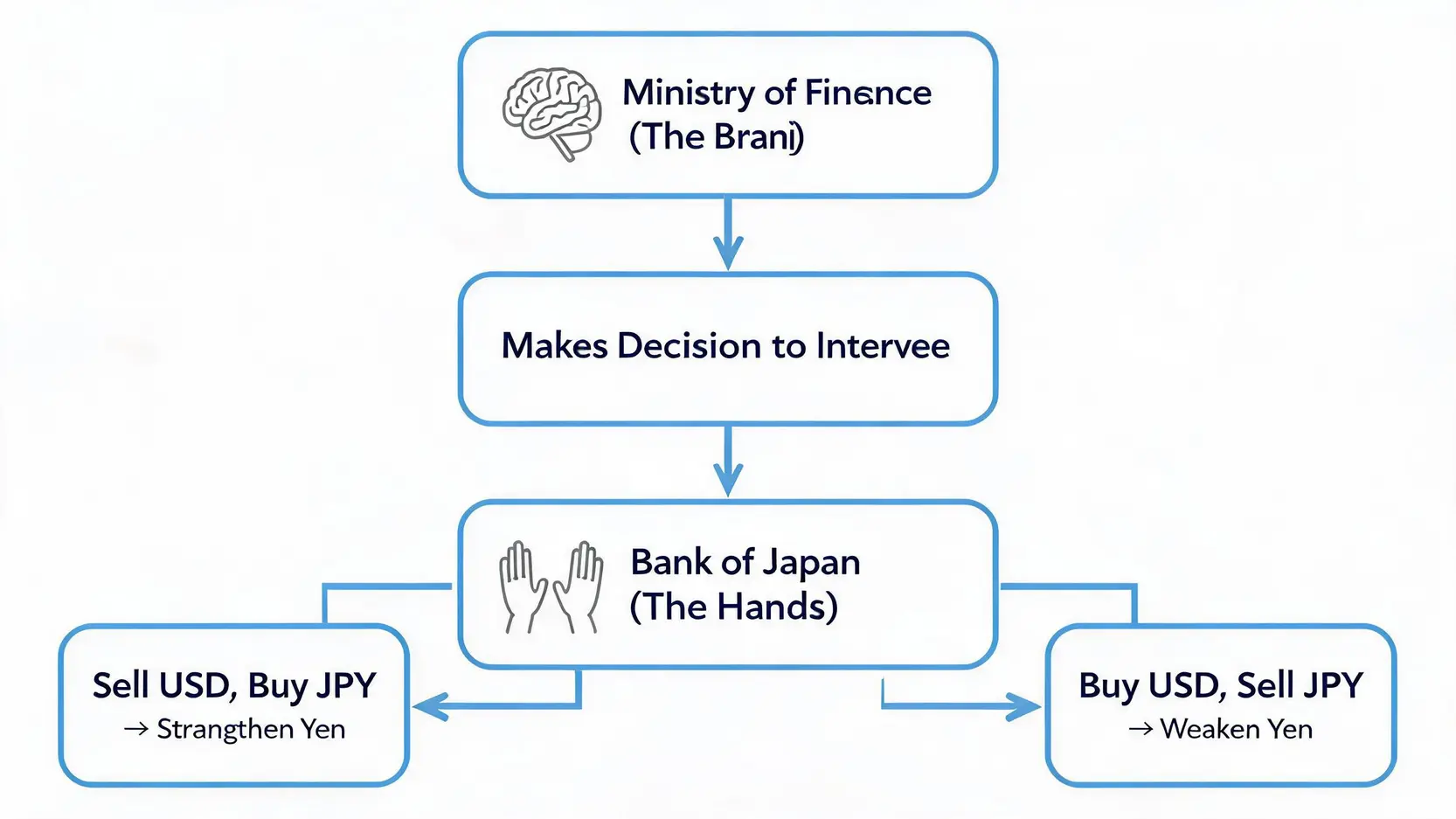
In matters related to foreign exchange intervention, the true “brain” is Japan’s Ministry of Finance (MOF). According to the “Bank of Japan Act”, the authority to decide on foreign exchange intervention rests entirely with the Finance Minister. The Ministry of Finance monitors foreign exchange markets, evaluates the impact of exchange rate movements on Japan’s economy, and ultimately issues intervention orders. Their decisions are not based solely on exchange rate levels (such as whether USD/JPY breaks above 150 or 160) but rather on the speed of exchange rate movements and overall market sentiment, especially whether excessive speculative activity exists. Historically, the market-famed “Mr. Yen” referred to the Vice Minister of Finance responsible for foreign exchange affairs. 


The Execution Arm: How the Bank of Japan Operates in the Market

Once the Ministry of Finance decides to intervene, the actual market operations are carried out by the Bank of Japan (BOJ) as the “execution arm”. The Bank of Japan uses its foreign exchange reserves to conduct large-scale currency transactions in the market. For example:

  • Supporting the Japanese Yen (Buying Yen): When the Japanese yen weakens excessively, the Bank of Japan sells US dollars and buys Japanese yen, increasing market demand for yen and pushing up its value.
  • Suppressing the Japanese Yen (Selling Yen): When the Japanese yen strengthens excessively, the central bank buys US dollars and sells Japanese yen, increasing the supply of yen and lowering its value.

Simply put, the Ministry of Finance acts as the commanding general issuing orders, while the Bank of Japan serves as the soldier fighting directly on the front lines.

日本政府干預匯市的決策與執行流程圖,顯示財務省下達指令,日本央行在市場上進行買賣操作。

Figure 1: The Decision-Making and Execution Process of Japanese Foreign Exchange Intervention


The Three Major Trigger Conditions for Japanese Yen Intervention

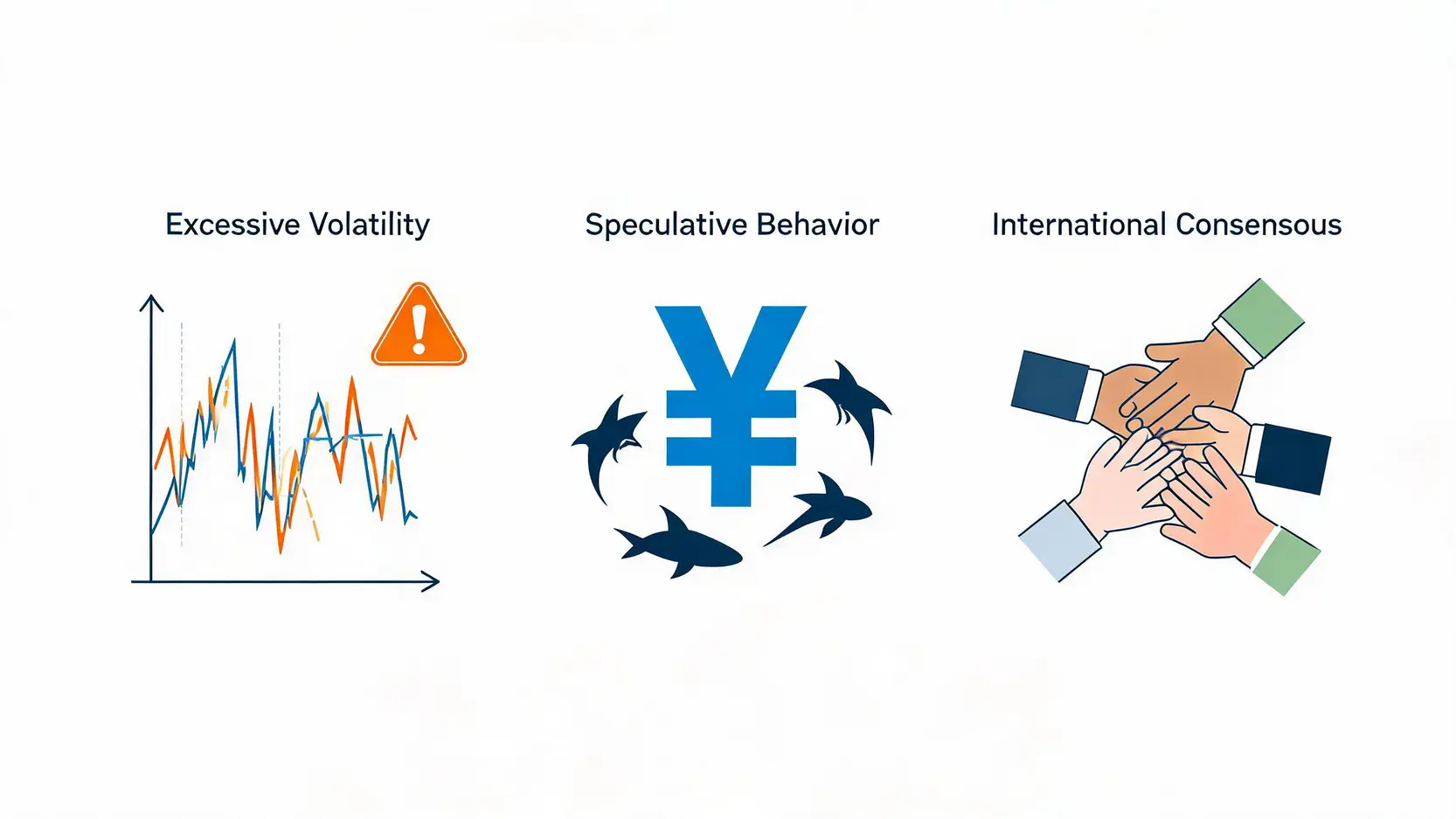
Markets fluctuate every day, but not every sharp rise or decline triggers intervention. When deciding whether to act, Japan’s Ministry of Finance generally evaluates the following three major Japanese yen intervention conditions, which are more important than exchange rate levels alone.

觸發日圓干預的三個關鍵條件示意圖:過度波動、投機行為和國際共識。

Figure 2: The Three Major Trigger Conditions for Intervention


Condition One: Excessive Exchange Rate Volatility Rather Than the Exchange Rate Level

What concerns the government most is not the “price”, but the “speed”. Even if USD/JPY reaches 160, if the move happens gradually over several weeks or months, the Ministry of Finance may still remain on the sidelines. However, if the exchange rate surges from 155 to 160 within just a few days, this kind of “excessive volatility” is highly likely to be viewed as disorderly and could trigger intervention. Their primary goal is to “stabilize the market”, not to defend a specific exchange rate level.


Condition Two: Speculative Activity Dominating the Market

When exchange rate movements become detached from economic fundamentals (such as interest rate differentials and trade data) and instead become dominated by short-term speculative forces, the likelihood of intervention increases significantly. The Ministry of Finance evaluates whether “herd behavior” or malicious speculation exists in the market. If left unchecked, such conditions could lead to spiraling exchange rate declines or surges that ultimately damage the real economy. Therefore, undermining speculator confidence and reversing one-sided market expectations are among the key objectives of intervention.


Condition Three: International Pressure and G7 Consensus

In the globalized financial market, unilateral intervention has limited effectiveness and may even draw criticism from trading partners. Therefore, before taking action, Japan usually communicates with major economies such as the G7 (Group of Seven) to at least obtain their “tacit approval”. If consensus can be reached and coordinated intervention implemented, the effects become far more powerful. However, due to differing inflation conditions and monetary policy paths among countries in recent years (such as the high-interest-rate environment in the US), achieving international consensus has become increasingly difficult. This has forced Japan to rely more frequently on “unilateral intervention”.


History of Japanese Yen Intervention: Looking Back at Three Major Events

Reviewing the history of Japanese yen intervention reveals how the Japanese government responded under different economic conditions. History is not merely a story, but also a mirror for understanding current decisions. 

1985 “Plaza Accord”: Coordinated Intervention to Reverse US Dollar Strength

This was the most famous coordinated intervention in history. To address the US trade deficit at the time, finance ministers from the G5 (consisting of the US, Japan, West Germany, France, and the UK) reached an agreement at New York’s Plaza Hotel to jointly sell US dollars. This caused a sharp depreciation of the US dollar, while the Japanese yen appreciated dramatically over the following years, indirectly contributing to the formation of Japan’s asset bubble economy.


1997-1998 Asian Financial Crisis: A Defensive Battle to Support the Japanese Yen

During the Asian Financial Crisis, market confidence in Asian economies collapsed, and the Japanese yen faced severe depreciation pressure. To prevent the crisis from spreading further, the Japanese government repeatedly coordinated with the US to intervene by purchasing Japanese yen in order to stabilize the exchange rate. This intervention was defensive in nature and aimed at restoring market confidence.


2022-2024: Recent Intervention to Address Inflation and Interest Rate Differentials

The background of recent interventions has been completely different. While Japan maintained ultra-low interest rates, the Federal Reserve aggressively raised rates to combat inflation, and the massive interest rate gap led to the continued depreciation of the yen. Since 2022, when the USD/JPY exchange rate rapidly broke through key psychological levels such as 145 and 150, Japan’s Ministry of Finance carried out several large-scale “yen-buying interventions” to slow the currency’s decline. A key feature of these operations was “stealth intervention”, where authorities only confirmed the action afterward in order to maximize the element of surprise.


The 4 Major Core Impacts of Ministry of Finance Intervention

Once the Ministry of Finance intervenes, regardless of whether the intervention succeeds, it will trigger a series of chain reactions affecting both markets and individuals. Understanding these Ministry of Finance intervention impacts can help us plan the next strategic steps. 

Short-Term and Long-Term Impact on the Japanese Yen Exchange Rate

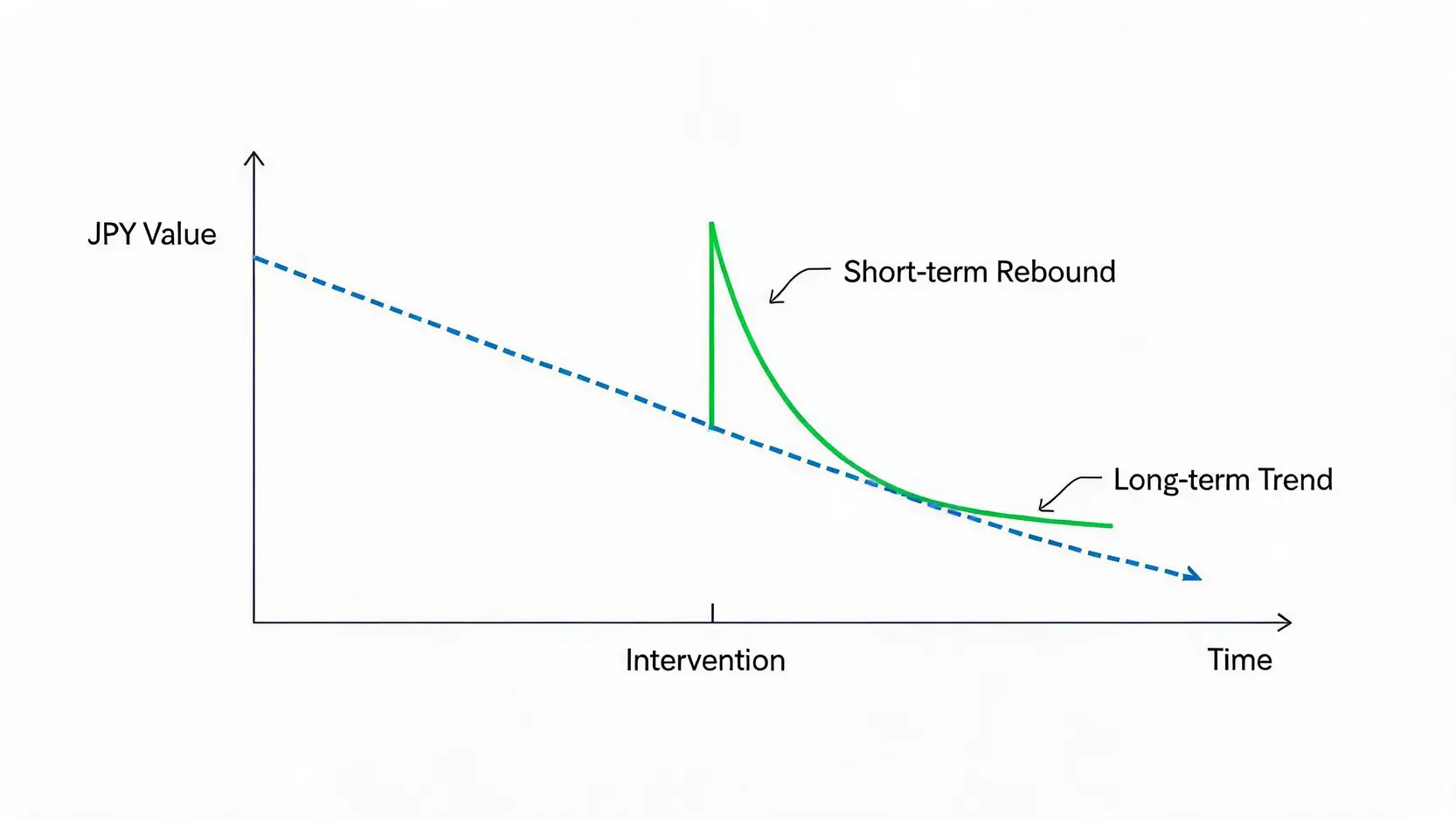
  • Short Term: Intervention can usually produce immediate effects within hours or days, causing the Japanese yen exchange rate to rebound sharply (in cases of yen-support intervention). For example, the exchange rate may quickly move from 160 back to 155 within a short period.
  • Long Term: Intervention struggles to reverse long-term trends driven by economic fundamentals (such as interest rate differentials). If Japan’s interest rate policies remain unchanged relative to other countries, the Japanese yen may gradually return to its previous depreciation trend after rebounding. Intervention acts more like “buying time with money”, providing a buffer period for economic adjustment. For deeper Japanese yen exchange rate trend analysis, you may refer to our dedicated feature article.

日圓干預對匯率的短期與長期影響示意圖,顯示干預後匯率短暫急升,但長期仍可能回歸基本面趨勢。

Figure 3: The Short-Term and Long-Term Impact of Intervention on Exchange Rates


Impact on Japan’s Imports, Exports, and Domestic Economy

Intervention aims to stabilize exchange rates, which creates both positive and negative effects on the economy. Preventing excessive Japanese yen depreciation may reduce foreign exchange profits for exporters, but it also lowers cost pressure on importers. Since Japan heavily relies on imports of energy and raw materials, such actions help suppress imported inflation and stabilize domestic living costs.


Impact on Foreign Exchange Reserve Consumption

Intervention does not come without costs. Buying Japanese yen requires selling US dollars, which directly consumes Japan’s foreign exchange reserves. As of early 2024, Japan held more than US$1.2 trillion in foreign exchange reserves, ranking among the highest in the world. Although Japan possesses substantial financial firepower, these reserves are not unlimited. Continuous large-scale intervention would weaken Japan’s ability to respond to future financial crises.


Implications and Strategies for Investors and Travelers

  • For Investors: Intervention means market volatility may increase sharply. For investors engaged in forex margin trading, this creates both opportunities and risks. Investors should avoid blindly chasing prices higher or panic selling when intervention rumors are strongest, and proper stop-loss management is essential.
  • For Travelers and Currency Exchangers: Sharp Japanese yen appreciation caused by intervention can create excellent currency exchange opportunities. If you plan to travel or study in Japan, you may monitor market developments and gradually purchase Japanese yen after intervention occurs and the exchange rate rebounds, helping lock in relatively favorable exchange costs.


Frequently Asked Questions About Japanese Government Foreign Exchange Market Intervention (FAQ)

Q: Is Japanese Government Foreign Exchange Market Intervention Always Effective?

A: Not necessarily. The effectiveness of intervention depends on multiple factors, including the scale and timing of the intervention, whether it is conducted as “stealth intervention”, and whether support is received from other countries (especially the US). If unilateral intervention goes against the broader market trend, it usually only produces short-term effects and struggles to reverse long-term trends.

Q: Will the Ministry of Finance Give Advance Warning Before Intervention?

A: Almost never. To maximize market impact, intervention is usually carried out as a surprise operation. However, before intervention occurs, Ministry of Finance officials tend to increase the frequency of “verbal intervention”, such as stating that they are “closely monitoring the market” or “not ruling out any options”, in order to warn market speculators. When these types of statements become increasingly frequent, investors should remain highly alert.

Q: Where Does the Funding for Foreign Exchange Intervention Come From?

A: The funding mainly comes from the Japanese government’s “foreign exchange reserves”, which are managed under the Foreign Exchange Fund Special Account. These reserves primarily consist of US dollar assets (such as US Treasury bonds). During intervention, the Bank of Japan acts on behalf of the Ministry of Finance by using these assets to conduct market operations.

Q: How Should Individual Investors Respond to Japanese Yen Intervention Risk?

A: First, investors must recognize that intervention can trigger extreme volatility, and therefore avoid taking oversized positions when market sentiment becomes overly emotional. Second, setting clear stop-loss and take-profit levels is essential for protection. Finally, investors should pay close attention to statements from Ministry of Finance officials. When warnings escalate, it may be wise to reduce leverage or temporarily stay on the sidelines.


Conclusion

In summary, Japanese government foreign exchange market intervention is an unconventional policy tool aimed at stabilizing the economy and combating speculative activity. Decisions are made by the Ministry of Finance based on factors such as exchange rate volatility speed, market sentiment, and international cooperation, while execution is carried out by the Bank of Japan. Although intervention can strongly influence Japanese yen trends in the short term, its long-term effectiveness ultimately remains constrained by differences in economic fundamentals and interest rate policies between Japan and the rest of the world. For both investors and the general public, understanding the mechanisms, conditions, and history of intervention not only helps interpret the meaning behind financial news, but also enables calmer and wiser decision-making amid future market turbulence.

编者
Evan Lin

Evan Lin

我是Evan Lin,从大学时期开始接触外汇交易,至今已有多年实战经验,熟悉技术分析与EA策略,热衷于研究市场脉动与风险管控,喜欢分享实战经验和交易技巧,和大家一起学习、一起进步!

If you liked this article, please share it!

Related Articles

  • Trading Drawdown Recovery: Psychological Adjustment Guide
    The Taiwan Dollar Surges Past 31.5! With Hot Money and Foreign Capital Inflows, Is This an Opportunity or a Risk? An In-Depth Analysis The Capital Frenzy: The Three Major Drivers Behind the Taiwan Dollar Breaking Above 31.5 The New Taiwan dollar has recently become the absolute focal point of the...
    2026 年 6 月 10 日
  • Taiwan Dollar Surge: Stocks, Bonds, or USD?
    Taiwan Dollar Appreciation and Hot Money Inflows! An Investor's Action Guide: Should You Buy Stocks, Bonds, or Exchange for US Dollars at This Stage? One of the hottest topics in the market recently has been the capital-driven rally fueled by foreign investors' consecutive net buying of Taiwan stocks, pushing the...
    2026 年 6 月 10 日
  • Hot Money Flows Into Taiwan Bonds: What It Means
    Hot Money Flows Into Taiwan's Bond Market: Understanding the Causes, Impact, and Investor Response Strategies in One Article One of the hottest topics in the market recently is "hot money flowing into Taiwan's bond market". Why have these fast-moving international funds, which come and go like the wind, chosen the...
    2026 年 6 月 10 日
返回顶部