A key Asia-Pacific network hub enabling ultra-low latency access to global financial centers.
Stable Financial Infrastructure and Regulatory Environment
As an international financial center, Hong Kong offers a mature financial system, strong legal framework, and reliable power infrastructure. Hosting trading VPS in Hong Kong not only provides network speed advantages but also ensures system stability and security, which is critical for 24/7 automated trading systems.
Further Reading (Highly Recommended)
【CFD Platform Lowest Spread】2026 Hong Kong Top 5 Forex Platforms Spread Comparison
MT5 Forex Trading Ultimate Guide: Platform Recommendations, Analysis Techniques, and Practical Strategies
Top 3 Hong Kong VPS Trading Hosting Providers in 2026
Choosing a high-quality VPS provider is the foundation of achieving cloud-based low-latency trading optimization. Below are three top Hong Kong VPS providers selected based on network latency, hardware performance, system stability, and customer support.
| Provider |
Core Advantages |
CPU Performance |
Storage |
Network Route |
Target Users |
| SpeedyNode VPS |
Extreme ultra-low latency, designed specifically for HFT |
High clock speed (4.5GHz+) |
NVMe SSD |
CN2 GIA + international dedicated lines |
High-frequency traders and professional investors with extreme speed requirements |
| EquinixConnect HK |
Top-tier stability and security |
Enterprise-grade Intel Xeon |
RAID 10 NVMe SSD |
Multi-line BGP with redundant backup |
Institutional users seeking 99.99% uptime stability |
| QuantumTrade Servers |
High cost-performance ratio with flexible plans |
Mainstream multi-core (3.5GHz+) |
NVMe SSD |
Optimized Mainland China and international routing |
Multi-account managers and beginners in algorithmic trading |
Provider 1: SpeedyNode VPS – The Ultimate Low-Latency Choice
SpeedyNode VPS focuses on delivering extreme performance for financial trading. Its key advantage lies in ultra-high clock speed CPUs, which are critical for trading platforms that rely heavily on single-thread performance (such as MT4). Combined with premium CN2 GIA and international dedicated lines, it ensures minimal ping latency to major global exchanges.
Provider 2: EquinixConnect HK – Stability and Cost Efficiency Combined
Backed by Equinix, the world’s largest data center provider, EquinixConnect HK offers unparalleled stability and security. Although its CPU clock speed is not the highest, its enterprise-grade hardware and network redundancy ensure 24/7 uninterrupted trading system uptime. This makes it the most reliable choice for traders managing large capital and requiring zero downtime risk.
Provider 3: QuantumTrade Servers – Ideal for Multi-Account Management
QuantumTrade Servers strikes an excellent balance between performance and cost. It offers flexible configuration options, allowing users to customize CPU cores, memory, and bandwidth according to their needs. This makes it particularly suitable for users running multiple trading accounts simultaneously or testing different trading strategies.
5 Practical Methods to Reduce Trading Network Latency
Choosing the right VPS is only the first step. Fine-tuning your setup is equally important. The following five practical methods can help you minimize trading latency.
Method 1: Hardware Optimization – Choosing the Right CPU and SSD Configuration
Hardware is the foundation. When selecting VPS specifications, core count is not the only factor. Many trading platforms are more sensitive to single-core performance (high clock speed) than multi-core processing. Therefore, prioritize CPUs with clock speeds above 3.5GHz. In addition, NVMe SSD storage should be preferred, as it significantly outperforms traditional SATA SSDs in read/write speed, reducing both data processing and strategy backtesting time.
Method 2: Network Route Optimization – Selecting Dedicated or Low-Latency Network Nodes
The network path between your VPS and the trading server directly determines latency. High-quality VPS providers offer optimized routing solutions such as CN2 GIA, which significantly reduces latency when connecting to servers in Mainland China. When selecting a provider, prioritize those offering BGP multi-line routing or financial-grade dedicated network access.
Method 3: Software and System Tuning – Optimizing OS and Trading Platform Settings (MT4/MT5)
System-level optimization can also deliver meaningful improvements. For example, disabling unnecessary system services and adjusting kernel-level network parameters (such as the TCP/IP stack) can reduce internal processing delay. For platforms like MT4/MT5, disabling non-essential chart indicators, turning off news feeds, and minimizing log recording can reduce client-side load and improve responsiveness. For more optimization techniques, refer to the MT5 Forex Trading Ultimate Guide.
Method 4: Geographic Location Selection – Deploying Servers Closest to Exchanges
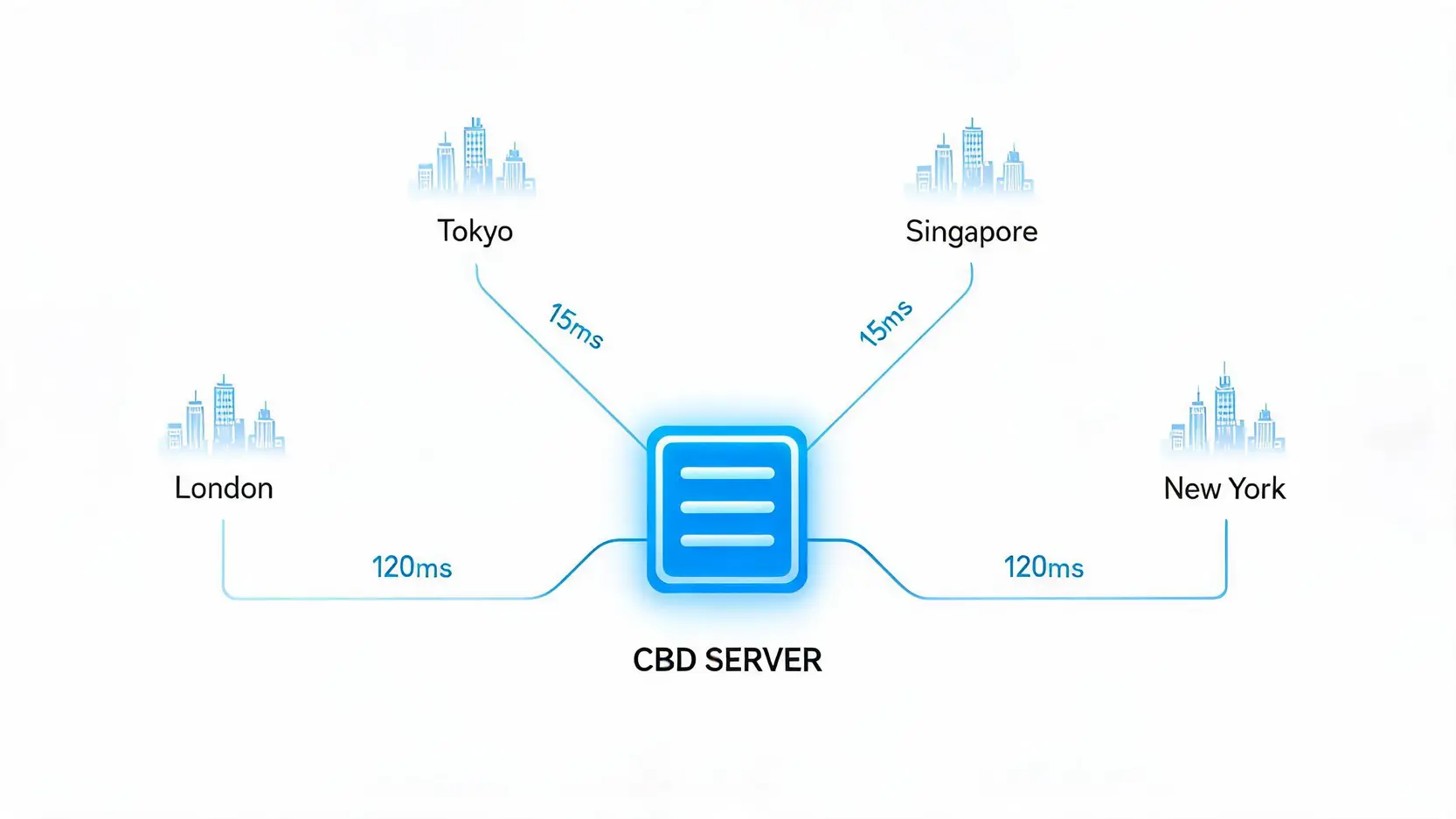
This is one of the most fundamental principles. Physical distance is an unavoidable constraint, as even the speed of light has limits. Your VPS data center should be as close as possible to your target exchange servers. For example, if you primarily trade CME (Chicago Mercantile Exchange) products, hosting your VPS in Chicago or New York will offer better latency than Hong Kong. Always place your server as close as possible to the “money flow” source.
Method 5: Continuous Monitoring and Testing – Using Ping and Traceroute Tools
Network conditions are not static. You should regularly monitor VPS network performance using diagnostic tools.
- Ping: Measures round-trip time (RTT), which represents latency. A stable and low ping value is the foundation of low-latency trading.
- Traceroute: This tool displays every network node (router) that data packets pass through from your VPS to the target server. With Traceroute, you can identify where latency occurs, whether it is an issue with the VPS provider or with intermediate network carriers.
Regular testing and result tracking are essential. Once you detect an abnormal increase in latency, you should immediately contact your VPS provider for a solution.
Conclusion
In summary, to achieve cloud-based low-latency trading optimization, selecting a high-performance VPS trading host located in Hong Kong is the first critical step. This requires a comprehensive evaluation of geographic location, hardware specifications, and network quality. However, the real advantage comes from continuous optimization and fine-tuning. By combining the five key methods outlined in this article, from hardware selection and network path optimization to software tuning and ongoing monitoring, you can significantly improve execution speed and system stability, allowing you to capture opportunities within milliseconds. Choose the VPS solution that best fits your needs based on our recommendations and start your low-latency trading journey.
FAQ (Frequently Asked Questions)
What is a trading VPS? How is it different from a normal VPS?
A trading VPS (Virtual Private Server) is a virtual server specifically optimized for financial trading. Compared with a standard VPS, it typically features: 1. Higher-performance hardware: High clock speed CPUs and NVMe SSD storage to ensure faster computation and data processing. 2. Optimized network routes: Low-latency connections located close to major exchange data centers. 3. Higher stability: Near 100% uptime guarantees with backup power systems to ensure uninterrupted trading operations.
What is the most important specification when choosing a Hong Kong VPS host?
The three most important specifications, in order of priority, are: network latency > CPU single-core performance > storage speed. First, use tools like ping and traceroute to test the actual latency between the VPS and your target exchange, as this is the most critical factor. Second, choose a high clock speed CPU (measured in GHz), as most trading platforms are more sensitive to single-thread performance. Finally, ensure the VPS uses NVMe SSD storage for faster system and application responsiveness. RAM only needs to be sufficient to run your trading platform and strategies; in most cases, 4GB is already more than adequate.
How can I test the network latency between my VPS and the exchange?
The most direct method is to use the Ping command. First, obtain the server IP address or domain name of your target exchange (usually provided by your broker). Then log in to your VPS and open the Command Prompt (Windows) or Terminal (Linux), and enter: ping [exchange server IP or domain]. Check the time=xx ms value in the results, which represents latency. For more accurate results, perform multiple tests and calculate the average. If you want to identify where latency occurs, use the tracert command (Windows) or traceroute command (Linux).
Do I need high network bandwidth for my trading VPS?
Usually not. Trading data (such as order execution and price feeds) consumes very little bandwidth. A 10Mbps connection is more than sufficient for most traders. The key factors are low latency and stable connectivity (no packet loss), rather than high bandwidth. Unless you frequently transfer large historical datasets or run other high-traffic applications, there is no need to pay extra for higher bandwidth tiers.