Futures Margin Risk: What to Do After a Margin Call

Updated: 2026/03/31  |  CashbackIsland

futures-margin-risk-guide

Futures Margin Risk Explained: What to Do When You Receive a Margin Call Notice? Understand the Serious Consequences of Insufficient Margin

When engaging in futures trading, the appeal of leverage lies in the ability to achieve large returns with a small capital base. However, behind this potential also lies significant futures margin risk. One of the most feared scenarios for many investors is suddenly receiving a “margin call notice”, or even ultimately facing the nightmare of “forced liquidation” (commonly known as a blow-up). Without understanding the rules of the game, hard-earned assets may disappear in a short period of time. This article will break down the mechanics of futures margin in a clear and accessible way, from basic concepts to response strategies, helping you fully understand the seriousness of insufficient margin consequences and learn how to effectively manage positions, protect your investment capital, and avoid total loss. 


Lesson 1: What Exactly Is Futures Margin?

Before exploring the risks in depth, it is essential to establish a solid foundation. Futures margin is not a “fee” for trading futures, but rather functions more like a “deposit” or “performance bond”. Its purpose is to ensure that both parties in a trade have sufficient funds to cover potential losses from market fluctuations, thereby maintaining market stability. Margin is mainly divided into two types:


Initial Margin vs Maintenance Margin: The Minimum Thresholds for Opening and Holding Positions

These two terms are central to understanding futures margin risk, as they represent the capital thresholds for opening and maintaining positions respectively.

Item Definition and Function Key Characteristics
Initial Margin The minimum amount of funds that must be in the account when opening a new futures position (long or short). Think of it as an “entry ticket”, without this amount you cannot start trading.
Maintenance Margin The minimum level of account equity that must be maintained while holding a position (usually 75%-80% of the initial margin). Acts as a “buffer zone”, if account equity falls below this level, it will trigger an alert.

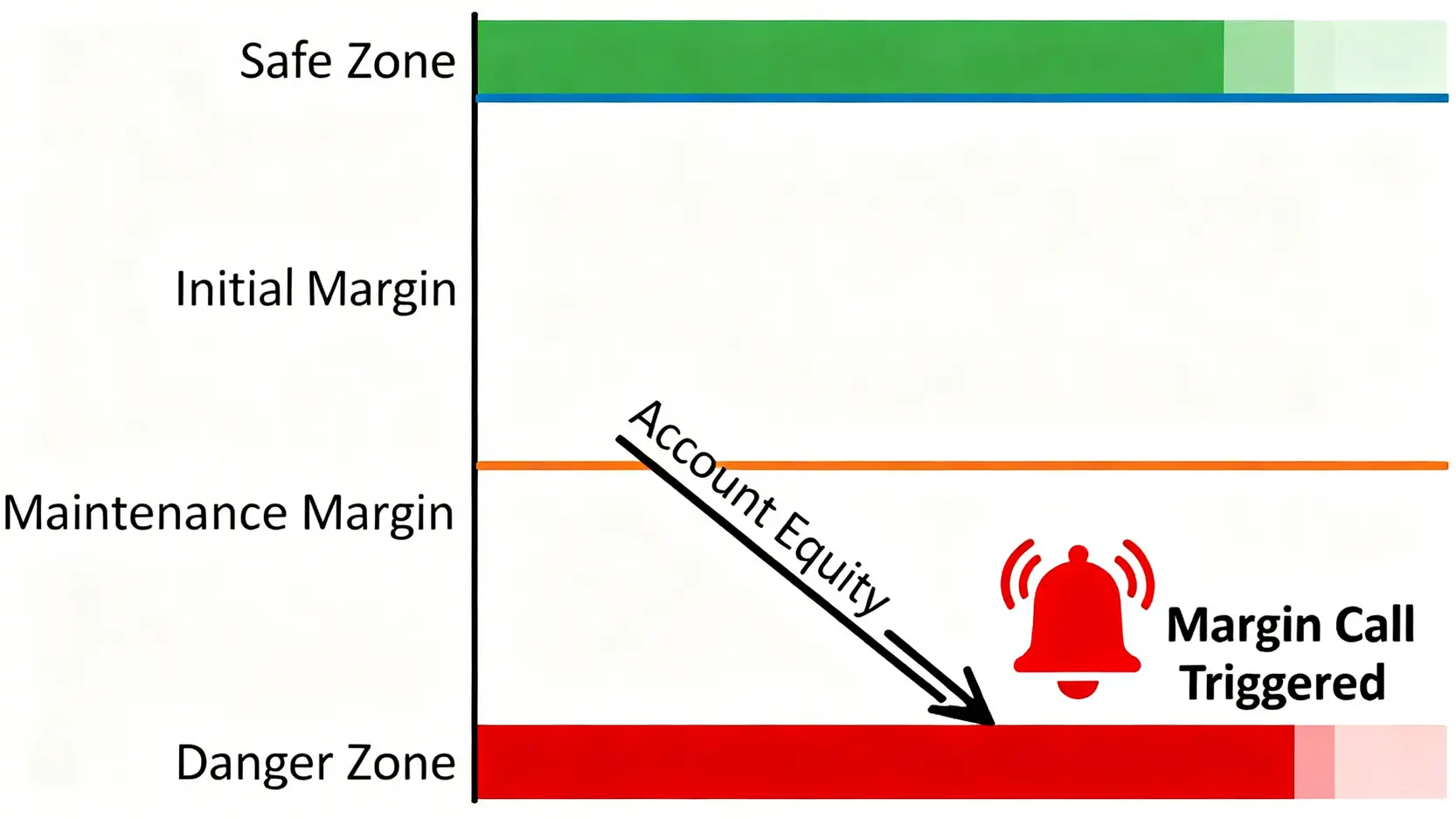
For example, suppose the initial margin for one mini Hang Seng Index futures contract is HKD 25,000, and the maintenance margin is HKD 20,000. This means you need at least HKD 25,000 to open a position, and during the holding period, your account equity must not fall below HKD 20,000. Once the market moves against you and causes your account equity to drop below this level, the alarm will be triggered.

一張圖表解釋期貨原始保證金與維持保證金的關係,顯示帳戶權益低於維持保證金時觸發追繳通知。

Relationship Between Account Equity and Margin Level Diagram


How to Calculate the Margin Maintenance Ratio? Safeguard Your Risk Threshold

The margin maintenance ratio is the most direct indicator of your account risk. It tells you how far your current account equity is from the required maintenance margin. The formula is straightforward:

Margin Maintenance Ratio = (Account Equity / Maintenance Margin Required for Open Positions) x 100%

Generally, brokers will set a risk threshold. For example, when the maintenance ratio falls below 100%, a “margin call notice” will be triggered. Some platforms may issue warnings earlier at 150% or 120%. Monitoring this ratio at all times is the first line of defense in managing futures margin risk.


Further Reading (Highly Recommended)

US Stock Futures Tutorial: 5 Steps to Get Started With Dow/Nasdaq Futures Trading Strategies (2026 Handy Guide)

2026 US Stock CFD Trading Complete Guide: Platform Comparison, Pros and Cons, and Beginner Tutorial!


Alarm Triggered: When You Receive a Margin Call Notice

A “margin call notice” is one of the last messages any trader wants to receive. This notice, issued by the futures broker, formally informs you that your account funds have fallen below the required maintenance margin level and are at risk. At this point, you must take immediate action to resolve the situation.


Why Do You Receive a Margin Call? A Comprehensive Breakdown of Trigger Conditions

The only reason a margin call is triggered is that your account equity has declined due to unfavorable market price movements, causing losses to expand and eventually fall below the maintenance margin threshold. Continuing the previous example, when your account equity drops from HKD 25,000 to HKD 19,999 due to losses, it falls below the HKD 20,000 maintenance margin requirement, and a margin call will be triggered. 

How Much Time Do You Have to Respond After Receiving the Notice? Critical Response Window

The response window is extremely tight! Typically, the futures broker will require you to top up your account funds to the “initial margin” level by the next trading day before market open, not merely back to the maintenance margin level. If no action is taken within the deadline, the broker has the authority to intervene and execute forced liquidation. 

Three Response Strategies: Deposit Funds, Reduce Positions, or Strategically Close Positions

When receiving a margin call, do not panic. After calmly assessing the current market conditions and your own situation, you have the following three main response options:

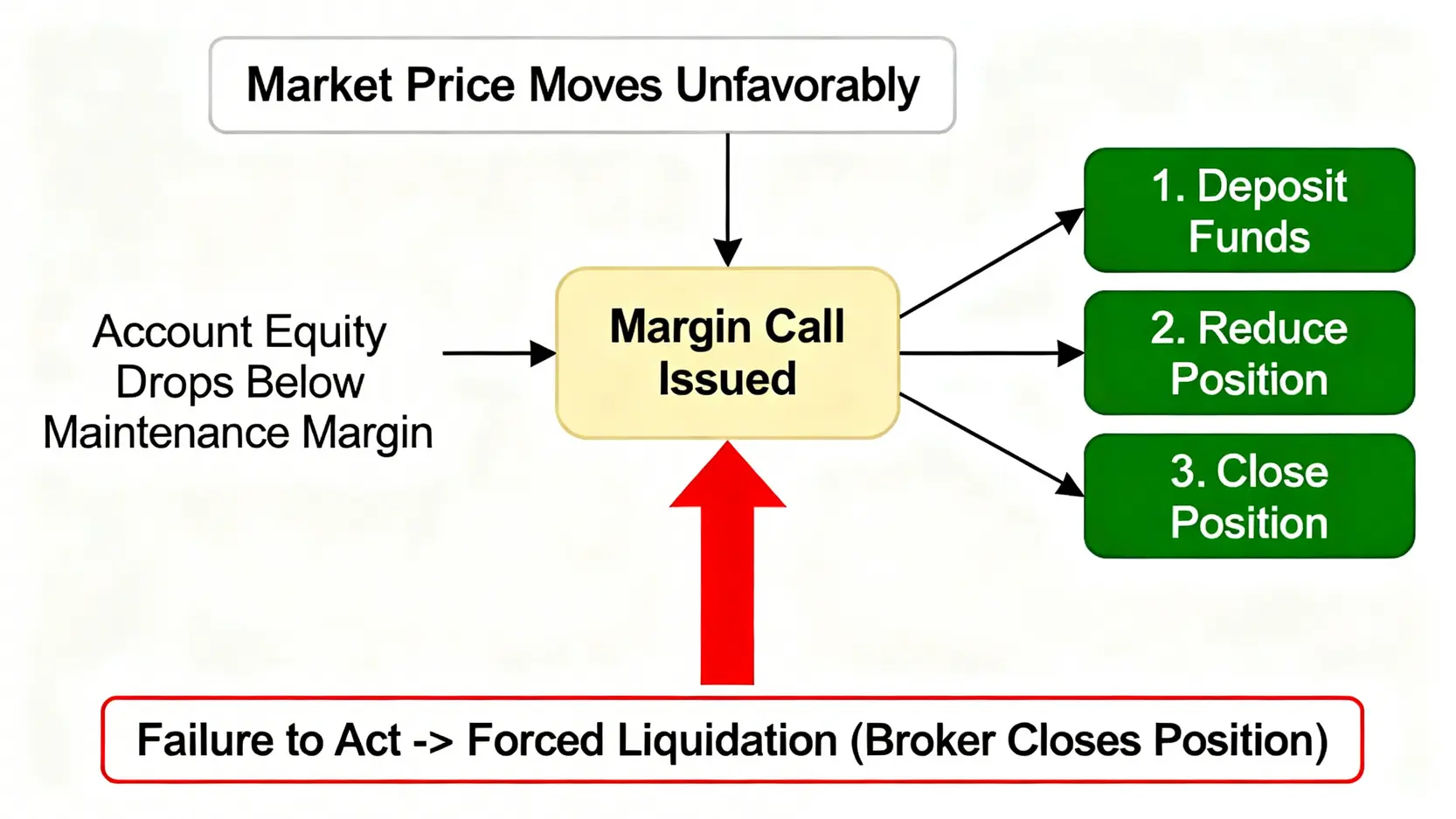
  1. Deposit sufficient funds (funding): This is the most direct method. If you still have confidence in the market outlook and have additional funds available, you can immediately deposit money into your trading account to restore your equity above the initial margin level and remove the alert.
  2. Reduce part of your positions (partial liquidation): If you do not want to inject more funds or wish to reduce risk exposure, you can close part of your futures contracts. This will immediately lower the total required maintenance margin and improve your margin maintenance ratio.
  3. Close all positions (strategic Liquidation): If, after evaluation, you believe the market trend has reversed and continuing to hold positions will only increase losses, decisively closing positions to cut losses is a wise decision. Although this means realizing losses, it helps avoid worse outcomes.


Worst-Case Scenario: The Serious Consequences of Insufficient Margin

If you ignore the margin call notice, or if market volatility is too extreme for you to respond in time, you will face the most severe consequence, forced liquidation, which is the most serious outcome of insufficient margin.

一張流程圖說明收到追繳保證金通知後,從應對策略到可能面臨強制平倉的完整過程。

Margin Call Handling Process Diagram


What Is a Blow-Up? How Futures Brokers Execute Forced Liquidation

“Blow-up” or “forced liquidation” refers to the futures broker forcibly closing your open positions at market price without your consent, in order to protect itself and other market participants. The purpose is to prevent your account losses from expanding further and avoid liabilities exceeding your account balance. This is typically executed when your margin maintenance ratio falls to a critically low level (for example below 50%) or when you fail to meet the margin requirement within the specified timeframe.


After Forced Liquidation, Will All My Funds Be Wiped Out? Analysis of Excess Loss Risk

This is the most common concern. The answer is: Not only can your balance be wiped out, it may even become negative!

If the market experiences extreme gap movements (for example, the opening price is far lower than the previous closing price), the execution price of forced liquidation may be highly unfavorable, resulting in total losses exceeding all the funds in your account. This situation is referred to as “negative balance” or “margin deficit”. Once it occurs, you will not only lose all your principal but also owe the futures broker additional funds, which must be repaid. This is the most severe risk brought by leverage in futures trading.


How to Effectively Manage Futures Margin Risk? 4 Practical Risk Management Strategies

After understanding the consequences of insufficient margin, it is crucial to learn how to proactively manage risk. The following four practical strategies can help you avoid margin calls and forced liquidation scenarios.


Strategy 1: Do Not Allocate All Funds to the Margin Account

A common mistake among beginners is depositing all available trading funds into the futures account at once. A more prudent approach is to allocate only two to three times the required margin for opening positions, while keeping the remaining funds in a bank account as reserves. The benefits include:

  • Providing a buffer: When the market temporarily pulls back, you will have sufficient reserve funds to handle margin calls without being forced to close positions at unfavorable prices.
  • Maintaining discipline: Avoid letting large fluctuations in account equity affect your judgment and lead to emotional trading decisions.


Strategy 2: Use Stop-Loss Orders to Control Potential Losses

Before opening any position, you should set a stop-loss level. A stop-loss order is a preset instruction that automatically closes your position when the market reaches your defined loss threshold. It acts like insurance for your trades, keeping losses within a manageable range and preventing a single misjudgment from causing catastrophic losses. To learn more about risk management tools, you can refer to the “2026 US Stock CFD Trading Complete Guide”. 

Strategy 3: Regularly Monitor Positions and Margin Levels

The futures market changes rapidly, so you must never adopt a “buy and forget” mindset. You should develop the habit of checking your positions and margin maintenance ratio daily, or even hourly during periods of high volatility. Many trading platforms offer price alerts and margin level warnings. Utilizing these tools allows you to stay informed of risk conditions in real time.


Strategy 4: Use Appropriate Leverage Levels

Leverage is a double-edged sword. Over-leveraging is a major cause of account blow-ups. Do not maximize your position size simply because high leverage is available. Instead, choose a leverage level that aligns with your risk tolerance and trading strategy. Generally, beginners should start with lower leverage and gradually adjust as they gain experience.


Common Questions About Futures Margin Risk (FAQ)

Q: What happens if you ignore a margin call notice?

A: If you ignore a margin call notice and fail to take any action within the timeframe specified by the futures broker (such as depositing funds or reducing positions), the broker has the right to execute forced liquidation on your positions without further notice in order to control risk. At that point, your losses will be realized, and the liquidation price is usually unfavorable to you.

Q: How is the forced liquidation price determined?

A: Forced liquidation is typically executed using a “market order”, meaning positions are closed at the best available price in the market at that time. In extreme market conditions with low liquidity or price gaps, the execution price may deviate significantly from your expectations, resulting in substantial losses or even excess losses.

Q: How much funds should be in my account to be considered safe?

A: There is no absolute standard, but a common rule of thumb is that the funds in your account should be at least two to three times the total “initial margin” required for all your positions. For example, if your total initial margin requirement is USD 50,000, your account should ideally hold USD 100,000 to 150,000. This keeps your margin maintenance ratio at a very healthy level and helps withstand larger market fluctuations.

Q: Are margin requirements the same for all futures products?

A: No. Margin requirements vary depending on the underlying asset’s price, volatility, and market liquidity. For example, crude oil futures, which are more volatile, typically have higher margin requirements than less volatile bond futures. Exchanges regularly review and adjust margin levels, and you can find the latest information on the official websites of major exchanges, such as the Hong Kong Exchanges and Clearing (HKEX) margin tables

Conclusion

In summary, futures margin is a core tool for managing leverage risk, not something to fear. A deep understanding of how initial margin and maintenance margin work, along with continuous monitoring of the margin maintenance ratio, is essential for every futures investor to safeguard capital. When facing a margin call, avoid panic. Instead, calmly assess market conditions and choose the most appropriate response strategy, whether depositing funds, reducing positions, or closing positions. By applying the four risk management strategies outlined in this article, maintaining reserve funds, using stop-loss orders, regularly monitoring positions, and using appropriate leverage, you can participate in the futures market with greater stability and confidence, effectively avoiding the catastrophic consequences of insufficient margin. Now is the time to review your positions and implement a safer trading plan.

If you liked this article, please share it!

Related Articles

  • Volatility Surface Guide: Skew Trading Strategies
    Practical Applications of Volatility Surfaces: From Options Modeling to Advanced Skew Trading Strategies In options markets, implied volatility is never a flat line. Instead, it forms complex "smile" or "skew" surfaces. For advanced traders, mastering the practical applications of volatility surfaces is equivalent to possessing a lens that reveals market...
    2026 年 6 月 3 日
  • Foreign Capital Flow Model: Track Institutional Money
    Building a Foreign Capital Flow Copy Trading Model: A Stock Market Indicator for Accurately Tracking Institutional Positioning In Asia-Pacific stock markets, foreign capital inflows and outflows often determine the direction of the index. However, simply looking at daily net buy and sell data is no longer enough. Only by building...
    2026 年 6 月 3 日
  • Options Buying Strategies for Extreme Market Risks
    Options Buyer Strategies During Extreme Market Conditions: Black Swan Hedging and Cross-Market Arbitrage During Volatility Surges The most terrifying aspect of financial markets is not a gradual decline, but overnight flash crashes and cross-market capital withdrawals accompanied by volatility surges. In the highly unpredictable global macroeconomic environment of 2026, geopolitical...
    2026 年 6 月 3 日
返回顶部