Is Crypto Mining Legal in Hong Kong? 2026 Guide

Is Cryptocurrency Mining Legal in Hong Kong? A Complete Guide to the 2026 Legal Framework, Licensing, and Tax Reporting Requirements
Want to join the cryptocurrency mining boom but worried whether mining in Hong Kong is legal? Faced with unclear legal boundaries and complex tax issues, many people feel confused. In particular, the legal rules surrounding cryptocurrency mining, as well as how mining income should handle mining tax reporting responsibilities in Hong Kong, are the issues miners care about most. This article provides a one stop guide, from Hong Kong cryptocurrency mining laws and SFC regulation to the specific requirements for mining tax reporting, offering a comprehensive explanation of your rights and obligations so you can mine in Hong Kong with confidence.
Is Mining Legal in Hong Kong? The Key Lies in Scale and Intent
Many people’s first question is: “Is mining in Hong Kong illegal?” The answer is not a simple “yes” or “no”, but depends on your mining scale, intent, and operating model. The Hong Kong legal system approaches this emerging field primarily through the framework of existing commercial and financial regulations rather than introducing a standalone law to prohibit it.
Personal Hobby vs. Commercial Operation: How Does the Law Define It?
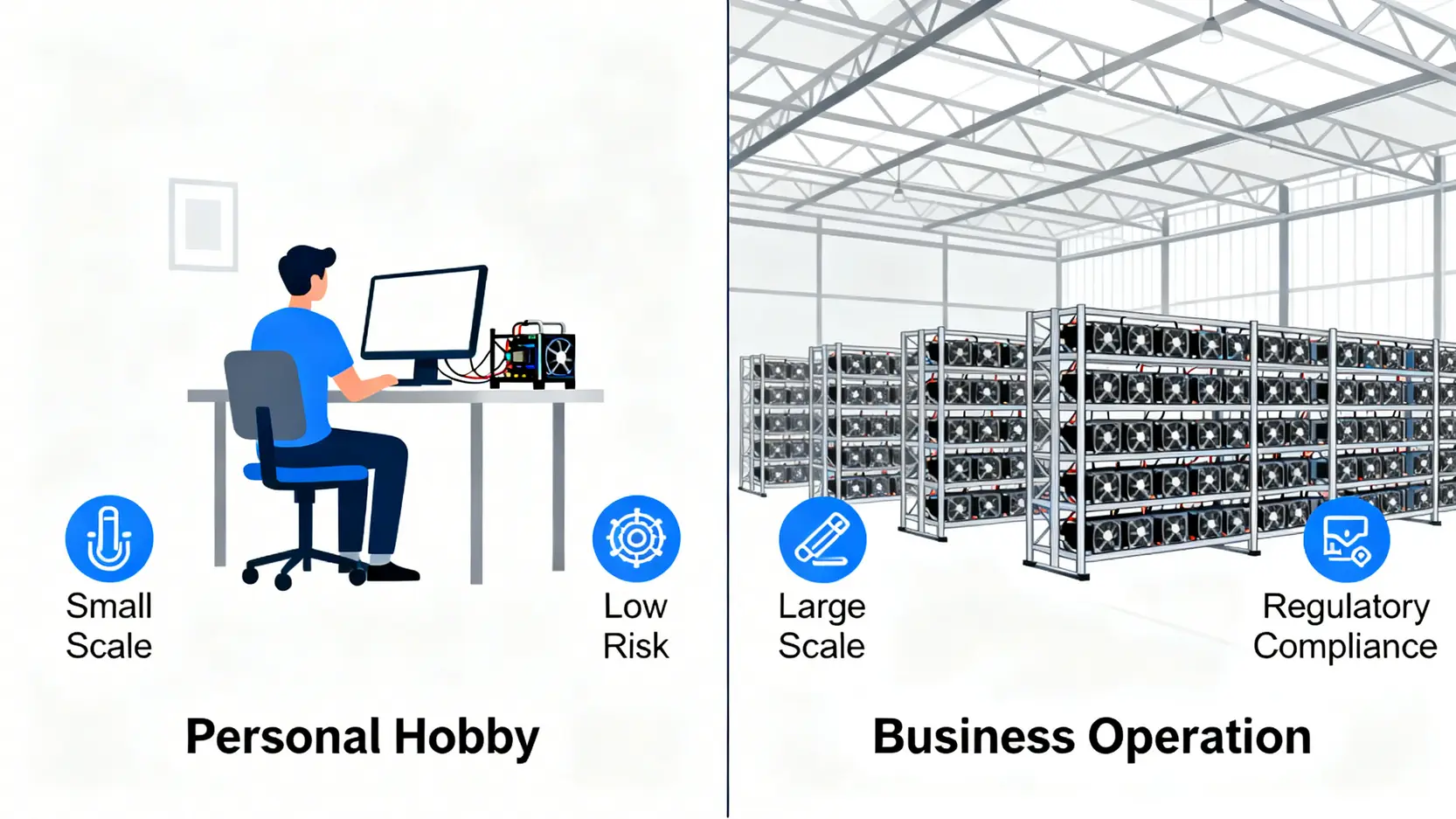
The biggest legal dividing line is whether your mining activity is considered a “personal hobby” or a “commercial operation”.
- Personal hobbyists: If you are simply using your own personal computer or a small number of dedicated mining machines (for example one or two units) to conduct small-scale mining at home, it is usually regarded as a personal interest or hobby. In this situation, the legal risk is extremely low.
- Commercial operators: However, if you rent industrial units, systematically deploy a large number of mining machines, invest substantial capital, and have a clear profit making purpose, or even hire staff for maintenance, it is very likely to be classified as “carrying on a business”. Once it is regarded as a business, you must comply with more commercial regulations.

Key Legal Distinction: Personal Hobby vs. Commercial Operation
Under Hong Kong’s existing laws, there is no explicit prohibition on individuals conducting cryptocurrency mining
First, a reassuring fact: as of now, no Hong Kong law explicitly states that “individuals are prohibited from conducting cryptocurrency mining”. It is similar to playing games at home to earn virtual items. As long as you do not affect others and properly manage related safety issues, the government generally does not interfere with personal level mining activities.
When Will It Be Considered “Carrying on a Business” and Be Regulated Under the “Anti Money Laundering Ordinance”?
When your mining scale expands to the commercial level, you need to pay special attention to the “Anti Money Laundering and Counter Terrorist Financing Ordinance” (AMLO). If your business involves providing virtual asset services, such as mining on behalf of clients, operating a mining pool, or converting mined cryptocurrencies into fiat currency on a large scale as an exchange service, you may need to apply for a license from the Securities and Futures Commission (SFC) and comply with related customer due diligence (KYC) and anti money laundering (AML) requirements.
Further Reading (Highly Recommended)
How to Buy Bitcoin in Hong Kong: 2026 Beginner’s Guide to Deposits, Trading, and Secure Storage!
2026 Hong Kong Cryptocurrency Beginner’s Guide: From Zero to Safely Entering the Virtual Asset World!
Cryptocurrency Mining Laws and Compliance Requirements You Must Understand
Even for personal mining, it does not mean regulations can be completely ignored. There are certain potential legal risks that all miners should pay attention to, particularly regarding electricity usage, premises, and noise issues.
Electricity Usage and Premises Safety: Potential Legal Risks and Key Considerations
Mining is an extremely electricity intensive activity, and mining machines operating 24/7 generate significant heat. You need to pay attention to the following aspects:
- Power load: Ensure that your electrical system can handle the high load from mining machines to avoid short circuits or fires caused by electrical overload. Unauthorized modification of electrical installations may violate the “Electricity Ordinance”.
- Fire safety: Mining conducted in residential or industrial premises must comply with the “Fire Service (Installations and Equipment) Regulations”. The site must have proper ventilation and heat dissipation, and be equipped with appropriate fire safety equipment.
- Tenancy agreements: If you are renting a unit, you should check whether the lease restricts high power consumption equipment or the use of the unit for business purposes. Many industrial building leases explicitly prohibit high electricity consumption activities such as data centers.
Noise Control Ordinance: How to Avoid Violations Caused by Mining Equipment?
The cooling fans of mining machines produce continuous noise, especially noticeable during quiet nights. Under Hong Kong law Chapter 400 “Noise Control Ordinance”, any noise that disturbs others during nighttime hours (11 PM to 7 AM the next day) or on public holidays may constitute an offense. If neighbors file complaints, the Environmental Protection Department has the authority to investigate and require improvements, and may even initiate prosecution.
The Importance of Choosing Compliant Mining Pools or Cloud Mining Services
For those who do not want to handle hardware and site issues themselves, joining a mining pool or using cloud mining services is a popular option. However, when choosing a service provider, you must be cautious:
- Background checks: Choose service providers with good reputations and transparent operations. Verify their company registration location, operating history, and user reviews.
- Compliance: Understand whether the platform complies with local regulatory requirements. As SFC supervision of virtual assets becomes clearer, choosing platforms that are licensed or applying for licenses provides greater protection.
- Contract terms: Carefully read the service agreement to understand details such as computing power fees, profit distribution, and withdrawal policies, and avoid hidden clause traps.
Do Mining Profits Need to Be Reported for Tax? A Full Analysis of Hong Kong Inland Revenue Department Guidance
“Do I need to pay tax if I earn money?” This is the most practical question for all miners. The answer is: very likely yes. Although Hong Kong does not have capital gains tax, if mining is regarded by the Inland Revenue Department as a “business”, then your profits may be subject to profits tax.
Profits Tax vs. Capital Gains: Which Category Does My Mining Income Belong To?
The Inland Revenue Department determines the nature of an activity based on the “Badges of Trade”. In simple terms:
- Capital gains (usually tax exempt): If you simply purchase cryptocurrency and hold it long term, waiting for appreciation before selling, similar to holding stocks for value growth, such one off or non frequent gains may be regarded as capital gains.
- Profits tax (taxable): Mining is a continuous and systematic activity. You invest capital (such as mining machines and electricity costs) to produce new assets (in the form of cryptocurrency). This process itself carries a strong commercial nature. Therefore, the Inland Revenue Department is highly likely to classify mining as “carrying on a trade, profession or business in Hong Kong”, and the profits generated are subject to profits tax.
How to Calculate Taxable Income? Can Electricity Costs and Mining Machine Depreciation Be Deducted?
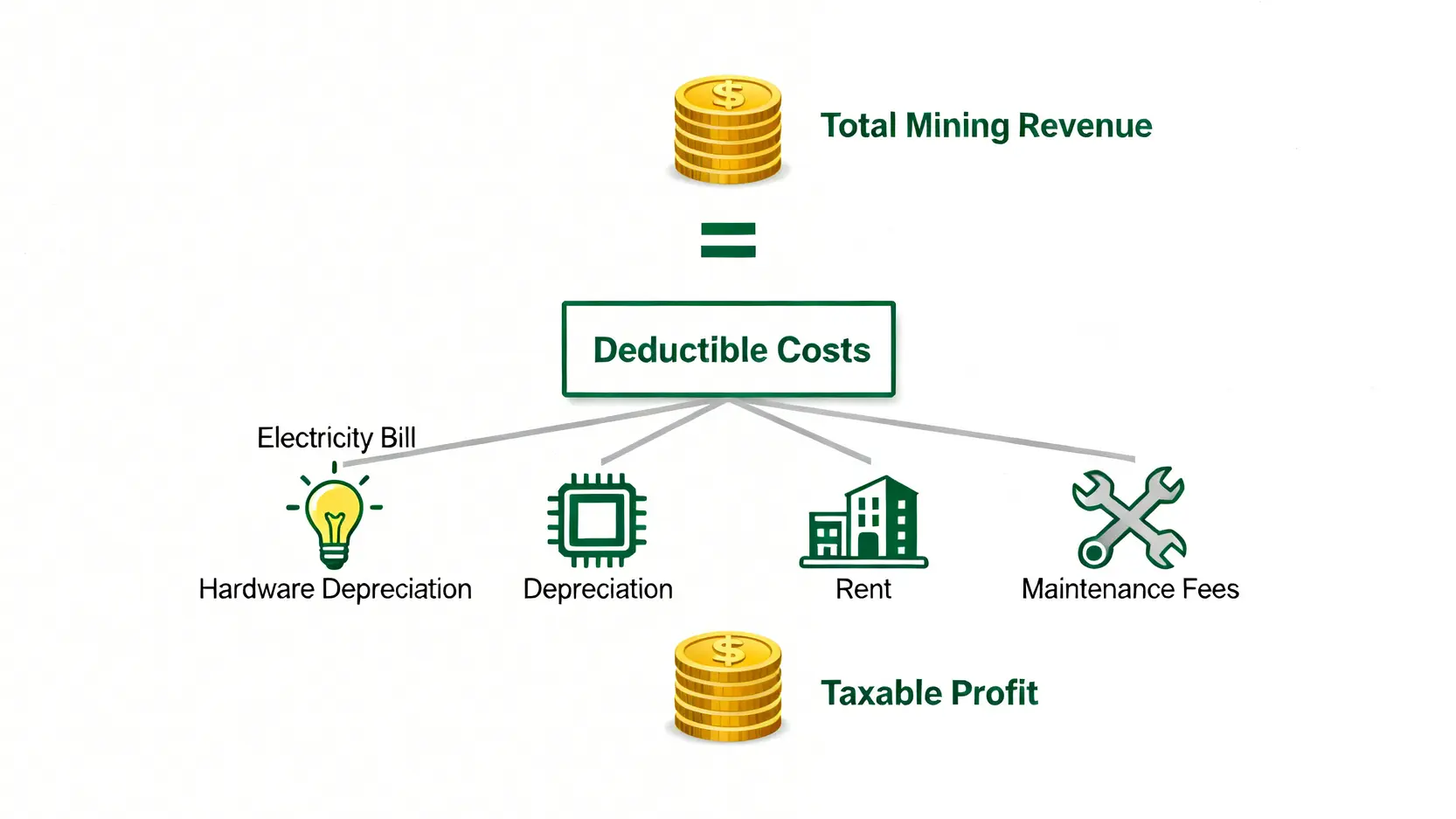
If it is determined that profits tax must be paid, the good news is that related operating costs can be deducted. The formula for calculating taxable profit is roughly as follows:
Taxable profit = total mining income – deductible costs

Common deductible costs include:
- Electricity expenses: Electricity costs generated by mining activities.
- Hardware costs: Depreciation of mining machines, graphics cards, and other equipment. The Inland Revenue Department has specific methods for calculating asset depreciation rates.
- Premises rent: If you rent premises for mining operations, the related rent can be deducted.
- Maintenance expenses: Costs such as repairing mining machines or paying mining pool management fees.
You must retain all relevant receipts and records, such as electricity bills, equipment purchase receipts, and lease agreements, so they can serve as supporting documents during tax reporting. For more detailed guidance on profits tax, you can refer to the pamphlets provided by the Hong Kong Inland Revenue Department.
Latest Development: The Future Impact of the Crypto Asset Reporting Framework (CARF) on Miners
Global tax transparency continues to increase. The Crypto Asset Reporting Framework (CARF) introduced by the Organisation for Economic Co-operation and Development (OECD) will be the future trend. As an international financial center, Hong Kong is also expected to gradually adopt this framework. CARF requires crypto asset service providers (which may include large mining pools) to automatically exchange users’ transaction information with tax authorities. This means that in the future, the Inland Revenue Department will find it easier to track taxpayers’ crypto asset activities, and it will become increasingly difficult to avoid mining tax reporting responsibilities in Hong Kong.
Conclusion
In summary, conducting cryptocurrency mining in Hong Kong is not illegal in itself, but the key lies in its business nature and scale. Small scale personal mining carries relatively low legal risk, but attention must still be paid to issues such as noise and electricity safety. Once it evolves into a business operation, you must strictly comply with relevant cryptocurrency mining laws and anti money laundering regulations, and consider applying for the required licenses. At the same time, any profits generated from mining are very likely to involve tax reporting responsibilities in Hong Kong. Before committing significant resources, it is advisable to consult legal and tax professionals to ensure that your mining activities are fully compliant, so you can mine with peace of mind and confidence.
FAQ: Common Questions About Cryptocurrency Mining in Hong Kong
Q: If I conduct small-scale mining at home using my own computer, is it illegal?
A: Generally speaking, using a personal computer for small-scale mining is not considered illegal. Hong Kong currently has no law that explicitly prohibits this type of personal hobby activity. However, you must ensure that the mining process does not violate other regulations, such as the “Noise Control Ordinance” (equipment being too noisy) or the “Electricity Ordinance” (electricity load overload), and you should also check whether the building deed of mutual covenant contains any related restrictions.
Q: If the cryptocurrency earned from mining is not converted into Hong Kong dollars, do I still need to report tax?
A: Yes. According to tax principles, the tax liability arises at the moment you “earn” the income, not when you “convert” it. The Inland Revenue Department will treat the market value of the cryptocurrency on the day it is mined as your income. Therefore, even if you continue holding the cryptocurrency, in principle you still need to report profits tax based on its value at the time it was mined.
Q: If I participate in an overseas mining pool, how should the income be reported?
A: Hong Kong adopts the “territorial source principle” of taxation, meaning only profits sourced in Hong Kong are subject to tax. If your mining decisions, control, and primary operating activities are conducted in Hong Kong, then even if the mining pool server is located overseas, the related income is very likely to be regarded as sourced in Hong Kong and must be reported for tax. The Inland Revenue Department will consider all relevant factors, so it is advisable to consult a professional tax advisor for such complex situations.
Q: Are there any legal issues with buying or selling mining equipment (such as mining machines or graphics cards)?
A: No. Purchasing, owning, or selling computer hardware, including dedicated ASIC mining machines or high performance graphics cards, is completely legal in Hong Kong. These devices are neutral technology products, and the law does not impose restrictions on their purchase or sale.
Q: If my mining business loses money, can the losses be deducted for tax purposes?
A: Yes. If your mining activity is assessed by the Inland Revenue Department as a business, the related losses can be handled under the “Inland Revenue Ordinance”. Business losses can generally be carried forward indefinitely to offset profits from the same business in future years, thereby reducing future tax payable.
Related Articles
-
In-Depth Review of Intelligent Order Flow Detection Tools: Understanding Institutional Activity and Identifying Real Market Buying and Selling Pressure What Is Order Flow, and Why Is It a “Leading Indicator” for Price Prediction? Candlestick charts and technical indicators can be misleading, but the real-money "Order Flow" within the market cannot....2026 年 6 月 4 日
-
Social Sentiment Quantitative Indicators: Mining PTT and Dcard Discussions to Predict Stock Prices What Are Social Sentiment Quantitative Indicators, and Why Are They Becoming Increasingly Important? In an era of information overload, financial markets are no longer driven solely by cold financial statements and macroeconomic data. The "Shipping King" phenomenon...2026 年 6 月 4 日
-
Avoid Fraudulent Platforms! A Visual Guide to Taiwan FSC Licensed Futures Merchant Verification and Scam Prevention In recent years, driven by heightened volatility in global financial markets and the impact of monetary easing policies worldwide, more investors have begun seeking diversified investment instruments. However, underground futures operators and overseas fraudulent...2026 年 6 月 4 日