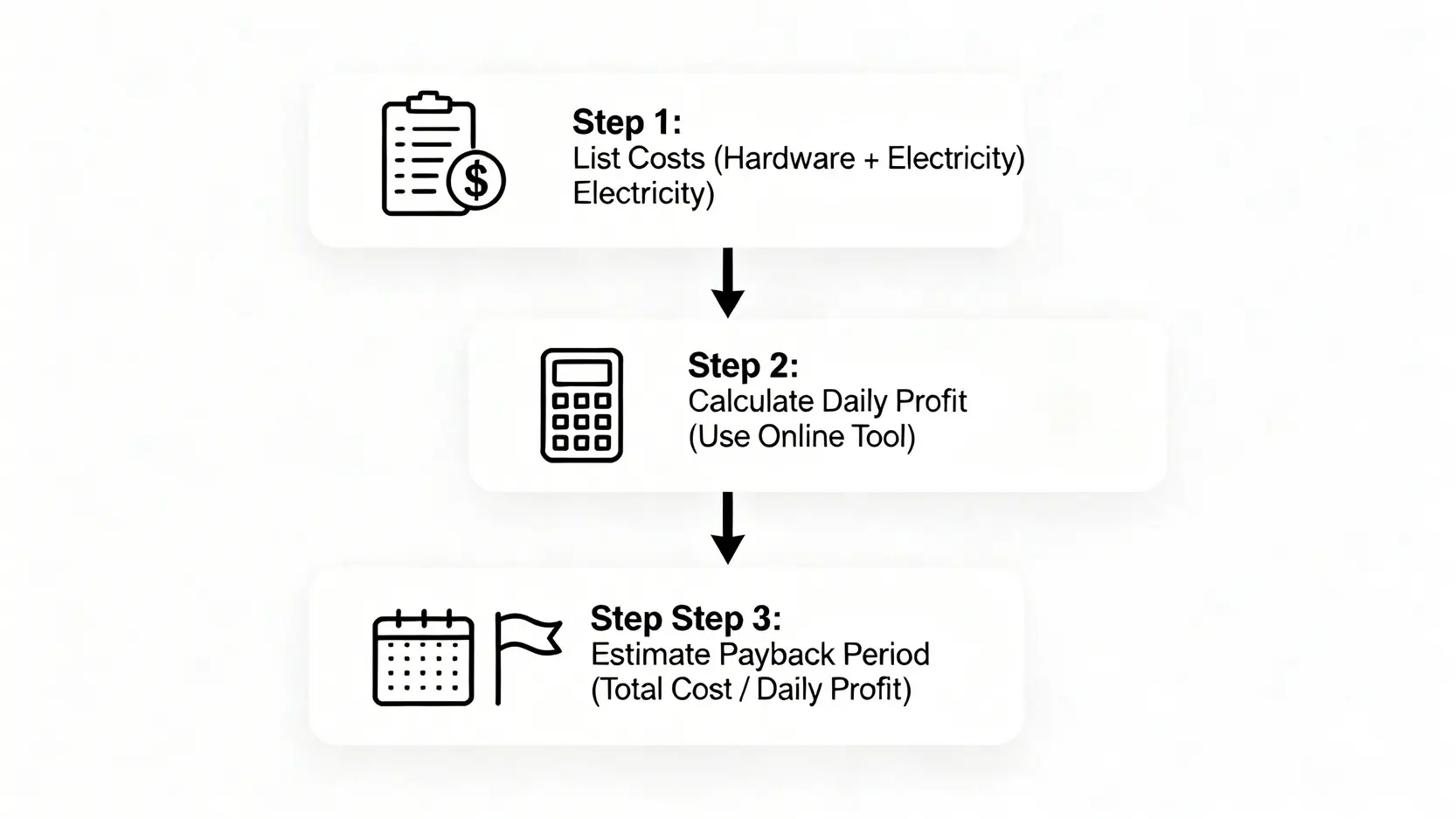
Three Step Calculation Method: Clearly Estimate Your Mining Payback Cycle.
Step One: Comprehensive Mining Cost Analysis (Hardware Investment and Hong Kong Electricity Costs)
First, you need a clear cost list. This step requires absolute honesty, and no expenses should be omitted.
Total hardware investment:
- ASIC mining machines / GPU graphics cards total price: __________ HKD
- Power supply units, motherboards, racks, and other accessories: __________ HKD
- Total initial investment (A): __________ HKD
Daily operating costs:
The formula for calculating electricity costs is: total mining machine power consumption (kW) × 24 hours × electricity price per kWh (HKD/kWh)
- Total mining machine power consumption: Check your mining machine specifications and convert watts (W) into kilowatts (kW). For example, 3000W = 3kW.
- Hong Kong electricity costs: Hong Kong electricity is mainly supplied by CLP and HK Electric. Electricity prices follow a progressive tariff system where higher consumption results in higher unit prices. According to the 2026 electricity tariff information published by CLP, residential electricity costs vary based on consumption levels, with the average net tariff around 1.4 HKD per kWh. For accurate calculations, you should check the latest official electricity tariff.
Assuming your mining machine total power consumption is 3.5kW and the electricity price is 1.4 HKD/kWh:
Daily electricity cost (B) = 3.5 kW × 24 h × 1.4 HKD/kWh = 117.6 HKD
Step Two: Use Online Tools for Mining Profit Calculation (Recommended Calculators)
Unless you are highly skilled in mathematics, manually calculating profits while considering mining difficulty is extremely complex. Fortunately, many professional mining profit calculators online can do the work for you. They automatically retrieve real time cryptocurrency prices and network difficulty data.
Recommended tools:
- WhatToMine: This is a very popular and powerful calculator. It supports multiple cryptocurrencies and allows you to input multiple graphics cards of different models to calculate combined revenue. It is particularly useful for GPU miners.
- CryptoCompare: The interface is simple and intuitive, making it suitable for beginners.
How to use these tools
You only need to input the following key parameters:
- Hashrate: Your total mining machine hashrate.
- Power consumption: Your total mining machine power consumption (W).
- Cost per KWh: Enter the Hong Kong electricity price calculated in step one, such as 1.4 HKD.
- Pool fee: Usually between 1% and 2%.
After submitting the information, the calculator will immediately display estimated “daily or monthly revenue”, “electricity cost”, and most importantly “daily or monthly profit”. This profit figure represents your daily net profit (C).
For example, the calculator may show that your estimated daily profit is 150 HKD.
Further Reading (Highly Recommended)
What Is Bitcoin and How to Use It? The Most Complete 2025 Guide: From 0 to 1 Understanding Four Investment Strategies and the Account Opening Process
Complete Cryptocurrency Investment Guide: Understand Risks, Avoid Scams, Ensure Asset Security and Regulatory Compliance
Step Three: Calculate Net Profit and Dynamically Estimate the Mining Payback Period
Once you have the total investment and daily net profit, calculating the static mining payback period becomes very simple.
Payback period (days) = total initial investment (A) / daily net profit (C)
Using the example above: assume your total hardware investment is 50,000 HKD and your daily net profit is 150 HKD.
Payback period = 50,000 HKD / 150 HKD/day ≈ 333 days
Important reminder: This is a “static” estimate. The actual payback period will change due to cryptocurrency price volatility and increases in mining difficulty. A prudent miner regularly recalculates mining profits, for example weekly, to dynamically track the payback progress and adjust strategies based on market conditions. For instance, when profits become too low, you may consider temporarily shutting down machines or switching to mine other more profitable cryptocurrencies. Managing these uncertainties is a crucial part of cryptocurrency investment risk management.
Common Questions (FAQ)
Q: What is currently the biggest challenge of mining in Hong Kong?
A: The biggest challenge is undoubtedly the high operating costs, mainly reflected in two aspects. The first is “electricity costs”. Hong Kong’s electricity prices are relatively high globally, directly eroding most mining profits. The second is “space and cooling costs”. Hong Kong has extremely limited space, and it is not easy to find a location that has good ventilation, sufficient space, and the ability to isolate noise to place mining machines. The resulting cooling costs, such as air conditioning, further increase the overall mining expenses.
Q: If the price of Bitcoin falls, how much longer will my mining payback period become?
A: There is no fixed answer to this question because the payback period does not have a linear relationship with the cryptocurrency price. If the price drop causes your daily revenue to be exactly equal to your daily electricity costs, meaning the break even point, then your payback period becomes infinitely long. If the price falls below this point, you lose money every day you mine. Therefore, miners must set a “shutdown price”, meaning when the market price falls below this level, the electricity cost of mining exceeds the value of the output, and continuing operations is economically unreasonable.
Q: Besides electricity costs and mining machines, what other hidden mining costs exist?
A: There are several hidden costs that are often overlooked. 1. Opportunity cost. The funds used to purchase mining machines could potentially generate different returns if invested in other assets, such as directly purchasing Bitcoin or investing in stocks. 2. Hardware depreciation and obsolescence risk. Mining machine technology evolves rapidly, and the computing efficiency of older models can quickly be surpassed by newer models, causing their value to decline rapidly and potentially lose competitiveness before reaching the payback period. 3. Maintenance and downtime losses. Hardware failures, network interruptions, or power outages can all cause mining to stop, and the resulting zero income during this period is also a form of loss.
Conclusion
In summary, although mining offers potential rewards, conducting a detailed mining cost analysis and mining profit calculation in advance is the key to success in a high cost environment like Hong Kong. Through the three step tutorial provided in this article, you should be able to more clearly evaluate the mining payback period and potential profits, allowing you to determine whether this investment suits you. Remember that the cryptocurrency market changes rapidly, and there is no permanent strategy. Continuously monitor profits, electricity costs, and network difficulty, and always be ready to adjust your mining strategy in order to stay ahead in this world full of challenges and opportunities.