HK Money Market Funds: 4% Return & Risk Guide

Updated: 2026/03/30  |  CashbackIsland

hk-money-market-fund-annual-return-guide

[Hong Kong Money Market Funds Guide] Annual Return Up to 4%? 5 Key Uses and Full Risk Analysis

Are Hong Kong dollar savings rates persistently low, and you are watching your cash being eroded by inflation while not daring to enter the stock market? You may have heard of “money market funds”, a financial tool that claims to offer higher returns than savings accounts while being more flexible than fixed deposits. But are the returns in the Hong Kong money market fund market really that attractive? What potential money market fund risks should you be aware of? This article will comprehensively break down the real uses and potential of money market funds, helping you make the most informed capital allocation decisions. 


What Are Hong Kong Money Market Funds? Your “Advanced Version” of a Savings Account

Simply put, a money market fund (Money Market Fund) is an introductory fund that pools capital from multiple investors and invests specifically in short-term, high-quality, and highly liquid debt instruments. Due to the very low risk of its underlying investments, it is often regarded as a substitute for cash, or an “enhanced” savings account, offering higher returns than banks while maintaining high liquidity.


Basic Definition: Why Is It Considered a Low-Risk Investment Tool?

Money market funds are classified as low risk due to their strict investment discipline. Fund managers allocate capital to issuers with strong creditworthiness and very low default risk, and the average maturity of the investment instruments is usually limited to within 60 days. This means the fund’s portfolio has very low sensitivity to interest rate changes, and its net asset value (NAV) can remain within a very narrow fluctuation range, with losses being extremely rare.


Breakdown of Investment Targets: What Is Your Money Actually Invested In?

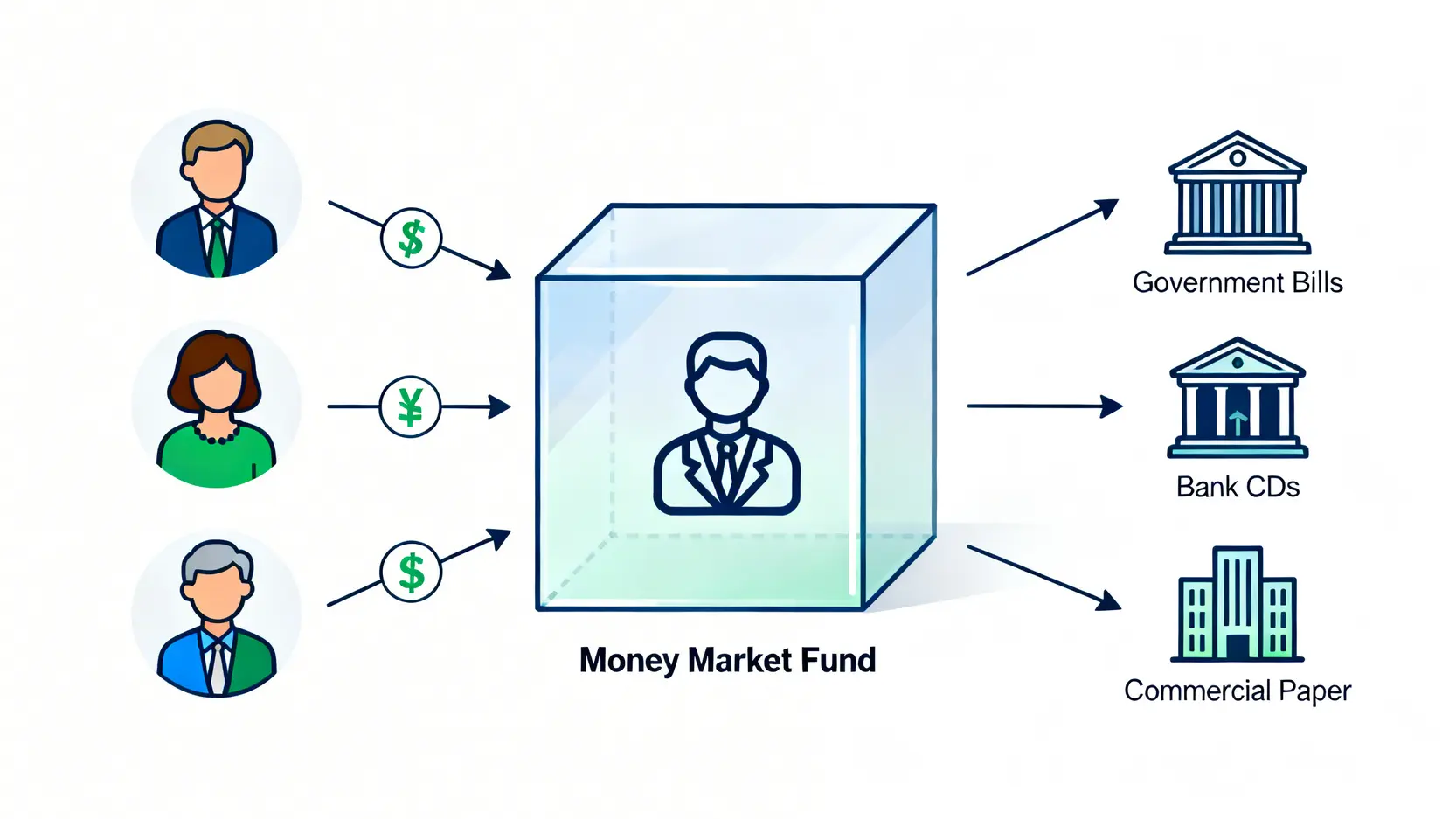
When you invest in a money market fund, you are not directly buying equities or long-term bonds. Instead, the fund manager diversifies your capital across a range of short-term debt instruments, mainly including:

  • Short-term government securities: Such as treasury bills or Exchange Fund Bills issued by the government, considered risk-free assets.
  • Certificates of deposit (CDs): Issued by large commercial banks with high credit ratings.
  • Commercial paper: Issued by large corporations for short-term financing, generally with good creditworthiness.
  • Repurchase agreements (Repo): A type of short-term loan secured by bonds.

The common characteristics of these instruments are “short duration and high credit quality”, ensuring overall fund stability.

貨幣基金運作原理示意圖,展示投資者的資金如何被匯集並投資於政府票據、銀行存單和商業票據等短期債務工具。

Money market funds diversify your capital across a range of high-credit, short-term debt instruments to maintain stability.


Differences from General Funds: Why Is Its Volatility Much Lower Than Equity Funds?

The biggest difference between money market funds and equity or bond funds lies in their “investment objectives” and “investment targets”.

  • Investment objective: Equity funds aim for capital appreciation, whereas money market funds prioritize “capital preservation” and “liquidity”, with moderate interest returns as a secondary goal.
  • Investment targets: Equity funds invest in highly volatile listed company stocks, whose prices are influenced by market sentiment and company performance; money market funds invest in the short-term fixed-income instruments mentioned above, with minimal price fluctuations.

In comparison, equity funds are like speedboats chasing performance, experiencing strong turbulence in rough markets, while money market funds are like cruise ships sailing in calm harbors, stable and secure.


Comprehensive Evaluation: Full Breakdown of Money Market Fund Risks and Returns

Although money market funds are regarded as stable cash management tools, treating them as “risk-free” bank deposits is a misconception. Only by understanding the potential risks and return calculation methods of money market funds, then you can make the most informed decisions.

[Risk Section] Is “Capital Preservation” an Illusion? Analysis of 3 Major Potential Risks

Money market funds do not guarantee capital preservation, although the probability of losses is extremely low. Investors should still be aware of the following three potential risks:

  1. Interest rate risk: When market interest rates rise, newly issued short-term instruments offer higher yields, making existing holdings less attractive, which may slow the fund’s return growth or in extreme cases lead to slight declines. Conversely, falling interest rates are beneficial to the fund.
  2. Credit risk: Although highly unlikely, if an issuer of commercial paper or certificates of deposit held by the fund defaults, it will result in losses to the fund’s assets. This is why it is important to choose funds investing in high-credit-quality instruments.
  3. Liquidity risk: In extreme market panic situations (such as a financial crisis), if a large number of investors request redemption simultaneously, the fund manager may need to sell assets at a discount to meet redemptions, leading to losses. However, due to the high liquidity of the underlying assets, such situations are very rare.


[Return Section] How Are Money Market Fund Returns Calculated? Why Are They Usually Higher Than Bank Savings Accounts?

Money market fund returns come from the interest generated by all short-term instruments within the portfolio. These returns are typically presented as “7-day annualized yield” and “per 10,000 units income”.

  • 7-day annualized yield: Converts the average return over the past seven days into an annualized figure. This is an estimate and fluctuates daily.
  • Per 10,000 units income: Refers to the actual income earned per day for every 10,000 currency units invested (such as HKD 10,000).

The reason money market fund returns are generally higher than bank savings accounts is that they invest directly in the money market, with rates closely linked to benchmark market interest rates. In contrast, savings account rates are determined by banks and are usually much lower, allowing banks to earn the spread. In simple terms, money market funds allow you to bypass banks and earn interest closer to market levels.


Further Reading (Highly Recommended)

2026 Hong Kong High-Interest Savings Accounts and Credit Cards Guide: Taishin, Sinopac, and Major Bank Offers …

What Are ETF Risks? Comprehensive Analysis of ETF Risk Levels and Investment Management Strategies


Comparative Analysis: Money Market Funds vs Fixed Deposits, How Should I Choose?

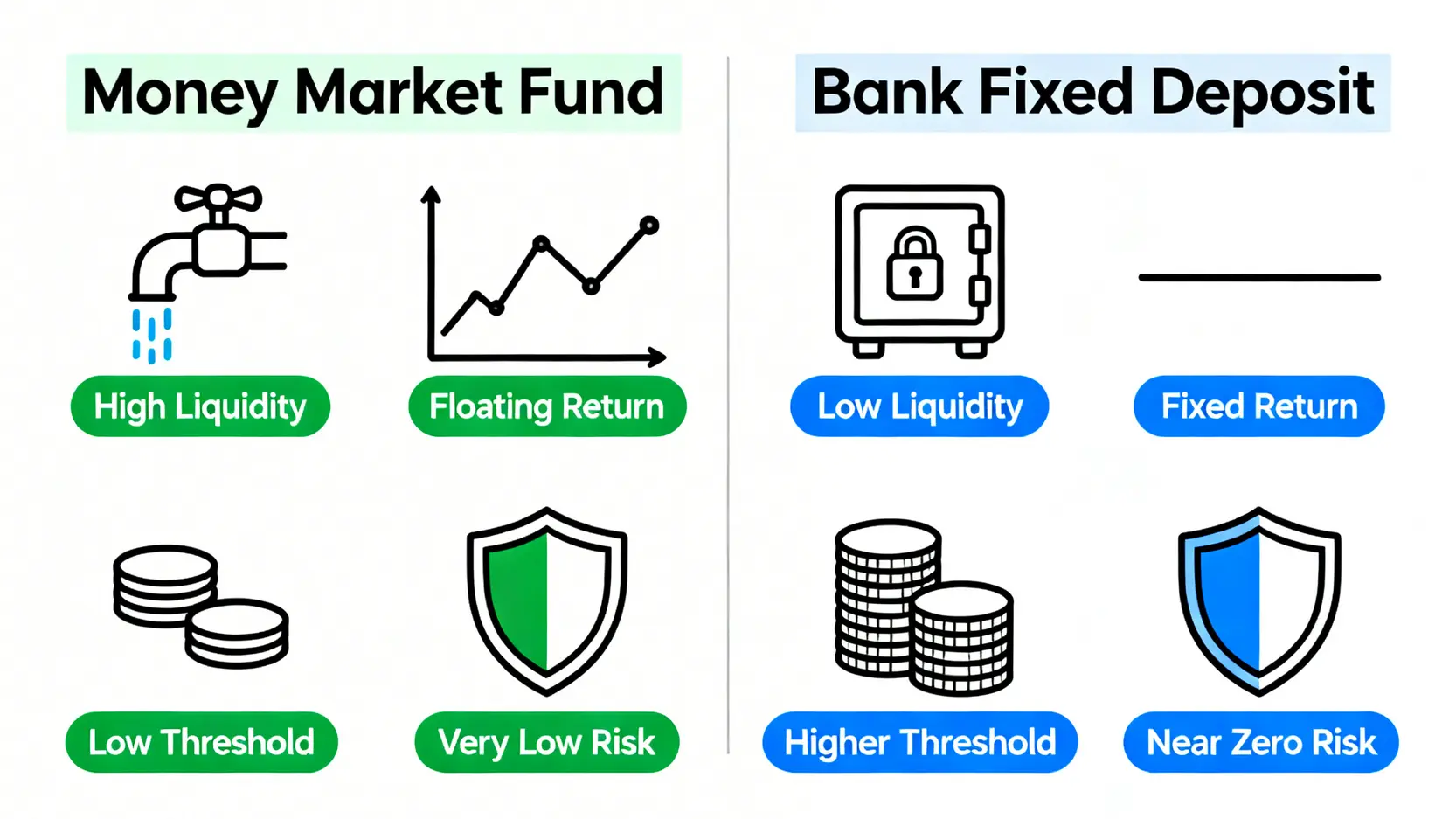
Both are low-risk cash management tools, but they have different characteristics and suit different needs. The table below provides a clear comparison:

Comparison Items Money Market Funds

Bank Fixed Deposits

Liquidity Very high, typically redeemable on T+1 or T+2, with no lock-up period Low, with a fixed lock-up period (such as 3 months or 1 year), early withdrawal will result in loss of interest
Return Rate Floating, closely tracks market interest rates, usually higher than savings accounts Fixed, remains unchanged during the lock-up period, usually higher than money market funds
Entry Threshold Very low, some platforms allow a minimum investment starting from HKD 1 Relatively high, usually requires a minimum deposit (such as HKD 10,000 or HKD 100,000)
Risk Not capital guaranteed, but very low risk

Protected by the Deposit Protection Scheme (HKD 500,000 in Hong Kong), close to zero risk

Suitable Scenarios Parking idle funds, emergency reserves, waiting for investment opportunities

Funds that will not be used for a defined period, seeking stable returns

貨幣基金與銀行定期存款的對比圖,比較兩者在流動性、回報率、入場門檻和風險上的主要分別。

Money market funds excel in flexibility, while fixed deposits are strong in locking in returns. Both serve different cash management needs.

In summary, if you pursue maximum flexibility and want your funds to be readily available at any time, money market funds are your best choice. If you have a sum of money that you are certain will not be used and wish to lock in a higher return than money market funds, then bank fixed deposits are more suitable.


5 Practical Uses of Money Market Funds in Hong Kong: Making the Most of Every Idle Dollar

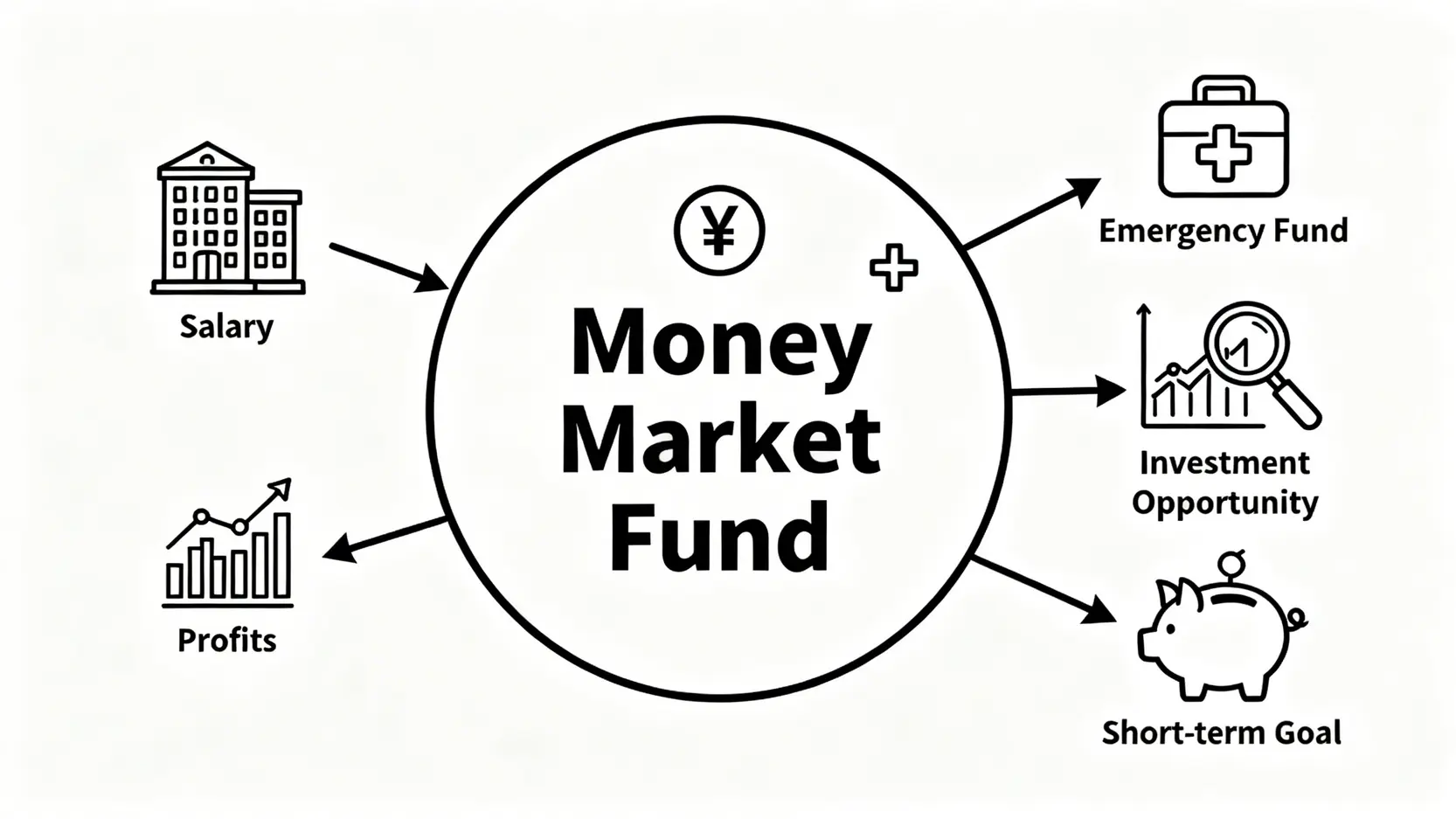
貨幣基金作為現金管理樞紐的概念圖,展示了薪金和投資利潤等閒置資金流入,再靈活用於緊急備用金、等待投資機會或短期儲蓄。

Use money market funds as a cash transit hub to ensure every idle dollar continues to grow.

After understanding the risks and returns, let us now look at how money market fund uses can play a role in your financial planning. It is not just a savings tool, but also an efficient cash management hub. 

Use 1: A Growth Tool for Short-Term Idle Funds

For funds that remain temporarily unused after receiving your salary, money set aside for insurance premiums or tax payments, or even a budget reserved for upcoming expenses, leaving them in a savings account yields almost no return. By transferring these funds into a money market fund, even if held for just a few days or weeks, you can earn returns several or even dozens of times higher than a savings account, truly achieving the effect of “accumulating small gains into a larger sum”.


Use 2: Building a Highly Liquid Emergency Reserve

Financial experts often recommend setting aside 3-6 months of living expenses as an emergency fund. The key for this fund is “safety” and “immediate accessibility”. Traditionally, people place this in savings accounts, but this means giving up the time value of money. By placing your emergency fund in a money market fund, you can maintain high liquidity while allowing the funds to continue growing and combating inflation.


Use 3: A Capital Transit Hub While Waiting for Market Entry Opportunities

Stock market fluctuations require patience to identify good entry points. When you take profits from selling stocks or are waiting for a market correction, you may hold a large amount of cash. Parking these “reserves” in a money market fund avoids idle funds and ensures that when opportunities arise, you can quickly redeem the funds (usually settled on T+1) and deploy them into the market, achieving “both offense and defense”.


Use 4: A Stable Core in Conservative Investment Portfolios

For investors with lower risk tolerance, or when building an investment portfolio, money market funds serve as an excellent stabilizing component. They can act as the cash portion of a portfolio, helping to reduce overall volatility. During market downturns, their stability provides a buffer; when rebalancing is needed, they provide sufficient liquidity. 

How to Buy and Sell Money Market Funds in Hong Kong? Comparison of Three Main Channels

In Hong Kong, investing in money market funds is very convenient, mainly divided into the following three channels, each with its own advantages and disadvantages.


Further Reading (Highly Recommended)

2026 Hong Kong High-Interest Savings Accounts and Credit Cards Guide


Through Securities Platform Apps (for example: Futu “Cash Plus”)

  • Advantages: Extremely convenient operation, seamlessly integrated with stock trading accounts. Deposits and redemptions usually incur no fees, with fast redemption speed. Some platforms allow instant redemption for stock trading use. Very low entry threshold, suitable for beginners and active traders.
  • Disadvantages: Limited fund selection, mainly consisting of products from a few large fund companies partnered with the platform.


Through Robo-Advisors (for example: Stashaway Simple™)

  • Advantages: Designed specifically for cash management, with a simple interface and one-click operation. Usually selects the most competitive money market funds in the market for clients, eliminating the need for personal research.
  • Disadvantages: May charge a certain percentage of management fees (although typically low) and redemption time may be slightly longer than securities platforms.


Through Traditional Banks or Fund Companies

  • Advantages: Offers a very wide selection of funds, providing access to products from different fund companies. Professional relationship managers are available to provide consultation.
  • Disadvantages: Subscription and redemption processes may be more complex, requiring form submissions or operation through online banking fund platforms. There are more types of fees, such as subscription fees, redemption fees, and platform fees, which may erode returns.


FAQ Frequently Asked Questions

Q: Is there a chance of loss when investing in Hong Kong money market funds?

A: Theoretically possible, but the probability is extremely low. Historically, only in extreme financial crises (such as 2008) have a very small number of money market funds fallen below par value. For funds investing in high-quality short-term government and corporate debt, the risk of capital loss is minimal. Choosing funds managed by large and reputable fund companies can further reduce risk.

Q: Are returns from money market funds distributed daily?

A: Returns are calculated daily, but are usually settled monthly and reinvested as “dividend reinvestment”, increasing your fund units. Therefore, you will notice an increase in your fund units at the beginning of each month, which represents the interest earned.

Q: What fees are involved in purchasing money market funds in Hong Kong?

A: The main fees are “management fees” and “custodian fees”, which are deducted daily from the fund assets. The annualized return you see is the net return after these fees. Through securities platforms or robo-advisors, there are usually no additional subscription or redemption fees, but purchasing through traditional banks may involve such charges. It is important to fully understand the fee structure before investing.

Q: What is the difference between Hong Kong dollar money market funds and US dollar money market funds?

A: The main difference lies in the currency and underlying assets. Hong Kong dollar money market funds invest in HKD-denominated short-term debt instruments, with returns mainly influenced by the Hong Kong Interbank Offered Rate (HIBOR). US dollar money market funds invest in USD assets, with returns closely linked to the US federal funds rate. Under the linked exchange rate system, the interest rate trends of both are highly correlated, but short-term spreads may occur due to market supply and demand.


Conclusion

In summary, Hong Kong money market funds, as an efficient cash management tool, offer high liquidity and relatively stable returns, making them a strong alternative to traditional bank deposits. They are particularly suitable for investors seeking low risk and flexible capital allocation, whether used as an emergency reserve, a holding place for funds while waiting for market entry opportunities, or a stabilizer in conservative investment portfolios, all of which play an important role. With a clear understanding that they are not risk-free, making good use of the various functions of money market funds can effectively enhance your capital efficiency. Review your cash allocation now and discover the growth potential that money market funds can bring.

编者
Evan Lin

Evan Lin

我是Evan Lin,从大学时期开始接触外汇交易,至今已有多年实战经验,熟悉技术分析与EA策略,热衷于研究市场脉动与风险管控,喜欢分享实战经验和交易技巧,和大家一起学习、一起进步!

If you liked this article, please share it!

Related Articles

  • Order Flow Analysis Tools: Track Institutional Activity
    In-Depth Review of Intelligent Order Flow Detection Tools: Understanding Institutional Activity and Identifying Real Market Buying and Selling Pressure What Is Order Flow, and Why Is It a “Leading Indicator” for Price Prediction? Candlestick charts and technical indicators can be misleading, but the real-money "Order Flow" within the market cannot....
    2026 年 6 月 4 日
  • Social Sentiment Indicators: Predicting Stock Trends
    Social Sentiment Quantitative Indicators: Mining PTT and Dcard Discussions to Predict Stock Prices What Are Social Sentiment Quantitative Indicators, and Why Are They Becoming Increasingly Important? In an era of information overload, financial markets are no longer driven solely by cold financial statements and macroeconomic data. The "Shipping King" phenomenon...
    2026 年 6 月 4 日
  • Taiwan FSC Futures Broker Verification Guide
    Avoid Fraudulent Platforms! A Visual Guide to Taiwan FSC Licensed Futures Merchant Verification and Scam Prevention In recent years, driven by heightened volatility in global financial markets and the impact of monetary easing policies worldwide, more investors have begun seeking diversified investment instruments. However, underground futures operators and overseas fraudulent...
    2026 年 6 月 4 日
返回顶部