Gold Volatility: Safe-Haven Role & Trading Strategy

A Complete Analysis of the Causes Behind Major Gold Price Volatility: Does Its Safe-Haven Function Still Hold? Investment Impact and Strategies Under High Volatility
Recent international gold price movements have been like a roller coaster. Sharp volatility has left many investors anxious and has also cast doubt on traditional investment wisdom. The market has many different opinions on the causes behind major gold price volatility, and although gold has long been regarded as a safe harbor during market turbulence, its safe-haven function seems to show signs of “failure” at certain times. When soaring volatility impacts the entire market, how should we view the value of gold?
This article will provide an in-depth analysis of the five core factors driving dramatic gold price fluctuations, objectively evaluate gold’s true safe-haven value in today’s complex economic environment, and offer practical investment strategies for navigating market turmoil, helping you stay ahead during uncertainty and make wiser decisions.
Revealing the 5 Core Causes Behind Major Gold Price Volatility
Gold price movements are not caused by a single factor, but rather by the combined forces of multiple macroeconomic powers. Understanding these underlying causes is the first step in mastering gold investment strategies. The following five core factors are key drivers of recent gold price trends.
Global Central Bank Monetary Policy: How Do Interest Rate Changes Affect Gold Prices?
The monetary policies of major global central banks (especially the US Federal Reserve (Fed)), are among the most direct factors influencing gold prices. Gold itself is a non-yielding asset, so the “opportunity cost” of holding gold becomes crucial.
- Rate Cuts or Monetary Easing: When central banks cut interest rates, returns on cash or bonds decline. This lowers the opportunity cost of holding gold because gold’s disadvantage of not generating interest becomes less significant. Capital tends to flow into gold markets for value preservation, thereby pushing gold prices higher.
- Rate Hikes or Monetary Tightening: Conversely, when central banks raise rates to combat inflation, US dollar deposits and bonds become far more attractive. At this point, the opportunity cost of holding gold increases, and investors may sell gold in favor of assets that offer stable interest income, creating pressure on gold prices.
Simply put, interest rates and gold prices generally have a “negative correlation”. Therefore, closely monitoring Federal Reserve rate decision meetings (FOMC) and officials’ speeches is essential for judging gold’s short-term direction.
Geopolitical Risks: How Do Wars and Conflicts Become Catalysts for Gold Prices?
As the saying goes, “When cannons roar, gold is worth ten thousand taels”. This perfectly illustrates the impact of geopolitical risks on gold prices. When international tensions rise, such as wars, regional conflicts, or severe political instability, market uncertainty increases sharply.
At such times, investors seek “hard assets” that can transcend sovereign credit risks to protect wealth. Gold, as a globally recognized store of value with thousands of years of historical trust, naturally becomes the top choice. Funds flow out of stocks, risk currencies, and other assets into gold markets, causing gold prices to surge in a short period. Events such as the Russia-Ukraine war and Middle East conflicts in recent years have repeatedly validated gold’s safe-haven value during times of chaos.
Inflation Expectations and US Dollar Strength: How Do Both Jointly Influence Gold’s Value?
Inflation and the US dollar exchange rate are two other major variables affecting gold prices. They are interconnected and jointly shape the gold market.
- A Tool Against Inflation: Inflation means declining purchasing power of currency. When markets expect inflation to rise, investors buy gold to hedge against currency depreciation. Because gold supply is relatively stable, its value is not diluted like fiat currency through unlimited money printing.
- The US Dollar “Seesaw Effect”: International gold is priced in US dollars, so the strength of the dollar usually has a negative correlation with gold prices. When the US dollar strengthens, gold becomes more expensive for investors using other currencies, which may reduce demand. Conversely, when the US dollar weakens, gold appears cheaper to foreign buyers, boosting demand and driving prices higher.
Therefore, when analyzing gold prices, inflation data (such as the Consumer Price Index (CPI)) and US Dollar Index (DXY) trends must both be considered.
Market Supply and Demand Changes: Central Bank and ETF Buying Trends
Beyond investment demand, physical gold supply-demand balance is equally important, with two major forces standing out:
- Central Bank “Gold Accumulation”: In recent years, global central banks have become major buyers in the gold market. To diversify foreign exchange reserves, reduce dependence on the US dollar (de-dollarization), and manage geopolitical risks, many emerging market countries (such as China, Turkey, and India) have continued increasing gold reserves. According to World Gold Council data, sustained central bank purchases provide strong structural support for gold prices.
- Gold ETF Fund Flows: Gold ETFs (exchange-traded funds) are a primary channel for retail investors to participate in the gold market. Net inflows or outflows directly reflect market sentiment. Large-scale inflows push gold prices up, while outflows create selling pressure. Monitoring holdings changes in major gold ETFs (such as GLD) is a practical indicator for assessing short-term bullish or bearish sentiment.
Speculative Sentiment and the Impact of Derivatives Markets
Finally, speculative behavior in financial markets can also amplify gold price volatility. In derivatives markets such as futures and options, traders can use high leverage for long and short positions. When major news or data is released, large speculative buying or selling can flood the market in a short period, causing sudden sharp price swings. This market sentiment and algorithm-driven activity often intensifies gold volatility, pushing it away from fundamentals and creating both opportunities and risks for short-term traders.
Is Gold’s Safe-Haven Function Still Effective? Understanding Both Sides of the Debate
For a long time, gold has been regarded as the ultimate safe-haven asset. However, during certain extreme market situations, gold prices can also decline alongside risk assets, leading many to question its protective function. So, does gold’s safe-haven halo still shine?
The Bullish View: Why Gold Remains a Solid Shield Against Inflation and Recession
Supporters of gold’s safe-haven effectiveness mainly base their views on the following:
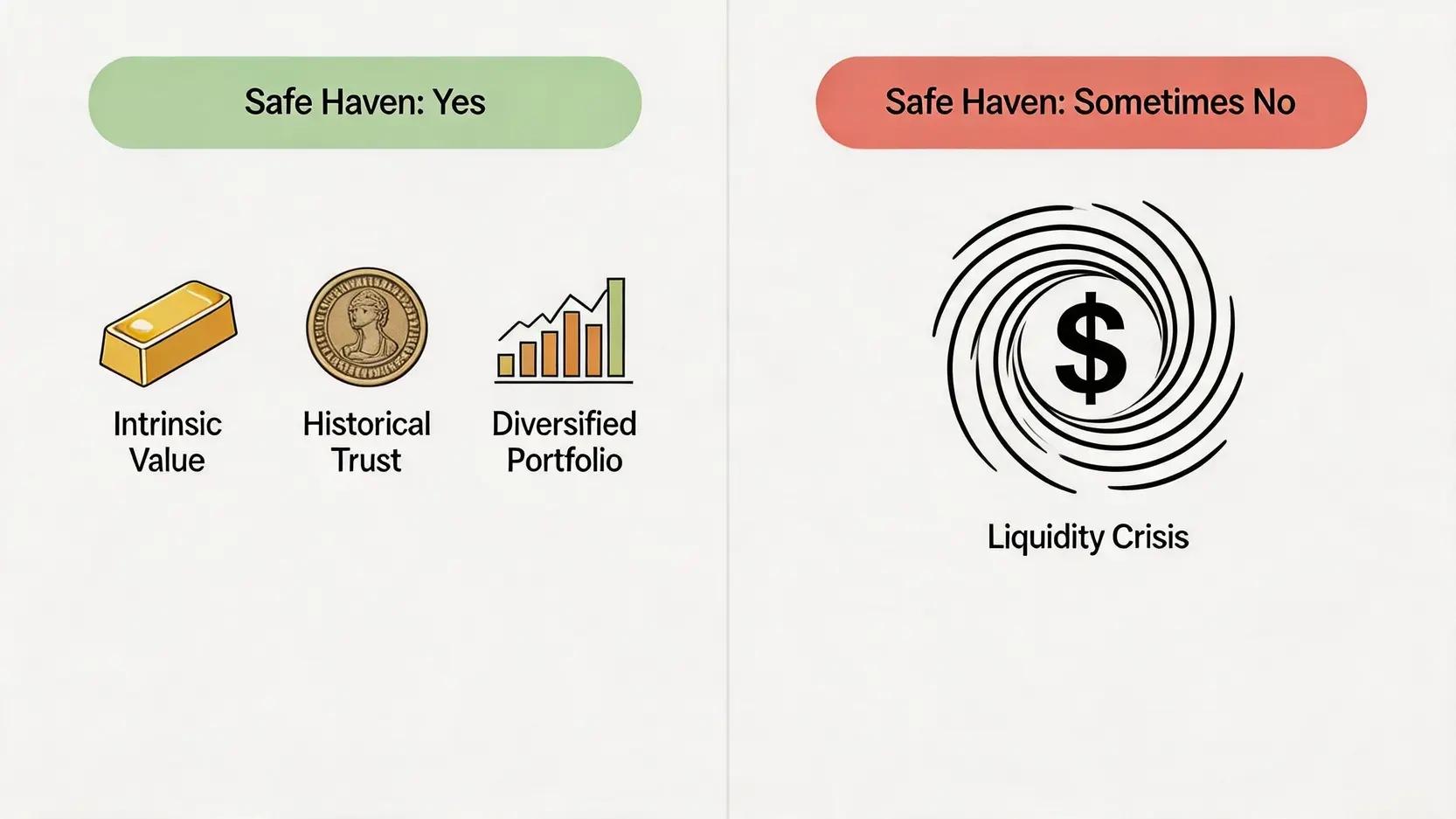
- Intrinsic Value and Scarcity: Gold is a physical commodity with tangible properties. Unlike stocks or bonds, it cannot become worthless due to corporate bankruptcy or government default. Its scarcity ensures value stability.
- More Than 5,000 Years of Historical Trust: Gold’s history as money and a store of value spans over 5,000 years. This cross-civilizational consensus gives it an unmatched foundation of trust.
- Low Correlation With Traditional Assets: In most market conditions, gold has low or even negative correlation with stocks and bonds. This means when stock markets fall, gold often rises against the trend, effectively diversifying portfolio risk.

The Bearish View: Why Gold Also Faces Selling Pressure When “Cash Is King”
However, in certain extreme situations, gold’s safe-haven function can temporarily “fail”.
The most typical case is a “liquidity crisis”. When markets experience severe panic, such as during the 2008 financial crisis or the early stage of the 2020 COVID-19 pandemic, investors may sell all assets at any cost in exchange for cash (especially US dollars). This is what is known as “cash is king”. In such circumstances, even gold cannot escape selling pressure, because profitable investors may need to sell gold to offset losses in other assets, or institutions may need to meet margin calls. As a result, gold prices can experience a sharp but temporary plunge. However, historical experience shows that once the initial liquidity shock passes, gold’s safe-haven demand usually returns quickly, and prices often rebound accordingly.
The 3 Major Impacts of Surging Volatility on Investors and Response Strategies
In a market environment where gold volatility is soaring, investors face both challenges and potential opportunities. The key lies in understanding the impact and adopting appropriate response strategies.
Impact 1: Portfolio Risk Increases Dramatically
High volatility means prices may experience significant upward and downward swings in the short term. For investors with a relatively high proportion of gold in their portfolios, this can increase overall portfolio instability. Without proper risk management, sharp price corrections may trigger panic selling, turning unrealized losses into actual losses. This risk is even greater for investors using leveraged gold derivatives.
Impact 2: How Can Volatility Be Used for Strategic Trading?
Risk and opportunity coexist. For experienced short-term traders, high volatility provides excellent trading opportunities. They can use tools such as gold CFDs or futures to capitalize on rapid price swings through buying low and selling high, or selling high and buying low, to profit from price differences. For example, buying when prices reach key support levels or chasing momentum after breaking resistance levels are common volatility trading strategies. However, this requires precise market judgment and strict stop-loss discipline.
Response Strategy: 3 Suggestions for Adjusting Gold Asset Allocation
For most medium- to long-term investors, adopting stable response strategies is more important than speculation when facing highly volatile markets.
- Define Allocation Ratios Clearly and Maintain Discipline: Based on your own risk tolerance, set a reasonable gold allocation ratio, typically recommended between 5% and 15%. Regardless of market volatility, try to maintain this target range and avoid chasing highs or panic selling due to market sentiment.
- Use Diversified Investment Tools: Do not put all your eggs in one basket. In addition to directly purchasing physical gold, consider gold ETFs, which offer better liquidity and lower transaction costs. For investors seeking amplified returns and willing to accept higher risks, a small portion of capital may be allocated to gold CFD trading.
- Buy in Batches to Average Costs: When price volatility is intense, making a large one-time purchase carries extremely high risk. Consider using dollar-cost averaging or phased buying to gradually build positions during price pullbacks. This method can effectively spread holding costs and reduce the risk of buying heavily at a single peak.
Frequently Asked Questions (FAQ)
What Is the Relationship Between Gold Prices and the Stock Market?
Gold prices and the stock market (especially US equities), typically show a negative correlation. When the economic outlook is optimistic and stock markets rise, investors’ risk appetite increases, and funds tend to flow out of safe-haven assets such as gold into equities in search of higher returns, which may put downward pressure on gold prices. Conversely, when economic recession or stock market declines occur, market panic spreads, and investors seek safe havens by shifting funds into the gold market, pushing gold prices higher. However, as mentioned earlier, during extreme liquidity crises, both markets may temporarily fall at the same time.
Under the Current Market Conditions, Is Now a Good Time to Buy Gold?
It depends on your investment objectives and risk tolerance. In the long term, against the backdrop of high global debt levels and persistent geopolitical uncertainty, gold still holds strategic value as part of a diversified asset allocation. However, in the short term, gold prices are highly volatile, and chasing highs carries certain risks. For conservative investors, it is generally recommended to accumulate positions in batches during significant price pullbacks rather than entering during market euphoria. Before making any decision, it is important to fully assess the current interest rate environment, US dollar trends, and geopolitical conditions.
What Are the More Flexible Gold Investment Instruments Besides Physical Gold?
Modern financial markets offer a variety of gold investment instruments, each with its own advantages and disadvantages:
- Gold ETFs: Traded on stock exchanges, highly liquid, low transaction costs, closely track gold prices, suitable for most investors.
- Gold Savings Accounts: Offered by banks, eliminating the need to store physical gold, but usually involve a bid-ask spread.
- Gold CFDs (Contracts for Difference): Margin-based trading that allows leverage to amplify both gains and risks, suitable for active traders seeking short-term price movements.
- Gold Mining Stocks: Investing in publicly listed gold mining companies, whose share prices are influenced not only by gold prices but also by company performance and production costs, resulting in potentially higher volatility than gold itself.

What Does Central Bank Gold Buying Signal for Ordinary Investors?
As one of the most important and stable types of investors globally, central banks’ continued accumulation of gold serves as a strong endorsement of gold’s long-term value. It indicates that amid ongoing global economic and political uncertainty, the strategic reserve and value storage functions of gold are being increasingly recognized again. For ordinary investors, this sends a powerful signal: including gold as part of a long-term investment portfolio to hedge against potential systemic risks is a strategy worth considering.
Conclusion
In summary, understanding the causes of major gold price volatility is the foundation for developing effective gold investment strategies. The interplay of global monetary policy, geopolitical risks, inflation expectations, US dollar strength, and supply-demand dynamics collectively contributes to the current heightened volatility in the gold market. Although short-term price fluctuations may be unsettling, gold’s safe-haven function and long-term store of value remain highly relevant in a macro environment of persistent global uncertainty.
In the face of market volatility, investors should remain calm and rational, avoiding emotional trading. The key lies in clearly defining gold’s role within a personal asset allocation framework based on one’s risk tolerance and investment horizon, and flexibly using diversified investment tools. Through disciplined strategies, investors can navigate short-term market noise, realize gold’s true value within their portfolios, and achieve long-term stable wealth growth.
Related Articles
-
In-Depth Review of Intelligent Order Flow Detection Tools: Understanding Institutional Activity and Identifying Real Market Buying and Selling Pressure What Is Order Flow, and Why Is It a “Leading Indicator” for Price Prediction? Candlestick charts and technical indicators can be misleading, but the real-money "Order Flow" within the market cannot....2026 年 6 月 4 日
-
Social Sentiment Quantitative Indicators: Mining PTT and Dcard Discussions to Predict Stock Prices What Are Social Sentiment Quantitative Indicators, and Why Are They Becoming Increasingly Important? In an era of information overload, financial markets are no longer driven solely by cold financial statements and macroeconomic data. The "Shipping King" phenomenon...2026 年 6 月 4 日
-
Avoid Fraudulent Platforms! A Visual Guide to Taiwan FSC Licensed Futures Merchant Verification and Scam Prevention In recent years, driven by heightened volatility in global financial markets and the impact of monetary easing policies worldwide, more investors have begun seeking diversified investment instruments. However, underground futures operators and overseas fraudulent...2026 年 6 月 4 日