Futures Short Selling Guide: 5 Steps to Profit

[Futures Short Selling Tutorial] Beginner’s Guide: Master Index Futures Short Selling Operations and Profit Techniques in 5 Steps
When the market is broadly bearish and the index continues to decline, must you simply sit and wait helplessly? In fact, through “futures short selling”, there are opportunities to generate profits even in a bear market. Many novice investors feel confused about futures short selling and do not understand its operating principles and potential risks. This article will provide you with a complete index futures short selling tutorial, starting from fundamental concepts, breaking down detailed futures short selling steps, and sharing practical strategies and risk management techniques to help you safely master this powerful investment tool.
What Is Futures Short Selling? Why Is It a Profit Weapon in a Bear Market?
Before understanding the specific futures short selling operations, you must first build a solid theoretical foundation. Simply put, futures short selling is an investment strategy that allows you to “profit from a bearish view”. When you expect the price of an asset (such as the Hang Seng Index) to decline, you can deploy your strategy by short selling futures contracts.
The Basic Principle of Futures Short Selling: Sell First, Buy Later, Profit From the Price Difference
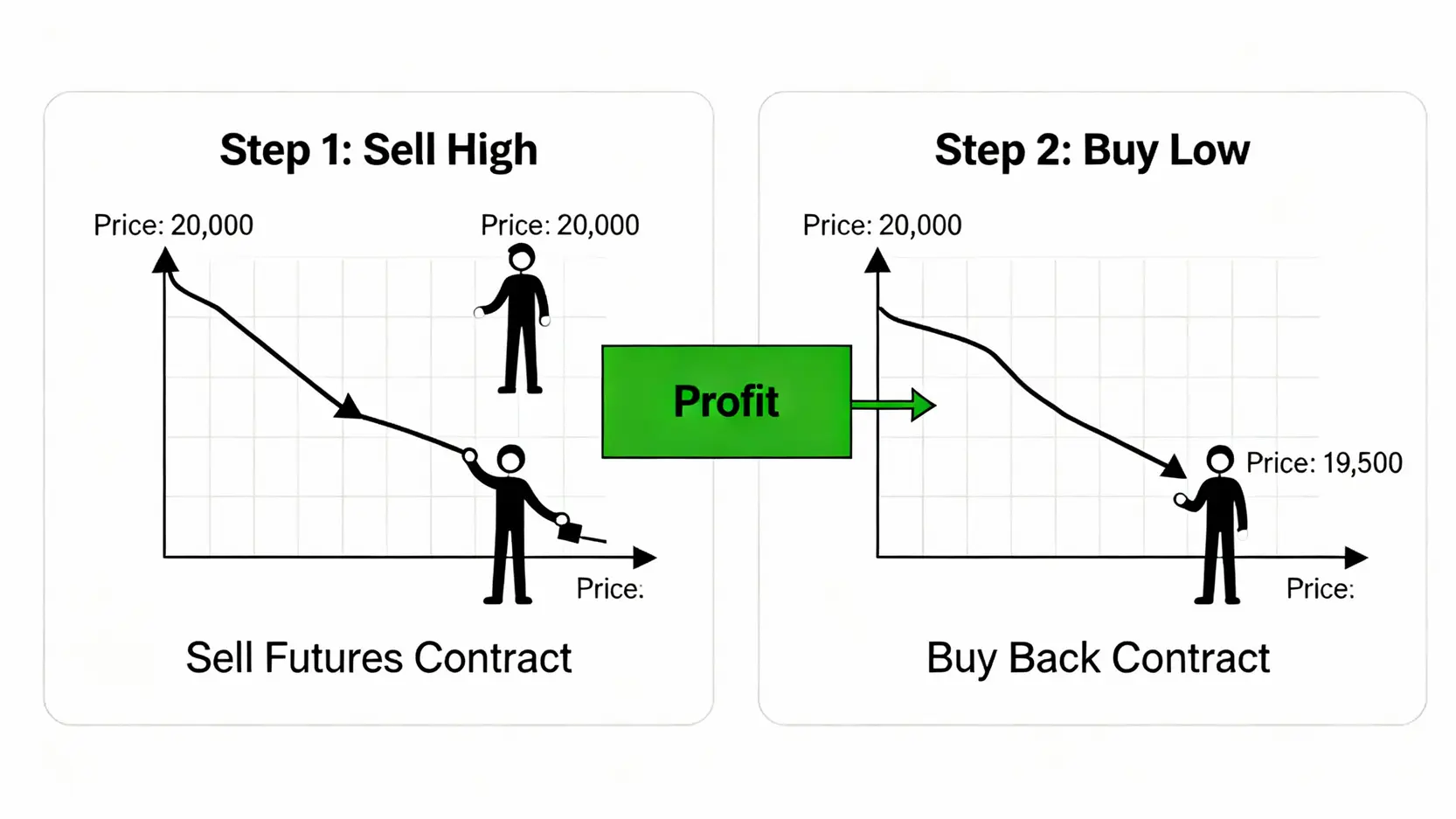
Traditional investing follows the principle of “buy first, sell later”, purchasing at a low price and selling at a higher price to earn a profit. Futures short selling is the exact opposite. Its core logic is “sell first, buy later”. The operational process is as follows:
- Expect a decline, establish a short position: You anticipate a market decline, so you “sell” a futures contract at a high level that you do not actually hold. This is called “establishing a short position” or “opening a short”.
- Price declines, close the position for profit: When the market price falls as expected, you “buy” the same futures contract at a lower level to offset your previous short position. This action is called “closing the position”.
- Earn the price difference: The difference between the selling price and the buying price, after deducting transaction costs, constitutes your profit. For example, if you short one Hang Seng Index futures contract at 20,000 points and later close the position at 19,500 points, you earn a profit of 500 points.

This “sell first, buy later” mechanism is precisely the key reason why futures short selling becomes a powerful profit tool in a declining market.
Futures Short Selling vs Stock Short Selling: What Are the Differences in Operation and Costs?
Although both involve short selling, futures short selling and stock short selling differ significantly in practical operations and cost structures. For investors, understanding these differences is crucial.
Comparison Item Futures Short Selling Stock Short Selling
| Underlying Instrument | Standardized futures contracts, such as index futures and commodity futures. |
Stocks of individual listed companies. |
| Leverage Effect | Built in high leverage, requiring only a portion of the contract value as “margin” to trade. | Requires borrowing shares through a margin (securities lending) account, with relatively lower leverage. |
| Borrowing Cost | No borrowing cost, only trading commission and margin are required. | Requires payment of borrowing interest, and the longer the holding period, the higher the cost. |
| Expiration Date | Has a clear expiration settlement date and cannot be held indefinitely. | Theoretically has no expiration date, but the broker has the right to call the loan at any time. |
| Short Selling Restrictions | Fewer restrictions, flexible trading. | Subject to the “uptick rule”, and not all stocks are eligible for short selling. |
Why Choose Short Index Futures? An Analysis of Liquidity and Hedging Advantages
Among the many futures products available for short selling, index futures, commonly (referred to as “index futures”), such as Hang Seng Index Futures (HSIF), are the preferred choice for many professional investors. There are two main reasons:
- High liquidity and low transaction costs: Mainstream index futures markets (such as the Hang Seng Index and the S&P 500 Index) have substantial daily trading volumes and extremely tight bid ask spreads. This means investors can enter and exit the market at prices close to market value at any time, without worrying about liquidity risk such as being unable to buy or sell.
- Effective portfolio hedging: If you hold a basket of stocks but are concerned about a short term market pullback, shorting index futures is a highly efficient hedging tool. Because an index represents overall market performance, when the market declines, losses in your stock portfolio can be offset by profits from shorting index futures, thereby protecting your assets. The cost of this hedging approach is far lower than selling each stock in your portfolio individually.
Complete Futures Short Selling Tutorial: 5 Steps to Complete a Trade From Scratch
With the theory covered, it is time to move into practice. Using the most common Hang Seng Index futures as an example, the following outlines a complete futures short selling process that even beginners can easily follow.

Step One: Choose and Open an Account That Supports Futures Trading
First, you need a securities or futures account that supports “derivatives trading” or “futures trading”. Not all stock accounts have this function enabled by default. When opening the account, the broker will usually require you to complete a questionnaire regarding derivatives knowledge to ensure that you understand the associated risks.
Step Two: Understand and Deposit Sufficient “Initial Margin” and “Maintenance Margin”
This is the core concept of futures trading. Since futures involve leveraged trading, you do not need to pay the full contract value, but only deposit a sum called “margin”.
- Initial Margin: The minimum amount of capital required to establish a position, (whether long or short).
- Maintenance Margin: The minimum level of funds that must be maintained in your account after a position is opened. If market conditions move against you and your account balance falls below the maintenance margin level, the broker will issue a “Margin Call”, requiring you to deposit additional funds up to the initial margin level, otherwise your position will be forcibly closed.
Margin levels are adjusted periodically by the exchange based on market volatility. You can check the latest margin requirements on the Hong Kong Exchanges and Clearing website. Understanding the margin system is an essential lesson before engaging in futures short selling. For more detailed guidance, refer to Yuanta Futures Deposit Guide: Process, Account and Margin Explained in One Article!.
Step Three: Select the Appropriate Futures Contract (Using Hang Seng Index Futures as an Example)
Taking Hang Seng Index Futures as an example, you need to select which contract month to trade. Generally, the most liquid contract is the “front month contract”. You should also pay attention to the contract type. For example, the “large contract” (HSIF) has a value of HK$50 per point, while the “mini contract” (MHI) has a value of HK$10 per point. Beginners may start with the lower threshold “mini contract”.
Step Four: Place a “Sell” Order and Set a Stop Loss Order
In the trading platform, select the contract you wish to trade and place a “sell” order. Suppose you believe that 20,000 points is a resistance level for the Hang Seng Index, you may set your short selling order at that price level.
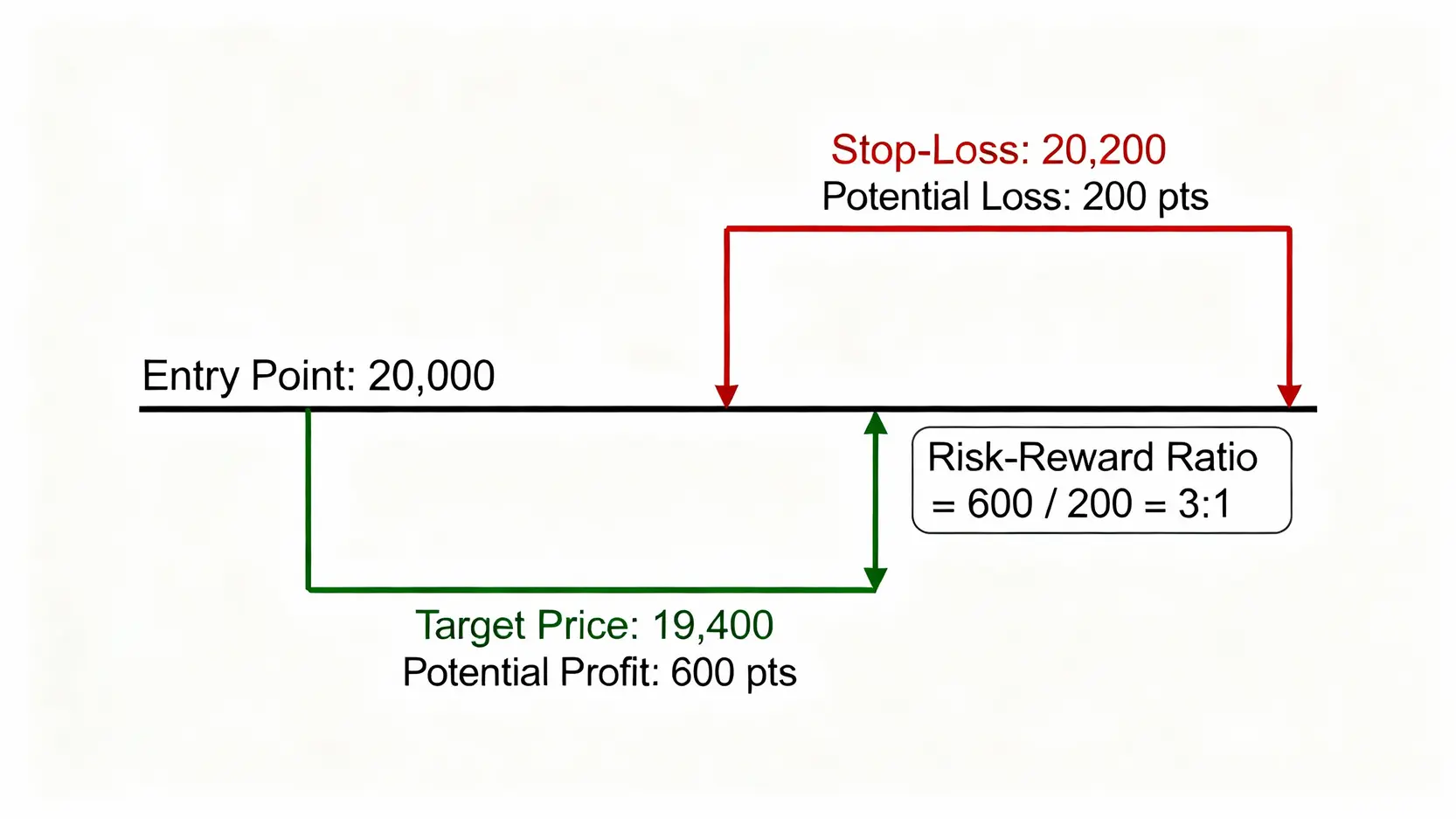
🚨 Extremely Important: At the time of placing the order, you must set a “Stop Loss Order”. Since the theoretical loss of futures short selling is unlimited (as prices can rise indefinitely), the stop loss order is your most important safety measure. For example, if you short at 20,000 points, you may set a stop loss at 20,200 points. If the price rises instead of falls and reaches this level, the system will automatically close your position, limiting your loss to 200 points.
Step Five: “Close the Position” at the Right Time to Lock In Profit or Loss
After establishing your short position, you need to closely monitor market conditions. When the price falls to your target level, for example 19,500 points, you can place a “buy” order to close the position and lock in a profit of 500 points. Conversely, if market conditions do not develop as expected, in addition to relying on the stop loss order, you may also choose to close the position manually in advance to control losses.
Further Reading (Highly Recommended)
How to Buy Apple Stock? A Beginner’s 5 Step Guide: From Currency Exchange to Placing an AAPL Order
3 Essential Index Futures Short Selling Strategies and Risk Management for Beginners
After mastering the basic futures short selling operations, the next step is learning when it is the right time to short. Below are three common strategies, along with the most important principles of risk management.
Strategy One: Follow the Trend, Short in Line With the Downtrend
“The trend is your friend” is a well known market saying. When the market has formed a clear downward trend (for example when prices continue to make new lows and remain below major moving averages), shorting in line with that momentum usually offers a higher probability of success. The core of this strategy is to avoid “guessing the top”. Do not attempt to predict where the market peak is. Instead, wait for confirmation of the downtrend before entering. To learn more about trend identification techniques, you may start with moving average tutorials.
Strategy Two: Short at Resistance Levels, Deploy at Key Technical Levels
Another common strategy is to use technical analysis to identify key “resistance levels” on the chart. A resistance level refers to a price zone where prices have repeatedly risen to that level but failed to move higher, subsequently reversing downward. When the price rebounds to a significant resistance level, it may present a potential short selling opportunity, as it indicates concentrated selling pressure at that level. Combining this with other indicators, (such as trading volume and RSI) can improve the accuracy of your judgment.
Risk Management: How to Calculate the Risk Reward Ratio and Control Potential Losses?
Any futures short selling operation must prioritize risk management. Before establishing a position, you must ask yourself three questions:
- Where is the stop loss level? (If I am wrong, how much am I willing to lose at most?)
- Where is the target price? (If I am right, how much profit do I expect to earn?)
- Is the Risk Reward Ratio reasonable?
Risk Reward Ratio = Potential Profit / Potential Loss

A healthy trade should have a risk reward ratio of at least 1.5:1 or above. In other words, the potential profit should be at least 1.5 times the loss you are willing to bear. If a trade offers only 100 points of potential profit but carries a potential loss of 200 points, it is not worthwhile and should be decisively abandoned. Strict adherence to the risk reward ratio principle is key to long term survival in the market.
Frequently Asked Questions About Futures Short Selling (FAQ)
Q: What is the greatest risk of futures short selling? Is unlimited loss possible?
A: Yes, theoretically the greatest risk of futures short selling is unlimited loss. Since asset prices can rise indefinitely, after you short, if the price rises instead of falls, every additional point of increase adds to your loss. This differs from a “long position”(buy), where the maximum risk is losing your entire principal. Therefore, setting a stop loss order is an indispensable discipline in short selling operations, used to confine potentially unlimited risk within a controllable range.
Q: How much capital is required to short index futures?
A: The required capital depends on the initial margin requirement of the futures contract you trade. Using Hong Kong Hang Seng Index futures as an example, the “initial margin” for one “mini contract” is slightly above HK$10,000, while one “large contract” requires more than HK$100,000 (although margin levels are adjusted according to market conditions). However, never prepare only the exact amount of required margin. It is advisable to maintain account funds at least two to three times the initial margin to provide sufficient buffer against market volatility and avoid margin calls or forced liquidation.
Q: What is a “short squeeze”? How should you respond when shorting?
A: A “short squeeze” refers to a sudden and sharp rise in asset prices without fundamental support, forcing a large number of short position holders to buy back at higher prices to stop losses. This panic driven covering further pushes prices higher, forming a vicious cycle. The best way to respond to a short squeeze is: 1) strictly execute stop losses and exit decisively once the stop loss level is reached, without wishful thinking; 2) control position size and avoid excessive leverage, ensuring that the loss of a single position will not cause devastating damage to your total capital.
Conclusion
In summary, futures short selling is an efficient tool commonly used by professional investors when they are bearish on the market outlook. It provides the opportunity to profit in declining markets and serves as a powerful instrument for hedging portfolio risk. However, high return potential is accompanied by equal or even greater risk. By fully understanding its operating principles and strictly implementing risk management measures, including calculating the risk reward ratio, controlling position size, and setting stop losses, even beginners can gradually master this operation. It is hoped that this index futures short selling tutorial has laid a solid foundation for you, enabling flexible responses under different market conditions and helping you make more informed investment decisions.
Related Articles
-
How to Get Started with Bitcoin? The Complete 2026 Bitcoin Buying Guide for Beginners After watching Bitcoin repeatedly reach new highs in recent years and successfully pass spot ETF reviews in the US and Hong Kong in 2024, officially entering mainstream financial markets, many investors have turned their attention to...2026 年 7 月 20 日
-
Is Gold’s V-Shaped Rebound a Bottom-Fishing Signal? A Complete Guide to Trading Strategies Amid “$100 Price Swings” What Is a Gold V-Shaped Rebound? More Than Just a Technical Pattern The gold market has recently experienced sharp rises and falls, with prices frequently displaying dramatic “gold V-shaped rebounds”. Single-day “$100 price...2026 年 7 月 20 日
-
What Is PPI Data? 2026 Latest Analysis: Understand the Differences from CPI and How It Affects Stock Market Trends With market information constantly changing, do you always hold your breath while waiting for CPI data to be released? But did you know that a more forward-looking inflation indicator, PPI data...2026 年 7 月 20 日