Forex Short Selling Guide 2026: Short USD & HKD

Updated: 2026/03/04  |  CashbackIsland

外匯沽空教學 | 2026最新指南:一文看懂如何沽空美元、港幣賺取差價

Forex Short Selling Tutorial | 2026 Latest Guide: Understand in One Article How to Short the US Dollar and Hong Kong Dollar to Profit From Price Differences

When the market broadly expects a currency (such as the US dollar or the Hong Kong dollar) to depreciate, do you only think of exchanging cash and miss potential profit opportunities? In fact, through “Forex short selling”, you can generate profits even in a declining market. This “sell first, buy later” strategy allows investors to profit from the price difference when a currency falls and is an essential skill for professional traders. This article will provide a detailed breakdown of the core concepts of Forex short selling and offer specific analyses of methods to short the US dollar and short the Hong Kong dollar, helping you master this powerful tool in a bear market and uncover trading opportunities regardless of market direction. 


What Is Forex Short Selling? Core Concepts Every Beginner Must Understand

Before exploring how to short the US dollar or the Hong Kong dollar, you must first understand the underlying logic of Forex short selling. In simple terms, short selling is an investment operation based on the expectation that an asset’s price will decline. Unlike the traditional “buy low, sell high”, short selling follows the principle of “sell high, buy low”.


The Principle of Short Selling: Sell First, Buy Later, Profit From the Downward Price Difference

The concept of Forex short selling may sound abstract. Let us illustrate it with a simple example:

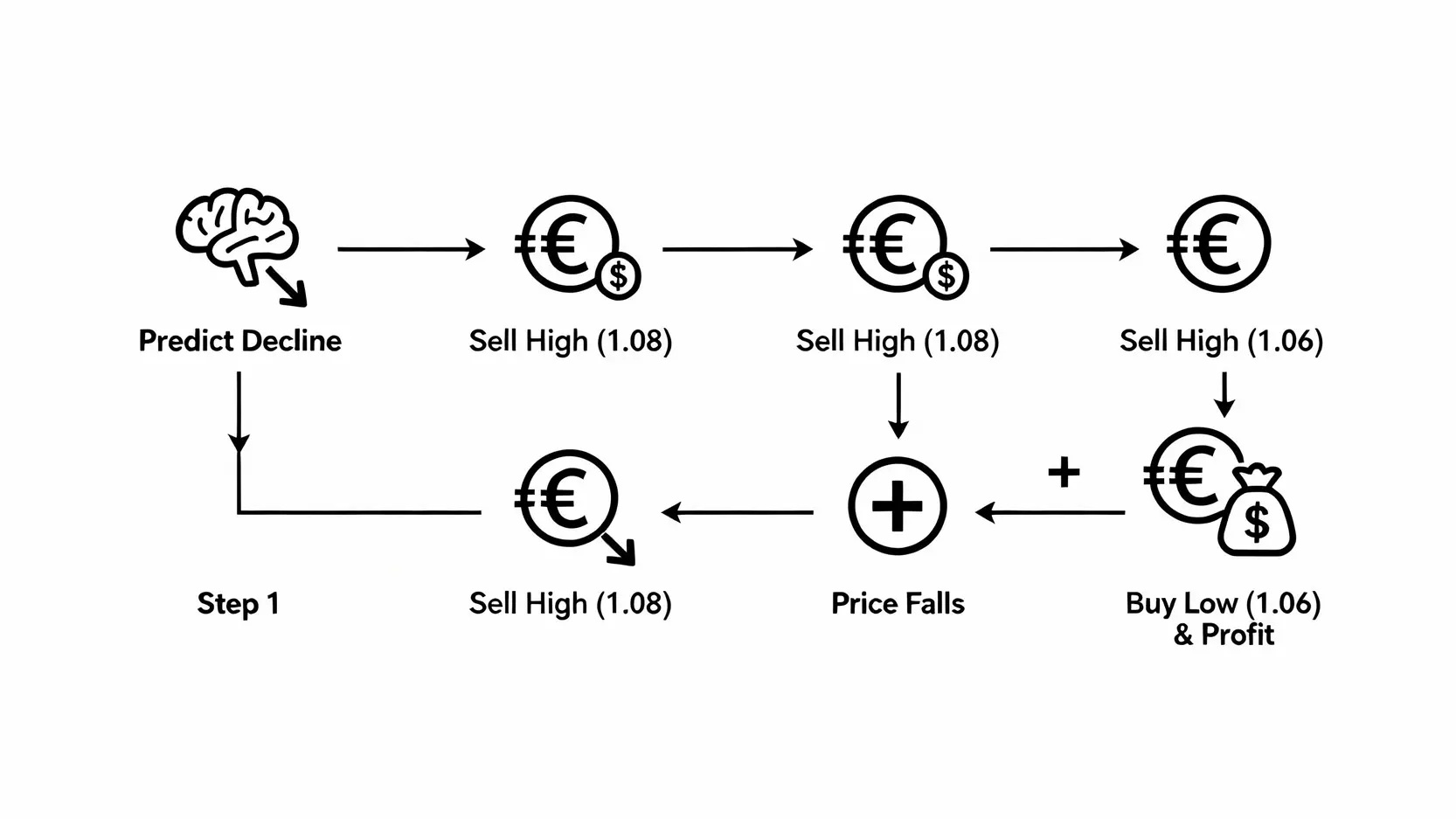
  1. Forecast the direction: After analysis, you believe that the current EUR/USD exchange rate of 1.08 is too high and expect it to decline in the future.
  2. Execute the short (sell): Through a Forex trading platform, you “borrow” euros and sell them at 1.08 in exchange for US dollars. This step is the “short” or “open short position”.
  3. Market declines: As expected, EUR/USD falls to 1.06.
  4. Close the position for profit (buy): At this point, you buy back the same amount of euros at the lower price of 1.06 and “return” them to the platform.
  5. Earn the price difference: The difference between selling and buying (1.08 minus 1.06 equals 0.02) is your profit (after deducting transaction costs).

Throughout the process, you never actually held euros but instead generated returns from the decline in the exchange rate. This is the core appeal of Forex short selling.

外匯沽空四步驟流程圖,展示如何透過預測跌勢、高賣、低買來賺取價差。

The Principle of Forex Short Selling: Four Simple Steps to Understand the Logic of “Sell First, Buy Later”.


Why Short Forex? Hedging Risk and Speculative Profit

Investors short currencies mainly for two purposes:

  • Speculative profit: This is the most common motivation. When traders, based on technical or fundamental analysis, determine that a currency is likely to weaken, they may short it to generate profit. For example, if the US Federal Reserve is expected to cut interest rates, which may weaken the US dollar, traders may consider shorting the US dollar.
  • Hedging risk: For companies or investors holding substantial foreign currency assets, Forex short selling is an effective hedging tool. For instance, if a Hong Kong company has significant US dollar receivables and is concerned that a depreciation of the US dollar may result in exchange losses, it can short the US dollar in the Forex market to lock in value and hedge against potential downside risk.


Short Selling vs Going Long: The Operational Differences Between Two Market Directions

To better understand short selling, we can compare it with the more familiar “long position”:

Comparison Item Long

Short

Market Expectation Bullish 🟢 Bearish 🔴
Order of Operation Buy First, Then Sell Sell First, Then Buy
Method of Profit Profit From Price Appreciation Profit From Price Decline
Potential Return Theoretically Unlimited Maximum Return Is 100% (Price Falls to Zero)
Potential Risk Maximum Loss Is the Entire Principal Theoretically Unlimited (Price Can Rise Indefinitely)

Understanding the fundamental differences between the two is the foundation for developing a two way trading strategy. A mature trader should be able to flexibly choose between going long or short based on market direction.

做多與沽空策略對比圖,顯示兩者在市場預期、操作方向和獲利方式上的根本差異。

Long vs Short: Understand the Core Operational Differences Between the Two Market Directions in One Illustration.


Further Reading (Highly Recommended)

CFD Trading Strategies: The Complete 2026 Guide to Avoiding 7 Major Fatal Risks!

How to Choose Forex Trading? 2025 Latest Forex Broker Recommendations and Comparison – Cashback Island


How to Short the US Dollar? A Comprehensive Analysis of Three Mainstream Methods

As the world’s primary reserve currency, fluctuations in the US dollar have far reaching impacts. When the market signals a bearish outlook on the US dollar (such as weak US economic data or accommodative monetary policy), investors may adopt the following methods to deploy short positions.


Method One: Short the US Dollar Index or Currency Pairs Through CFDs

Contract for Difference (CFD) is currently the most commonly used tool for retail investors to short the US dollar. It features high leverage, low entry threshold, and two way trading.

  • Short the US Dollar Index (DXY): The US Dollar Index measures the value of the US dollar against a basket of six major currencies (including the euro, Japanese yen, and British pound). If you expect the US dollar to weaken broadly, shorting the US Dollar Index CFD is the most direct approach.
  • Short US Dollar Currency Pairs: Select a currency you expect to strengthen relative to the US dollar, then short a currency pair where the US dollar is the base currency, or go long on a currency pair where the US dollar is the quoted currency. For example:
    • Go long EUR/USD: This is equivalent to buying euros and selling US dollars, that is, bearish on the US dollar.
    • Go long GBP/USD: This is equivalent to buying British pounds and selling US dollars.
    • Short USD/JPY: This is equivalent to selling US dollars and buying Japanese yen.
    • Short USD/CAD: This is equivalent to selling US dollars and buying Canadian dollars.


Method Two: Use Forex Futures Contracts to Establish Short Positions

Forex futures are standardized contracts traded on exchanges, where buyers and sellers agree to exchange a specified amount of currency at a predetermined price on a future date. Shorting US dollar futures means selling a contract that commits you to sell US dollars at a specified price in the future.

Compared with CFDs, Forex futures offer higher transparency and centralized clearing. However, the disadvantages are larger contract sizes, higher capital requirements, and expiration date constraints, making them more suitable for well capitalized professional investors or institutional participants.


Method Three: Purchase Inverse ETFs to Indirectly Short the US Dollar

An Inverse ETF is a fund designed to track the daily inverse return of an underlying asset. There are ETFs specifically designed to short the US Dollar Index, such as the Invesco DB US Dollar Index Bearish Fund (UDN). When the US Dollar Index declines by 1 percent, the net asset value of this ETF should theoretically increase by approximately 1 percent.

This method is simple to operate, similar to trading stocks. However, it is important to note that inverse ETFs may experience tracking error and management fees, and long term holding may result in performance deviation, making them more suitable for short term trading.


A High Difficulty Challenge: Methods and Historical Background of Shorting the Hong Kong Dollar

Compared with shorting the US dollar, shorting the Hong Kong dollar is exponentially more difficult and is even regarded as a “mission impossible”. The reason lies in Hong Kong’s unique monetary policy, the Linked Exchange Rate System.


Why Is It So Difficult to Short the Hong Kong Dollar? Understanding the Linked Exchange Rate System

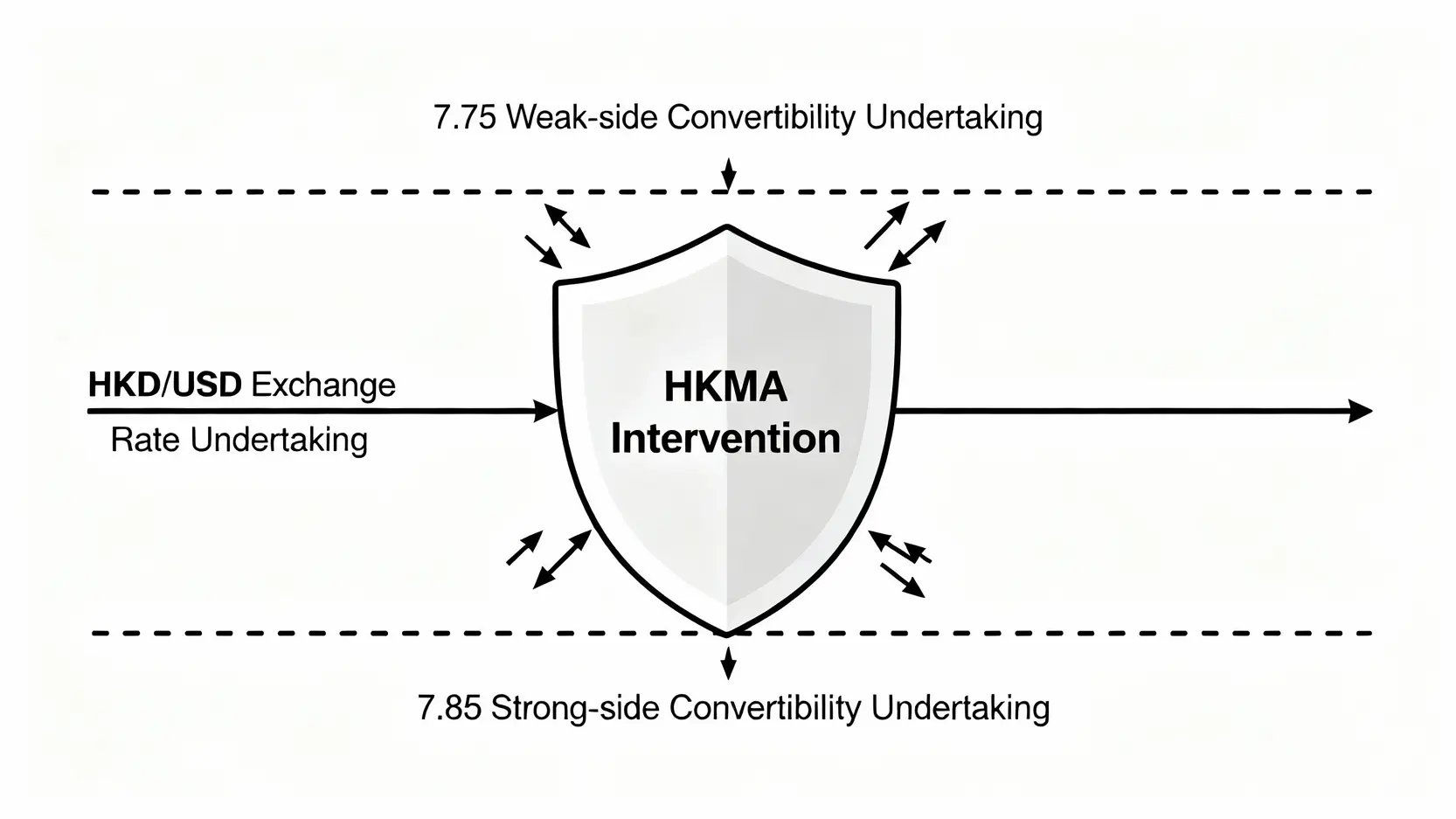
Since 1983, Hong Kong has implemented the Linked Exchange Rate System, pegging the Hong Kong dollar to the US dollar. The Hong Kong Monetary Authority (HKMA) undertakes to buy and sell Hong Kong dollars in unlimited quantities within the band of 7.75 (weak-side convertibility undertaking) and 7.85 (strong side convertibility undertaking) to maintain exchange rate stability. This means:

  • When the Hong Kong dollar exchange rate reaches 7.85, the HKMA will enter the market to sell US dollars and buy Hong Kong dollars, causing the Hong Kong dollar to appreciate.
  • When the Hong Kong dollar exchange rate reaches 7.75, the HKMA will enter the market to buy US dollars and sell Hong Kong dollars, causing the Hong Kong dollar to depreciate.

香港聯繫匯率制度示意圖,展示港元在7.75至7.85區間內波動,以及金管局如何干預以維持匯率穩定。

Hong Kong’s Linked Exchange Rate System: Why Shorting the Hong Kong Dollar Is a “Mission Impossible”.

Behind this system stands Hong Kong’s substantial foreign exchange reserves. Any attempt to massively short the Hong Kong dollar and challenge the linked exchange rate is effectively a direct confrontation with the financial strength of the Hong Kong government, with an extremely low probability of success.


A Historical Lesson: How Soros Attacked the Hong Kong Dollar in 1998?

During the 1998 Asian Financial Crisis, international speculators led by George Soros launched a fierce attack on the Hong Kong dollar. Their strategy was highly complex and not limited to shorting the Hong Kong dollar spot market. Instead, they adopted a “dual market strategy”:

  1. Short Hong Kong dollar futures: They sold Hong Kong dollars heavily in the currency market to create depreciation expectations.
  2. Short Hang Seng Index futures: Speculators anticipated that to defend the exchange rate, the Hong Kong government would have to sharply raise interest rates, leading to soaring rates and a significant decline in the stock market. Therefore, they simultaneously shorted index futures in the equity market.

Their calculation was that whether the government chose to rescue the currency market or the stock market, they would profit significantly in the other market. Ultimately, the Hong Kong government deployed substantial foreign exchange reserves to intervene directly in both the stock and currency markets, successfully repelling the speculators. Although the victory came at a high cost, it demonstrated the extreme difficulty of shorting the Hong Kong dollar.


Potential Modern Tools for Shorting the Hong Kong Dollar and Analysis of Extremely High Risks

Although extremely difficult, in theory there are still instruments available to short the Hong Kong dollar, but the risks are substantial:

  • Hong Kong dollar futures and options: By selling Hong Kong dollar futures contracts or purchasing Hong Kong dollar put options to speculate on depreciation.
  • Offshore renminbi and Hong Kong dollar cross currency pairs: Indirect operations through other currency pairs.

⚠️ Risk Warning: For ordinary investors, any attempt to short the Hong Kong dollar is akin to using a mantis’ arm to stop a chariot. Due to the existence of the Linked Exchange Rate System, the downside potential of the Hong Kong dollar is extremely limited, while failure may result in significant losses. Retail investors are strongly advised not to attempt to short the Hong Kong dollar.


Selection and Comparison of Forex Short Selling Platforms

Choosing a secure, reliable, and powerful trading platform is the first step in successfully executing a Forex short selling strategy. A good platform should feature low costs, high efficiency, and strong regulatory oversight.


Comparison of Mainstream Forex Broker Platform Features

When selecting a platform, the following key factors should be considered comprehensively:

Evaluation Criteria Description Precautions
Regulatory License Whether the platform is regulated by top tier financial authorities, such as the UK FCA and the Australian ASIC. This is the most important safeguard for fund security. Be sure to choose a platform that holds a top tier regulatory license.
Trading Costs (Spread) The difference between the bid and ask price, which constitutes the primary trading cost. The lower the spread, the better. Note that floating spreads may widen significantly during periods of high market volatility.
Leverage Ratio The leverage multiple offered by the platform, which can amplify both profits and losses. Beginners should start with low leverage and avoid excessive use of leverage.
Account Type Different account types (such as standard accounts and ECN accounts) have varying spread and commission structures. Select the most suitable account type based on your trading frequency and capital size.
Deposit and Withdrawal Convenience Whether multiple deposit and withdrawal methods are supported and the speed of processing. Give priority to platforms with clear withdrawal procedures and no unreasonable delays.


Account Opening Process and demo account Practice

The account opening process with a regulated Forex platform is usually simple and efficient, mainly including the following steps:

  1. Register an account: Fill in basic personal information.
  2. Identity verification, KYC: Upload identification documents (such as a passport or identity card) and proof of address (such as a utility bill within the past three months).
  3. Deposit funds: Deposit margin through various methods such as bank transfer or credit card.
  4. Download the trading platform: Usually MT4 or MT5. After logging in, you can start trading.

For beginners, before committing real funds, it is strongly recommended to use the free demo account provided by the platform. A demo account uses virtual funds, but market data is synchronized with the real market. It is the best way to familiarize yourself with platform operations, test trading strategies, and experience market fluctuations without any capital risk. 

Frequently Asked Questions About Forex Short Selling, FAQ

Q: Is shorting the Hong Kong dollar legal?

A: Yes, shorting the Hong Kong dollar itself is a legal market activity in Hong Kong. However, due to the Linked Exchange Rate System, the Hong Kong Monetary Authority has the determination and substantial foreign exchange reserves to maintain exchange rate stability. Therefore, although legal, the probability of success in shorting the Hong Kong dollar is extremely low and the risk is very high. For the vast majority of investors, it is not a prudent choice.

Q: What is the greatest risk of Forex short selling?

A: The greatest risk of Forex short selling is theoretically unlimited loss. When you go long, the maximum loss is your entire principal (if the price falls to zero). However, when you short, if the market moves against your expectation and the price continues to rise, theoretically it can rise indefinitely. This may cause your losses to expand continuously and even exceed your initial margin (triggering forced liquidation).

Q: How much margin is required to short Forex?

A: The required margin depends on three factors: the trade size in lots, the leverage ratio provided by the platform, and the currency pair traded. The formula is: Required Margin = (Contract Value × Trade Size) / Leverage Ratio. For example, with 100:1 leverage, trading one lot (100,000 units) of EUR/USD requires approximately 1,000 euros in margin. The higher the leverage, the lower the required margin, but the greater the risk.

Q: What is the difference between shorting the US dollar and shorting US stocks?

A: The underlying assets are entirely different. Shorting the US dollar targets the value of the US dollar as a currency, typically through Forex currency pairs (such as EUR/USD) or the US Dollar Index. Shorting US stocks targets the share price of a specific US listed company, such as Apple or Tesla, and is usually conducted through a stock broker or CFD platform. The analytical logic and influencing factors are also completely different.


Conclusion

In summary, Forex short selling is a powerful two way trading tool. Especially when bearish on the outlook of the US dollar or a specific currency, it provides an effective profit strategy. It enables investors to find opportunities in declining markets and achieve asset appreciation. However, behind high return potential lies equal or even greater risk. In particular, leverage amplifies both profits and losses. For currencies such as the Hong Kong dollar, which are strictly protected by policy, short selling is an extremely high risk operation that ordinary investors should avoid. Before engaging in actual trading, investors must thoroughly understand the leverage effect, set stop losses properly, and manage position size carefully. It is strongly recommended to begin with a demo account, accumulate sufficient experience, and only then move to live trading. Choose a top tier regulated platform and begin your Forex short selling learning journey!

Related Articles

  • Volatility Surface Guide: Skew Trading Strategies
    Practical Applications of Volatility Surfaces: From Options Modeling to Advanced Skew Trading Strategies In options markets, implied volatility is never a flat line. Instead, it forms complex "smile" or "skew" surfaces. For advanced traders, mastering the practical applications of volatility surfaces is equivalent to possessing a lens that reveals market...
    2026 年 6 月 3 日
  • Foreign Capital Flow Model: Track Institutional Money
    Building a Foreign Capital Flow Copy Trading Model: A Stock Market Indicator for Accurately Tracking Institutional Positioning In Asia-Pacific stock markets, foreign capital inflows and outflows often determine the direction of the index. However, simply looking at daily net buy and sell data is no longer enough. Only by building...
    2026 年 6 月 3 日
  • Options Buying Strategies for Extreme Market Risks
    Options Buyer Strategies During Extreme Market Conditions: Black Swan Hedging and Cross-Market Arbitrage During Volatility Surges The most terrifying aspect of financial markets is not a gradual decline, but overnight flash crashes and cross-market capital withdrawals accompanied by volatility surges. In the highly unpredictable global macroeconomic environment of 2026, geopolitical...
    2026 年 6 月 3 日
返回顶部