Allianz South African Rand Fund: 5 Risks Explained

Updated: 2026/03/04  |  CashbackIsland

安聯南非幣基金好唔好?5大關鍵風險拆解,高配息背後的真相

Is Allianz South Africa Currency Fund Good? 5 Key Risks Explained, the Truth Behind High Dividends

In recent years, the Allianz Income and Growth Fund South Africa currency version (Allianz Income and Growth Fund AM Dis (ZAR)) has successfully attracted the attention of many investors seeking stable cash flow with its astonishingly high dividend yield. However, do you truly understand that behind the seemingly attractive Allianz Income and Growth Fund dividends lies the significant risk brought by South Africa currency exchange rate fluctuations? Many people are dazzled by the halo of “stable monthly dividends”, yet overlook the harsh reality that they may ultimately “earn dividends but lose on price”. So, is the Allianz South Africa currency fund good? This article will provide an in-depth analysis of the true nature of this fund, from its investment strategy and dividend structure to the most critical Allianz South Africa currency risks, helping you comprehensively assess whether this investment is a source of asset appreciation or a trap that erodes principal. 


Understanding the Allianz Income and Growth Fund South Africa Currency: Why Is It So Special?

To determine whether an investment is good or bad, you must first understand its internal structure and operating model. The reason this fund has sparked widespread discussion in the market mainly stems from its unique asset allocation and choice of pricing currency.


Core Fund Strategy: Breaking Down Its Mixed Allocation of Stocks and Bonds

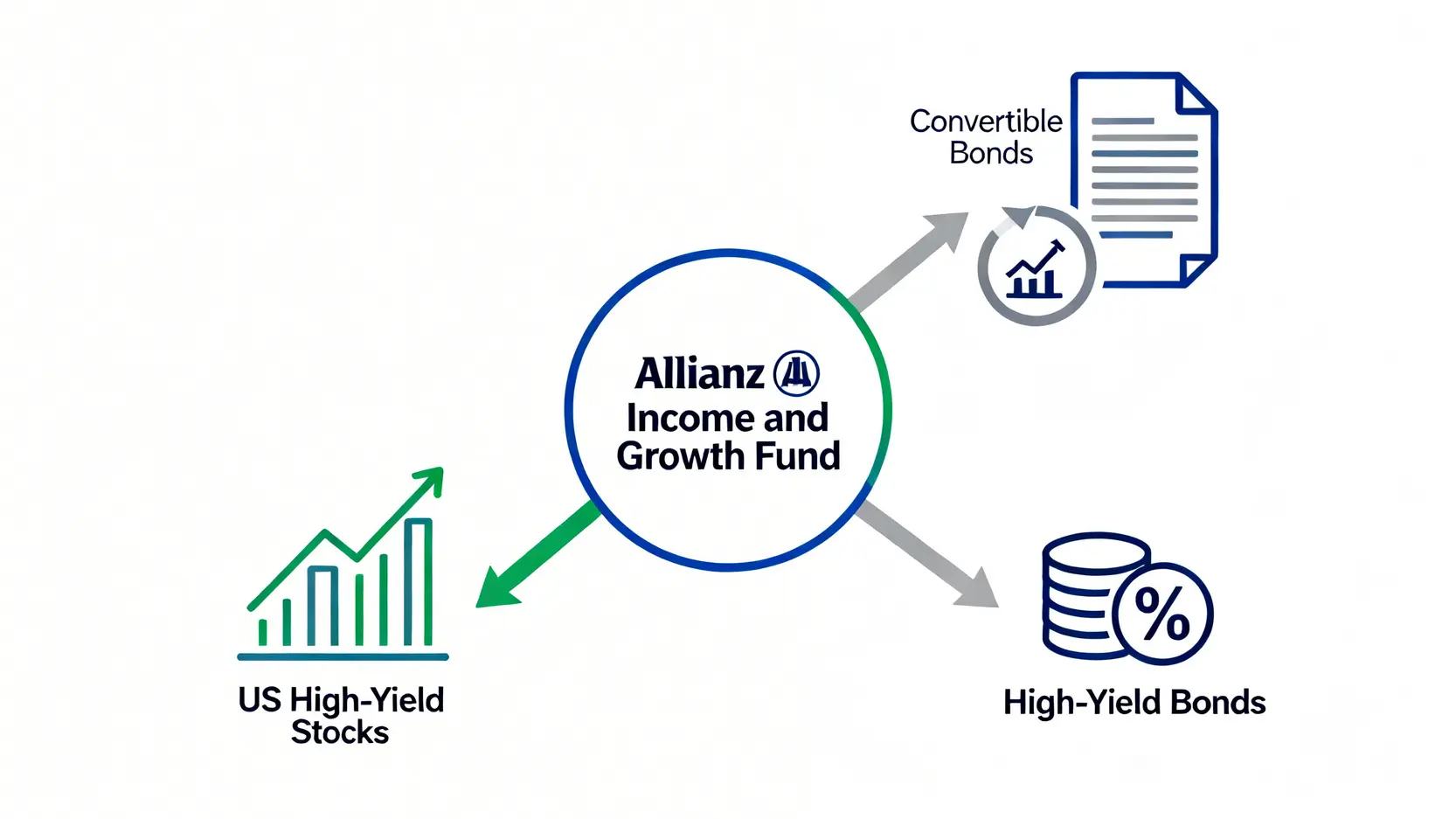
The Allianz Income and Growth Fund is neither a pure equity fund nor a pure bond fund, but a typical “mixed asset allocation fund”. Its portfolio mainly consists of three major components:

  • US High-Yield Stocks: The fund invests in large US companies with high dividend potential, aiming to earn capital appreciation and dividend income.
  • Convertible Bonds: These bonds grant holders the right to convert them into company shares under specific conditions. They combine the stability of bonds with the growth potential of equities and are an important tool for the fund in pursuing returns.
  • High-Yield Bonds: Also known as “junk bonds”, these are bonds issued by companies with lower credit ratings. Although they carry higher default risk, they offer interest rates far higher than investment-grade bonds and are the main source used to boost the dividend yield.

安聯收益成長基金的三大核心資產配置示意圖,包含美國高收益股票、可轉換債券與高收益債券。

The Allianz Income and Growth Fund portfolio mainly consists of stocks, convertible bonds, and high-yield bonds, aiming to balance growth and income.

This “stock-bond mix” strategy is theoretically designed to balance risk and return under different market conditions, with the equity portion pursuing growth while the bond portion provides relatively stable cash flow.


Why Is There a South Africa Currency Denomination? Revealing the Attraction and Trap of High-Interest-Rate Currencies

In addition to mainstream currencies such as the US dollar and euro, this fund specifically offers a South Africa currency (ZAR) denominated share class, which is precisely the secret behind its extremely high dividend yield. As an emerging market country, South Africa has long maintained benchmark interest rates at relatively high levels, far exceeding those of developed economies such as the US and Europe. Through “currency carry trade” operations, the fund company converts the US dollar assets primarily held by the fund into South Africa currency, thereby earning the substantial interest rate differential between the two and distributing this portion of income to investors as dividends.

Attraction: An extremely high nominal dividend yield that satisfies investors’ desire for cash flow.
Trap: Emerging market currencies such as the South Africa currency are highly susceptible to global economic conditions, political risks, and commodity prices, resulting in significant volatility. This means that although investors receive high monthly dividends, the net asset value of the fund they hold may shrink substantially due to sharp depreciation of the South Africa currency.


The Temptation of High Dividends: A Complete Record of Allianz Income and Growth Fund Dividend Performance

For many investors, the dividend yield is the most intuitive indicator when evaluating a fund. However, focusing only on the dividend yield without examining its source and its impact on total return is one of the most common mistakes in investing.


Dividend Data Backtest for the Past Three Years: Is the Annualized Dividend Yield Really That Attractive?

The table below is a hypothetical example of the recent dividend situation of the Allianz Income and Growth Fund South Africa currency share class (Note: This is illustrative data and not actual performance):

Year Annualized Dividend Yield (Approx.) Annual South Africa Currency to US Dollar Exchange Rate Change (Approx.)

Total Return Including Dividends (Approx.)

2024 18%

-10%

+8%
2025 20% -15% +5%
2026 19% +5% +24%

*The above data is for illustrative purposes only and does not represent the fund’s actual or future performance.

From the table, it can be seen that even if the annualized dividend yield is as high as 18%–20%, as long as the South Africa currency experiences significant depreciation, the investor’s actual total return will be substantially reduced. In other words, the interest you earn may very likely be eroded by exchange rate losses. Only when the South Africa currency exchange rate remains stable or appreciates can investors truly enjoy the benefits brought by high dividends.


Be Alert! How “Dividends May Be Paid Out of Capital” Affects Your Total Return

In the fund’s official prospectus, you will always see a warning: “Dividends may be paid out of capital”. This sentence is crucial. It means that the interest distributed by the fund in the current period does not come entirely from profits generated by investments (dividends, bond interest, capital gains); part of it may be directly drawn from your investment principal to pay you.

When this occurs, it will cause the fund’s net asset value (NAV) to decline. Although you receive cash every month, the total value of your assets may be decreasing. It is like taking money from your left pocket and putting it into your right pocket, while still paying fund management fees, which is highly detrimental to wealth accumulation in the long run. Therefore, when evaluating fund performance, you must not look only at the dividend yield, but focus on the “total return including dividends”, which is the true gold standard for measuring whether you are actually making money.


5 Major Allianz South Africa Currency Risks You Must Face Before Investing

After understanding how the fund operates, we must confront its significant potential risks. Regarding the question of whether the Allianz South Africa currency fund is good, risk assessment is the core part of making a decision. 

[Greatest Risk] South Africa Currency Exchange Rate: Why Does Your Fund NAV Always Fluctuate So Significantly?

This is the single largest source of risk when investing in this fund. The South Africa currency is a typical emerging market currency, and its value is highly dependent on global commodity prices (such as gold and platinum) as well as South Africa’s domestic political and economic stability. When global risk aversion rises and the US dollar strengthens, the South Africa currency often depreciates sharply. This means:

  • Asset value shrinks: Even if the US stocks and bonds held by the fund rise in price, once converted into South Africa currency denomination, your fund NAV will decline.
  • Earning dividends but losing on price: The high dividends received are completely insufficient to offset the principal losses caused by exchange rate depreciation. This is also the main reason why many investors, after holding for a long period, find that their total assets have decreased rather than increased.


[Credit Risk] Proportion of High-Yield Bonds: What Happens When Companies Default?

In pursuit of high interest income, the fund allocates a considerable portion to high-yield bonds. The issuers of such bonds are mostly companies with weaker credit profiles. When the economy enters a recession cycle and corporate profitability declines, the risk of default (failure to pay interest or repay principal) increases significantly. Once a default occurs, it will directly lead to a decline in the fund’s NAV.


[Capital Loss] Real Case Analysis of Earning Interest but Losing Principal

Let us use a simple example to illustrate the dilemma of “earning dividends but losing on price”:

  • Principal invested: Suppose you invest 100,000 Hong Kong dollars.
  • Dividends received: After one year, you receive 18,000 Hong Kong dollars in dividends (annualized dividend yield of 18%).
  • Exchange rate loss: During the same period, the South Africa currency depreciates by 20% against the Hong Kong dollar.
  • Current value of principal: Your 100,000 Hong Kong dollars principal, due to exchange rate losses, is now worth only 80,000 Hong Kong dollars.
  • Final result: Your total assets become 80,000 (principal) + 18,000 (dividends) = 98,000 Hong Kong dollars. On the surface, you earned high dividends, but in reality you incurred a loss of 2,000 Hong Kong dollars.
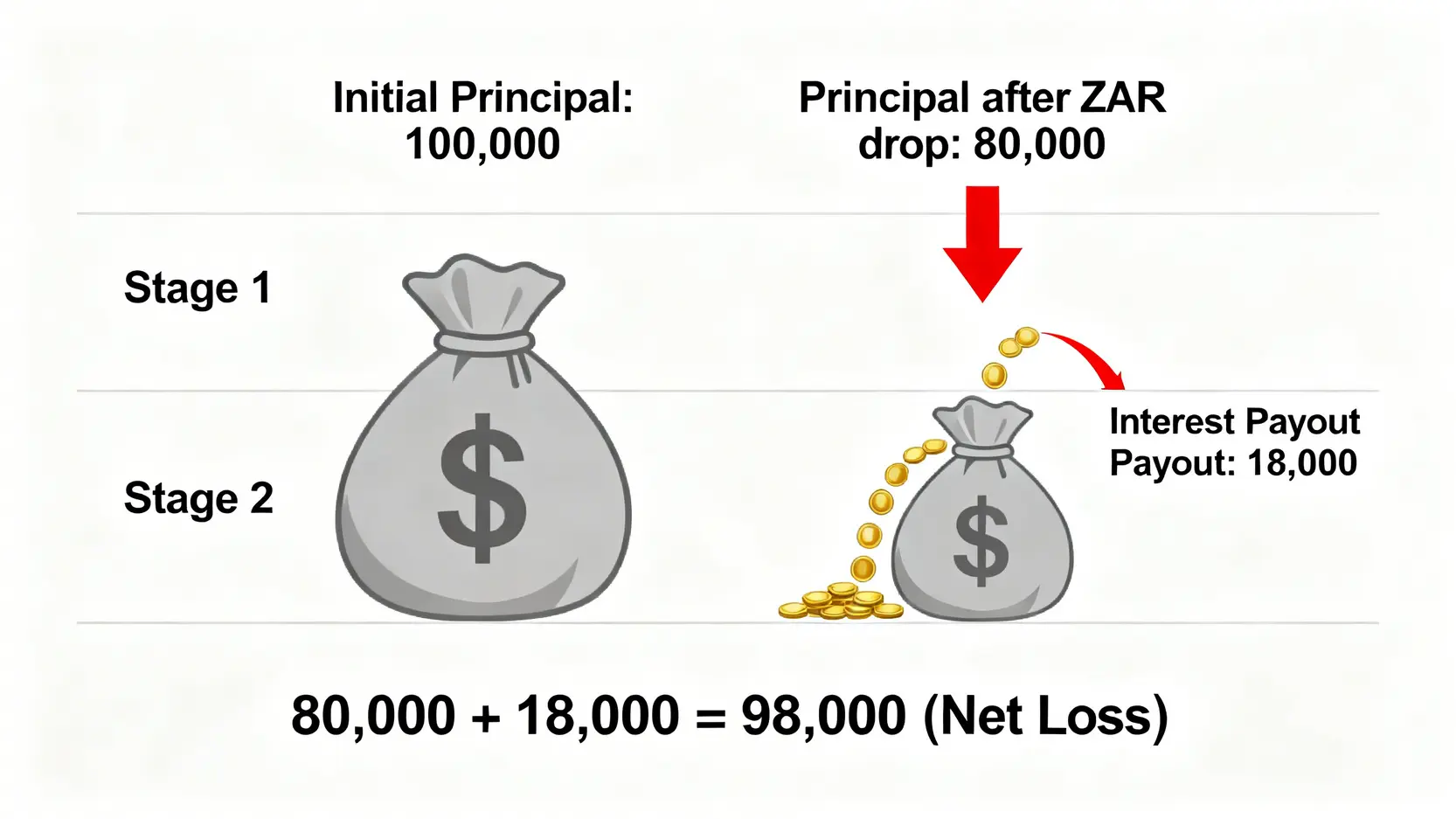
賺息蝕價概念圖,顯示初始本金因南非幣匯率貶值而縮水,即使加上高額配息,最終總資產仍為虧損。

Earning dividends but losing on price: Even after receiving 18% in high dividends, a 20% exchange rate depreciation will still cause your total assets to decline.

This example clearly reveals the core issue of Allianz South Africa currency risk: the destructive impact of exchange rate fluctuations far exceeds the attraction of high dividends. 

[Market Risk] How Does US Interest Rate Policy Affect Fund Performance?

The fund’s primary assets are located in the US. The Federal Reserve’s interest rate policy directly affects both its equity and bond positions:

  • Rate-hike cycle: Generally unfavorable to bond prices and may put pressure on the stock market, leading to a decline in the fund’s NAV.
  • Rate-cut cycle: Generally favorable to rising bond prices and may also stimulate the stock market, positively affecting the fund’s NAV.

Investors need to closely monitor global macroeconomic developments, especially the direction of US monetary policy.


[Liquidity Risk] Potential Trading Issues of Emerging Market Currencies

Although the South Africa currency is a relatively actively traded emerging market currency, during extreme periods of market panic, its liquidity may dry up rapidly, leading to wider bid-ask spreads. Investors may face unfavorable prices when redeeming the fund. This is a risk that is easily overlooked in normal times but becomes extremely important during crises.


Is the Allianz South Africa Currency Fund Good? Real Reviews From PTT/Dcard Users

On popular Taiwanese forums such as PTT and Dcard, discussions about the Allianz Income and Growth Fund South Africa currency have never ceased, and investor opinions are quite polarized.


Supporters’ View: Suitable for Investors Seeking Cash Flow?

Investors who support this fund usually focus on its ability to generate stable passive income. Their main viewpoints include:

  • Extreme cash flow: For retirees or those who require fixed monthly income, high dividends provide a stable source of cash.
  • Diversification tool: Some investors regard it as a satellite asset, allocating a small portion of funds to pursue high dividends without overly concerning themselves with NAV fluctuations.
  • Timing strategy: Some more aggressive investors attempt to capture South Africa currency exchange rate cycles, buying at relatively low points in hopes of earning both interest differentials and exchange rate gains.


Opponents’ View: Why Is It Not Recommended for Long-Term Investment?

The opposing voices are even louder. Most of them are long-term holders who have personally experienced the pain of “earning dividends but losing on price”. Their core arguments include:

  • Poor total return: In the long run, exchange rate losses often erode most or even all dividend income, resulting in low or negative total returns.
  • Risk and return are disproportionate: Investors bear extremely high exchange rate and credit risks, yet the eventual long-term returns may be inferior to those of a stable global equity ETF.
  • Significant psychological pressure: Large fluctuations in the fund’s NAV pose a substantial test to investors’ psychological tolerance and are unsuitable for conservative or novice investors. To build a long-term stable investment portfolio, assets with lower volatility should be chosen.


Frequently Asked Questions (FAQ)

Q: What Type of Investors Is the Allianz Income and Growth Fund South Africa Currency Suitable For?

A: This fund is mainly suitable for highly experienced investors with extremely high risk tolerance, a strong demand for cash flow, and a deep understanding of emerging market currency risks. It is more appropriate as a short-term or tactical trading tool, or as a very small satellite allocation within a highly diversified portfolio. For most conservative investors whose objective is long-term wealth appreciation, this is not an ideal choice.

Q: How Can I Check the Latest Dividend Information and NAV of This Fund?

A: You can obtain the latest information through the following channels:

  1. Allianz Global Investors Official Website: The official website publishes the most authoritative fund NAV, dividend history, and prospectus.
  2. Fund Distribution Platforms: Such as the websites or apps of banks, securities firms, or online fund trading platforms.
  3. Financial Information Websites: For example, Morningstar and Anue, which provide detailed fund data and analysis.

Q: Besides South Africa Currency, What Other Currency Classes Are Available for This Fund?

A: The Allianz Income and Growth Fund offers multiple currency share classes, including US dollar (USD), euro (EUR), and Australian dollar (AUD). Although the dividend yields of these mainstream currency classes are far lower than that of the South Africa currency class, their exchange rate risks are also relatively much lower, and NAV fluctuations are more stable. For investors unwilling to bear excessive exchange rate risk, the US dollar denominated fund would be a more prudent alternative.

Q: Are the Fund’s Extremely High Dividends Guaranteed?

A: Absolutely not guaranteed. The fund’s dividend yield may be adjusted according to market conditions, the actual returns of the investment portfolio, and changes in currency interest differentials. When market conditions are unfavorable, such as narrowing interest differentials or investment losses, the fund company may reduce the dividend yield or even suspend dividend distributions. Therefore, past high dividend yields must not be regarded as a commitment for the future.


Conclusion

Overall, the Allianz Income and Growth Fund South Africa currency is a double-edged sword. By utilizing the interest rate differential of high-interest-rate currencies, it has successfully created an extremely attractive high dividend yield. However, beneath this “sugar coating” lies the “poison” of South Africa currency exchange rate volatility. Investing in this fund is essentially a speculative bet on the South Africa currency exchange rate rather than a prudent long-term investment.

Before deciding whether to allocate capital, be sure to ask yourself several questions: Can you withstand a potential short-term loss of 20% or even more of your principal? Do you have sufficient confidence in the economic and political outlook of South Africa? Is your core investment objective cash flow or long-term growth of total assets?

Rather than blindly chasing unattainable high dividends, it is better to return to the essence of investing and build a diversified asset allocation aligned with your own risk tolerance. For most investors, choosing lower-risk US dollar denominated funds or more diversified global market ETFs may be the more practical and steady path toward financial freedom.

If you liked this article, please share it!

Related Articles

  • Volatility Surface Guide: Skew Trading Strategies
    Practical Applications of Volatility Surfaces: From Options Modeling to Advanced Skew Trading Strategies In options markets, implied volatility is never a flat line. Instead, it forms complex "smile" or "skew" surfaces. For advanced traders, mastering the practical applications of volatility surfaces is equivalent to possessing a lens that reveals market...
    2026 年 6 月 3 日
  • Foreign Capital Flow Model: Track Institutional Money
    Building a Foreign Capital Flow Copy Trading Model: A Stock Market Indicator for Accurately Tracking Institutional Positioning In Asia-Pacific stock markets, foreign capital inflows and outflows often determine the direction of the index. However, simply looking at daily net buy and sell data is no longer enough. Only by building...
    2026 年 6 月 3 日
  • Options Buying Strategies for Extreme Market Risks
    Options Buyer Strategies During Extreme Market Conditions: Black Swan Hedging and Cross-Market Arbitrage During Volatility Surges The most terrifying aspect of financial markets is not a gradual decline, but overnight flash crashes and cross-market capital withdrawals accompanied by volatility surges. In the highly unpredictable global macroeconomic environment of 2026, geopolitical...
    2026 年 6 月 3 日
返回顶部