Exotic FX Pairs: Risks & Trading Strategies

Updated: 2026/04/03  |  CashbackIsland

exotic-currency-pairs-trading-guide

Are Exotic Currency Pairs a Blessing or a Trap? An In-Depth Analysis of Investment Risks and High-Probability Trading Strategies

Have you heard that exotic currency pairs (also known as Exotic Pairs) hide significant profit opportunities, yet hesitate due to their high risks? Are you curious about what exotic currency pairs mean, and how to develop effective trading strategies while fully understanding their investment risks? This market is full of opportunities, but also filled with traps. This article provides you with a complete practical guide, from basic concepts to risk assessment, and further to expert-level trading techniques, helping you master the key to navigating this highly volatile market in one go. 


What Exactly Are Exotic Currency Pairs? How Do They Differ From Major and Minor Pairs?

In the forex market, currency pairs are generally divided into three categories: major pairs, minor pairs (also known as cross pairs), and today’s focus, exotic currency pairs. Understanding their differences is the first step to entering this field.


Definition of Exotic Currency Pairs: Understand Exotic Pairs in One Article

Exotic currency pairs, as the name suggests, are pairs composed of one major currency (such as the US dollar USD or the euro EUR) and the currency of an emerging market or smaller economy. For example, US dollar vs South African rand (USD/ZAR), Euro vs Turkish lira (EUR/TRY) and US dollar vs Mexican peso (USD/MXN) all fall into this category. They are referred to as “minor” or “exotic” because of their relatively low trading volume and fewer market participants. To learn more about forex fundamentals, you can refer to this 2026 forex trading beginner’s guide.


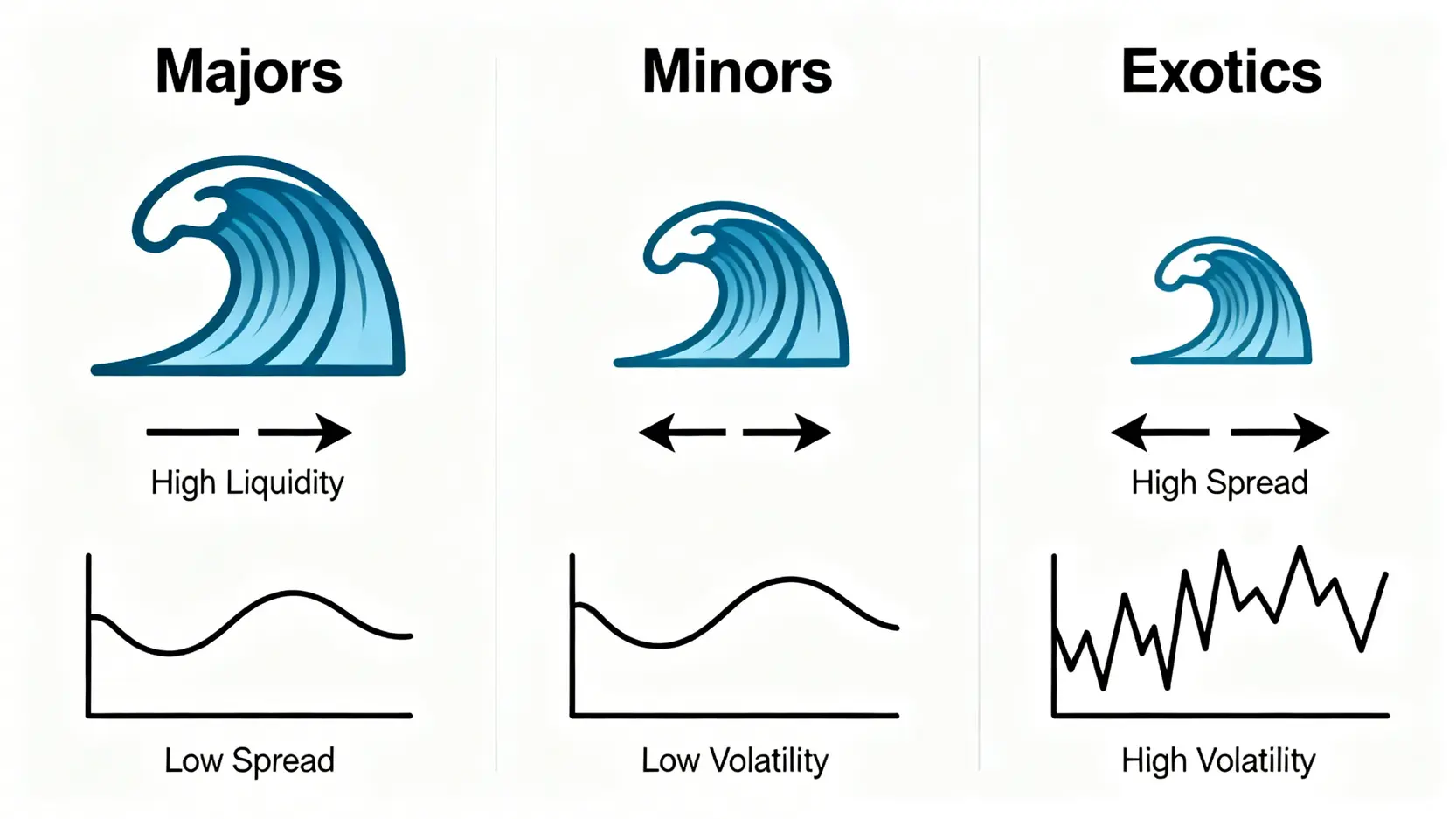
Chart Comparison: Differences in Volume, Spreads, and Volatility Among Exotic, Major, and Minor Currency Pairs

To help you better understand the differences, a comparison table is provided below:

Characteristics Major Currency Pairs (Majors)

Minor Currency Pairs (Minors/Crosses)

Exotic Currency Pairs (Exotics)

Composition Examples EUR/USD, USD/JPY, GBP/USD EUR/GBP, EUR/JPY, AUD/CAD USD/ZAR, EUR/TRY, USD/SGD
Market Liquidity Very High High Low
Trading Volume Huge

Relatively Large

Small
Bid-Ask Spread (Spread) Very Low Relatively Low Very high
Price Volatility Relatively Low Moderate Extremely high
Trading Costs Low Moderate High

主要、次要與冷門貨幣對在流動性、點差和波動性上的視覺化比較圖表。

Core Comparison of Major, Minor, and Exotic Currency Pairs

From the table, it is clear that exotic currency pairs exhibit distinct characteristics of “low liquidity, high spreads, and high volatility”, which are exactly where both their appeal and risks originate.

The Temptation of High Returns: 3 Key Advantages of Trading Exotic Currency Pairs

Despite their higher risks, exotic currency pairs continue to attract many traders. Their unique market characteristics offer potential opportunities that major pairs cannot match.

Advantage 1: Significant Price Volatility Creates Large Short-Term Profit Opportunities

High volatility is the most attractive feature of exotic pairs. Due to shallow market depth, a single piece of important economic data or political news can trigger movements of hundreds or even thousands of pips. For traders skilled in capturing trends and breakouts, this means far greater profit potential compared to relatively stable major pairs. A successful trade can generate substantial returns in a short period of time.

Advantage 2: Low Correlation with Mainstream Markets Enhances Portfolio Diversification

Exotic currencies are often driven more by their domestic economic conditions and tend to have lower correlation with global mainstream markets (such as US equities or the US dollar index). This makes them an effective diversification tool. When mainstream markets are consolidating or declining, certain exotic pairs may move independently due to country-specific factors, helping to spread overall portfolio risk.

Advantage 3: Country-Specific Economic Events Make Fundamental Analysis More Predictive

Compared to currencies like the US dollar or euro, which are influenced by multiple complex factors, exotic currencies tend to have more concentrated and straightforward drivers. Traders can focus on a specific country’s central bank decisions, inflation data, employment reports, and political developments. For those who deeply study a particular economy, fundamental analysis may offer stronger predictive value and clearer trading opportunities driven by single events.

High-Risk Warning: 5 Critical Risks You Must Understand Before Trading Exotic Currency Pairs

Before being drawn in by high returns, it is essential to recognize the significant risks involved. Ignoring these warnings is one of the main reasons many traders lose money in the exotic currency market.

Risk 1: Low Liquidity Makes Trade Execution Difficult

This is one of the most critical risks. Low liquidity means fewer buyers and sellers in the market. During periods of high volatility, your orders may not be filled at expected prices (due to slippage), or worse, you may not be able to exit positions quickly, causing losses to expand.

Risk 2: High Trading Costs Due to Wide Spreads

Because of low liquidity, brokers often offer much wider spreads to hedge their own risk. This means that the moment you open a position, you are already at a disadvantage. High transaction costs can significantly erode profits, especially for short-term traders who require larger price movements just to break even.

Risk 3: Political and Economic Instability Increases Exposure to Unexpected Events

Many exotic currencies belong to emerging markets, where political and economic conditions can be unstable. Events such as political upheaval, disputed elections, or sudden trade sanctions can cause rapid currency depreciation. These “black swan” events are difficult to predict and can have severe consequences. Understanding the background of Exotic Currency Pairs is therefore essential.


Risk 4: Low Information Transparency Makes Analysis More Challenging

Compared to developed economies, emerging markets may have less transparent or timely economic data, and in some cases, questionable data reliability. There is also less coverage from major financial media, making both fundamental and technical analysis more difficult and uncertain.

Risk 5: Leverage Amplifies Both Gains and Losses

Forex trading typically involves high leverage. When applied to highly volatile exotic pairs, leverage becomes a double-edged sword. While it can amplify profits, it can also accelerate losses at an alarming rate. Without strict risk management, a single mistake can result in a margin call or even complete account loss.

象徵冷門貨幣對高風險高回報的平衡蹺蹺板,一端是金幣,另一端是風險警示。

Exotic Currency Pairs: A Delicate Balance Between High Returns and High Risk


Further Reading (Highly Recommended)

2026 Forex Trading Beginner Guide: Master Risk Management and Broker Selection for Consistent Profitability!


Win with Stability: 3 Professional Trading Strategies for Exotic Currency Pairs

After understanding both the advantages and risks, the next step is how to execute effectively in real trading. Professional traders do not rely on luck, but on a structured and disciplined trading strategy to navigate the market.

Strategy 1: Trend Following and Breakout Strategy with Strict Stop Loss Discipline

Once a trend forms in exotic currency pairs, it often persists for an extended period, making trend following a highly effective approach. Traders can use indicators such as Moving Averages and Bollinger Bands to identify the direction of the trend and enter on pullbacks. At the same time, breakout strategies around key support and resistance levels can be applied, entering trades when price decisively breaks important levels. Regardless of the method used, the most critical rule is to set a strict stop loss at the time of entry to protect against sudden reversals. 

Strategy 2: Fundamental Analysis Focused on a Single Country

For traders who prefer in-depth research, it is advisable to focus on one or two exotic currency pairs and closely monitor the macroeconomic conditions of those countries. Key factors include:

  • Central bank interest rate decisions: Rate hikes are generally bullish for the currency, while rate cuts are bearish.
  • Inflation data (CPI): High inflation may lead to rate hikes, and vice versa.
  • GDP growth: Reflects the overall health of the economy.
  • Political stability: Elections and geopolitical risks can significantly impact currency value.

Positioning trades around major economic releases or events can often capture the most significant market movements.

Strategy 3: Risk Management First with Smaller Position Sizes and Hedging

This is the most important principle and the key to long-term survival in the market. Given the high risk of exotic pairs, traders should follow these rules:

  • Reduce position size: Allocate significantly less capital compared to major pairs, ideally no more than 1%–2% of total capital per trade.
  • Lower leverage: Use conservative leverage to avoid excessive exposure.
  • Consider hedging: If holding a long position in an exotic currency, consider shorting a correlated currency or allocating to safe-haven assets (such as gold) to partially offset risk.

交易冷門貨幣對的風險管理流程圖,強調設定小倉位和嚴格停損。

Pre-Trade Risk Management Checklist

Prioritizing forex trading risk management is essential for long-term consistency.


Frequently Asked Questions About Exotic Currency Pairs (FAQ)

Q: Are exotic currency pairs suitable for beginners?

A: Generally, they are not recommended for beginners. Due to high volatility, high transaction costs, and low liquidity, they require strong psychological discipline, risk management skills, and analytical ability. Beginners should start with major currency pairs, build experience, and only later allocate a small portion of capital to exotic pairs.

Q: When is the best time to trade exotic currency pairs?

A: The optimal trading time is when the trading sessions of the exotic currency’s country and its corresponding major currency (such as USD or EUR) overlap. For example, trading Euro vs Turkish Lira (EUR/TRY) is best during the overlapping hours of European and Turkish sessions, when liquidity is relatively higher and spreads may narrow.

Q: How can you select promising exotic currency pairs?

A: You can evaluate from several perspectives: 1) Choose countries you are familiar with, such as trading USD/ZAR if you understand South Africa’s economy. 2) Focus on economies undergoing clear macroeconomic shifts (such as entering a rate hike or rate cut cycle). 3) From a technical perspective, select pairs that have already established a strong directional trend and trade with the trend.

Q: Besides spreads, what hidden costs exist when trading exotic currency pairs?

A: In addition to wide spreads, traders should pay attention to “Overnight Interest” (Swap Fees). Since exotic currencies often have higher interest rates, shorting high-yield currencies (sell) can incur significant daily swap costs, which can erode capital over time. Conversely, going long may generate interest income.

Conclusion

In summary, trading exotic currency pairs is a balance between high risk and high reward. While understanding the meaning of exotic pairs and their profit potential, it is even more important to prioritize their inherent risks. This is not an exaggeration. Exotic pairs are like a wild horse, full of potential but difficult to control. By applying the exotic currency trading strategies outlined in this guide, such as trading with the trend, focusing on fundamentals, and most importantly, maintaining strict risk and capital management, you can improve your probability of success in this complex market. Before committing real capital, it is strongly recommended to practice thoroughly with a demo account and identify a trading rhythm and risk tolerance that suits you. 

If you liked this article, please share it!

Related Articles

  • Volatility Surface Guide: Skew Trading Strategies
    Practical Applications of Volatility Surfaces: From Options Modeling to Advanced Skew Trading Strategies In options markets, implied volatility is never a flat line. Instead, it forms complex "smile" or "skew" surfaces. For advanced traders, mastering the practical applications of volatility surfaces is equivalent to possessing a lens that reveals market...
    2026 年 6 月 3 日
  • Foreign Capital Flow Model: Track Institutional Money
    Building a Foreign Capital Flow Copy Trading Model: A Stock Market Indicator for Accurately Tracking Institutional Positioning In Asia-Pacific stock markets, foreign capital inflows and outflows often determine the direction of the index. However, simply looking at daily net buy and sell data is no longer enough. Only by building...
    2026 年 6 月 3 日
  • Options Buying Strategies for Extreme Market Risks
    Options Buyer Strategies During Extreme Market Conditions: Black Swan Hedging and Cross-Market Arbitrage During Volatility Surges The most terrifying aspect of financial markets is not a gradual decline, but overnight flash crashes and cross-market capital withdrawals accompanied by volatility surges. In the highly unpredictable global macroeconomic environment of 2026, geopolitical...
    2026 年 6 月 3 日
返回顶部