Crude Oil Futures Guide: WTI vs Brent Analysis

Updated: 2026/03/27  |  CashbackIsland

原油期貨走勢全解析:紐約期油(WTI)與布蘭特期油投資指南

Comprehensive Analysis of Crude Oil Futures Trends: An Investment Guide to New York Crude Oil (WTI) and Brent Crude Oil

International oil prices fluctuate frequently. What exactly are “New York crude oil” and “Brent crude oil” often mentioned in the news? For traders looking to participate in crude oil futures investment, this represents both risk and opportunity. Do you also want to understand crude oil futures trends but do not know where to start? This article provides you with the most comprehensive crude oil futures investment guide, from understanding New York crude oil prices to practical trading, helping you grasp market movements and develop your own investment strategy. 


What Are Crude Oil Futures? Why Are They Worth Investing In?

Crude oil, often referred to as “black gold”, is one of the most important industrial raw materials globally, with price fluctuations affecting everything from transportation to the chemical industry. Crude oil futures are standardized contracts that agree to deliver a specified quantity of crude oil at a predetermined price on a future date. They are not only used by physical enterprises for hedging, but also serve as a highly popular investment instrument in financial markets.


Core Concepts of Crude Oil Futures: Contracts, Margin, and Leverage

To enter the crude oil futures market, you must first understand several basic rules:

  • Contract: Futures trading is conducted through individual “contracts”. Each contract clearly specifies the quality of the commodity, quantity (for example, one WTI crude oil futures contract represents 1,000 barrels), delivery month, and location.
  • Margin: You do not need to pay the full contract value to trade. You only need to deposit a certain amount of funds called “margin”. This ensures that you can fulfill your contractual obligations.
  • Leverage: The margin system creates a leverage effect. With a smaller amount of capital, you can control assets worth several times more. This means potential profits can be amplified, but losses can also increase accordingly, making risk management essential.


3 Major Advantages and Potential Risks of Investing in Crude Oil Futures

Crude oil futures investment is attractive mainly due to the following advantages:

  1. High liquidity: With massive daily global trading volume, buying and selling are relatively easy, and it is unlikely to face situations where positions cannot be exited.
  2. Flexible for both long and short positions: The market allows both going long (buying) to profit from rising prices and going short (selling) to profit from falling prices, offering high flexibility.
  3. Price transparency: Prices are determined by global supply and demand, with relatively transparent information and less susceptibility to manipulation by a single entity.

However, high return potential is accompanied by notable risks:

  • High volatility: Oil prices are highly sensitive to geopolitical events and economic data, and can fluctuate sharply in a short period.
  • Leverage risk: Leverage is a double-edged sword. If the market moves against expectations, losses may exceed the margin you invested.
  • Professional threshold: Understanding the factors affecting oil prices requires a certain level of expertise and continuous market monitoring.


Two Major Benchmarks: Comparison Between New York Crude Oil (WTI) and Brent Crude Oil (Brent)

When discussing crude oil futures trends, two benchmarks are commonly mentioned: New York crude oil (WTI) and Brent crude oil (Brent). They are the most important global pricing benchmarks for crude oil, but there are differences between them.

一張比較紐約期油 WTI 與布蘭特期油 Brent 的示意圖,圖中顯示了它們各自的產地、油質特性和市場基準地位。

Understand at a Glance: Key Differences Between WTI Crude Oil and Brent Crude Oil


Analysis of Origin, Oil Quality, and Pricing Differences

The core differences between WTI and Brent come from their physical characteristics and geographical locations:

  • New York crude oil (West Texas Intermediate, WTI):
    • Origin: Mainly sourced from inland oil fields in Texas, US.
    • Oil quality: Classified as “light sweet crude”, with lower density and lower sulfur content, making it cheaper to refine into high-quality products such as gasoline and of higher quality.
    • Pricing: Serves as the benchmark for crude oil pricing in North America, with delivery at Cushing, Oklahoma, US. As an inland delivery point, it is more affected by regional inventory levels and transportation bottlenecks.
  • Brent crude oil:
    • Origin: Derived from a blend of crude oil from four North Sea fields: Brent, Forties, Oseberg, and Ekofisk.
    • Oil quality: Also light sweet crude, but slightly higher in density and sulfur content compared to WTI.
    • Pricing: Acts as the pricing benchmark for more than two-thirds of global crude oil transactions, especially in Europe, Africa, and the Middle East. Its price better reflects supply and demand conditions in the global seaborne market.


Understand at a Glance With a Comparison Table: Which Crude Oil Futures Should I Invest In?

For investors, the choice of which futures to trade depends on your strategy and focus. The table below helps you make a quick decision:

Comparison Item New York Crude Oil (WTI)

Brent Crude Oil (Brent)

Primary Market North American Market Global Market (Europe, Africa, Middle East)
Trading Location New York Mercantile Exchange (NYMEX) Intercontinental Exchange (ICE)
Oil Quality Light Sweet Crude (Higher Quality) Light Sweet Crude (Slightly Inferior to WTI)
Price Sensitivity More Sensitive to US Domestic Inventory, Economic Data, and US Dollar Trends More Sensitive to Global Geopolitics and OPEC+ Production Decisions
Trading Volume Slightly Lower Than Brent Crude Oil Largest Global Trading Volume With Excellent Liquidity
Investment Recommendation Suitable for Traders Focused on Analyzing US Economic Data Suitable for Traders Focused on Global Macro Conditions and Geopolitics


How to Analyze Crude Oil Futures Trends? 5 Key Factors Influencing Prices

Mastering the factors that influence New York crude oil prices and Brent crude oil trends is the first step to successful investing. These factors are complex, but can mainly be summarized as follows:

一張心智圖,展示影響原油價格的四大關鍵因素:供給、需求、地緣政治風險與金融市場。

Four Core Factors Influencing Crude Oil Futures Trends


Geopolitical Risks: OPEC+ Decisions and the Middle East Situation

Crude oil is a highly politicized commodity. Production decisions by the Organization of the Petroleum Exporting Countries and its allies (OPEC+) are key to global supply. Whenever OPEC+ holds meetings to discuss production increases or cuts, it often triggers significant market volatility. In addition, political instability, wars, or sanctions in major oil-producing regions, (such as the Middle East) can immediately raise concerns about supply disruptions, thereby pushing oil prices higher. Investors who wish to gain deeper insights can read this analysis article on the impact of OPEC+ meetings on oil prices

Global Economic Data: The Importance of US Dollar Trends and EIA Inventory Reports

Since international crude oil is priced in US dollars, the strength of the US dollar directly affects oil prices. When the US dollar strengthens, crude oil becomes more expensive for countries using other currencies, potentially reducing demand and putting pressure on oil prices. Conversely, a weaker US dollar supports oil prices. In addition, the weekly crude oil inventory report released every Wednesday by the US Energy Information Administration (EIA) is an authoritative indicator of US supply and demand conditions. If inventories drop significantly, it indicates strong demand and supports oil prices; if inventories increase sharply, the opposite is true.


How Market Sentiment and Speculative Behavior Affect Short-Term Prices

Market sentiment often amplifies price fluctuations. When the market is generally optimistic about future economic prospects, speculators tend to buy large amounts of crude oil futures, pushing prices higher. Conversely, pessimism can trigger sell-offs. Major financial news, analyst reports, and even discussions on social media can influence investor sentiment in the short term, causing rapid changes in crude oil futures trends

Further Reading (Highly Recommended)

What Is a VIX ETF? Can You Profit From the Fear Index? A Complete Guide to VIX ETF Investment and Risks

What Is a Contract for Difference (CFD)? How to Trade CFDs?


How Beginners Can Start Investing in Crude Oil Futures? 3 Main Methods

For general investors, directly participating in crude oil futures investment may involve a high entry barrier. Fortunately, there are now multiple ways to participate in the crude oil market, depending on your budget.

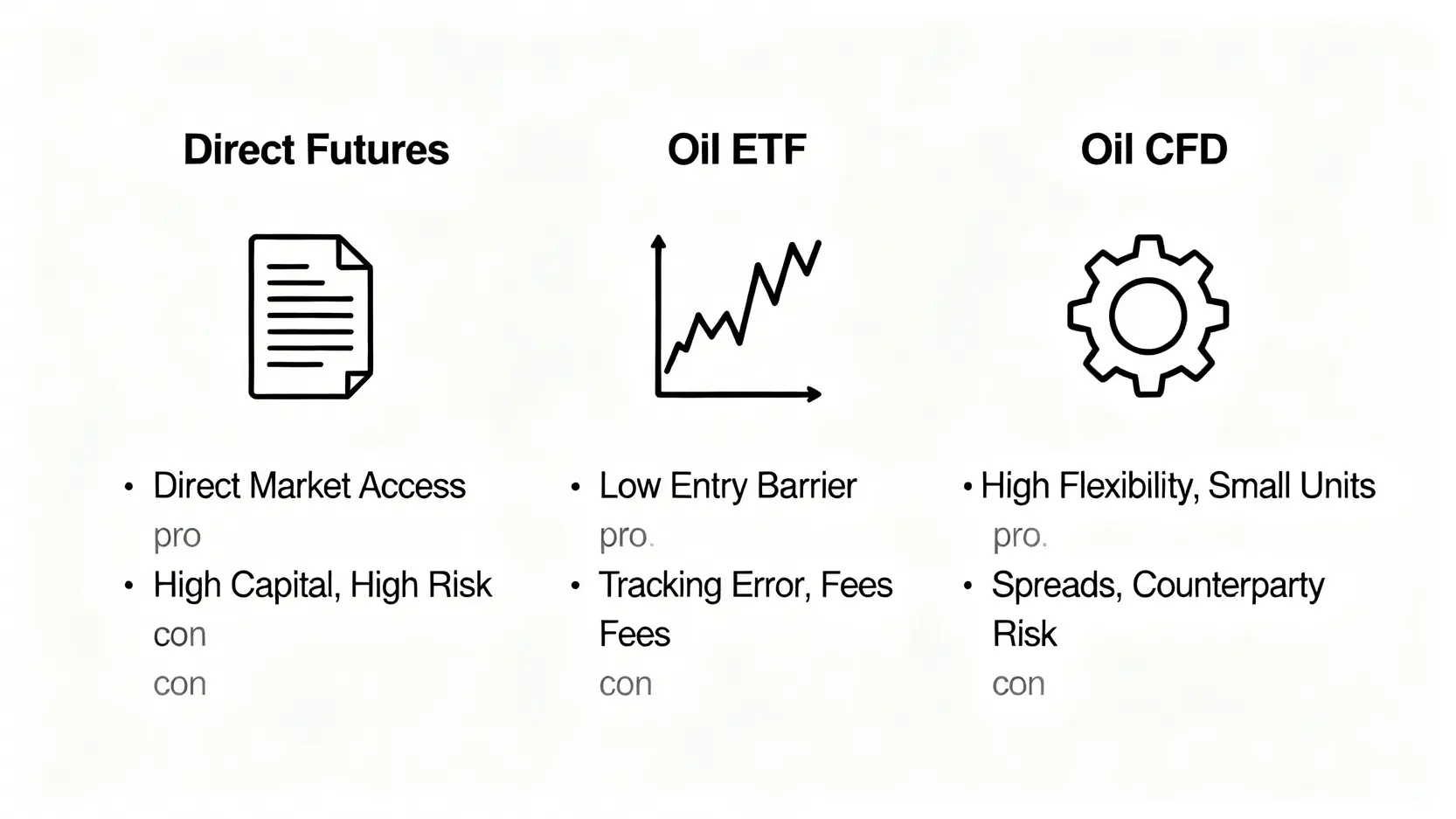
一張比較圖,展示直接期貨、原油 ETF 和差價合約(CFD)這三種原油投資方式的優點與缺點。

Comparison of the Advantages and Disadvantages of Three Crude Oil Investment Methods


Method One: Open a Futures Account to Trade Contracts Directly

This is the most traditional and direct approach. You need to open an account with a specialized futures broker and deposit sufficient margin to trade WTI or Brent crude oil futures contracts directly.

  • Advantages: Direct market participation, relatively low trading costs, and the most accurate reflection of market prices.
  • Disadvantages: High capital requirements, with a single contract often worth tens of thousands of US dollars; high leverage risk, and contracts have expiration dates, requiring “rollover” operations, making it unsuitable for beginners.


Method Two: Invest Indirectly Through Crude Oil ETFs

Investors who do not want to trade futures contracts can consider crude oil ETFs (Exchange-Traded Funds). These ETFs track the performance of crude oil futures prices, allowing you to invest in crude oil as conveniently as trading stocks. For example, the United States Oil Fund (USO) is a well-known ETF that tracks WTI futures prices.

  • Advantages: Low capital requirements, easy to trade, and no need to handle complex contract expiration issues.
  • Disadvantages: Tracking errors may occur, and management fees can reduce profits. In addition, the cost of futures rollover (Contango or Backwardation) can affect the long-term performance of the ETF. For more details, refer to this ETF investment guide.


Method Three: Use Contracts for Difference (CFD) for Flexible Trading

Contracts for Difference (CFDs) are more flexible financial derivatives that allow you to trade based on the price difference between opening and closing positions without actually holding the underlying asset. Many forex and CFD brokers offer crude oil CFD trading.

  • Advantages: Very low entry threshold, allowing trading in units much smaller than a standard contract; flexible leverage, ability to go long or short, and 24-hour trading.
  • Disadvantages: Spreads are usually higher than futures, and overnight interest fees apply. Choosing a reputable and well-regulated platform is crucial. To understand how CFDs work, you can read this detailed introduction on what CFDs are.


FAQ About Crude Oil Futures Investment

Q: Is the entry threshold for crude oil futures investment high? How much capital is required?

A: This depends on the investment method you choose. Directly trading futures contracts has the highest threshold, with margin requirements potentially ranging from several thousand to over ten thousand US dollars. Through crude oil ETFs or CFDs, the threshold is significantly lower, and you can start trading with a few hundred or even tens of US dollars, making it more suitable for investors with small capital.

Q: What was the historical “negative oil price”? Will it happen again in the future?

A: In April 2020, WTI crude oil futures experienced an unprecedented negative price due to a combination of factors such as storage capacity exhaustion and imminent contract expiration. This meant sellers had to pay buyers to take the oil off their hands. Although this was a rare event under extreme market conditions, it highlights the physical delivery nature of futures. If similar global demand collapses and inventory crises occur again, it is theoretically possible, but the probability is extremely low.

Q: What important trading times should be noted when investing in crude oil futures?

A: The crude oil futures market operates nearly 24 hours a day, but the most active trading periods are concentrated during European and US market hours. In particular, during the US morning session Eastern Time (which corresponds to late night in Asia), market volatility and trading volume are at their highest. In addition, the periods around the release of US EIA inventory data every Wednesday and during OPEC+ meetings are times when significant market fluctuations are most likely, requiring extra attention.

Q: What is the difference between investing in crude oil futures and investing in oil stocks?

A: Investing in crude oil futures (or related derivatives) is a direct speculation on “oil prices” with performance closely tied to crude oil trends. Investing in oil stocks (such as ExxonMobil or Shell), involves investing in companies engaged in the oil business. Their stock prices are influenced not only by oil prices but also by factors such as company performance, financial reports, dividend policies, and overall stock market conditions. Therefore, the risk and return dynamics are different.


Conclusion

In summary, crude oil futures investment is full of opportunities, but success depends on a thorough understanding of the market. This article has analyzed the differences between New York crude oil and Brent crude oil and revealed the key factors influencing price trends. Whether you choose to trade futures directly or participate through ETFs or CFDs, continuously monitoring global macroeconomic conditions, geopolitical risks, and maintaining strict risk management will be your first step toward achieving stable returns in this highly volatile market. Start tracking crude oil futures trends now and develop your own investment plan!

编者
Evan Lin

Evan Lin

我是Evan Lin,从大学时期开始接触外汇交易,至今已有多年实战经验,熟悉技术分析与EA策略,热衷于研究市场脉动与风险管控,喜欢分享实战经验和交易技巧,和大家一起学习、一起进步!

If you liked this article, please share it!

Related Articles

  • Order Flow Analysis Tools: Track Institutional Activity
    In-Depth Review of Intelligent Order Flow Detection Tools: Understanding Institutional Activity and Identifying Real Market Buying and Selling Pressure What Is Order Flow, and Why Is It a “Leading Indicator” for Price Prediction? Candlestick charts and technical indicators can be misleading, but the real-money "Order Flow" within the market cannot....
    2026 年 6 月 4 日
  • Social Sentiment Indicators: Predicting Stock Trends
    Social Sentiment Quantitative Indicators: Mining PTT and Dcard Discussions to Predict Stock Prices What Are Social Sentiment Quantitative Indicators, and Why Are They Becoming Increasingly Important? In an era of information overload, financial markets are no longer driven solely by cold financial statements and macroeconomic data. The "Shipping King" phenomenon...
    2026 年 6 月 4 日
  • Taiwan FSC Futures Broker Verification Guide
    Avoid Fraudulent Platforms! A Visual Guide to Taiwan FSC Licensed Futures Merchant Verification and Scam Prevention In recent years, driven by heightened volatility in global financial markets and the impact of monetary easing policies worldwide, more investors have begun seeking diversified investment instruments. However, underground futures operators and overseas fraudulent...
    2026 年 6 月 4 日
返回顶部