Avoid Liquidation: 5 Position & Stop-Loss Techniques

Updated: 2026/04/07  |  CashbackIsland

avoid-liquidation-guide

How to Avoid Liquidation? 5 Professional Position Management and Stop-Loss Techniques (2026 Pitfall Avoidance Guide)

Have you ever faced the risk of liquidation due to violent market fluctuations, causing your hard-earned capital to vanish instantly? Liquidation (also known as forced liquidation) is every trader’s worst nightmare, especially for beginners. If you want to know how to avoid liquidation, the key lies in building a comprehensive risk control system. This article provides a complete hedging strategy, from core “position management techniques” to essential “stop-loss setup guidance”, guiding you step by step to effectively protect your trading capital and stay in the market for the long run. 


What Is Liquidation? Why Is It Every Trader’s Worst Nightmare?

Before diving into how to avoid liquidation, it is essential to fully understand its nature. Liquidation is not just a loss; it represents a devastating blow to your account, enough to destroy a trader’s confidence and even force them out of the market.


Definition of Liquidation: Forced Position Closure When Margin Is Insufficient

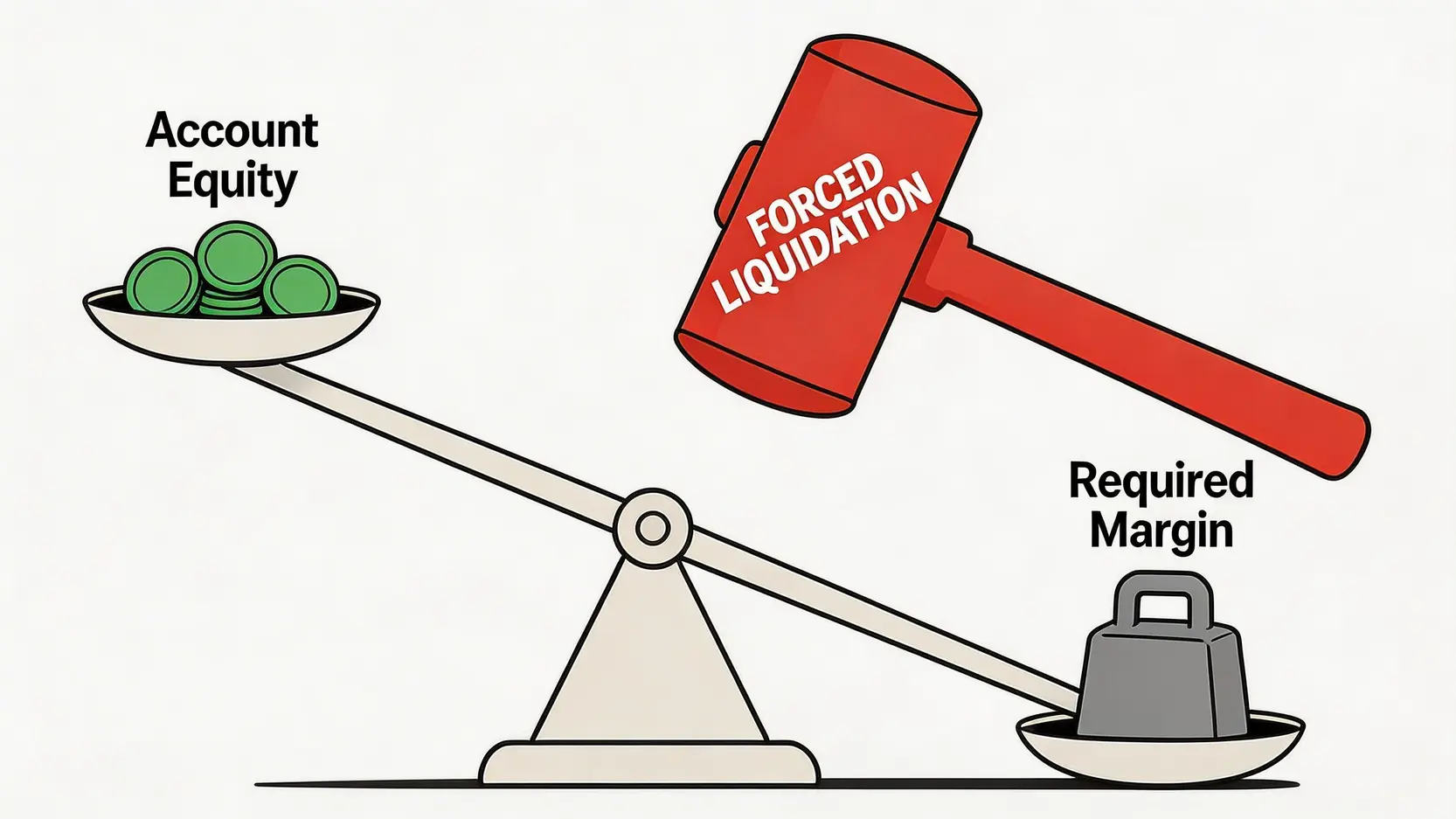
Liquidation, academically referred to as “forced liquidation” or “forced settlement” occurs in leveraged trading (such as forex, futures, and cryptocurrency contracts) when your account equity falls below the broker’s required minimum maintenance margin level. To prevent further losses, the system will automatically close your positions by selling or buying to offset them. It is similar to being “wiped out” in a casino, where your account balance can drop to zero instantly, or even turn negative in extreme market conditions.

一張概念圖,展示了交易帳戶淨值天平因低於所需保證金而嚴重失衡,從而引發強制平倉的風險。

When account equity (left side of the scale) can no longer support the minimum margin required for the position (right side of the scale), the system will trigger forced liquidation.


Three Common Causes of Liquidation: Excessive Leverage, Emotional Trading, Lack of Risk Planning

Most liquidation events are not accidental but are caused by a series of poor decisions. Understanding these causes is the first step in learning how to avoid liquidation.

  • The temptation of excessive leverage: Leverage is a double-edged sword. It amplifies profits but also magnifies losses. Many beginner traders are attracted by the idea of “small capital for large gains” and use leverage of 500x to 1000x, ignoring that even a minor adverse market movement can trigger forced liquidation. Excessive leverage is the fastest path to liquidation.
  • The trap of emotional trading: The Trap of Emotional Trading: When facing losses, traders may rush to recover by “holding losing positions”, or become overconfident during profits and “chase highs with heavy positions”. These are typical emotional trading behaviors. In such a state, traders abandon their original trading plans and risk management principles, such as repeatedly adding margin in an attempt to rescue losing positions, often ultimately ending in liquidation.
  • The fatal flaw of lacking risk planning: Trading without a plan is like entering a battlefield without a map. Many traders never consider, “What is the maximum loss I can take on this trade?” They do not set stop-loss orders or determine position size based on risk, relying purely on instinct. This lack of basic position management skills and stop-loss awareness makes liquidation inevitable.


Core Tactics: Three Essential Position Management Techniques

Mastering how to avoid liquidation lies in “position management”. Position management determines how much risk you are willing to take in a single trade and serves as your first line of defense against catastrophic losses. Below are three commonly used techniques by professional traders.


Technique One: Beginner Protection, the Fixed Percentage Rule (Such as the 2% Rule)

This is the most fundamental and important position management technique, especially suitable for beginners. The 2% rule means that for any single trade, your maximum loss must not exceed 2% of your total capital.

For example:

  • Your total capital is 10,000 USD.
  • The maximum loss per trade is 10,000 USD * 2% = 200 USD.
  • Assume you go long on gold at 2300 USD with a stop-loss at 2280 USD, meaning a potential loss of 20 USD per ounce.
  • Your position size should be 200 USD / 20 USD = 10 ounces.

This method forces you to calculate the worst-case scenario before entering a trade, fundamentally preventing significant losses from a single trade and forming the foundation of avoiding liquidation.


Technique Two: Trend-Based Scaling Strategy, the Pyramiding Position Management Method

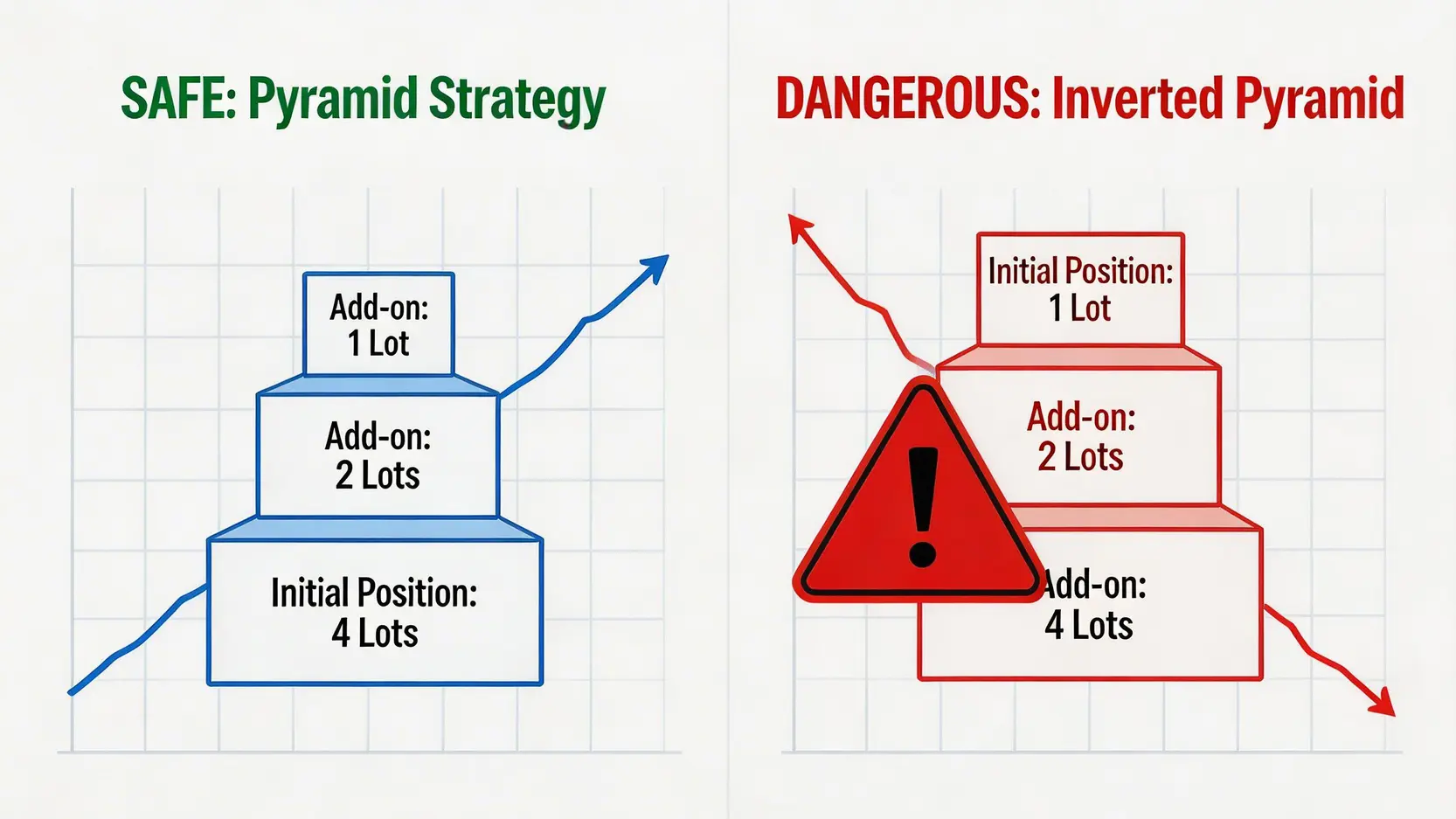
When your position starts to generate profit and the market trend is clear, you can consider using pyramiding to expand gains. The principle is “the initial position is the largest, and subsequent additions are progressively smaller”, like a pyramid with a stable base.

For example, you buy 4 lots at a low point, then add 2 lots after the price rises, and add another 1 lot after further increase. This helps keep your average entry cost at a relatively safe level, so even if the market reverses, you will not give back all your floating profits. Never add to a losing position to average down, as this forms an “inverted pyramid”, which is extremely risky.

一張對比圖,解釋了安全的金字塔式順勢加碼與危險的倒金字塔式虧損攤平之間的區別。

Correct scaling forms a pyramid (left), where the initial position is the largest; incorrect averaging forms an inverted pyramid (right), which carries extremely high risk.


Technique Three: Risk Diversification, How to Build a Diversified Portfolio

“Do not put all your eggs in one basket.” This classic investment principle applies equally to position management. Avoid allocating all your capital to a single or highly correlated asset. For example, heavily investing in AUD, NZD, and CAD simultaneously does not effectively diversify risk, as they are all commodity currencies with high correlation.

A healthy portfolio should include different asset types with low correlation, such as allocating funds across forex, indices, and precious metals. When one market experiences volatility, the stability of others can protect your overall account. This is a smart macro-level approach to avoiding liquidation.


Defense Key: Step-by-Step Stop-Loss Setup Guidance

If position management is your shield, then setting stop-loss is your escape route. It is a protection mechanism that allows you to exit the market with minimal loss when your judgment is wrong. A complete stop-loss setup guide is essential for every trader.


Why Not Setting a Stop-Loss Is the Fastest Path to Liquidation?

Markets are unpredictable, and every trade carries the possibility of loss. Not setting a stop-loss gives the market unlimited power to erode your capital. A single black swan event, such as the Swiss National Bank shock or the Brexit referendum, is enough to wipe out heavily leveraged traders without stop-loss orders. Remember, stop-loss is not meant to make you lose money, but to keep you in the game and preserve capital for future trades. 

Static Stop-Loss Setup: Support and Resistance Method and Fixed Point Method

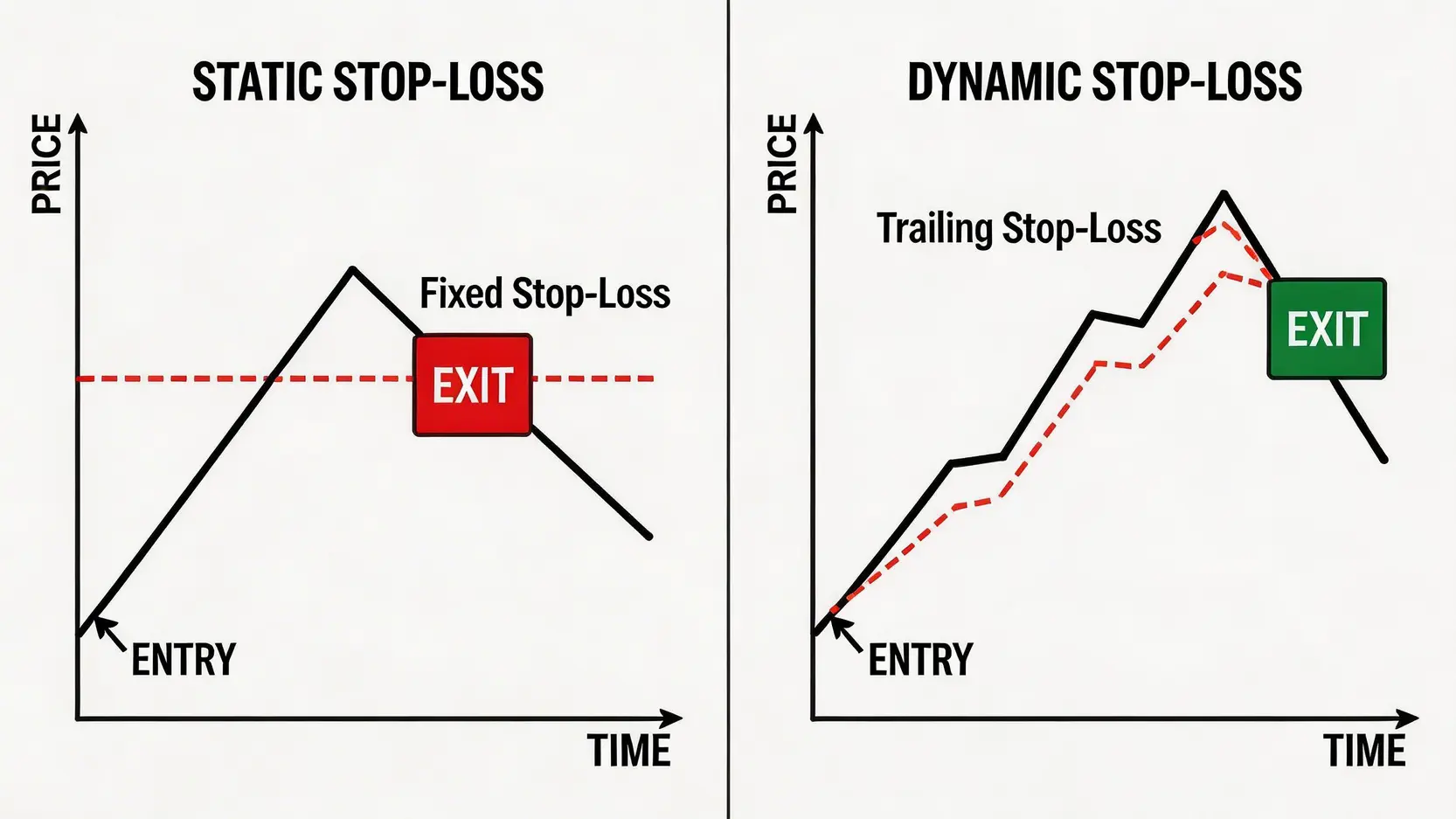
A static stop-loss sets a fixed price level at which the position will be closed immediately once reached.

  • Support and resistance method: This is the most common and reliable approach. When going long, set the stop-loss below a key support level; when going short, set it above a key resistance level. This gives the price “room to fluctuate” and avoids being stopped out by normal market noise.
  • Fixed points or amount method: Based on your risk tolerance, set a fixed loss in points or monetary value. For example, limit each trade to a maximum loss of 50 pips. This method is simple and direct but does not account for market volatility, which may result in stops that are too tight or too wide.


Dynamic Stop-Loss Application: ATR Indicator and Moving Average Trailing Stop

A dynamic stop-loss, also known as a trailing stop, is an excellent tool for letting profits run. The stop level moves in your favor as the price advances but does not move backward when the price retraces.

一張圖表,對比了靜態止損和動態追蹤止損的運作方式,顯示動態止損如何跟隨價格上漲以鎖定利潤。

Static stop-loss (left) remains fixed, while dynamic stop-loss (right) moves upward as profits increase, helping to protect floating gains.

  • ATR indicator trailing stop: The ATR (Average True Range) reflects market volatility. A common approach is to set the stop-loss at “entry price – 2 * ATR value” (for long positions) or “entry price + 2 * ATR value” (for short positions). Using ATR makes stop-loss placement more scientific and adaptable to different market conditions.
  • Moving average (MA) trailing stop: In an uptrend, a short- to medium-term moving average (such as the 20MA) can be used as a trailing stop reference. As long as the price remains above the moving average, hold the position; once it closes below the moving average, exit to secure profits.


Further Reading (Highly Recommended)

“Forex Trading Guide 2024”: The Ultimate Beginner’s Guide from 0 to 1 to Master Forex Trading Skills!


Conclusion

To completely eliminate liquidation, the key lies in internalizing risk management as trading discipline. The position management techniques and stop-loss setup guidance introduced in this article form the foundation for long-term survival in the market. Starting today, carefully evaluate the risk of every trade, treat the 2% rule as a strict principle, and make good use of tools such as ATR to set stop-loss scientifically. When you are no longer anxious about how to avoid liquidation but instead treat it as a systematic process, you will have truly evolved into a mature investor. 

Frequently Asked Questions (FAQ)

Q: Which is more likely to result in liquidation, isolated margin mode or cross margin mode?

A: In theory, isolated margin mode is more likely to lead to liquidation of a single position, as each position has independent margin and losses will not use funds from other parts of the account. In cross margin mode, the entire account balance serves as margin for all positions, providing stronger risk resistance, but once liquidation occurs, it will result in the loss of all funds in the account. For beginners, it is recommended to use isolated margin mode combined with strict position management and stop-loss, allowing better control of risk for each trade.

Q: Should stop-loss be set before or after placing an order?

A: You must set the stop-loss at the same time as placing the order! This is a rule that must be followed. Many traders think they can set it later, but sudden market volatility can cause significant losses within seconds, making it too late to set or manually close the position. Treat stop-loss as an indispensable part of every trading order.

Q: If the market is highly volatile, will my stop-loss fail?

A: Under extreme market conditions, such as price gaps (Gap), stop-loss orders may not be executed at the exact price you set but instead at the next available favorable price in the market. This situation is known as “slippage”. This means your actual loss may be greater than expected. Although slippage cannot be completely avoided, choosing a reputable broker with fast execution can help mitigate this issue to some extent. Despite the risk of slippage, setting a stop-loss remains a necessary risk control measure.

Q: What is the difference between capital management and position management?

A: Capital management is a broader concept that covers how you allocate your total trading capital, such as how much is used for trading and how much is kept as reserve. Position management is a subset of capital management, focusing more specifically on how much capital is allocated to each trade, that is, the size of the position. The 2% rule mentioned in this article is a typical example of a position management technique.

If you liked this article, please share it!

Related Articles

  • Volatility Surface Guide: Skew Trading Strategies
    Practical Applications of Volatility Surfaces: From Options Modeling to Advanced Skew Trading Strategies In options markets, implied volatility is never a flat line. Instead, it forms complex "smile" or "skew" surfaces. For advanced traders, mastering the practical applications of volatility surfaces is equivalent to possessing a lens that reveals market...
    2026 年 6 月 3 日
  • Foreign Capital Flow Model: Track Institutional Money
    Building a Foreign Capital Flow Copy Trading Model: A Stock Market Indicator for Accurately Tracking Institutional Positioning In Asia-Pacific stock markets, foreign capital inflows and outflows often determine the direction of the index. However, simply looking at daily net buy and sell data is no longer enough. Only by building...
    2026 年 6 月 3 日
  • Options Buying Strategies for Extreme Market Risks
    Options Buyer Strategies During Extreme Market Conditions: Black Swan Hedging and Cross-Market Arbitrage During Volatility Surges The most terrifying aspect of financial markets is not a gradual decline, but overnight flash crashes and cross-market capital withdrawals accompanied by volatility surges. In the highly unpredictable global macroeconomic environment of 2026, geopolitical...
    2026 年 6 月 3 日
返回顶部