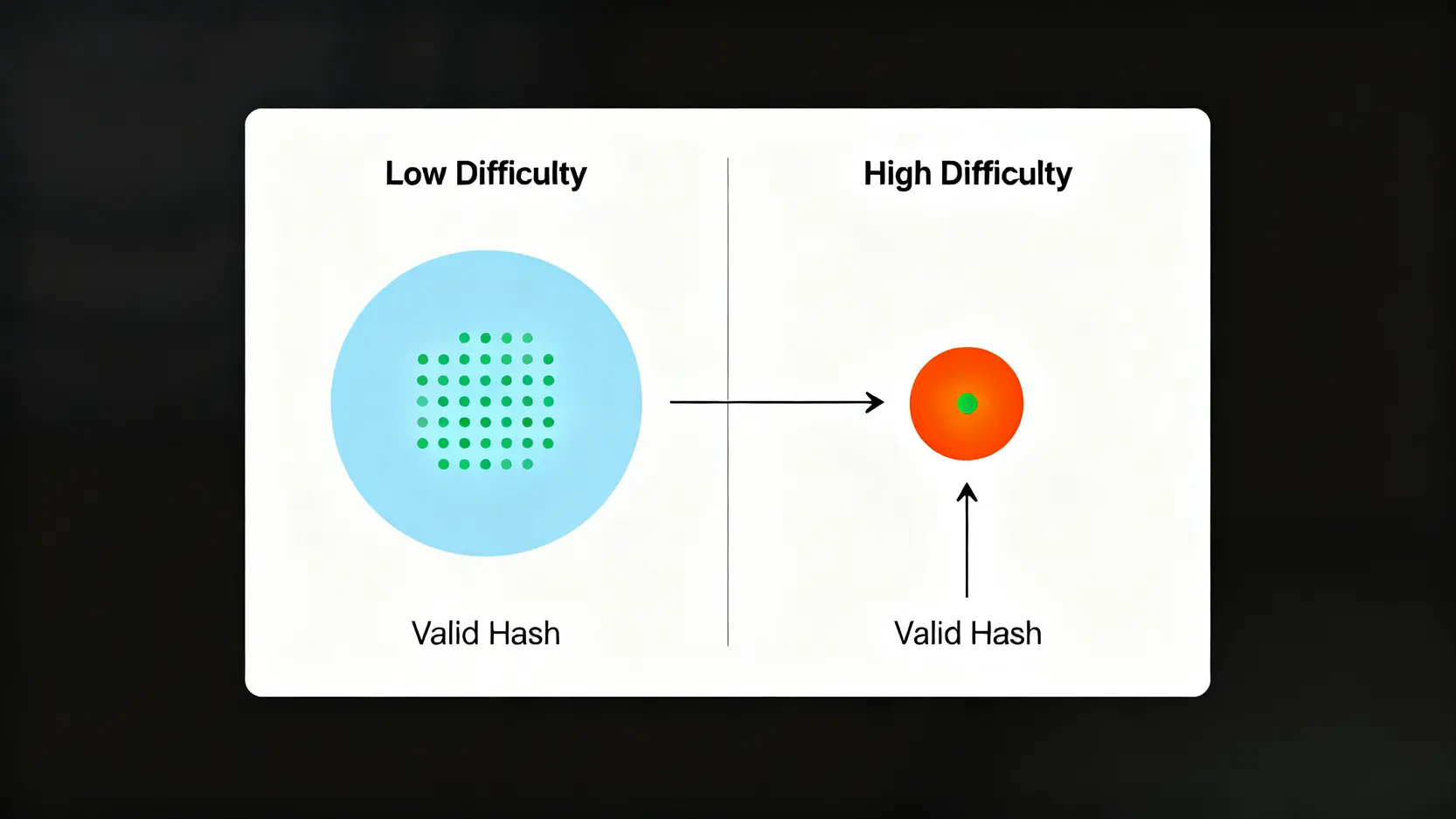
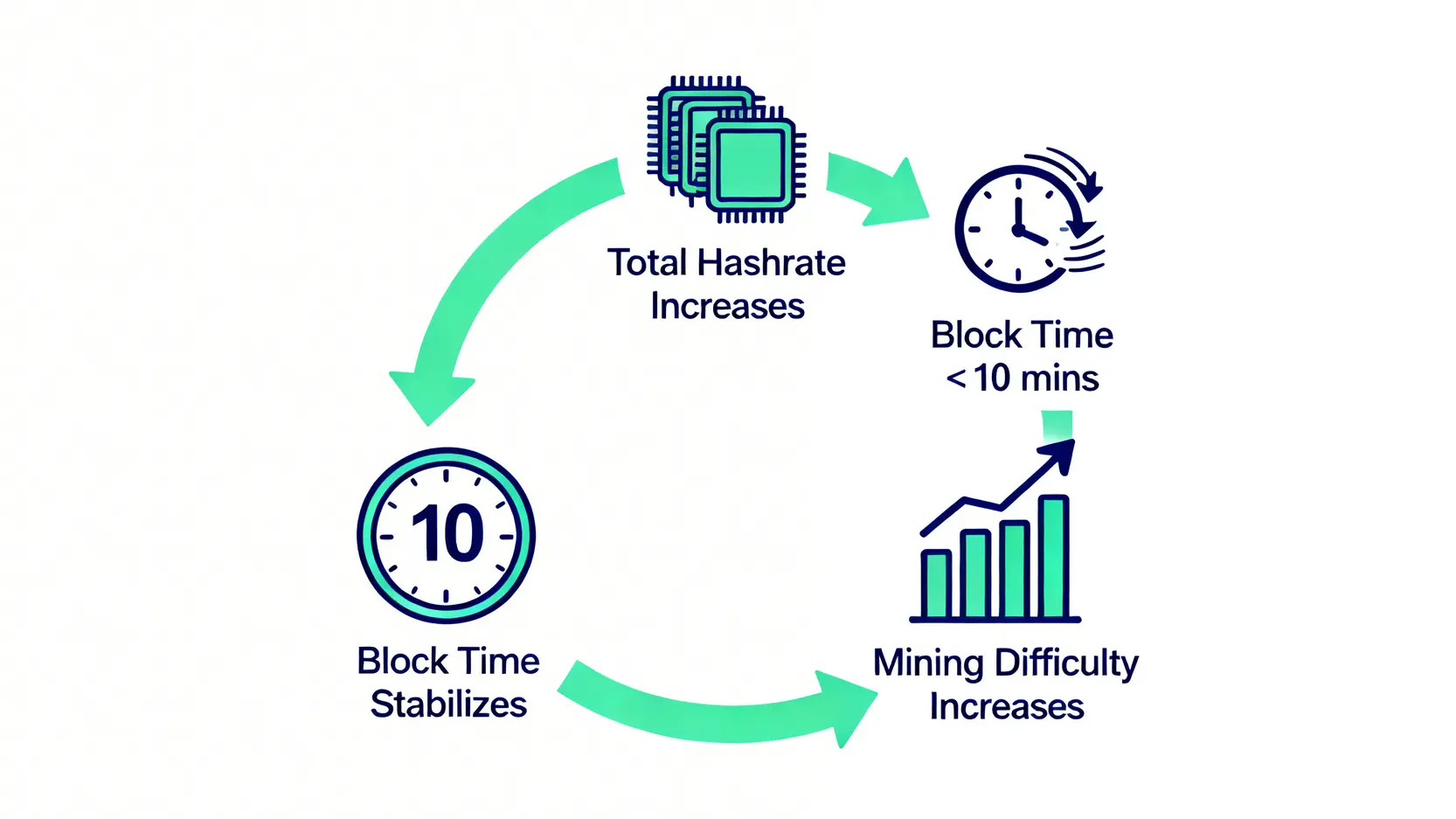
The automatic adjustment mechanism works as follows: when hashrate increases, block generation speeds up, which triggers a difficulty increase and ultimately restores block time stability.
Conversely, if Bitcoin prices decline and some miners shut down due to lower profitability, total hashrate decreases. This causes blocks to be generated more slowly. In the next adjustment cycle, the network lowers mining difficulty, encouraging remaining miners to continue maintaining the network while restoring the average block interval.
Visual Explanation: The Triangle Relationship Between Hashrate, Block Time, and Difficulty
We can simplify the relationship between these three elements as a self balancing triangular cycle:
| Trigger Condition |
Network Response |
Final Result
|
| Total Hashrate Increases |
Average Block Time < 10 Minutes |
Mining Difficulty Will Increase in the Next Adjustment Cycle |
| Total Hashrate Decreases |
Average Block Time > 10 Minutes |
Mining Difficulty Will Decrease in the Next Adjustment Cycle |
| Mining Difficulty Increases |
Under the Same Hashrate, Expected Mining Rewards Decrease |
May Cause Some Less Efficient Miners to Exit, Leading to a Decline in Total Hashrate |
| Mining Difficulty Decreases |
Under the Same Hashrate, Expected Mining Rewards Increase |
May Attract New Miners to Join or Encourage Existing Miners to Restart, Increasing Total Hashrate |
Bitcoin Difficulty Adjustment: The Network’s Self Healing Mechanism
One of the most ingenious designs of Bitcoin is its “difficulty adjustment” mechanism, which operates without the intervention of any central authority. It functions like a built-in thermostat, ensuring that the network neither “overheats” nor “slows down excessively”, and always continues operating along its intended path.
Why Difficulty Adjustment Is Necessary: Maintaining the Target of One Block Every Ten Minutes
Maintaining a ten minute block interval is a core element of Satoshi Nakamoto’s design. This time interval was not chosen randomly. It balances several critical factors:
- Transaction Confirmation Speed: Ten minutes allows newly generated blocks to propagate across the global network, reducing the risk of “orphan blocks” caused by network delays.
- Predictable Monetary Issuance: A stable block production rate ensures that the supply of newly created bitcoins remains predictable, which is essential for Bitcoin’s role as a store of value.
- Security: Matching mining difficulty with total network hashrate ensures that attacking the network remains extremely expensive.
Adjustment Cycle: Automatic Adjustment Every 2016 Blocks
Bitcoin’s difficulty adjustment is executed entirely by code according to the following rules:
- Adjustment Frequency: The network adjusts mining difficulty after every 2016 blocks are produced.
- Calculation Basis: The network calculates the total time taken to generate the most recent 2016 blocks.
- Standard Time: Based on the target of ten minutes per block, the expected time to produce 2016 blocks is 2016 × 10 minutes, which equals 20160 minutes (or roughly fourteen days).
- Adjustment Formula: New Difficulty = Old Difficulty × (Standard Time ÷ Actual Time Spent)
For example:
- If the previous 2016 blocks were produced in only twelve days, approximately 17280 minutes, it means the total network hashrate was too high and blocks were produced too quickly. The network will increase the difficulty. New Difficulty = Old Difficulty × (14 ÷ 12) This results in an approximate difficulty increase of about 16.7 percent.
- If the same 2016 blocks took sixteen days (approximately 23040 minutes), it indicates that the network hashrate was insufficient and blocks were generated too slowly. The network will reduce the difficulty. New Difficulty = Old Difficulty × (14 ÷ 16) This leads to a difficulty decrease of roughly 12.5 percent.
This mechanism ensures that regardless of changes in the external environment, the Bitcoin network can automatically recalibrate itself and return to the target of producing one block approximately every ten minutes.
How Difficulty Adjustment Affects Miner Profitability?
Difficulty adjustments are among the most important events for miners because they directly affect mining income.
- Difficulty Increase: This means greater competition. If your hashrate remains unchanged, your share of the total network hashrate becomes smaller, reducing your expected share of block rewards. To maintain profitability, miners often need to upgrade to more efficient mining hardware (that provides higher hashrate with lower power consumption).
- Difficulty Decrease: This is generally good news for miners who remain active in the network. With reduced competition, the same amount of hashrate can generate more bitcoin rewards, potentially increasing short term profitability.
For this reason, experienced miners closely monitor not only cryptocurrency prices but also total network hashrate and upcoming difficulty adjustments. These metrics help them evaluate mining costs, estimate potential profits, and decide when to upgrade equipment or adjust their operational strategies.
FAQ
Q: What Happens if Global Hashrate Suddenly Drops by Half
A: This is an extreme but useful thought experiment. If global hashrate suddenly drops by half, the average block production time would immediately double from about ten minutes to roughly twenty minutes. This would slow down transaction confirmations and could temporarily increase transaction fees. However, the Bitcoin network has a built-in self recovery mechanism. This slower block production would continue until the next difficulty adjustment cycle. At that point, because generating 2016 blocks would take much longer than the expected fourteen days, the network would automatically reduce mining difficulty by roughly fifty percent, bringing the block time back to around ten minutes. The network might experience temporary disruption, but it would not collapse.
Q: Where Can You Check Real Time Bitcoin Mining Difficulty Data
A: Several authoritative blockchain explorers and data analysis platforms provide real time information. You can check websites such as BTC.com, Blockchain.com, or Glassnode. These platforms provide the current mining difficulty as well as estimates for the next difficulty adjustment time and projected adjustment percentage, making them valuable reference tools for miners and analysts.
Q: Will Mining Difficulty Continue Increasing Forever
A: Not necessarily. The long term trend of mining difficulty is closely related to Bitcoin price movements, mining hardware technology development (Moore’s Law) and global energy costs. Historically, as Bitcoin adoption increased, prices generally rose and mining technology improved, which pushed both total hashrate and mining difficulty higher over time. However, if Bitcoin enters a prolonged bear market, prices remain depressed, or an energy crisis causes electricity costs to surge, mining may become unprofitable. In such situations, many miners will shut down their machines, causing total hashrate to decline and mining difficulty to adjust downward accordingly.
Q: What Is the Relationship Between Mining Difficulty and Bitcoin Price
A: The two are highly correlated, but with some lag. Typically, changes in Bitcoin price influence mining profitability, which then affects total network hashrate and eventually leads to adjustments in mining difficulty. When Bitcoin prices rise and mining becomes more profitable, more miners join the network and hashrate increases, which later triggers a difficulty increase. Conversely, when prices fall and mining margins shrink, higher cost miners exit the network, reducing hashrate and causing difficulty to decrease. In this sense, Bitcoin price can be viewed as a leading indicator of changes in hashrate and mining difficulty.
Conclusion
In summary, Bitcoin mining difficulty, network hashrate, and the difficulty adjustment mechanism are closely interconnected, forming a sophisticated economic and security model. Mining difficulty is not merely a measure of how hard it is to mine a block. It is a fundamental mechanism that safeguards network stability and security. The dynamic balance between mining hashrate and difficulty demonstrates the competitive nature and resilience of decentralized networks. Meanwhile, the periodic Bitcoin difficulty adjustment serves as the system’s core self correction mechanism, allowing the network to adapt to external changes. Understanding this framework is essential for miners and investors who want to develop effective strategies and gain deeper insight into how the cryptocurrency ecosystem operates.