Fund Investment vs. Single Stock: Effectively Diversify Risk and Pursue Steady Growth.
Compared with directly buying Apple stock, choosing a technology fund heavily invested in Apple offers the following three major advantages:
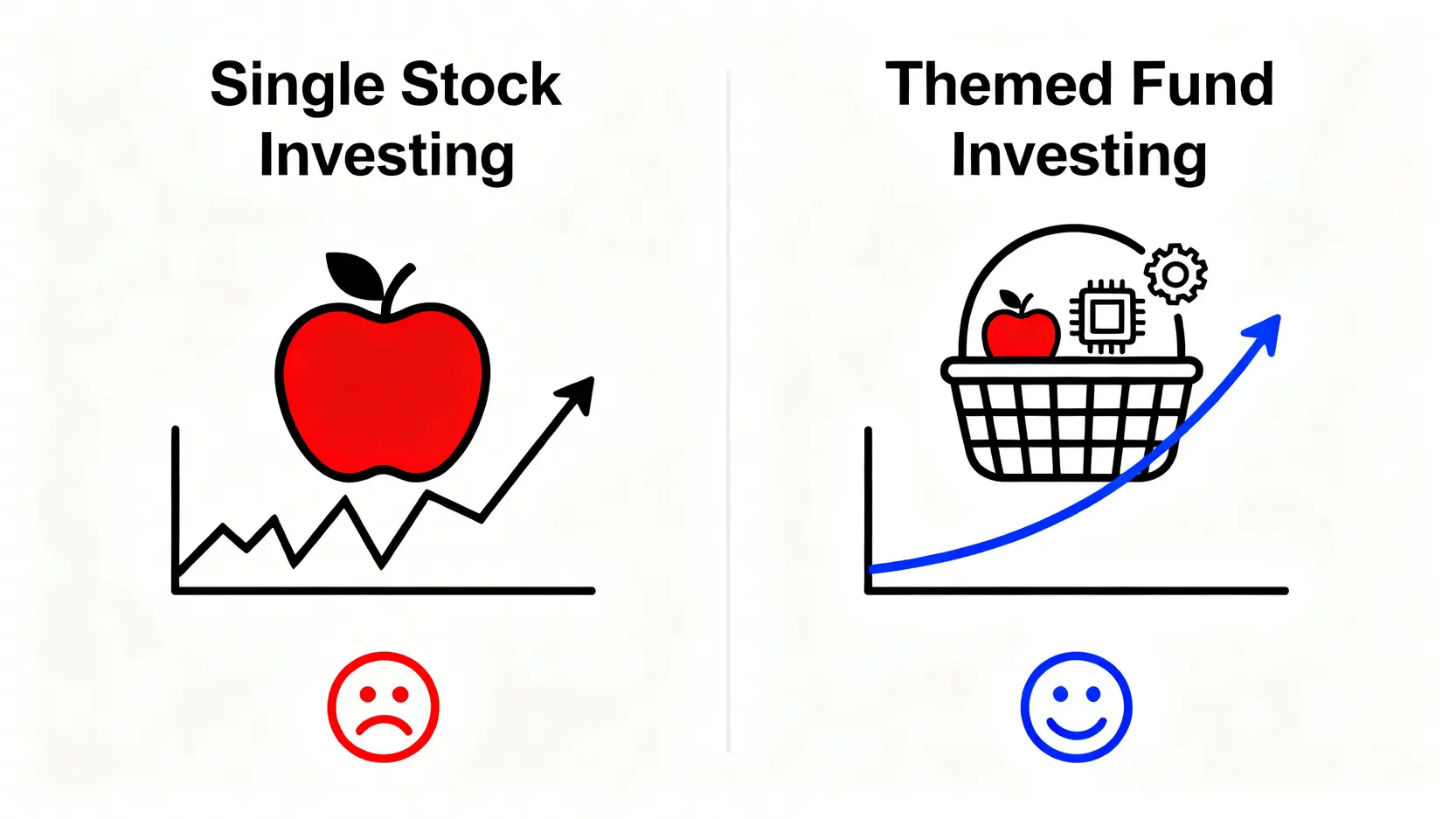
- Effective risk diversification: Do not put all your eggs in one basket. Even if Apple is your top choice, through a fund, your capital will be allocated across dozens or even hundreds of companies. When a single company (even Apple), experiences sharp share price fluctuations, the impact on the overall portfolio can be cushioned by other holdings, resulting in greater stability.
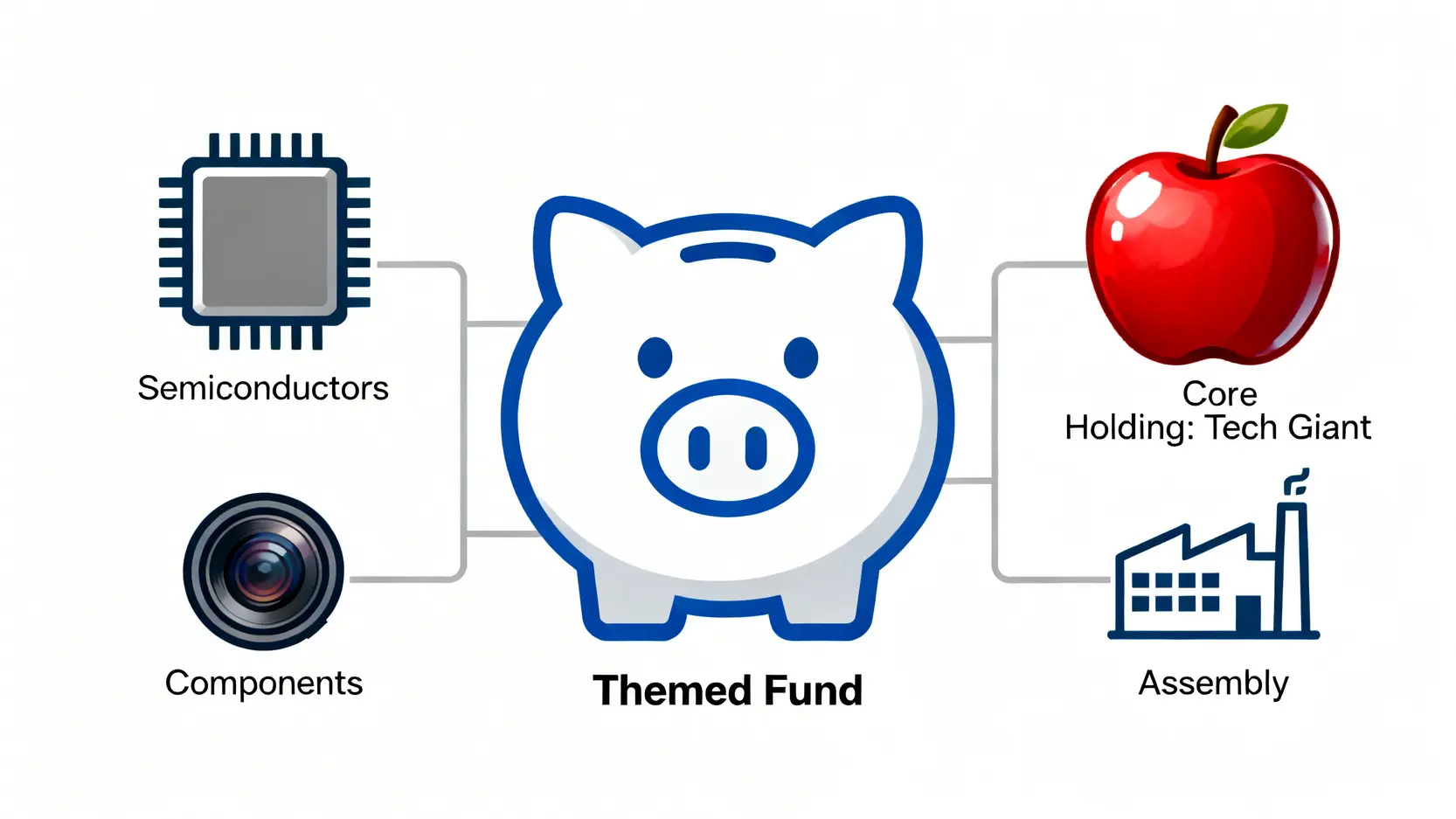
- Comprehensive exposure to technology trends: Apple’s success does not stand alone, but is built on a vast and highly efficient supply chain. Investing in an Apple concept fund means simultaneously capturing the growth potential of multiple frontier technology sectors, including semiconductors, AI, and consumer electronics.
- The convenience of professional management: Funds are managed by professional manager teams responsible for research and decision-making. They continuously monitor market developments, analyze financial reports, and adjust holdings, saving investors significant time and effort, especially for office workers or beginner investors who do not have time to watch the market closely.
How to Choose the Technology Fund Heavily Invested in Apple That Suits You Best? Three Key Indicators
There are countless technology funds in the market. How can you find a truly high-quality fund heavily invested in Apple that matches your needs? The following three key indicators are the points you must carefully examine when making your selection.
Indicator 1: Review Apple Holding Weight and the Concentration of the Top Ten Holdings
This is the most direct benchmark. You can check the fund’s detailed holdings list through its prospectus or monthly report.
- Apple holding weight: Whether a fund is “heavily invested” in Apple usually means Apple accounts for more than 8% of its holdings, and in some cases even as much as 20%. The higher this proportion, the stronger the fund’s performance linkage to Apple’s share price.
- Top ten holdings concentration: Besides Apple, which companies are included in the fund’s top ten holdings? Are they other technology giants such as Microsoft, NVIDIA, and Google, or lesser-known stocks you are unfamiliar with? The higher the total proportion of the top ten holdings, the more concentrated the fund’s style is, and the greater its potential volatility. A balanced portfolio should strike a balance between concentrated bets and diversified allocation.
Indicator 2: Compare Fund Size, Management Fees, and Long-Term Historical Performance
A fund’s internal conditions are equally important and directly affect your final return.
- Fund size (AUM): The fund’s total assets under management. If the fund is too small (for example less than US$100 million), it may face liquidation risk and may be less able to handle large-scale market redemptions. Choosing a larger fund generally offers greater stability.
- Management fees and total expense ratio (TER): These are the fees deducted from your investment by the fund company each year. Although the fee ratio may seem small, over the long term these costs can significantly erode your profits. Active funds tend to charge higher fees, generally between 1.5% and 2.5%, so try to choose products with relatively lower expense ratios.
- Long-term historical performance: Short-term performance may involve a large element of luck, but over long-term performance (at least 3, 5, or even 10 years), better reflects the fund manager’s capability. Remember to compare it with funds of the same category and major market indices (such as the S&P 500 or NASDAQ 100).
Further Reading (Highly Recommended)
Complete Guide to US Stock CFD Trading in 2026: Platform Comparison, Pros and Cons, and Beginner Guide!
Indicator 3: Understand the Fund’s Investment Strategy (Growth vs. Value)
Technology funds can generally be divided into two major strategy types. Understanding the difference can help you match the fund to your own risk preference.
- Growth: These funds focus on finding companies whose revenue and profit growth far exceed the market average. They are usually willing to pay higher share prices for high growth potential, so their price-to-earnings ratios may be relatively high, and their volatility may also be greater. Most technology funds fall into this category.
- Value: Value funds aim to identify “good bargains” whose market price is below their intrinsic value. They may include some mature technology giants with stable dividend payments but lower growth potential. This strategy is relatively stable, but its upside during a bull market may be less explosive than that of growth funds.
You can determine which category a fund belongs to by reviewing its investment objectives and strategy description, and then choose the fund that best matches your investment philosophy.
2026 Selected Recommendations: 5 Technology Funds Heavily Invested in Apple
Based on the above selection criteria, we have compiled 5 technology funds that are widely followed in the market and heavily invested in Apple. Please note that the following list is for illustration and reference only and does not constitute any investment advice. Before investing, be sure to conduct your own independent research.
| Fund Name |
Key Features and Strategy |
Suitable Investors |
Key Considerations |
| Fidelity Global Technology Fund |
A well-established global technology fund with broad exposure across high-quality tech companies in the US, Europe, and Asia, featuring a relatively stable investment style. Apple is usually among its top three holdings. |
Investors who want diversified exposure to leading global technology companies rather than being limited to the US market. |
Apple holding typically ranges between 8% and 12%. |
| Morgan Stanley US Growth Fund |
Focuses on high-quality growth companies in the US, with a concentrated portfolio. Apple is often the largest holding, sometimes exceeding 15%, reflecting an aggressive investment style. |
Investors who have strong confidence in US technology leaders and can tolerate higher risk and volatility. |
Pay attention to the risks associated with high concentration, as performance is highly dependent on the top holdings. |
| Allianz Global Artificial Intelligence Fund |
A thematic fund focused on the AI industry chain, including companies (such as NVIDIA and ASML), with Apple positioned as one of its core holdings in AI deployment. |
Investors who are optimistic about the long-term AI trend and want to participate in Apple’s growth at the same time. |
Thematic funds carry higher sector risk, so it is important to monitor the development cycle of the AI industry. |
| UPAMC Global New Technology Fund |
A Taiwan-based fund that places particular emphasis on Apple’s supply chain companies in Taiwan (such as TSMC), offering both global exposure and local market insight. |
Investors who want to invest in global technology while also including Taiwan’s competitive industries in their portfolio. |
Performance is influenced by both global technology cycles and the performance of Taiwan’s electronics sector. |
| BlackRock Next Generation Technology Fund |
Focused on identifying next-generation growth opportunities (such as cloud computing, the Internet of Things, and fintech), with Apple as a key core holding. |
Investors with higher risk tolerance who are willing to target emerging technology sectors for potentially higher returns. |
The underlying assets are relatively new with higher uncertainty, making it more suitable as a satellite allocation rather than a core holding. |
Frequently Asked Questions (FAQ)
Q: What are the main risks of investing in Apple concept funds or technology funds?
A: There are three main risks. First is “concentration risk”, as technology stocks are often affected by overall industry cycles and interest rate changes, leading to synchronized rises and falls. Second is “high volatility”, as technology stocks tend to fluctuate more than traditional industries, potentially resulting in larger short-term paper losses. Third is “valuation risk”, since many technology stocks have high price-to-earnings ratios. If market sentiment shifts or company growth falls short of expectations, price corrections can be significant.
Q: Should I invest a lump sum or use dollar-cost averaging for these funds?
A: For technology funds with higher volatility, dollar-cost averaging is a very suitable strategy. By investing at different time points, you can effectively average costs and reduce timing risk, avoiding entry at market peaks. If you have a larger amount of idle capital, you may also consider a combination of “lump sum investment and dollar-cost averaging”, allocating part of the funds upfront while investing the rest regularly to balance short-term opportunities and long-term positioning.
Q: Are there any recommended ETFs related to Apple or technology stocks besides active funds?
A: Yes. If you prefer lower costs and higher transparency, you can consider ETFs that track technology indices. Two of the most well-known are the Invesco QQQ Trust (QQQ), which tracks the Nasdaq 100 Index with Apple as its largest holding, and the Vanguard Information Technology ETF (VGT), which specifically tracks US information technology stocks and has an even higher allocation to Apple. Both are excellent choices for passive exposure to Apple and the US technology sector.
Q: What are the available channels to purchase these overseas funds?
A: In regions such as Taiwan and Malaysia, there are three main channels to purchase overseas funds. First, through the wealth management departments of local banks. Second, through licensed fund platforms (online investment platforms). Third, through overseas brokers (such as Interactive Brokers) to invest directly. Each channel differs in fees, minimum investment requirements, and product availability, so it is important to compare based on your own needs before making a decision.
Conclusion
In summary, by investing in technology funds heavily weighted in Apple, investors can not only participate in the growth of Apple as a leading technology giant, but also effectively diversify the risks of single-stock exposure while capturing opportunities across the broader technology ecosystem. When selecting Apple concept funds, it is essential to evaluate multiple factors including portfolio structure, management fees, long-term performance, and investment strategy. The selection framework and recommended funds provided in this article aim to serve as a strong reference for your investment decisions, helping you navigate the fast-changing world of technology investing with greater confidence and stability.